The most effective way to teach your child emotional regulation isn’t through lectures or time-outs; it is by serving as their external emotional mirror until they can develop their own internal thermostat.
- Mirroring is Biological: Children’s brains are wired to “co-regulate” with caregivers, meaning your calm helps stabilize their nervous system.
- Label, Don’t Dismiss: Identifying an emotion (“You seem frustrated because the tower fell”) validates the child and reduces the intensity of the reaction.
- The Pause is Power: Teaching yourself to pause before responding to a child’s tantrum provides the “mirror” they need to learn how to self-soothe.
We have all been there. It is 5:30 PM, you are juggling a conference call, the dog is barking, and your four-year-old decides that the specific way you cut their apple is an unforgivable crime against humanity. The screaming starts, the floor becomes the primary location for their body, and your own stress levels skyrocket.
In these moments, our instinct is often to stop the noise—to tell them to “calm down” or “be quiet.” But what if we treated these outbursts not as behavioral problems to be silenced, but as data points to be processed? This is where the concept of the “emotional-regulation mirror” comes in. It is a shift from controlling the child to modeling the regulation they haven’t yet mastered.
Understanding the Biology of the ‘Big Feeling’
Before we can teach emotional regulation, we have to recognize that a child’s brain is literally under construction. The prefrontal cortex—the part of the brain responsible for impulse control, planning, and emotional regulation—is not fully developed until our mid-twenties. When a child has a “meltdown,” they are often experiencing a hijack of their amygdala, the brain’s alarm system.
Think of it like a computer system that has had too many programs running at once. The CPU (the child’s brain) overheats, and the screen goes black. Telling a child to “calm down” while their brain is in this state is like telling a computer to “run faster” while the motherboard is smoking. They physically cannot access the logic centers of their brain because the alarm system is screaming.
This is where you come in. As the adult, your nervous system acts as an external regulator. If you stay calm, you provide a stable baseline that their nervous system can “latch onto.” This process is called co-regulation. You are the mirror. If you reflect chaos back at them, the chaos doubles. If you reflect calm and validation, the chaos begins to dissipate.
The Anatomy of a Mirroring Interaction
Mirroring is not about agreeing with the behavior; it is about acknowledging the feeling. A child can be angry that they cannot have a cookie, and you can hold that boundary firmly while still acknowledging that they are indeed angry.
| The Old Way (Reaction) | The Mirror Way (Response) |
|---|---|
| “Stop crying, it’s just a broken crayon!” | “I see you are upset because your crayon snapped. That is frustrating.” |
| “If you don’t stop screaming, you’re going to time-out.” | “You are having a really hard time right now. I am here with you until you feel safe.” |
| “Why are you acting like this? It’s not a big deal.” | “It feels like a big deal to you. Let’s take a breath together.” |
Step-by-Step: Implementing the Mirror Technique
So, how do we actually do this in the heat of the moment? It requires a deliberate, almost mechanical process at first, until it becomes second nature. Here is a breakdown of how to turn yourself into that mirror.
1. The Internal Reset (The 3-Second Rule)
Before you engage, you must regulate yourself. If you are angry, tired, or stressed, you cannot mirror calm. Take three deep breaths. Remind yourself: This is not an emergency. They are not giving me a hard time; they are having a hard time.
2. Physical Presence
Get down to their level. Standing over a child while they are having a meltdown can feel intimidating, even if you are trying to be helpful. Sitting on the floor or crouching down changes the power dynamic and provides a sense of connection rather than confrontation.
3. Labeling the Emotion
Use simple, non-judgmental language. “You seem disappointed,” or “I can see you are feeling overwhelmed.” By giving the emotion a name, you are helping the child move the experience from the reactive, emotional centers of the brain to the language-processing centers. This is the first step toward cognitive control.
4. Validating, Not Fixing
The most common mistake parents make is trying to “fix” the problem immediately. We offer a distraction, a treat, or a lecture. Instead, just sit with them. Allow them to feel the frustration. Say, “It’s hard to stop playing when it’s time for dinner.” You are showing them that it is okay to feel big, uncomfortable emotions, and that they will pass.

Why ‘Calm Down’ is Actually Counterproductive
If you look at the research, telling a child to “calm down” is frequently cited as one of the least effective ways to handle a tantrum. Why? Because it implies that the child is choosing to be upset and has the agency to simply “turn it off.” It invalidates their internal experience.
When you tell a child to calm down, you are essentially telling them that their emotions are an inconvenience to you. This leads to emotional suppression. A child who learns to suppress their emotions because they are “bad” or “annoying” doesn’t learn how to regulate them. They learn how to hide them, which often leads to larger, more explosive outbursts later in life.
Instead of “calm down,” try “breathe with me.” This is a directive that involves action and connection. You are teaching them a tool for regulation rather than just demanding a state of being. You might say, “My shoulders are tight, I’m going to take a big breath. Want to do it with me?” This is the mirror in action—you are showing them how to navigate the physiological stress response.
Creating a ‘Regulation Environment’ at Home
Regulation is not just a momentary intervention; it is a lifestyle. You can build “mirrors” into your home environment to help children identify and manage their states before they hit the point of a total meltdown.
The ‘Calm-Down’ Corner
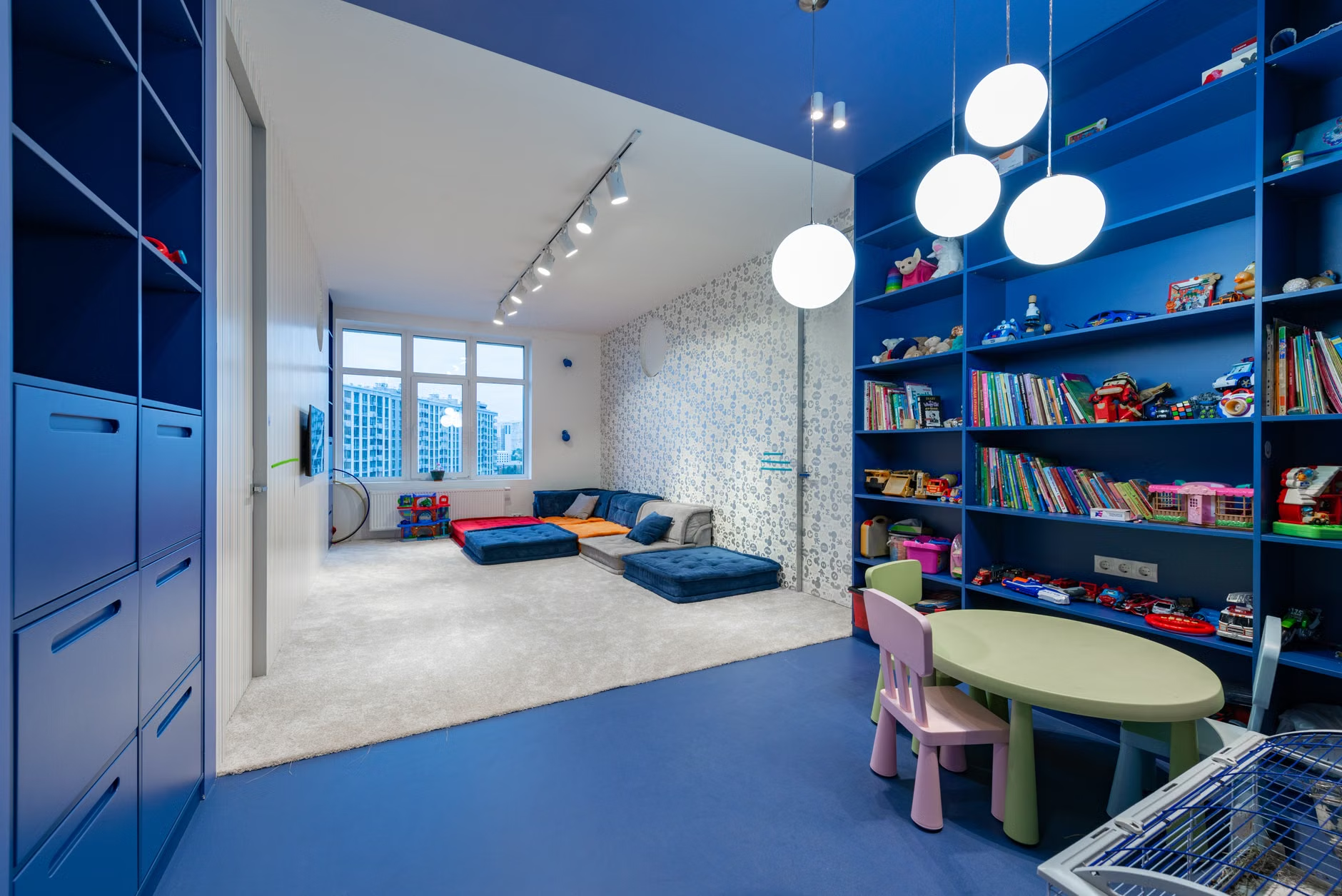
Many parents worry that a “calm-down corner” looks too much like a time-out. The difference is in the intent. A time-out is a punishment for bad behavior. A calm-down corner is a sanctuary for emotional regulation. It should be a place they want to go. Include items like a soft blanket, a few books, some sensory fidget toys, or even a set of emotional flashcards.
Modeling Your Own Regulation
Your children are watching you all the time. If you stub your toe and scream an expletive, they are learning how to handle frustration. If you are having a bad day, tell them. “I’m feeling really frustrated because my project didn’t go well. I’m going to take five minutes to have a cup of tea and breathe, and then I’ll be ready to play.”
This is the most powerful mirror you can provide. It teaches them that:
- Emotions are normal for everyone, including parents.
- It is okay to take space when you feel overwhelmed.
- Regulation is a skill that requires effort and practice.
Common Pitfalls and How to Avoid Them
Even with the best intentions, you will stumble. Here are a few common traps parents fall into when trying to implement the mirror technique, and how to course-correct.
The ‘Lecture’ Trap
When a child is finally calm, the temptation to lecture them about what they did wrong is high. Avoid this. When they are calm, their brain is finally ready to learn, but if you start lecturing, you are just re-triggering the stress response. Keep the post-meltdown talk short, simple, and focused on connection.
The ‘Consistency’ Trap
You might try this for a week and see no change. Keep going. Emotional regulation is a long-term developmental milestone, not a quick fix. Your child is building neural pathways every time you mirror them successfully. It takes thousands of repetitions for these pathways to become the default response.
The ‘Perfection’ Trap
You will lose your cool. You will yell. You will handle a situation poorly. When this happens, the best thing you can do is model repair. Go back to your child and say, “I’m sorry I yelled. I was feeling overwhelmed, and I didn’t handle it well. I’m going to try to do better next time.” This shows them that even adults make mistakes and that we can take responsibility for our emotions.

The Developmental Arc of Self-Regulation
It is helpful to understand what is realistic at different ages. A toddler cannot “self-regulate” in the way an adult can. They are almost entirely dependent on co-regulation. By the time they hit school age, they should start to be able to identify their feelings and perhaps use a simple tool (like taking a breath or going to their room) to help themselves. By adolescence, they should be internalizing these processes, though the teenage brain is notoriously volatile.
Think of your role as a bridge. In the early years, you are the entire bridge. As they grow, you slowly let them walk more of the bridge on their own, while you stay nearby just in case they stumble. If you rush the process or pull away too soon, they may not have the internal scaffolding needed to handle the stresses of adult life.
Data and Perspectives from Child Psychology
Modern developmental psychology, particularly the work surrounding “Attachment Theory,” emphasizes that the security of the caregiver-child bond is the primary predictor of a child’s ability to regulate their emotions. When children feel “seen”—which is exactly what the mirror technique does—they develop a secure attachment. This security provides the confidence to explore the world and the resilience to handle setbacks.
Recent studies in neurobiology have shown that “empathic attunement”—the technical term for what we are calling mirroring—lowers cortisol levels in children. Cortisol is the primary stress hormone. High levels of cortisol over long periods can actually impair brain development. By mirroring, you are literally protecting your child’s brain from the long-term effects of chronic stress.
However, it is vital to remember that this is not about “gentle parenting” as a performance. It is about the quality of the connection. If you are mirror-talking but your body language is tense, your child will sense the incongruence. The biological regulation comes from your nervous system, not your words. If you can’t be calm, it is better to take a break and return when you are regulated than to force a calm voice while you are internally boiling.
Practical Scenarios for Busy Parents
Let’s look at a few common, everyday scenarios and how the mirror technique applies.
Scenario A: The Grocery Store Meltdown
Your child wants a treat. You say no. They scream.
The Mirror: Instead of saying “Stop it, you’re embarrassing me,” get low. Make eye contact. “You really wanted that chocolate. It looks delicious. It’s hard to say no when you see something you really want.” You haven’t given them the chocolate, but you have validated their desire. Often, that is all they need to move on.
Scenario B: The Homework Struggle
Your child is crying over a math problem.
The Mirror: “This math is feeling really tricky today. It’s frustrating when the answer doesn’t come quickly.” You are not doing the math for them, but you are acknowledging the emotional weight of the task. This makes them feel less “stupid” and more capable of trying again.
Scenario C: The Transition Tantrum
It is time to leave the park.
The Mirror: “We have to go home now. I know, you were having so much fun on the swings. It’s sad to have to stop when you’re having fun.” Acknowledging the loss of the fun activity helps them process the transition. It doesn’t mean you stay at the park, but it means you are respecting their experience of the transition.
Implications and Cautions
The biggest implication of this approach is that it requires you to be honest with yourself. You cannot mirror your child if you are unwilling to look at your own emotional triggers. Why does their crying make you so angry? Is it because you were never allowed to cry as a child? Is it because you feel like you are failing as a parent when they act out in public?
These are uncomfortable questions, but they are the key to unlocking your ability to be a better mirror. If you find that you are constantly triggered by your child’s behavior, it might be a sign that you need to prioritize your own mental health. Parenting is a high-stress role, and you cannot pour from an empty cup. Seeking therapy or finding a supportive community of other parents can be just as important for your child’s development as any specific parenting technique.
Finally, a word of caution: do not aim for perfection. Aim for connection. There will be days when the mirror breaks, when you lose your cool, and when the house is filled with noise. That is okay. Repair is the most important part of the process. If you mess up, own it, apologize, and try again. That is the ultimate lesson in emotional regulation—that even when things fall apart, we can put them back together.
Frequently Asked Questions
1. Is this the same as “Gentle Parenting”?
While it shares roots with gentle parenting, the “mirror” technique is more specific. It focuses on the physiological aspect of co-regulation. You can be a firm parent—setting clear boundaries and consequences—while still acting as an emotional mirror. Being a mirror does not mean being a doormat.
2. What do I do if my child is so upset they won’t even look at me?
Sometimes a child is too overwhelmed for direct interaction. In these cases, simply being in the room is enough. You can say, “I am going to sit right here on the chair. I am here whenever you are ready for a hug or just to talk.” You are providing a “secure base,” which is a form of mirroring even without words or eye contact.
3. Does this work for older children or teenagers?
Yes, but the application changes. With a teenager, you don’t sit on the floor. Instead, you mirror by listening and summarizing their feelings. “It sounds like you feel really unheard when I ask about your grades.” The goal is still the same: to help them feel understood so their brain can move from a reactive state to a reflective state.
For further reading on child development and the science of connection, consider reviewing resources from the Harvard Center on the Developing Child or exploring the works of Dr. Daniel Siegel on the “whole-brain child.”