The smartest way to reclaim your vacation time this year isn’t by booking a flight across the ocean, but by embracing the “hyper-local” travel movement, which prioritizes deep exploration of your immediate surroundings over the stress of long-haul logistics.
- Reduced Friction: Hyper-local travel eliminates airport lines, jet lag, and expensive logistics, leaving more energy for actual relaxation.
- Economic Impact: Spending your leisure budget within a 20-mile radius directly supports your local economy and small business owners.
- The “Tourist Gaze”: By consciously treating your own town like a visitor, you can break the monotony of daily life and discover hidden gems you walk past every day.
Let’s be honest: when you are in your 30s or 40s, juggling a career, a mortgage, and perhaps a few kids who have specific nap schedules or sensory needs, the idea of a “vacation” often feels like just another logistics project. You spend weeks researching flights, stress-testing itineraries, and packing enough snacks to survive a small apocalypse. By the time you arrive at your destination, you’re exhausted. Then, you have to do it all in reverse to get home.
What if the “best” travel experience wasn’t measured by how many time zones you crossed, but by how much you actually disconnected from your routine? This is the core of the hyper-local tourism trend. It’s not just a fancy term for “staycation.” It’s a deliberate shift in perspective that treats your own region as a destination waiting to be mapped.
The Psychology of the “Tourist Gaze” in Your Own Backyard
The term “tourist gaze” was coined by sociologist John Urry to describe the way we look at a place when we are on holiday. We are more observant, more appreciative of architecture, and more willing to try local food. When we are at home, we are in “survival mode.” We walk past the historic library, the artisan bakery, or the urban nature preserve without seeing them because they are just obstacles on our way to the grocery store.
To practice hyper-local tourism, you have to intentionally flip the switch. You need to stop being a “resident” for a weekend and start being a “visitor.” This means doing the things you usually ignore. Have you ever visited that local museum that every tourist in town goes to, but you’ve skipped for five years? Have you actually walked the entirety of the local park trail, or do you just stick to the playground?
The barrier to this is usually psychological. We equate travel with “escaping” our lives. But if your life is so demanding that you need a total escape, perhaps the problem isn’t the location—it’s the intensity of the routine. Hyper-local travel allows you to keep the comforts of home (your own bed, your own kitchen) while shedding the monotony of your daily schedule.
Planning a Hyper-Local Itinerary: The “Tourist” Framework
If you decide to spend a weekend exploring your own area, don’t just “wing it.” If you wing it, you’ll end up doing the same things you always do. You need a structure to ensure you actually feel like you’re on a trip.
1. The Radius Limitation
Pick a radius—perhaps 10 or 20 miles. Everything you do for the next 48 hours must happen within that circle. This forces you to get creative. If you can’t drive two hours to the big amusement park, what can you do instead? Maybe you visit the local history archives, take a specialized walking tour, or attend a workshop at a local maker space.
2. The “No-Chore” Pact
This is the most important rule. If you are staying at home, you must treat it like a hotel. Do not do laundry. Do not reorganize the pantry. Do not look at the stack of mail on the counter. If you find it impossible to ignore these things, book a local boutique hotel or an Airbnb within your own city. The cost of a two-night stay at a local hotel is often less than the airfare for a family of four to a major tourist hub.
3. Digital Detox and Documentation
When we travel, we take photos. When we are home, we don’t. Start a photo journal of your weekend. It sounds silly, but documenting your “trip” forces you to look for beauty. You’ll find yourself framing shots of a local coffee shop or a sunset over the neighborhood park. This documentation validates the experience as a “vacation” rather than just a weekend off.
Why This Matters for Parents
For parents of young children, hyper-local travel is a game-changer. Air travel with children is often a high-stress event defined by ear pressure, middle-seat meltdowns, and the constant fear of losing a passport or a favorite stuffed animal. Hyper-local travel removes the “transit fatigue” entirely.
If your toddler has a meltdown at a local botanical garden, you are 20 minutes away from your own living room. You aren’t stuck in a foreign hotel room trying to soothe a child who is overstimulated by a new environment. You have access to your own supplies, your own pediatrician, and your own support network. This lower-stakes environment actually allows you to be more adventurous. You might be willing to try that “fancy” local restaurant with your kids because you know that if the meal goes south, the exit strategy is simple and quick.
Furthermore, hyper-local tourism is a powerful tool for teaching children about their community. Instead of flying across the world to see someone else’s culture, you can show your children the history of their own town. Who built this park? Why is this street named after this person? It builds a sense of belonging and stewardship that is often missing from modern, transient living.
A Comparative Look: Traditional vs. Hyper-Local Travel
To understand the trade-offs, let’s look at a standard comparison table. While traditional travel offers the thrill of the unknown, hyper-local travel offers the depth of the familiar.
| Feature | Traditional Travel | Hyper-Local Travel |
|---|---|---|
| Planning Time | High (Flights, visas, hotels) | Low (Curating local spots) |
| Cost | High (Flights, luggage, dining out) | Low (Activities, local food) |
| Stress Level | High (Jet lag, navigation) | Low (Familiar environment) |
| Environmental Impact | High (Carbon footprint) | Minimal (Walking/short drive) |
| Depth of Experience | Surface-level (Highlights) | Deep (Hidden details) |
Overcoming the “Boredom” Bias
The biggest criticism of hyper-local travel is the fear of boredom. “I’ve lived here for ten years, there’s nothing new to see.” This is a cognitive bias. We often assume that “new” equals “interesting,” but interest is a function of engagement, not novelty.
Consider the concept of “micro-adventures,” popularized by adventurer Alastair Humphreys. The idea is to seek out small, localized challenges that break the routine. Instead of just going to a park, go to the park at night with flashlights. Instead of going to the same coffee shop, commit to visiting every coffee shop in a five-mile radius and rating them on a spreadsheet.
The “boredom” you feel is likely not a result of your environment, but of your autopilot mode. When you are on autopilot, you process information in chunks. You don’t see the individual bricks on the building you pass; you see “building.” You don’t see the specific species of trees in the park; you see “green.” To break this, you must engage your senses. What does the neighborhood smell like in the morning? What are the sounds of the local market? What is the history of the architecture on your main street?

Practical Steps to Launch Your Hyper-Local Vacation
If you are ready to try this, here is a step-by-step framework to build your first hyper-local trip.
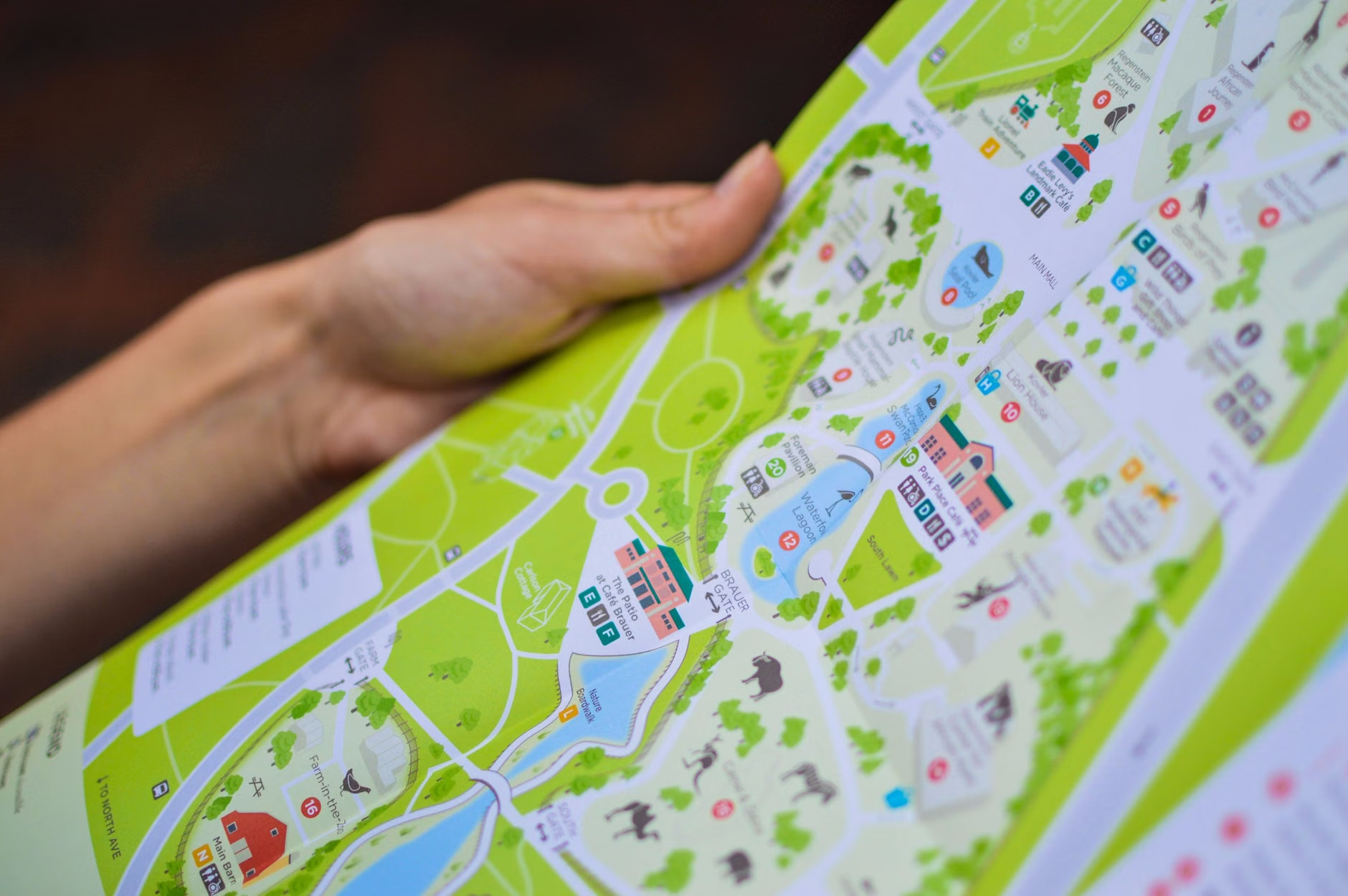
- The Audit: Spend one evening looking at a map of your town. Circle three places you have never been. These are your “destinations.”
- The Research: Don’t look at travel blogs for your city—those are usually for tourists. Look at local history books, municipal websites, or community event calendars. What local festivals, farmers’ markets, or minor sporting events are happening?
- The Constraints: Set a budget. Because you aren’t paying for travel, reallocate that money. Maybe you can afford to eat at the best restaurant in town, or hire a local guide to give you a private tour of a historic site.
- The Narrative: Tell your friends you are going on a trip. Put it on your calendar. When you treat it like a serious engagement, you are less likely to cancel it for mundane tasks.
- The Execution: During the weekend, commit to the “tourist” persona. Ask questions, take notes, and leave your phone in your pocket unless you are taking a photo.
Common Pitfalls and How to Avoid Them
The most common mistake is failing to create a clear boundary between “vacation time” and “home life.” If you allow your work emails to trickle in, or if you decide to “just do one load of laundry,” the entire illusion collapses. You are back in the cycle of maintenance, not exploration.
Another pitfall is “destination envy.” You might see your friends posting photos from exotic locations on social media and feel like your hyper-local trip is “lesser.” It is important to remember that social media is a highlight reel. Most travel is filled with waiting, transit, and fatigue. Your hyper-local trip is about quality of life, not about filling a feed with exotic locations.
Finally, avoid the trap of over-scheduling. You don’t need to visit five museums in one day. The goal is to slow down, not to run a marathon of local tourism. If you spend three hours sitting in a local park reading a book because it’s a beautiful day, that is a successful use of your time.

The Economic and Social Implications
Hyper-local tourism has positive externalities that extend beyond your personal well-being. By shifting your spending toward local businesses—independent bookstores, family-run restaurants, and local artisans—you are actively contributing to the resilience of your community. In an era where global chains dominate the landscape, supporting the unique character of your neighborhood is an act of cultural preservation.
Furthermore, this trend aligns with the growing movement toward sustainable living. By reducing your reliance on long-distance travel, you are significantly lowering your carbon footprint. You are trading a high-impact, high-stress experience for a low-impact, high-reward one. It is a rare instance where the “right” thing to do for the planet is also the most pleasant thing to do for your own sanity.
Final Thoughts on Reclaiming Your Time
In our 30s and 40s, we often feel like we are constantly running on a treadmill. We think that if we could just get away—really far away—we could finally stop running. But the treadmill follows us. It’s in our laptops, our phones, and our mental to-do lists. Traveling to a different continent doesn’t stop the treadmill; it just moves it to a different time zone.
Hyper-local travel is about learning to stop the treadmill where you are. It’s about realizing that you don’t need a departure gate to find wonder, and you don’t need a passport to be a tourist. It’s about reclaiming your autonomy, one weekend at a time, within the very streets you walk every single day. Start small. Take a walk in a direction you usually don’t go. Look up at the buildings. Talk to a shopkeeper. You might be surprised by what you find when you finally decide to pay attention.
Don’t wait for the “perfect” vacation to appear on your calendar. Create the vacation in the cracks of your existing life. Your neighborhood is waiting; you just haven’t been looking at it with the right eyes.
Frequently Asked Questions
1. How do I make hyper-local travel feel like a “real” vacation?
The key is to change your environment or your behavior. If you can, leave your house and stay in a local hotel or rental. If you must stay home, treat it like a hotel: no chores, no work, and no “daily life” tasks. Plan your activities as if you were a visitor, using a map to guide your exploration rather than your usual routine.
2. Is this trend really sustainable for long-term travel habits?
Hyper-local travel isn’t meant to replace international travel entirely; it is meant to supplement it. By adopting a hyper-local mindset, you can enjoy more frequent, low-stress “micro-vacations” throughout the year, reducing the pressure to make every single trip a massive, once-in-a-lifetime ordeal. It’s a sustainable way to maintain a sense of adventure without the burnout of constant travel planning.
3. What if my local area is boring?
Boredom is almost always a result of familiarity, not a lack of content. Every town has history, local businesses, parks, and architecture that you likely ignore in your day-to-day life. If you feel your town is “boring,” challenge yourself to find the history behind a local street name, visit every park in your zip code, or attend a local town hall or community event. The “tourist gaze” is a skill you develop, not something that exists only in “interesting” locations.
For further reading on the sociology of tourism and the benefits of slow, local travel, you can explore the following resources: