- What is a Third-Space? It is a social environment separate from the two primary “homes”—the residence (first space) and the workplace (second space)—that fosters community interaction.
- The Revival: City planners are shifting focus from car-centric sprawl to “15-minute cities” that prioritize walkable, accessible community hubs.
- Why it matters: For people in their 30s and 40s, these spaces are essential for reducing isolation, supporting work-life balance, and providing low-cost social outlets for families.
The secret to surviving the chaotic juggle of your 30s and 40s isn’t found in a productivity app or a better calendar—it is found in the physical architecture of your neighborhood. We are currently witnessing a global “Third-Space” revival, a shift in urban planning that recognizes that human beings weren’t designed to oscillate solely between the cubicle and the living room sofa.
Beyond the Home-Office Binary
If you feel like your life has become a predictable, sterile loop of home-to-work-to-home, you are experiencing the “Two-Space” trap. Sociologist Ray Oldenburg coined the term “Third-Place” in the late 1980s, describing those essential anchors of community life: the coffee shop, the public library, the park, the neighborhood pub, or the community center. These are the places where you aren’t an employee, and you aren’t “Mom” or “Dad”—you are simply a member of a community.
In the last few decades, city planning took a turn toward the hyper-efficient. We built suburbs that were essentially dormitories for commuters. We prioritized the car, which meant that to reach a “third space,” you had to drive for twenty minutes. This effectively killed the spontaneity that makes a neighborhood feel like a home. Now, post-pandemic, we are seeing a massive push to reclaim these spaces. It’s not just about aesthetics; it’s about mental health, social cohesion, and the simple, desperate need for a place to sit that doesn’t cost an admission fee.
What Makes a Space a “Third-Space”?
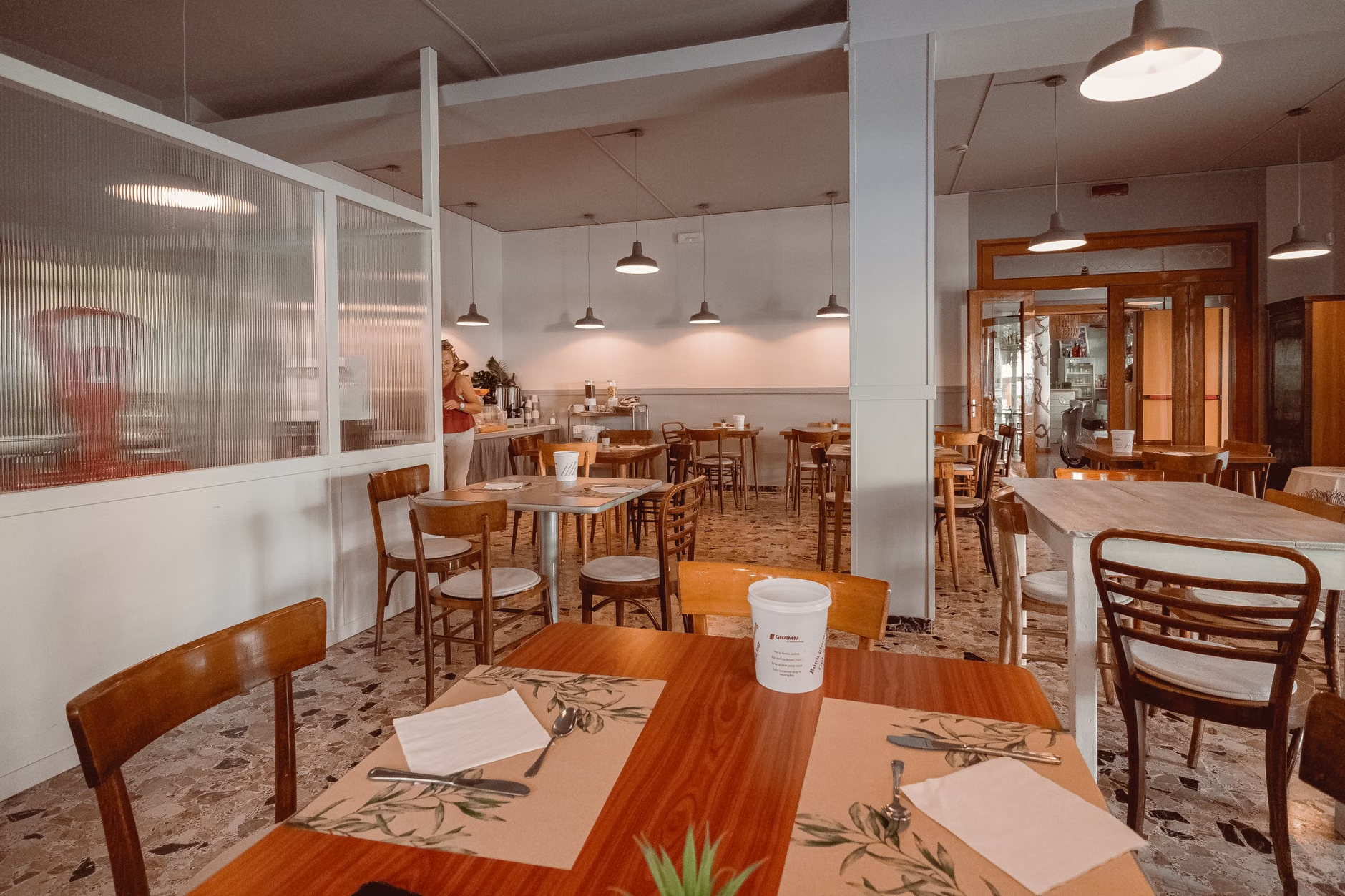
Not every public place qualifies as a third-space. A high-end shopping mall, for instance, is designed to extract money from you. A true third-space has specific characteristics that set it apart from commercial retail or private residential zones. If you are looking to identify or advocate for these spaces in your own city, look for these criteria:
- Accessibility: It is within walking distance or easy transit range from your home.
- Inclusivity: It welcomes diverse groups without requiring a membership or a high entry cost.
- The “Leveling” Effect: Social status matters less here. The CEO and the freelance writer are sitting at the same table.
- Conversation-Centric: The primary activity is interaction, not just consumption.
- Consistency: The “regulars” are there, providing a sense of familiarity and safety.
For those of us in the thick of parenting, these spaces are life-saving. When your home feels like a whirlwind of laundry and remote meetings, a local park or a library with a public reading area provides a “neutral ground” where you can be present without the domestic pressure. It is the difference between being “at home” and being “in the world.”
The 15-Minute City and the Urban Design Shift
You might have heard the term “15-minute city” thrown around in recent urban planning discussions. It sounds like a buzzword, but the concept is remarkably simple: everything you need—groceries, schools, work, parks, and cafes—should be within a 15-minute walk or bike ride from your front door. This is the structural backbone of the third-space revival.
When planners focus on “mixed-use development,” they are essentially trying to kill the commute. By integrating ground-floor retail into residential buildings and placing public squares at the heart of neighborhoods, cities are trying to force these casual intersections to happen again. In many European cities, this has been the standard for centuries, but in North America, Australia, and parts of Asia, this requires a massive retrofitting of suburbs that were built for cars, not people.
Table: The Shift in Urban Priorities
| Feature | Car-Centric Model (Old) | Third-Space Model (New) |
|---|---|---|
| Primary Focus | Traffic flow and parking | Walkability and social interaction |
| Zoning | Single-use (Residential vs. Commercial) | Mixed-use integration |
| Social Hubs | None (private homes only) | Public plazas, libraries, pocket parks |
Practical Challenges: Why Isn’t This Everywhere?
If third-spaces are so beneficial, why don’t we have more of them? The reality is that building and maintaining these spaces is difficult and expensive. Developers often prefer high-density commercial retail because it guarantees a return on investment. A public square or a free community reading room doesn’t generate tax revenue in the same way, making it a “hard sell” for local governments that are strapped for cash.
Furthermore, there is the issue of “private-public” spaces. Many modern “plazas” are actually owned by corporations. They look like public spaces, but they have rules against loitering, photography, or specific types of gatherings. These are “pseudo-third-spaces.” They offer the illusion of community without the genuine freedom of a truly public environment. As residents, we have to be vigilant about distinguishing between a space that is meant for us and a space that is meant to make us buy things.
Another hurdle is the “NIMBY” (Not In My Backyard) phenomenon. When cities propose high-density, mixed-use buildings that include parks or community hubs, existing residents often worry about traffic, noise, or property value fluctuations. Overcoming this requires a shift in how we view our neighborhoods—moving from seeing them as static assets to seeing them as living, evolving ecosystems.
How You Can Foster Third-Space Energy
You don’t need to be an urban planner to start cultivating this in your life. The revival of the third-space is a bottom-up movement as much as it is a top-down one. If you want more community, you have to start participating in the creation of it. Here are a few ways to start:
- Audit your neighborhood: Take a walk. Where are the places you could sit for 30 minutes without buying anything? If the answer is “nowhere,” that’s your starting point for advocacy.
- Support local, non-chain businesses: Independent cafes and bookstores are the most likely to host community events or allow people to linger.
- Join or organize a community group: Whether it’s a neighborhood garden, a book club, or a local sports league, these groups are the “social software” that makes the “physical hardware” of a third-space work.
- Advocate for “tactical urbanism”: Look into local initiatives that use temporary measures—like putting planters in the street to slow traffic or installing temporary seating—to test out new community spaces.
The Impact on Parenting and Work-Life Balance
For parents in their 30s and 40s, the lack of a third-space is a primary driver of burnout. When you are constantly at home, the boundaries between “work,” “chores,” and “parenting” collapse. You are always “on.” A third-space offers a psychological break. It allows you to step out of the domestic sphere into a place where you are just an individual again.
It also provides a natural environment for children to socialize outside of school and organized activities. Seeing other families in a shared space reinforces the feeling that “it takes a village.” It turns the neighborhood from a collection of houses into a support network. When you know your neighbors from the park or the local library, you are more likely to share resources, help with childcare, and look out for each other’s kids.
Common Misconceptions About Third-Spaces
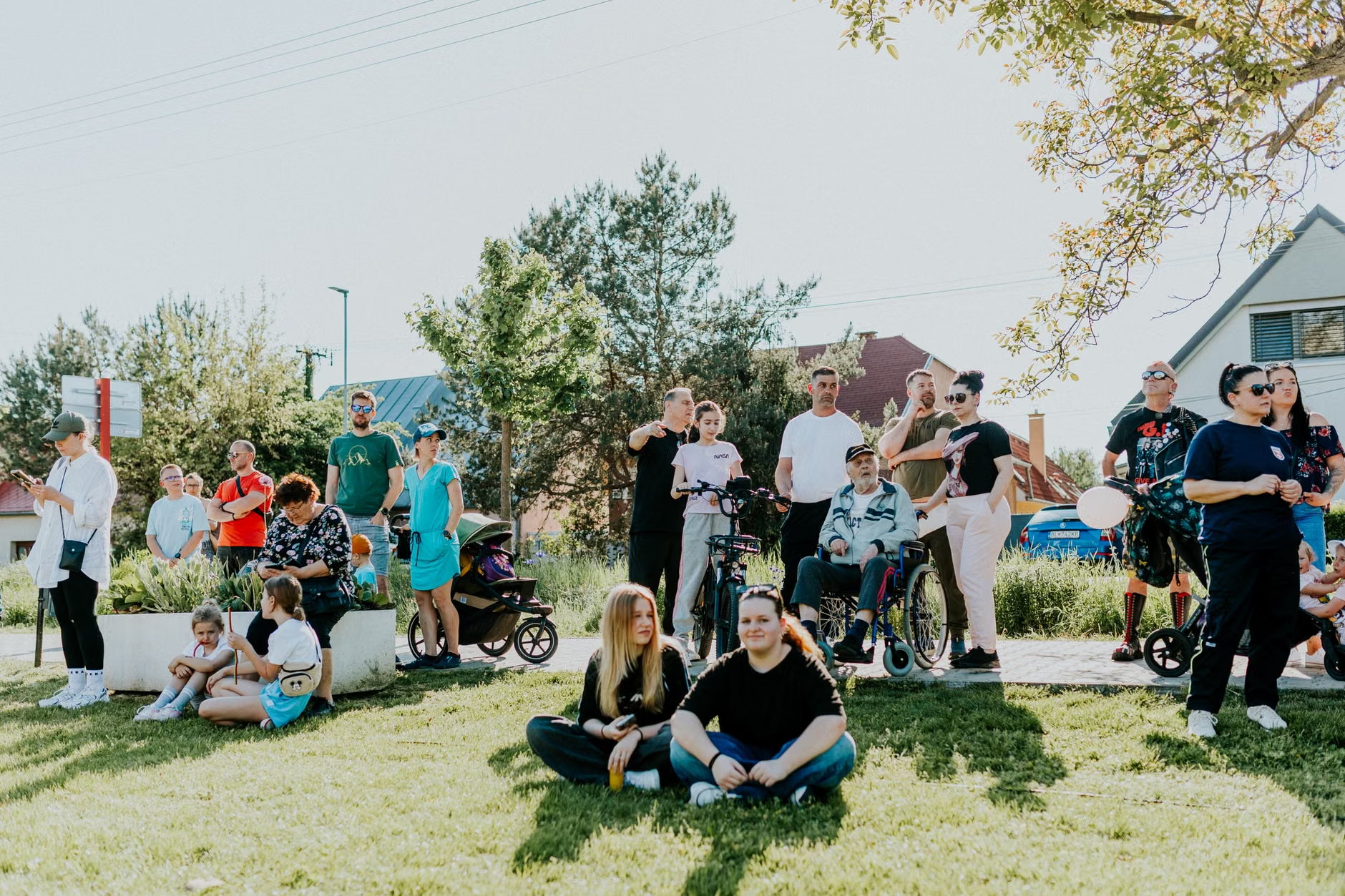
There is a prevailing myth that third-spaces are only for the young and the childless—that they are all about late-night bars or trendy co-working spaces. This couldn’t be further from the truth. A truly effective third-space is intergenerational. It should be as welcoming to a retiree reading a newspaper as it is to a toddler at a park or a professional taking a mid-day meeting.
Another misconception is that technology has replaced the need for physical space. While we have social media and messaging apps, they don’t provide the same chemical and psychological benefits as face-to-face interaction. The “weak ties”—the people you know by face but not by name—that you build in third-spaces are scientifically proven to increase your sense of belonging and happiness more than a thousand digital interactions.
The Future of Our Neighborhoods
The revival of the third-space is not a return to the past; it is an adaptation for a future where we are more digitally connected but physically lonelier than ever. We are learning that the “efficiency” of the last 40 years came at a high cost: our social fabric. By slowing down, by prioritizing walkability, and by demanding spaces that are designed for people rather than for cars, we can reclaim the lost art of the neighborhood.
If you find yourself feeling drained by the cycle of the modern routine, take heart. The tide is turning. Cities are beginning to realize that the most valuable commodity isn’t a parking spot—it’s a place where we can simply be, together.
Frequently Asked Questions
1. Can a co-working space be considered a third-space?
Yes, but with a caveat. If it is purely for work and requires a high membership fee, it functions more like a professional office. However, if it includes public-facing components like a cafe or community event space, it can definitely serve as a third-space.
2. How do I know if my neighborhood is planning for more third-spaces?
Check your local city council’s urban planning documents or search for “master plan” or “neighborhood revitalization” projects on your city’s official website. Many cities are now publishing “15-minute city” roadmaps that outline exactly where they intend to add parks and community hubs.
3. Is it possible to create a third-space in a car-dependent suburb?
It is difficult but possible through “tactical urbanism.” Small-scale interventions, like advocating for a community garden on an empty lot or asking for better pedestrian access to local shopping centers, can slowly change the character of a car-centric area into something more community-focused.
For further reading and official resources on urban planning and the 15-minute city concept, you can explore the resources provided by the C40 Cities Network and the Project for Public Spaces, which offer extensive guides on how communities can reclaim their public life.
The revival of these spaces won’t happen overnight, but every time you choose to linger in a park or support a local hub, you are contributing to a healthier, more connected future for us all. It is a small act, but in the context of our daily lives, it makes all the difference.