The secret to building a child’s mathematical confidence isn’t an expensive tutor or a high-tech app; it’s shifting the focus from “getting the right answer” to the process of thinking through a problem during everyday moments at the kitchen table.
- Process over Product: Growth mindset focuses on the effort and strategy used to solve a problem, rather than the speed or correctness of the final result.
- Low-Stakes Environment: Using the kitchen table as a “lab” rather than a “classroom” removes the pressure of grading, allowing children to experiment with numbers safely.
- Real-World Application: Integrating math into cooking, chores, and games makes abstract concepts tangible and relevant to a child’s daily life.
If you have ever watched your child freeze up over a page of long division or heard the dreaded phrase, “I’m just not a math person,” you know the specific brand of exhaustion that follows. In our thirties and forties, we are often managing the “mental load” of the entire household—schedules, meals, work deadlines—while simultaneously trying to nurture our children’s academic development. It feels like a second job, and often, it’s a job we feel ill-equipped to perform.
The “Growth-Mindset” movement, popularized by psychologist Carol Dweck, suggests that intelligence is not a fixed trait. When a child believes their brain is a muscle that grows with effort, they are more likely to persist through challenges. When it comes to math, this is revolutionary. Instead of viewing a math error as a mark of failure, we can reframe it as a data point—a moment where the brain is actually growing.
Why the Kitchen Table is the Best Classroom
There is a unique pressure associated with the “homework hour.” It’s usually late in the day, everyone is tired, and the stakes feel artificially high. By moving “math time” away from the desk and into the kitchen, we change the environment from one of compliance to one of exploration. The kitchen is full of manipulatives—measuring cups, timers, ingredients, and cutlery—that naturally invite mathematical thinking.
When you play games at the table, you aren’t “teaching” in the traditional sense. You are modeling curiosity. If you make a mistake while calculating a tip or measuring an ingredient, point it out. “Oh, I miscalculated that! Let me rethink my strategy.” This is the core of a growth mindset: demonstrating that even adults are still learning.
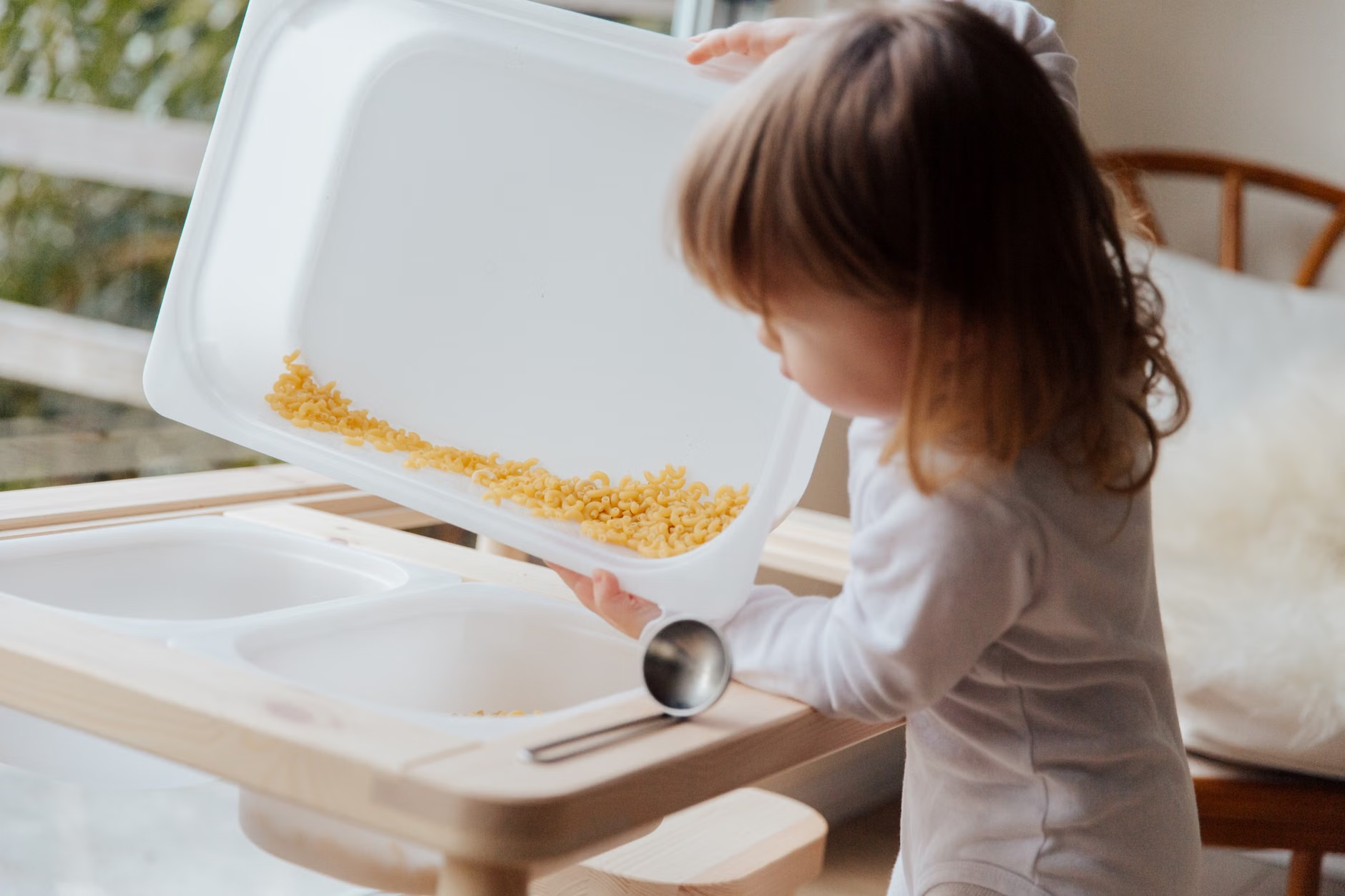
1. The Pasta Pattern Challenge
Sorting and classifying are the bedrock of algebraic thinking. You don’t need specialized blocks. A box of mixed pasta shapes (penne, rotini, farfalle) is perfect. The goal here is to ask your child to create a pattern or sort them by attributes. This isn’t just about counting; it’s about recognizing rules and sequences.
How to play: Ask your child to create a sequence—for example, two penne, one rotini, two penne, one rotini. Then, ask them what comes next. Once they master simple patterns, introduce “rule-breaking.” Make a mistake in the pattern and ask them to find the “glitch.” This helps them develop the analytical habit of looking for errors, which is essential for higher-level math.
2. The “Fraction Bake-Off”
Baking is perhaps the most practical application of fractions in the home. It is also the most common place where parents accidentally “do the math for the child.” The next time you are measuring flour or sugar, hand the measuring cup to your child and ask them to figure out how many 1/4 cups make a 1/2 cup.
The Growth Mindset Twist: If the recipe calls for 3/4 cup of sugar and you only have a 1/4 cup measure, let them struggle with the process for a moment. Instead of giving the answer, ask, “How many times do we need to fill this to get to the total?” This forces them to visualize the relationship between the parts and the whole.

3. The “Dicey” Dinner Conversation
Probability is a topic that often feels abstract until you introduce dice. During dinner, keep a pair of dice on the table. Before you start eating, pick a number between 2 and 12 and predict how many rolls it will take to hit that number.
Why this works: It introduces the concept of likelihood and data collection. Keep a small tally on a napkin. If they predict the number 7, they’ll quickly realize through repeated trials that 7 is the most probable sum. This is a foundational concept in statistics that is far more intuitive when learned through play than through a textbook.
4. The “Grocery Receipt” Estimation
This is a great activity for older elementary students. Before you go to the store, give them a budget of $20. As you pick items, ask them to keep a running total in their head or on a notepad. The rule is not to get the exact amount—the rule is to stay under the budget.
The Growth Mindset Focus: If they go over, don’t criticize the math. Ask, “Where did our estimate drift?” This helps them develop “number sense”—the ability to understand the magnitude of numbers and how they interact—rather than just memorizing algorithms.
5. The Card Game “Make 10”
Standard playing cards are excellent for math practice. For younger children, remove the face cards. For older children, keep them as 10s or 11s. The game is simple: deal out a row of cards and have them find combinations that add up to 10 (or 20 for more advanced players).
The Challenge: Introduce a “constraint.” Tell them they can only use three cards to make the total. This forces them to look for alternative strategies. When they can’t find a combination, encourage them to “audit” their hand. “What other combinations could we make with these numbers?”

Understanding the “Math Anxiety” Barrier
Math anxiety is a real, documented phenomenon. It often stems from the belief that there is only one “right way” to solve a problem and that speed equals intelligence. Research from the University of Chicago suggests that when parents are anxious about math, their children pick up on that stress, which correlates with lower math achievement.
If you are someone who struggled with math in school, be honest with your child. Say, “I used to find this really hard because I thought I had to be fast. But I’ve learned that math is actually just a puzzle. Let’s solve this puzzle together.” This vulnerability is the ultimate growth-mindset tool. It tells your child that even if they are struggling, they are not failing—they are just in the middle of the puzzle-solving process.
Practical Framework for Implementation
To make these games a sustainable part of your routine, you need to avoid the “homework trap.” If you try to force these games when everyone is exhausted or after a difficult day of school, they will be rejected. Use the following framework to integrate these games without adding to your mental load.
| Strategy | Implementation | Goal |
|---|---|---|
| The “Transition” Moment | Play a 5-minute card game while dinner is being plated. | Shift focus from school stress to home relaxation. |
| The “Weekend Lab” | Bake together on Saturday mornings using measurement challenges. | Build confidence in fractions and ratios. |
| The “Waiting Room” Game | Use dice or mental estimation while waiting for food or appointments. | Normalize math as a way to pass time, not just a school task. |
Common Mistakes and How to Avoid Them
We often make the mistake of “teaching” by showing the shortcut. For example, if your child is struggling to add 7 + 8, you might say, “Just think of it as 7 + 7 + 1.” While that is a valid strategy, if you give it too early, you rob them of the chance to discover it for themselves.
Cautions to remember:
- Avoid praising intelligence: Instead of saying “You’re so good at math,” say “I noticed you tried three different ways to solve that puzzle before you found the answer.”
- Don’t emphasize speed: Speed is a byproduct of practice, not a measure of capability. Pushing for speed creates anxiety.
- Stop when it’s not fun: If the “game” starts feeling like a lesson, stop. The goal is to build a positive association with numbers, not to finish the math.
The Long-Term Impact of a Growth Mindset
When children develop a growth mindset, they stop fearing mistakes. In the context of mathematics, this is the most important skill they can acquire. High-level mathematics is rarely about simple calculation; it is about modeling, logic, and persistence. By playing these games, you are teaching your child that they are capable of navigating complexity.
This does not mean your child will suddenly enjoy every math worksheet they bring home. It does mean that when they hit a wall, they will have a toolkit of strategies and a belief in their own capability to work through it. They will learn to ask, “What other way can I approach this?” rather than, “I can’t do this.”
Expanding the Conversation: Beyond the Kitchen
Once you have established these routines, you can expand them into other areas of family life. If you are planning a trip, involve your child in the budget. How much will gas cost if the car gets 30 miles per gallon? How long will the trip take if we drive 60 miles per hour? These are not just math problems; they are life-planning skills.
By framing these conversations as “planning” rather than “problems,” you shift the dynamic. You are partners in solving the logistics of your life. This creates a sense of agency that is incredibly empowering for children in their pre-teen years.
Refining Your Approach: The Role of Feedback
As you implement these activities, pay attention to the feedback you give. Research consistently shows that process-oriented feedback is far more effective than result-oriented praise. When your child succeeds, don’t just say “Great job.” Ask them, “What strategy did you use to get that answer?”
This forces them to reflect on their own thinking. It moves them from a passive learner—who waits for the teacher to provide the “right” method—to an active learner who understands that there are many paths to a solution. This is the essence of mathematical maturity.
The Importance of Consistency Over Intensity
One of the biggest pitfalls parents face is thinking they need to do “math time” for 30 minutes every day. You don’t. In fact, short, frequent interactions are much more effective for building long-term habits. A five-minute game of “Make 10” while you are waiting for the oven to preheat is worth more than an hour of forced study on a Sunday afternoon.
Consistency builds familiarity. Familiarity reduces anxiety. When math becomes a familiar, low-stakes part of your family culture, it loses its power to intimidate. It becomes just another language that you speak together at the table.
Addressing Potential Edge Cases
What if your child is genuinely struggling with a specific concept, like multiplication tables? It is okay to use tools like flashcards, but turn them into a game. Time them, but don’t hold them to the clock. Instead of “Can you get all 10 right in under a minute?”, try “Can you beat your own time from yesterday?”
This subtle shift from competition against others to competition against oneself is a hallmark of the growth mindset. It focuses on personal progress, which is the only metric that truly matters in the development of a child’s confidence.
Final Thoughts on Mathematical Literacy
Mathematical literacy is a form of empowerment. It allows us to understand the world, from the interest rates on our savings accounts to the probability of weather events. By fostering a growth mindset at the kitchen table, you are providing your child with a foundation that goes far beyond the classroom. You are teaching them how to think, how to persist, and how to embrace the process of learning.
Remember that the goal is not to turn your dining room into a tutoring center. The goal is to keep the conversation about numbers, logic, and patterns alive and lighthearted. When you show your child that you are willing to learn, adapt, and even make mistakes, you are giving them the greatest gift of all: the permission to be human, and the confidence to keep growing.
For further reading on the science of learning and growth mindset, check out the resources provided by the YouCubed initiative at Stanford University, which offers excellent, research-backed strategies for parents and educators. You can also explore the National Council of Teachers of Mathematics for practical advice on how math is being taught and how you can support those concepts at home.
Frequently Asked Questions
1. My child hates math. How do I start these games without them getting frustrated?
Start with games that have nothing to do with schoolwork. Use the “Dicey Dinner” or “Pasta Sorting” games mentioned above. The key is to keep it under 5-10 minutes and stop before they get frustrated. If they see you having fun and treating the numbers as a puzzle rather than a test, their resistance will naturally lower over time.
2. Does a growth mindset mean my child will never get upset when they make a mistake?
Not at all. A growth mindset isn’t about eliminating frustration; it’s about changing how we react to it. It’s normal for a child to feel frustrated when they can’t solve a problem. The growth mindset approach is to validate that feeling (“I can see this is a tough one”) and then pivot to the next step (“What other strategy could we try here?”). You are teaching them that frustration is just a part of the learning process.
3. How much time should I dedicate to these games each week?
You don’t need a set schedule. The most effective approach is “micro-learning.” Use the moments you are already together—waiting for dinner, during a car ride, or while cleaning up. Aim for 5-10 minutes a few times a week. The consistency of these small, informal interactions is far more powerful than a single, long, structured session.
For more evidence-based parenting tips and educational resources, keep an eye on our upcoming features on child development and the changing landscape of modern education.