The most effective way to reclaim two hours of your day isn’t by becoming more productive; it is by eliminating your commute entirely through the rise of hyper-local co-working hubs.
Key Takeaways
- The 15-Minute Radius: Hyper-local hubs focus on accessibility, allowing you to walk or bike to work, effectively reclaiming “dead time” spent in transit.
- Community Over Corporate: Unlike massive city-center hubs, these spaces prioritize local networking and provide a buffer zone between home and office life.
- Economic Reality: While memberships may seem like an added expense, the savings on commuting costs, child-care scheduling flexibility, and increased hourly output often offset the monthly fee.
If you are in your 30s or 40s, you likely remember the era when “going to work” meant a soul-crushing commute into a central business district. Today, the landscape has shifted. We aren’t just talking about working from home—which, as any parent knows, often means answering emails while hiding in a pantry from a toddler—but about the emergence of the “hyper-local” office.
These are small, neighborhood-based workspaces that sit right in the heart of residential communities. They aren’t trying to be WeWork; they are trying to be your living room, but with better Wi-Fi, a professional desk, and zero laundry piles in your peripheral vision.
Why the ‘Hyper-Local’ Shift Matters for Modern Parents
The traditional office model was built on the assumption that you have a “work self” and a “home self,” separated by a physical distance. For many, that distance is currently a 45-minute train ride or a highway crawl. When you work from home, that boundary dissolves, leading to the “always-on” exhaustion that is common in our demographic.
A hyper-local hub acts as a “third space.” It is close enough to be convenient—usually a 5- to 10-minute walk—but far enough that when you leave, you have actually “left work.” This psychological separation is crucial for mental health. When you are in the hub, you are a professional; when you walk out the door, you are a partner or parent again.
Consider the logistical nightmare of a standard school run paired with a 9-to-5 commute. If your office is in the city, you are locked into a rigid schedule. If your office is three streets away, you gain the ability to handle a mid-day emergency or a school pickup without it becoming a three-hour logistical operation. This is not just about convenience; it is about reclaiming autonomy over your own life.
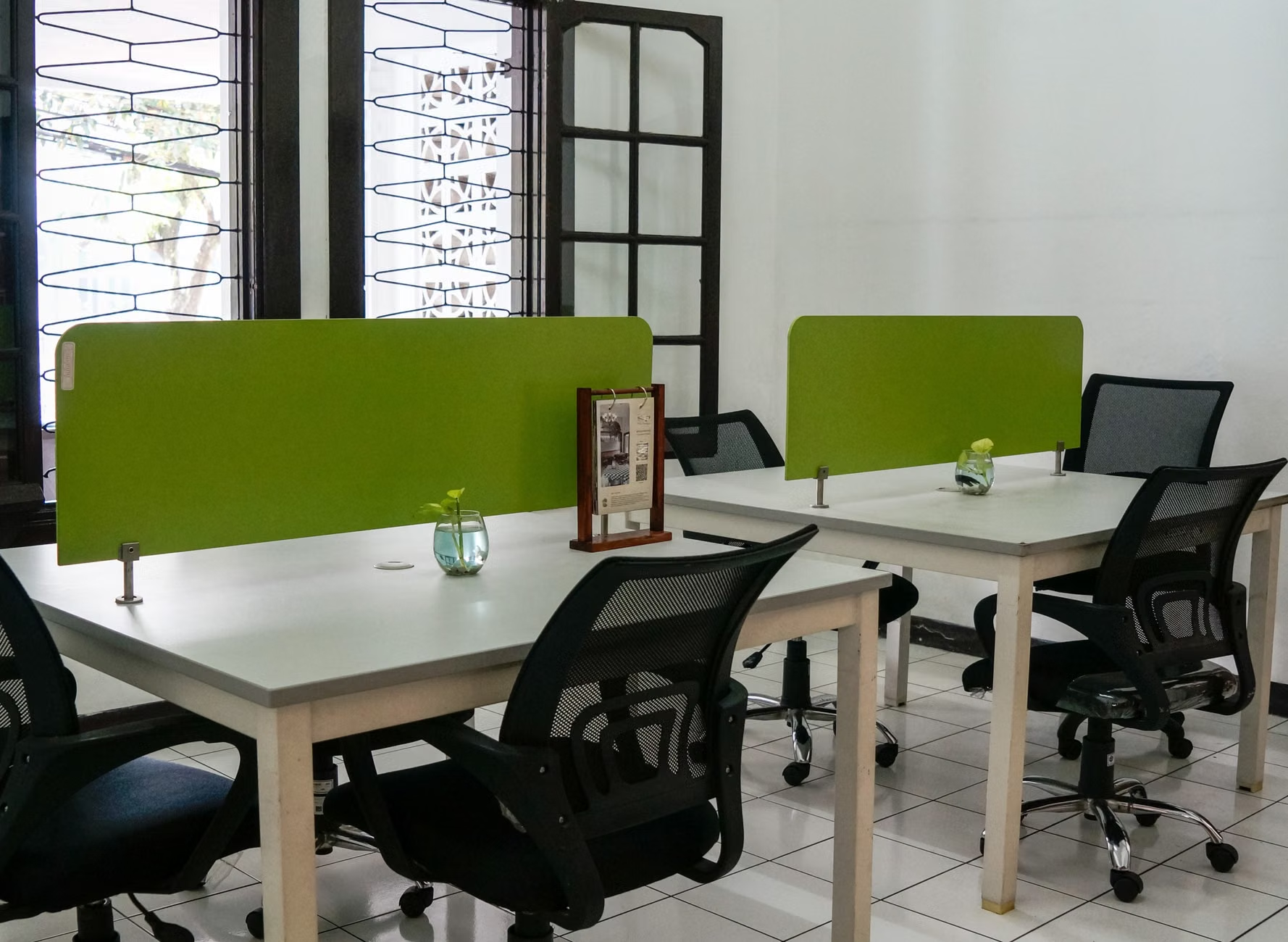
What Defines a True Hyper-Local Hub?
Not every small office is a “hyper-local hub.” There is a difference between a shared desk in a basement and a curated neighborhood workspace. A true hub focuses on three pillars: proximity, community, and infrastructure.
1. Proximity as a Service
The primary value proposition is the commute. If you have to drive more than 15 minutes, the “hyper-local” benefit begins to decay. The goal is to integrate the workspace into your existing neighborhood loop—right next to the grocery store, the school, or the local gym.
2. The Community Layer
These spaces are usually managed by residents or local entrepreneurs. This creates an environment where you are networking with neighbors, not just strangers. You might find a potential client, a local contractor, or just someone who understands the local school district’s quirks.
3. Professional Infrastructure
You aren’t just paying for a desk; you are paying for reliability. This includes high-speed fiber internet, sound-proofed booths for Zoom calls, and an environment where you are not expected to be “on” for the household. If you are constantly interrupted by deliveries, pets, or family members, the hub serves as a productivity firewall.
Comparing Your Work Options: A Decision Framework
To help you decide if a hyper-local hub is the right move, let’s look at how different work environments stack up for the average professional in their 30s or 40s.
| Feature | Working from Home | City-Center Office | Hyper-Local Hub |
|---|---|---|---|
| Commute Time | Zero | 60-90 mins | 5-10 mins |
| Distraction Level | High | Low | Low |
| Cost | Low | High (Travel/Food) | Moderate (Subscription) |
| Flexibility | High | Very Low | High |
The “High” cost of a city-center office often hides the “hidden costs” of dry cleaning, expensive lunches, and the mental fatigue of commuting. When you calculate your hourly rate, the cost of a local hub membership (often $150–$300/month depending on your region) is usually cheaper than the gas, parking, and time lost in a traditional office commute.

Common Misconceptions and Hidden Trade-offs
One common mistake people make is assuming that all co-working spaces are the same. A massive, corporate-owned hub in a downtown skyscraper has a different “vibe” than a neighborhood hub. If you are looking for a hyper-local space, avoid the ones that prioritize “hot-desking” volume over actual community. You want a place that knows your name, not a place that treats you like a QR code.
Another misconception is that you need to be there every day to make it “worth it.” That is not true. These spaces are about *optionality*. You might only go on Tuesdays and Thursdays when your schedule is packed with back-to-back video calls. Having that space available when you need it is a form of insurance against burnout.
Be wary of “hidden costs” like extra charges for printing, meeting room bookings, or coffee. Always ask for a transparent breakdown of what is included in the base membership. Some spaces charge a premium for “quiet zones,” while others are open-plan only. If you do creative or analytical work that requires deep focus, a space with dedicated phone booths or quiet rooms is non-negotiable.
How to Evaluate a Local Hub Before Signing Up
Don’t just look at the website photos. Websites are designed to look like polished magazines; reality is often a bit more “lived-in.” Before you commit to a monthly subscription, follow these steps:
- The “Mid-Day Walk” Test: Visit the space at 2:00 PM on a Wednesday. Is it quiet? Is the internet stable? Does it smell like someone is cooking fish in the kitchen? This is when you will actually be using it.
- The “Zoom” Test: Ask the manager if you can sit in a phone booth for five minutes to test the acoustics. If you can hear the person in the next booth talking, your client calls will be stressful.
- The “Community” Test: Look at the communal board. Are there local events posted? Is it active? A dead space is just a lonely office. You want a place that fosters (or at least respects) a sense of community.
If the space fails any of these tests, keep looking. Because the space is hyper-local, you are limited by your geography, but don’t settle for a space that makes your work harder. The goal is to reduce friction, not add to it.

Addressing the “Always-On” Culture
For those of us in our 30s and 40s, the temptation to work at all hours is high. We are often managing teams, raising children, and trying to maintain a social life. The hyper-local hub can actually help you enforce a “shutdown” routine. Because you have to physically leave the space to get home, you create a tangible end to the workday.
Use the commute home as a “transition period.” Whether it’s a 5-minute walk or a quick bike ride, use that time to listen to a podcast, catch up with a friend, or just exist in the world without a screen. When you walk through your front door, you are mentally ready to switch into parent mode, rather than bringing the stress of the office with you.
This is a major upgrade from the “working from the kitchen table” model, where the boundary between “work” and “home” is a literal piece of furniture. By creating a physical boundary, you are not just improving your productivity; you are protecting your personal time.
Financial and Practical Considerations
Is this a luxury? For some, yes. But if you view it as a productivity tool, the math changes. If you are currently struggling to hit deadlines because of home interruptions, you are losing money in terms of efficiency and potential career growth. A $200 monthly fee for a desk space is, in many cases, a tax-deductible business expense (depending on your local tax laws—always check with a professional).
Beyond the money, consider the opportunity cost of your time. If you spend 10 hours a week commuting, that is 520 hours a year. That is almost 22 full days of your life spent in transit. Even if a local hub costs money, the time you get back is a non-renewable asset.
If you are a freelancer or a remote employee, talk to your employer. Many companies are now willing to subsidize local co-working memberships because they see the value in their employees being happier, more productive, and less likely to burn out. It never hurts to ask if there is a “remote work stipend” available for such purposes.
Looking Ahead: The Future of Neighborhood Work
We are seeing a trend where residential developers are starting to include “community co-working” as a standard amenity in new apartment buildings. This is the ultimate evolution of the hyper-local hub. If you are looking to move, this might be a factor to consider. The ability to walk down an elevator to a professional workspace is a game-changer for parents.
However, you don’t need a fancy new building to benefit from this. Existing libraries, community centers, and small cafes are often starting to offer “quiet hours” or reserved desk spaces. Keep an eye on your local community boards. Sometimes, the best hub is one that hasn’t even branded itself as a “co-working space” yet.
Final Thoughts: Your Next Action
The rise of hyper-local co-working isn’t about following a trend; it’s about reclaiming your time and sanity in an era where work-life balance has become dangerously blurred. By moving your office closer to your front door, you are making a deliberate choice to prioritize your energy and your presence at home.
Do not wait for your employer to suggest it or for the “perfect” space to open. Start by mapping out the 15-minute radius around your home. Look for quiet cafes with reliable Wi-Fi, check if there are any small office suites that rent by the day, and test the waters. You might find that the best way to be a better parent and a better professional is simply to be closer to both.
Your next step: Spend the next three days observing your current work environment. Track how much time you lose to transitions, interruptions, and the “blur” of working from home. If that number exceeds five hours a week, it is time to start looking for a local hub. The investment in your own peace of mind is worth more than the monthly membership fee.
Frequently Asked Questions
1. Is a hyper-local co-working space really better than a traditional office?
It depends on your goals. A traditional office is often better for high-level collaboration and corporate culture immersion. However, for a 30- or 40-something balancing family and career, the hyper-local hub wins on time-efficiency and stress reduction. You lose the commute and the “always-on” home pressure while keeping the flexibility to handle family responsibilities.
2. What should I do if there are no co-working spaces in my immediate neighborhood?
Look for “hidden” alternatives. Many public libraries now offer excellent dedicated quiet zones with fast Wi-Fi and power outlets. Additionally, some quiet, independently owned cafes are happy to host “work-from-cafe” regulars if you make it a habit to buy lunch or coffee there consistently. You can also check local community centers or church halls, which are increasingly renting out space during weekday business hours.
3. How do I justify the cost of a membership to my partner or my budget?
Frame it as a productivity and wellness investment. Calculate your hourly rate and compare it to the time you save by not commuting. If you save 5 hours a week in commuting, that is 20 hours a month. If those 20 hours allow you to be more focused and less stressed, the cost is often offset by the increase in your own quality of life and potential for higher professional output. If you are a freelancer, remember to check if your local tax authority allows you to deduct this as a business expense.
For further reading on the future of work and remote trends, you can explore the OECD’s insights on the Future of Work, which highlights how shifting work locations are impacting global labor dynamics.