- The “One Activity” Rule: Plan no more than one major activity per day to accommodate the varying energy levels of toddlers and seniors.
- Accommodation is Everything: Prioritize vacation rentals with separate bathrooms and a common area over hotel rooms to prevent “proximity fatigue.”
- Delegate Logistics: Assign a “Travel Point Person” for bookings and a “Logistics Runner” for daily tasks to prevent decision exhaustion among the group.
The secret to surviving a multi-generational trip—where you are balancing the needs of your parents, your partner, and your own children—is accepting that it is not a vacation in the traditional sense; it is a logistical operation. If you try to force a “relaxing” itinerary that ignores the physical and psychological needs of three different age groups, you will inevitably end up with a group of grumpy travelers and a massive hole in your savings account.
I have spent years observing how families navigate the intersection of toddlers needing naps and grandparents needing accessible infrastructure. The reality is that the “perfect” trip is a myth. The “successful” trip, however, is entirely achievable if you treat it with the same rigor you would apply to a project management task at work. Let’s break down the logistics of getting three generations from point A to point B without a complete meltdown.
Choosing the Right Base: Why “Hotel Rooms” Are Often the Enemy

One of the most common mistakes travelers in their 30s and 40s make is defaulting to hotel bookings. While hotels offer convenience, they create “proximity fatigue.” When you are traveling with children and elderly parents, the lack of private space can lead to sensory overload. You have a toddler who wakes up at 6:00 AM, a grandparent who wants to read in the quiet, and you and your partner just trying to find a moment to breathe.
The Decision Rule: If your trip exceeds three nights, look exclusively for vacation rentals (such as apartments or villas) that provide at least one bathroom per two adults and a central “buffer zone” (a living room) that is physically separated from the sleeping quarters. This allows the toddler to nap in a bedroom while the adults socialize in the living area without having to whisper.
When searching for these properties, do not just look at the photos. Check the floor plan. If the only way to get to the kitchen is through a bedroom, you have a bottleneck. A bottleneck in a multi-generational group means someone is going to be woken up or disturbed, which inevitably leads to conflict. Aim for properties with a “split-wing” layout where bedrooms are on opposite sides of the living space.
The Accessibility Audit
Before you hit “book,” you must perform an accessibility audit. This isn’t just about whether a place is “wheelchair-friendly.” It is about the subtle barriers that become major issues for older travelers. Does the building have an elevator? If so, is it large enough for a stroller and a walker? Is the shower a walk-in, or is there a high-sided tub that requires a precarious step over?
If you are booking through platforms like Airbnb or Vrbo, do not rely on the “accessible” filter alone. It is often inaccurate. Use the “Contact Host” feature to ask these three specific questions:
- “How many steps are there between the street entrance and the elevator?” (Even one step can be a dealbreaker for someone with limited mobility).
- “Is the shower a walk-in, and does it have grab bars?”
- “Is the property located on a hill? Please describe the incline to the nearest public transit or grocery store.”
The Geometry of Transport: Managing the “Moving Parts”
Transporting six to eight people is not just “twice as hard” as transporting three; it is exponentially more complex. You have to account for the slowest member of the group. If your father walks slowly, the entire group moves at his pace. If you try to force a faster pace, your parents will feel like a burden, which ruins the emotional dynamic of the trip.
The 50% Rule: Calculate how long Google Maps says it takes to get from your accommodation to a landmark. Then, add 50% to that time. If it takes 20 minutes to walk, plan for 30. If it takes 30 minutes to drive, plan for 45 to account for getting everyone into the car, buckling car seats, and handling the inevitable “I forgot my glasses” moment.
Car Rental vs. Private Transfers
For groups larger than four, renting a single large van can seem like a cost-saver. However, consider the “Split-Group Flexibility” factor. If you are all in one vehicle, you are tethered to that vehicle. If the children get tired and need to go back to the hotel, the grandparents are forced to leave the museum early, too. If you are in a location with decent public transit or reliable rideshare apps (like Uber or Bolt), it is often better to use two separate vehicles. The cost difference is usually negligible compared to the cost of a ruined day due to conflicting energy levels.
| Group Size | Recommended Transport | Why? |
|---|---|---|
| 3-4 People | Standard Sedan/SUV | Cost-effective and easy to park. |
| 5-7 People | Two Sedans or two Ubers | Allows for splitting the group when energy levels diverge. |
| 8+ People | Private Minibus/Driver | Eliminates the stress of navigating and parking multiple cars. |
When choosing between a rental car and a private driver, consider the “Navigation Tax.” If you are in a foreign country with different traffic laws or a high-stress driving culture, do not underestimate the mental load of driving. Paying for a driver for the day is not an indulgence; it is a way to ensure the designated “planner” of the family can actually look out the window and enjoy the trip instead of white-knuckling the steering wheel.
Scheduling: The “One Activity” Constraint

The most common failure point in multi-generational travel is the “packed itinerary.” When you are in your 30s, you might be used to waking up at 7:00 AM and hitting the ground running. Your parents might prefer a slower start, and your children might have a mid-day meltdown regardless of your plans.
The “One Major Activity” Rule: Plan exactly one significant event per day (e.g., a museum tour, a boat ride, or a hike). Everything else should be optional. If you accomplish the one thing, the day is a success. If you do more, that is a bonus.
Use the “Split-Day” strategy. In the morning, everyone does the activity together. After lunch, the group splits. One parent takes the kids to a park or back to the rental for a nap, while the other parent takes the grandparents to a cafe or a shop they are interested in. This allows for personalized experiences and prevents the “herd mentality” that leads to arguments.
Managing Expectations Before Departure
Before you leave, have a “Logistics Huddle.” This is not a formal meeting, but a casual conversation. Ask each adult what their “must-do” is. If your mother wants to see a specific cathedral and your partner wants to visit a local market, put those on the calendar first. If someone’s “must-do” isn’t on the list, it won’t happen, and resentment will build. By setting these priorities early, you avoid the “What do you want to do?” “I don’t know, what do you want to do?” cycle that consumes hours of vacation time.
Financial Logistics: Avoiding the “Who Pays?” Dance
Money is the fastest way to turn a family vacation into a family feud. Never assume that costs will be split “naturally.” Even if you have a good relationship with your parents, the ambiguity of who pays for dinner, who covers the extra taxi, and who buys the coffee can create unnecessary friction.
The Shared Ledger Strategy: Use a shared app like Splitwise or Tricount. Every time someone pays for a group expense, they enter it immediately. The app does the math and tells everyone exactly what they owe at the end of the trip. This removes the need for awkward “I’ll get this one, you get the next one” mental accounting, which almost always results in someone feeling like they paid more than their fair share.
The “Buffer” Rule: Always add a 20% buffer to your total budget for “spontaneous expenses.” These are not luxuries; they are things like an emergency taxi because it started raining, a quick snack for a hangry toddler, or an extra entrance fee because you decided to skip the long line. If you don’t have this buffer, you will be stressed every time you reach for your wallet.
Health, Safety, and the “What-If” Contingencies
When traveling with three generations, you have a wider range of medical needs. You are responsible for everything from a toddler’s scraped knee to a grandparent’s potential medication mix-up. This is where most people get lazy, and it is the area where you need to be the most prepared.
The Digital Medical Folder
Create a shared folder (Google Drive or Dropbox) that contains the following for every family member:
- A photo of the photo page of their passport.
- A list of current medications and dosages (crucial if someone needs emergency care).
- Proof of travel insurance (including the emergency contact number).
- A list of known allergies.
Why does this matter? In an emergency, your brain will not function at 100%. If you are in a foreign country and need to explain your father’s medical history to a doctor who speaks a different language, having a pre-written, clear list is a lifesaver. It is not about being pessimistic; it is about being efficient.
The “Medication Time” Variable
If your parents take daily medication, factor that into your daily schedule. If they need to take pills with food at 8:00 AM, do not plan a 7:30 AM excursion that involves a long walk. It sounds minor, but ignoring the rhythm of daily health routines is the fastest way to make an older traveler feel out of control and physically unwell.
Common Mistakes That Derail Multi-Generational Trips
Even with the best planning, common traps exist. Here is how to avoid them:
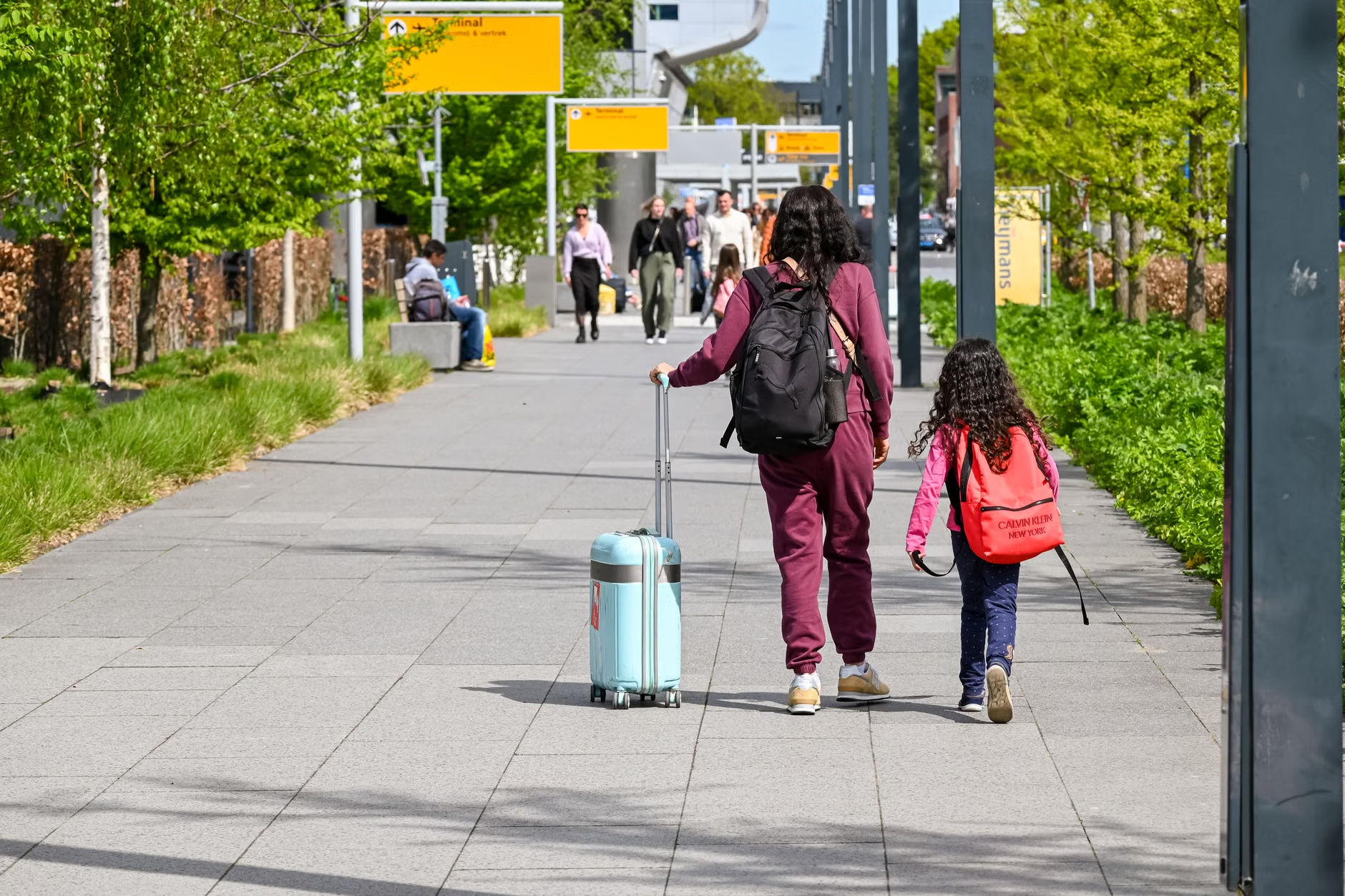
- The “Helpfulness” Trap: Do not try to carry everyone’s luggage. You are not a pack mule. Encourage everyone to bring luggage they can manage independently. If a grandparent cannot manage their suitcase, they should bring a smaller one. If you try to carry everything, you will be exhausted by hour two of the trip.
- The “Dining Out” Trap: Eating out three times a day with a large group is exhausting and expensive. It also makes it difficult to manage the children’s sleep schedules. Aim for breakfast at the rental (using local groceries), a quick lunch out, and a nice dinner out. This saves money and provides a predictable “home base” for the start and end of the day.
- The “Ignoring the Kids” Trap: Do not force children to participate in adult-centric activities for more than two hours at a time. If you are at a museum, plan a “reward” afterward, like a playground visit or ice cream. If you don’t incentivize the behavior you want from the kids, they will make the trip miserable for the adults.
Actionable Steps for Your Next Trip
If you are currently in the planning phase, follow this sequence:
- The “Must-Haves” List: Ask every adult (including your parents) to write down their top two priorities for the trip. If it’s not on the list, it’s not a priority.
- The Budget Agreement: Have a direct conversation about how costs will be handled. Suggest the shared ledger app approach. If your parents insist on paying for everything, set a “limit” or ensure you are contributing in other ways, like doing the planning or handling the driving.
- The Floor Plan Check: When booking, prioritize space over location. A slightly further-out apartment with three bathrooms and a large living room is infinitely better than a cramped hotel suite in the city center.
- The “Buffer” Schedule: Map out your days and ensure no day has more than one major commitment. Add at least two hours of “unstructured time” every single day.
Multi-generational travel is a test of patience, logistics, and communication. It is rarely perfect, but it is often deeply rewarding. The goal is not to have a trip where nothing goes wrong; the goal is to have a trip where you have enough space, time, and financial clarity to handle the things that do go wrong with grace. By shifting your mindset from “vacationer” to “logistics manager,” you protect the relationship you have with your parents and your children, which is, at the end of the day, the entire point of going away together.
Remember: You are the bridge between your parents and your children. If you are stressed, they will be stressed. If you are organized and calm, the entire group will follow your lead. Keep the schedule loose, the logistics clear, and the expectations realistic.
Frequently Asked Questions
Q: How do we handle different sleep schedules for toddlers and grandparents?
A: The best solution is to prioritize accommodation with separate bedrooms and a living area. If you are in a hotel, ask for connecting rooms. Always establish a “quiet hour” policy for the shared living space so that those who want to sleep are not disturbed by those who are still active.
Q: What should I do if a family member is constantly complaining about the itinerary?
A: This is why the “One Activity” rule and the “Split-Day” strategy exist. If someone is unhappy, give them the freedom to opt out. Never force a family member to participate in an activity they don’t want to do. If they prefer to stay back at the hotel or explore on their own, encourage it. It prevents resentment and allows everyone to enjoy the trip on their own terms.
Q: Is it better to travel to a familiar destination or somewhere completely new?
A: For multi-generational trips, familiarity is your friend. If you have been to a city before, you already know the layout, the best transport routes, and where to get groceries. This lowers your cognitive load, allowing you to focus on managing the group rather than figuring out how the local metro system works. If you do choose a new destination, add an extra 20% to your “buffer” time for logistics.
Useful Resources:
CDC Travel Planning Guide – Essential for health and safety preparation for families.
AARP Travel Center – Useful for tips on accessible travel and accommodating older adults.
Splitwise – The industry standard for managing shared expenses among group travelers.