Three Key Takeaways for Rail-Based Family Travel
- The “Door-to-City-Center” Advantage: Unlike airports, which are often 45-60 minutes outside urban hubs, train stations land you directly in the heart of the city, saving you roughly 3 hours of transit-related stress per trip.
- The Biological Advantage: Trains allow children to move freely, use restrooms at will, and maintain a consistent sleep schedule, which significantly reduces the “travel meltdown” threshold common in cramped airplane seats.
- The Financial Math: While high-speed tickets can appear pricey, factoring in the elimination of airport transfer costs, baggage fees, and the ability to bring your own food makes rail travel more cost-effective for families of three or more.
If you have ever spent four hours in an airport security line with a toddler, a carry-on, and a fading sense of sanity, you already know why the “slow-transit” movement is gaining momentum among parents in their 30s and 40s. We aren’t talking about slow as in “inefficient.” We are talking about slow as in “intentional.”
The modern family travel experience is often defined by the “sprint and wait” model: sprinting through terminals, waiting at gates, and sprinting again for connections. Rail travel, or the “slow-transit” approach, flips this script. It turns the journey into a legitimate part of the vacation rather than a hurdle to be cleared. If you are looking to regain control over your family’s travel experience, it is time to look at the tracks.
The Hidden Costs of Air Travel vs. The Rail Reality
When we compare travel options, we often look only at the ticket price. This is a common mistake. For a family of four, the ticket price is only about 60% of the actual cost of a flight. You have to add in the Uber or airport shuttle ($50–$100 each way), the inevitable $15 airport sandwiches, and the baggage fees.
Rail travel operates on a different economic logic. When you factor in the “hidden” costs, the numbers often tilt in favor of the train. Most major rail stations in Europe, Japan, and parts of North America are located in the city center. This allows you to walk to your accommodation or use a quick, cheap local transit pass, effectively eliminating the “last mile” cost that plagues air travelers.
| Expense Category | Air Travel (Family of 4) | Rail Travel (Family of 4) |
|---|---|---|
| Airport/Station Transfer | $100 – $200 (Total) | $0 – $20 (Local transit) |
| Baggage Fees | $150+ (Standard) | Usually Included |
| Food/Snacks | High (Airport prices) | Low (BYO allowed) |
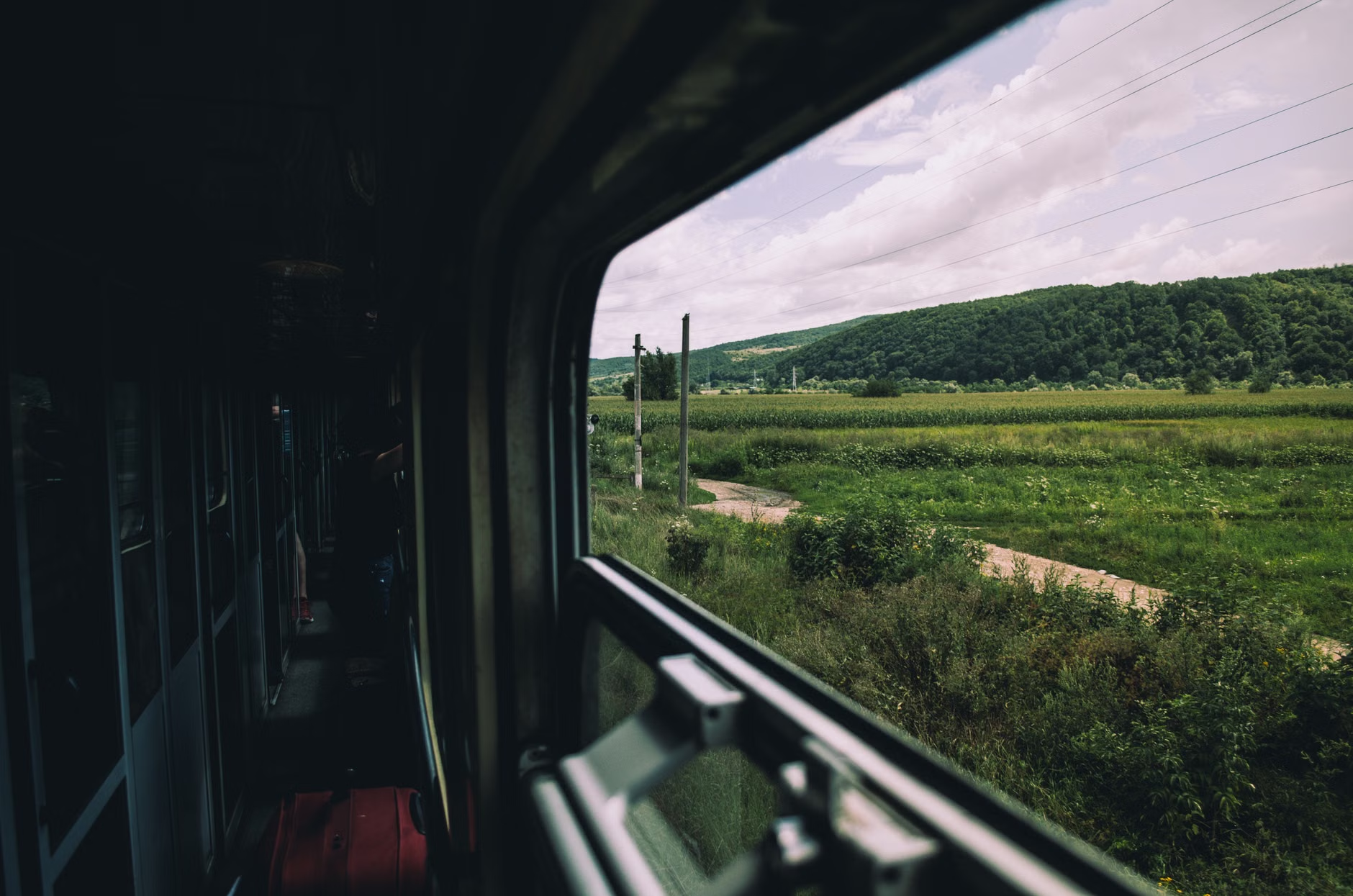
Beyond the money, there is the opportunity cost of stress. When you are on a train, you are not trapped in a pressurized tube. You can walk to the dining car, you can stretch your legs, and you can actually see the landscape changing. For parents, this means the environment is inherently more forgiving of the unpredictable nature of children.

Redefining “Slow”: Why Movement Matters for Families
The term “slow travel” has been co-opted by influencers to mean “spending three months in a Bali villa.” For the average parent balancing a full-time career and a mortgage, that is not realistic. For us, slow-transit is about rhythm. It is about choosing a mode of transport that matches the human pace of life.
Think about the last time you traveled by air with kids. You spent 90% of the time managing their boredom or anxiety. On a train, the landscape acts as a natural pacifier. Research in environmental psychology suggests that “soft fascination”—watching trees, fields, or urban architecture pass by—significantly lowers cortisol levels in children. It is a built-in entertainment system that requires no batteries.
Furthermore, the physical act of moving through a station is far less taxing than the security theater of an airport. You arrive 20 minutes before departure, not two hours. You board, you sit, and you are gone. This reduction in “transition time” is the primary reason why families who switch to rail travel report higher overall satisfaction scores for their holidays.
Strategic Planning: How to Pick Your Route
Not all rail routes are created equal. If you are planning a trip, your decision should depend on the “experience-to-hassle” ratio. Here is how to decide which routes are worth your time:
1. The “Corridor” Route
These are routes connecting major cities (e.g., Paris to Lyon, Tokyo to Kyoto, New York to Washington D.C.). These are high-speed, high-frequency, and extremely reliable. Choose these when your primary goal is efficiency. You can leave at 9:00 AM and be at your destination by noon, ready for lunch.
2. The “Scenic” Route
These are the routes where the journey *is* the destination. Think of the Glacier Express in Switzerland or the West Highland Line in Scotland. These are best for families with older children (8+) who can appreciate the view. Warning: Avoid these if you have a toddler who is prone to motion sickness, as these routes often wind through mountains.
3. The “Night Train” (The Parent’s Secret Weapon)
If you can book a sleeper cabin, do it. You board in the evening, the kids go to sleep in a bunk bed (which feels like an adventure to them), and you wake up in a new city. It saves you one night of hotel costs and eliminates the “daytime travel fatigue” that usually ruins the first day of a trip.
Practical Logistics: The “Pro-Parent” Rail Checklist
Even with the benefits, rail travel requires a different type of preparation than flying. Because you aren’t being “managed” by airline staff at every turn, the responsibility falls on you. Here is your checklist for a smooth transition:
- The “Station-First” Rule: Always book your accommodation within a 10-minute walk of the train station. This makes the arrival and departure days significantly easier. If you have to take a taxi from the station to your hotel, you have already lost the biggest advantage of rail travel.
- The Power of the Table: When booking, try to secure “table seats.” Many trains offer four seats facing each other with a table in the center. This is the holy grail for families—it allows for drawing, card games, and eating without fighting over armrests.
- The Tech-Free Hour: Use the first hour of the train ride for “analog” time. Bring physical books, a deck of cards, or a travel-sized board game. Once the “novelty” of the train wears off, you can transition to tablets or movies, but starting with analog keeps the children engaged with their new surroundings.
- The “Go-Bag” Strategy: Do not rely on your main luggage. Keep a small backpack with essentials (snacks, water, chargers, a change of clothes for the kids, and a small first-aid kit) right next to you. If you are on a train with limited luggage space, you don’t want to be digging through suitcases in the aisle.

Common Misconceptions That Cost You Money
There is a pervasive myth that “trains are always more expensive than flying.” This is only true if you book last minute on a high-demand route. Just like airlines, rail companies use dynamic pricing. The difference is that rail price fluctuations are often less extreme.
Another misconception is that you need a “Eurail” pass to travel Europe. For most families, individual point-to-point tickets are cheaper and offer more flexibility. Only buy a pass if you plan on traveling every single day for a week. If you are doing a “hub and spoke” trip (one city for 3-4 days), individual tickets are almost always the better financial choice.
The Trade-offs You Need to Accept
Before you commit to a rail-heavy itinerary, acknowledge the trade-offs. Trains are not as “locked down” as planes. You are responsible for your own bags during boarding and disembarking. If you have a massive amount of luggage, you will struggle. This is the perfect excuse to practice “minimalist packing.”
Second, service levels vary wildly. A high-speed train in Japan (the Shinkansen) is a luxury experience. A regional commuter train in a rural area might be basic and lack air conditioning. Always check the specific train type on the operator’s website before booking. Look for “reserved seating” options—never skip this if you are traveling with children. Standing for three hours is not a vacation; it is a test of endurance.
Finally, there is the “last mile” reality. If your destination is truly remote, a train might get you 90% of the way, but you will still need a rental car or a bus for that final stretch. Plan your route using a tool like Rome2Rio to see the full door-to-door journey time. Sometimes, the train is faster, but sometimes, it is the more scenic, albeit slower, option.
A Final Word on Intentional Travel
Choosing to take the train is a vote for a calmer life. It is an acknowledgment that the way we get to our destination shapes our memory of the destination itself. By choosing the tracks over the runway, you are giving yourself and your family the gift of time—time to look out the window, time to talk, and time to breathe.
Start small. Try a two-hour train journey for your next weekend getaway. Once you experience the lack of airport security, the ability to walk around, and the joy of arriving in the city center with your bags in hand, you will find it very difficult to ever return to the “sprint and wait” model of air travel.
Frequently Asked Questions
1. How much earlier should I arrive at the train station compared to the airport?
For most domestic or regional trains, arriving 20-30 minutes before departure is plenty. This gives you enough time to find your platform and get settled without the stress of security queues. If you are taking an international cross-border train (like the Eurostar), aim for 60 minutes to account for passport control.
2. What is the best way to handle luggage on a train?
The golden rule is “if you can’t lift it, don’t bring it.” Most trains have overhead racks for smaller bags and a storage area at the end of each carriage for larger suitcases. If you are traveling with young children, prioritize a “stroller-friendly” train, which is usually indicated on the booking site. If you have a lot of gear, consider using a luggage-forwarding service (like Yamato in Japan) to send your bags ahead to your hotel.
3. Are train snacks actually edible?
It depends on the service level. High-speed, long-distance trains usually have a cafe car or seat-side service with decent options. However, as a parent, never rely on it. Always pack a “survival kit” of high-protein snacks, fruit, and water. Train food is often overpriced and might not cater to picky eaters, so bringing your own supplies is the standard move for experienced rail travelers.
Resources for further planning:
- The Man in Seat 61 – The definitive global guide to train travel logistics.
- Eurail Official Site – For planning European rail itineraries.
- JR Pass Official Guide – For navigating Japan’s high-speed rail network.