The secret to a successful hike with children isn’t the distance you cover or the peak you reach; it’s the pace you set—and that pace must be significantly slower than you think.
Three Key Takeaways for Slow-Adventure Hiking
- Redefine Success: Shift your goal from “reaching the summit” to “spending two hours of engagement in nature.”
- The 1:3 Rule: Allocate three times as much time as you think you need for any given trail distance to account for curiosity, fatigue, and snack breaks.
- Gear Minimalism: Over-packing is the fastest way to kill the mood; focus on weight-to-utility ratios rather than bringing every “just in case” item.
If you are in your 30s or 40s, you probably remember hiking as a test of endurance—an activity where you measured success by elevation gain and mileage. But now, with a toddler or a grade-schooler in tow, that same mindset is a recipe for disaster. If you try to force a “conquer the mountain” attitude on a four-year-old, you’ll end up with a crying child, a frustrated partner, and a hike that feels more like a military operation than a weekend getaway.
This is where the “Slow-Adventure” approach comes in. It’s not about laziness; it’s about intentionality. It is a philosophy that prioritizes the sensory experience of the outdoors over the destination. For busy parents balancing work and home life, it’s a way to reclaim the outdoors as a space for connection rather than another item on the to-do list that requires high-performance execution.
Why the “Slow” Approach Actually Works Better for Families
When we hike as adults, we tend to move in a “transportation mode.” We want to get from A to B. Children, however, are naturally in “exploration mode.” They don’t care about the trailhead marker; they care about the beetle crawling across the leaf or the texture of the moss on a tree. When we force them out of exploration mode to satisfy our need for movement, we create a cognitive mismatch that leads to tantrums.
The Slow-Adventure movement, which has gained traction among European outdoor enthusiasts, argues that by slowing down, we allow children to regulate their own nervous systems. Nature is a low-stimulus environment compared to screens or school, but it requires time for a child to tune into it. If you walk too fast, the brain doesn’t have time to process the environment. When you walk at their speed, the hike becomes a series of micro-adventures.
Practically speaking, this means the “hike” is not the trail; the “hike” is the process of being in the woods. You might cover only 0.5 miles in an hour. That is perfectly fine. In fact, that is the goal.

Planning Your First Slow-Adventure: The Logistics of Less
The biggest mistake parents make is over-preparing. You don’t need a professional-grade trekking pole or a high-tech hydration bladder for a two-mile loop. You need snacks, basic safety, and a massive amount of patience. Here is how you can structure your planning to ensure you actually enjoy the time rather than managing crises.
The 1:3 Time Estimation Rule
Most trail apps or guidebooks estimate hiking time based on a standard adult pace of roughly 2.5 to 3 miles per hour. For a family with young children, you should divide that speed by three. If a guide says a trail takes 60 minutes, plan for three hours. This isn’t just about walking speed; it’s about the “friction points” of parenting in the wild: lacing up boots, helping them over a log, the inevitable bathroom break, and the mandatory “look at this rock” pause.
The “Minimalist” Gear Checklist
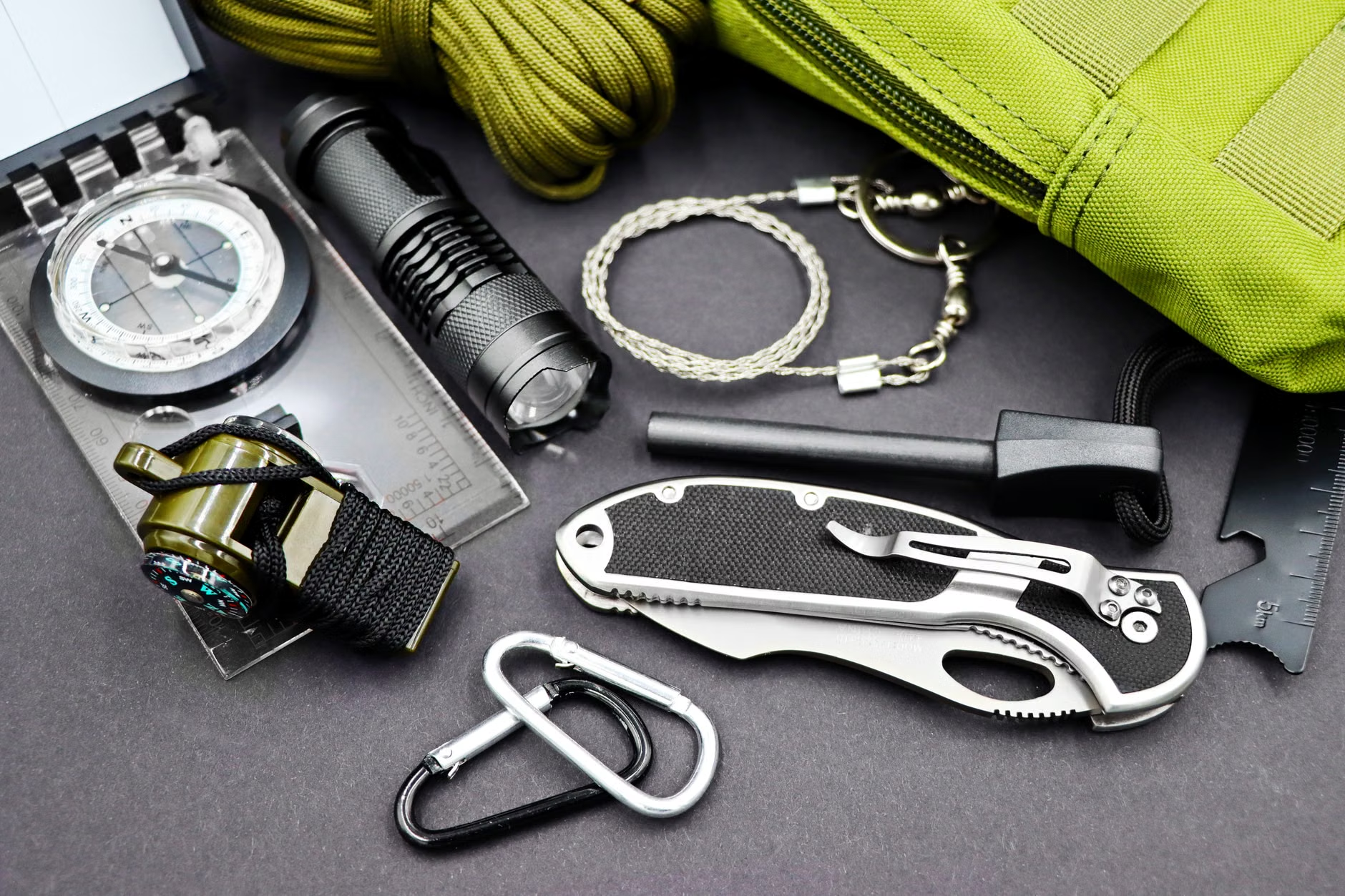
You want to be mobile. If you are carrying a 30-pound pack, you will be tired, and you will be grumpy. Your gear should support the child, not just the hike. Use the following table to prioritize your pack weight.
| Item Category | The “Must-Have” | The “Leave at Home” |
|---|---|---|
| Hydration | Individual water bottles for kids | Heavy multi-liter water bladders |
| Nutrition | High-calorie “treat” snacks | Full meal prep containers |
| Safety | Mini first-aid kit, whistle | Heavy survival gear/knives |
The “treat” snacks are non-negotiable. Save them for the hardest parts of the trail—the uphill sections or the last half-mile back to the car. This provides a positive reinforcement loop for the physical effort.
Common Pitfalls and How to Pivot
Even with perfect planning, things go wrong. Weather changes, kids get tired, or the “fun” trail turns out to be overgrown and muddy. In your 30s and 40s, you might feel the urge to “push through” because you’ve already driven an hour to get there. Resist this.
The “Bail-Out” Rule
Establish a bail-out rule before you leave the house. Tell your partner: “If we hit the halfway point and the mood is sour, we turn around.” This removes the pressure to finish the loop. If you turn around, you haven’t failed; you have successfully avoided a meltdown and kept the experience associated with “fun” rather than “chore.”
Dealing with the “I’m Tired” Wall
When a child says they are tired, they are often just bored or hungry. Instead of picking them up (which ends the hike for you and starts a heavy carry for your back), change the mode of movement. Switch from “hiking” to “animal walking.” Can we walk like a bear for 10 steps? Can we hop like a bunny? This usually distracts them from the fatigue and gets them another 100 meters down the trail.
The Role of Technology: Use It, Don’t Let It Use You
While the goal is to disconnect, technology is a powerful tool for engagement. Use apps like Seek by iNaturalist (available globally) to identify plants and insects. It turns a boring walk into a scavenger hunt. Instead of asking “Are we there yet?”, your child will be asking, “What is this leaf?”
However, keep the phone in your pocket. If you are constantly checking your GPS or taking photos for social media, you are signaling to your child that the device is more interesting than the woods. Set a rule: Phones are for identification and emergency photos only. Everything else stays in the bag.

Building Resilience Through Slow Exploration
Why bother with all this effort for a 0.5-mile walk? Because the benefits for a child’s development are significant. Research in environmental psychology consistently shows that unstructured time in nature reduces cortisol levels in children. For parents, it’s a form of “active recovery.” You aren’t sitting on the couch, but you are engaging in a low-intensity activity that allows your mind to reset from the high-stress demands of professional and domestic life.
The hidden benefit is the development of “nature literacy.” By moving slowly, children learn to read the terrain. They learn which rocks are slippery, how to balance on uneven ground, and why we don’t pick certain flowers. These are not just hiking skills; they are life skills. They teach risk assessment and environmental stewardship in a way that no classroom can.
If you find that your child is consistently struggling with hiking, don’t blame the child. Look at the trail. Is it a “highway” trail—wide, paved, and monotonous? Children prefer “feature-rich” trails: trails with streams, rocks to climb, caves, or dense forests. The terrain itself should provide the motivation. If the trail is boring, the child will be bored. Always prioritize trails with high “play value” over trails with high “scenic value.”
Practical Next Steps for Your Family
To start this weekend, follow these three steps:
- Audit your local area: Don’t look for “great hikes.” Look for “nature parks” or “interpretive trails” within a 20-minute drive. The closer the start, the less stress you carry into the hike.
- The “One-Item” Rule: Let your child bring one “adventure item”—a magnifying glass, a pair of kid-sized binoculars, or a small notebook for “nature journaling.” This gives them a sense of agency and purpose.
- Post-Hike Ritual: End every hike with a specific, simple reward that doesn’t involve screens. A hot chocolate at a local cafe or a specific fruit snack in the car. This cements the memory of the outing as a positive, rewarding event.
Most importantly, be the role model for the pace. If you are rushing, they will be anxious. If you are looking at the trees, they will look at the trees. The “Slow-Adventure” isn’t just about the kids; it’s about giving yourself permission to stop performing and start observing. In a world that demands constant speed, the most radical thing you can do is walk slowly with your family.
Frequently Asked Questions
Q: My child refuses to walk after 15 minutes. Should I force them to continue?
A: No. Pushing them to continue when they are genuinely exhausted or overwhelmed will only create a negative association with hiking. Use the “Bail-Out” rule. If you must continue, stop for a significant break—at least 20 minutes—where they can sit, eat, and reset. If they still refuse, it’s time to head back. It’s better to have a short, happy walk than a long, miserable one.
Q: How do I handle the “I’m bored” complaint on the trail?
A: Boredom is often the precursor to creativity. Don’t immediately jump to provide entertainment. Instead, offer a “mission.” Give them a task: “Find five different types of leaves,” or “Count how many blue things you can see.” This shifts their perspective from “I am walking” to “I am searching.”
Q: What if the weather turns bad? Is there a point where we should just stay home?
A: Unless there is an active severe weather warning (like lightning or high winds), bad weather is just another layer of the adventure. Rain gear is essential. A child in a high-quality raincoat and rubber boots will have more fun in a puddle than they would on a dry, sunny day. The key is to ensure they stay warm and dry. If they are warm, they won’t care about the rain.
For further resources on child-led outdoor play and trail selection, you can visit the Children & Nature Network, which provides evidence-based research on the importance of nature access for families.