The most effective mountain retreat isn’t the one with the most activities; it’s the one where you successfully do the least.
- Quiet-tourism is about subtraction: You aren’t paying for experiences; you are paying to remove the sensory overload of daily parenting and professional life.
- The 48-Hour Rule: It typically takes two full days for the nervous system to shift from “survival mode” to “rest mode.” Plan your retreat for at least three nights to actually reap the benefits.
- Digital boundaries are non-negotiable: A retreat without a strict “no-notification” policy is just work-from-home in a different zip code.
If you are in your 30s or 40s, your version of a “vacation” likely involves a complex logistical operation: packing for kids, managing flight times, finding the “best” local restaurants, and ensuring everyone is entertained. By the time you get home, you feel like you need a vacation from your vacation. This is where the quiet-tourism movement becomes a survival strategy rather than just a travel trend.
What Quiet-Tourism Actually Means for Overwhelmed Parents
Quiet-tourism isn’t a marketing buzzword for “boring.” It is a deliberate choice to prioritize low-stimulus environments. For a parent who spends the entire day navigating decision fatigue—what to cook, how to handle school drop-offs, or which Slack message to answer first—the mountain retreat offers a rare commodity: a lack of choices.
When you choose a mountain retreat under this philosophy, you are trading “doing” for “being.” In real life, this looks like choosing a cabin that is 30 minutes away from the nearest “attraction.” It means the goal of the trip is to finish one book, walk one trail, and sleep without an alarm. It sounds simple, but for many of us, the hardest part of this trip is managing the internal guilt of not “seeing the sights.”
The Physiology of Burnout Recovery
Why do we specifically look to mountains? Research into “Attention Restoration Theory” (ART) suggests that urban environments drain our cognitive resources because they require constant, directed attention—navigating traffic, avoiding crowds, and processing digital input. Nature, conversely, allows for “soft fascination.” Looking at a tree canopy or a mountain ridge doesn’t require active processing; it allows your brain to recover from the exhaustion of modern multitasking.
For someone in their 30s or 40s, this isn’t just about “feeling better.” It is about a physiological reset. When you remove the constant pinging of devices and the pressure to perform, your cortisol levels drop. However, this doesn’t happen the moment you check in. If you only go for 24 hours, you’ll spend 18 of them still thinking about your email inbox. This is why the duration of your stay is a critical decision factor.
Planning Your Low-Stimulus Retreat: A Decision Framework
The biggest mistake most people make is over-planning the itinerary. If you find yourself looking at “top 10 things to do” lists for your mountain destination, you are already doing it wrong. The objective is to design a space where you don’t *need* to do anything.
Use the following table to decide if a property is suitable for a true quiet-tourism experience:
| Feature | Quiet-Tourism Choice | Common Trap |
|---|---|---|
| Location | Remote, limited cell service | Near a “resort village” or tourist hub |
| Amenities | Full kitchen, wood stove/hearth | Concierge, daily housekeeping, noisy lobby |
| Connectivity | Wi-Fi optional/off-switch | High-speed fiber, smart-home features |
If you are traveling with family, the “quiet” aspect can become a challenge. The solution isn’t to force silence, but to reduce the friction of the environment. Choose a location where the outdoors is an extension of the living room. If the kids can run outside without you having to supervise them in a parking lot or a busy street, you have successfully achieved a low-stimulus environment for the whole family.
The Hidden Costs of “Doing Nothing”
People often underestimate the “withdrawal” phase of a quiet retreat. When you finally stop the noise, your brain often fills that silence with anxiety. You might feel restless or bored on the first afternoon. This is common. Do not mistake this for a sign that you should have gone somewhere with more activities.
Common Misconception: Boredom is a failure of the vacation.
The Reality: Boredom is the gateway to creativity and rest. If you are bored, your brain is finally beginning to process the backlog of stress it has been holding onto. Instead of reaching for your phone to kill the boredom, lean into it. Bring a physical book, a sketchbook, or simply sit on the porch. The “itch” to check your phone will pass after about 48 hours.
Another hidden factor is the “Logistics Tax.” If you are staying in a remote cabin, you are your own cook and cleaner. If you pack like you are going to a hotel, you will spend your retreat doing chores. To avoid this, pre-plan your meals. Use a grocery delivery service to drop off supplies at the start of your trip, or prepare frozen, pre-portioned meals that only require a single pot to heat. The goal is to spend less than 30 minutes a day on “housekeeping” tasks.
Step-by-Step Execution for a Successful Retreat
If you want to ensure your next mountain trip actually results in rest, follow this sequence:
- The 72-Hour Lead Time: Stop checking work emails three days before you leave. Set an “Out of Office” that clearly states you are unreachable. This prevents the “mental carry-over” where you are physically in the mountains but mentally in the office.
- The Single-Goal Rule: Pick one, and only one, thing you want to accomplish. It could be “walk to the creek,” “finish this novel,” or “take a nap every day.” If you have a list of five hikes, you are back to “achieving” rather than “retreating.”
- The Digital Quarantine: If you are struggling to stay off your phone, use a physical lock-box. Put your phone in it and leave it in your luggage. If you need it for emergencies, keep it in the car, not in your pocket.
- The Transition Back: Never travel back to your home on the same day you return to work. If you end your retreat on a Sunday, make sure Monday is a “buffer day” where you don’t have meetings. This prevents the immediate “re-entry shock” that ruins the benefits of the retreat.
This approach isn’t about being ascetic; it’s about being strategic with your limited energy. When you are in your 30s and 40s, your time is the most expensive resource you have. Don’t spend it managing the logistics of a “fun” vacation; spend it managing the recovery of your nervous system.
Beyond the Obvious: The Overlooked Variables
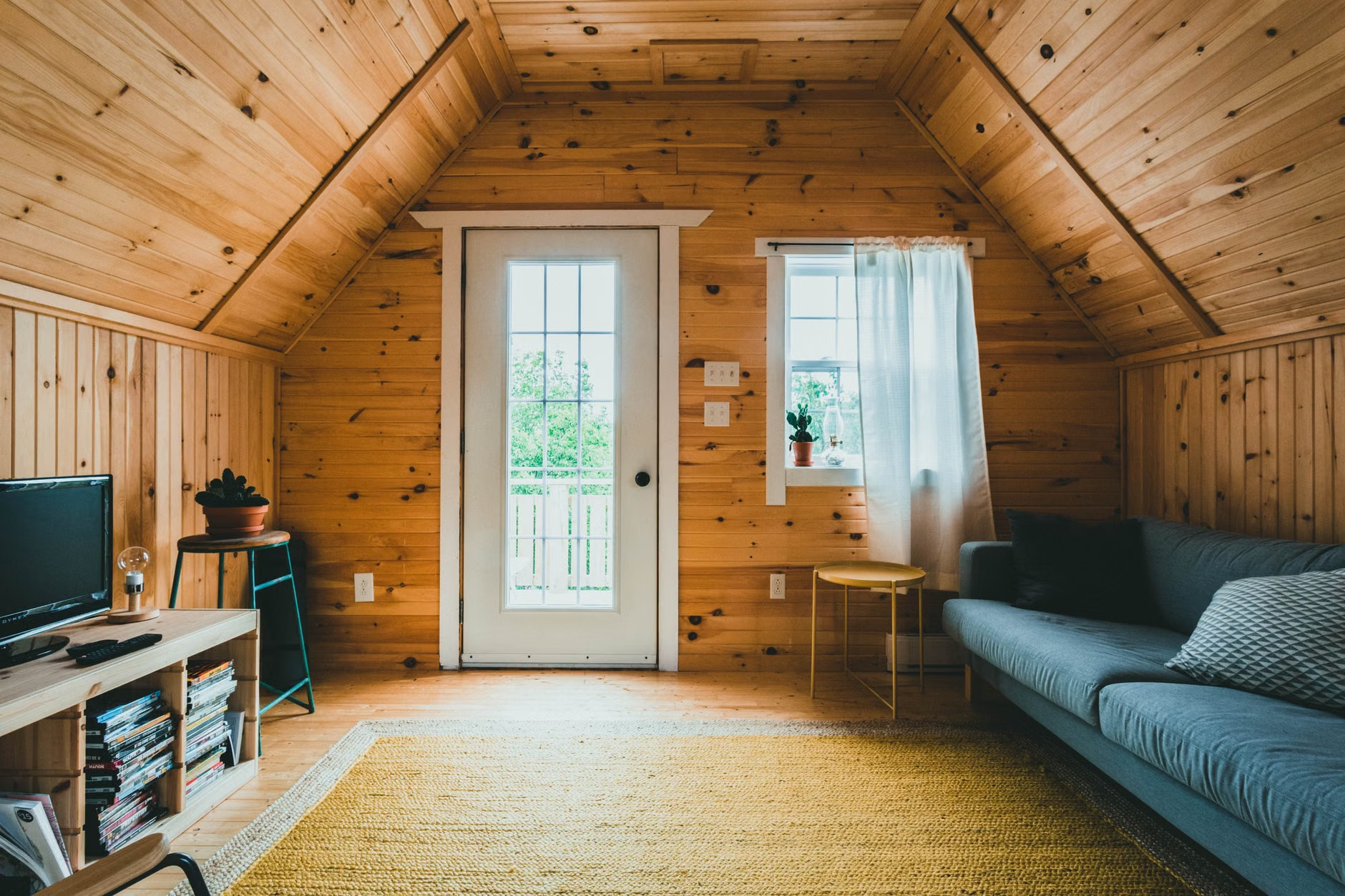
One variable that almost everyone misses is the lighting of your accommodation. In the city, we are used to harsh, artificial light. In a mountain retreat, if your cabin has poor natural lighting or is filled with flickering, cold-toned LED bulbs, it will prevent your body from entering a relaxed state. Look for photos of the interior—does it have large windows? Does it look like it uses warm, ambient lighting? This small detail significantly impacts how quickly you decompress.
Another overlooked factor is altitude. If you are heading to a higher altitude, remember that your body needs more hydration and more sleep. Don’t plan a high-intensity hike for the first morning. Treat the first 24 hours as an acclimatization period. If you feel lethargic, that’s not a failure; that’s your body working to adjust to the environment. Honor that by sleeping more.
Finally, consider the soundscape. Many mountain cabins are advertised as “secluded,” but they may be near logging roads or popular flight paths. Check satellite maps on Google Maps before you book. Look for the proximity to main roads. If you see a large, gray line nearby, that’s a highway, not a quiet forest trail. A 10-minute drive further into the woods can make the difference between silence and the constant hum of distant tires.
Conclusion: The Priority is You
The quiet-tourism movement is a pushback against the “performance” of travel. You don’t need a photo of a mountaintop to prove you rested. You need the actual rest. For parents, the most radical thing you can do is to stop prioritizing the “best experience” for your kids or your partner and instead prioritize the “best environment” for your own nervous system.
Start by booking that three-night stay. Choose the remote cabin with the view. Leave the itinerary at home. And when you feel that first urge to check your email or “do something,” remind yourself: you are exactly where you need to be.
Frequently Asked Questions
1. Is quiet-tourism practical if I am traveling with young children?
Yes, but it requires a shift in mindset. Instead of “entertainment,” focus on “immersion.” Choose a location with a safe outdoor space where they can explore nature. If they are occupied by a forest, a creek, or a field, you are free to sit nearby and rest. The goal is to avoid the “parenting-as-logistics” trap.
2. How do I handle the anxiety of being disconnected from work for several days?
The anxiety is a symptom of the very burnout you are trying to cure. The most effective way to handle it is to have a “point person” back home or at work who has permission to contact you only in the event of a genuine emergency. Knowing there is a system in place allows your brain to let go of the “what if” scenarios.
3. What if I get bored or feel restless during the trip?
Restlessness is a sign that your body is finally stopping its “fight or flight” response. It is a withdrawal symptom from the dopamine spikes of your daily life. Do not fight it with more activity. Instead, engage in a low-effort, grounding activity like walking, stretching, or reading. The feeling will pass, usually within 48 hours, leaving you with a deeper sense of calm.
For more information on the psychological benefits of nature and low-stimulus environments, you can consult research from the American Psychological Association on the benefits of nature for mental health.