- Digital nomad visas are primarily residency permits, not tax exemptions; you likely remain a tax resident in your home country unless you formally relocate.
- For families, the “cost of entry” isn’t just the visa fee—it’s the mandatory private health insurance and proof of income, which often requires 2x to 4x the local average salary.
- Schooling is the biggest logistical hurdle; many nomad-friendly countries require proof of enrollment in a local or international school before a dependent visa is granted.
The dream of working from a balcony in Lisbon or a quiet cafe in Bali while your children play nearby is no longer just for the single, backpack-toting freelancer. For those of us in our 30s and 40s, the “work-from-anywhere” trend has shifted from a rebellious career move to a calculated lifestyle strategy. However, the reality of moving a family across borders involves more than just a laptop and a fast Wi-Fi connection.
Governments have caught on to this shift. Over 50 countries now offer specialized “Digital Nomad Visas” (DNVs) or temporary residency permits for remote workers. But these aren’t simple tourist visas. They are legal frameworks that come with specific, often stringent, requirements. If you are considering this move, you need to look past the Instagram-worthy photos and focus on the cold, hard logistical requirements of the host country.

Why “Work-From-Anywhere” Visas Are Not One-Size-Fits-All
When you see a country advertising a “Digital Nomad Visa,” the first thing to clarify is whether it is a residency permit or merely a tax status. Most of these programs provide a temporary residency permit that allows you to live in the country for 6 to 24 months. Crucially, these visas generally do not grant you the right to work for a local company. You must continue to be employed by an entity outside of that country or be self-employed with clients abroad.
For parents, the most significant “hidden” factor is the dependency clause. Not all DNVs automatically include spouses or children. For instance, some countries require you to prove a significantly higher income if you are bringing dependents. If your income is $3,000 USD per month, you might qualify for a solo visa in Country A, but you might need $5,000 or $6,000 to bring your partner and child. Always check the “family reunification” policy of the specific visa program before making plans.
The Reality of Tax Residency
Many people mistakenly believe that holding a nomad visa exempts them from taxes in their home country or the host country. This is almost never the case. If you spend more than 183 days in a country, you often become a tax resident by default. You may end up in a situation where you owe taxes in both your home country and your new host country. While some DNV programs offer tax incentives, they are the exception, not the rule. Before you pack your bags, consult a cross-border tax accountant who understands the specific double-taxation treaties between your home country and your target destination.
| Requirement Type | What it Means for Parents | Common Pitfall |
|---|---|---|
| Income Threshold | Must prove consistent, high income | Assuming freelance income is as stable as a W-2/full-time salary. |
| Health Insurance | Requires comprehensive international coverage | Using basic travel insurance instead of full expat health plans. |
| Education | Proof of child enrollment required | Assuming you can “homeschool” without local legal registration. |
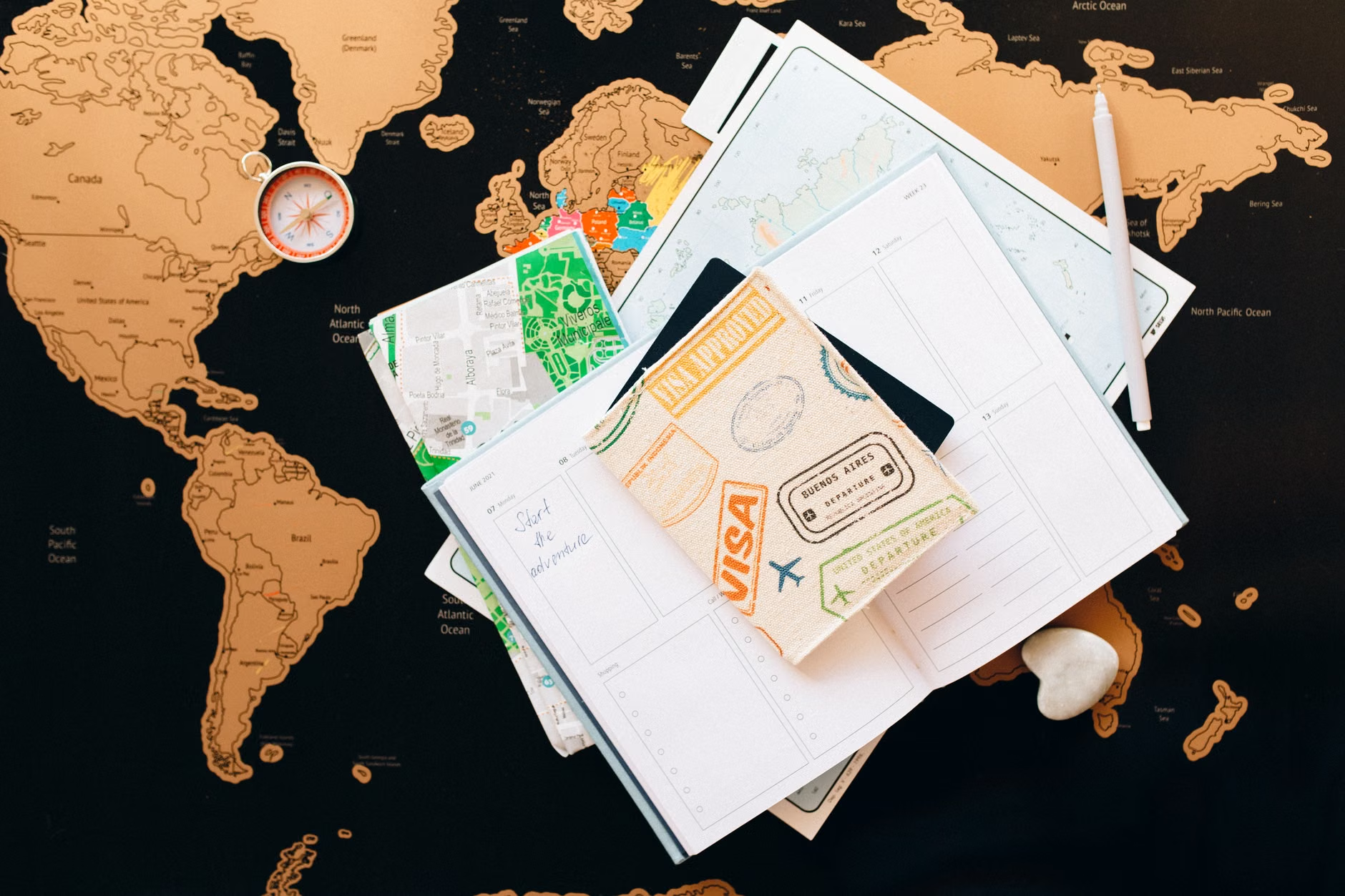
Moving a family is a logistical marathon. Unlike moving to another city in your own country, moving to a new country requires navigating foreign bureaucracies, school systems, and healthcare providers. The most successful families we see are those who treat the relocation like a business project with a six-month lead time.
First, address the schooling issue. In many European countries, if your child is of mandatory school age, you are legally required to enroll them in a school. This means you need to research the local international school scene—which can be expensive—or the public school system, which may require a working knowledge of the local language. Do not assume you can simply “do your own thing” regarding your child’s education while on a residency permit.
Second, prioritize healthcare. Your home country’s public health plan will not cover you abroad. You will need to purchase private international health insurance. This is often a mandatory document for the visa application itself. When selecting a plan, look for one that covers pediatric care and emergency evacuation. Do not opt for the cheapest “travel” insurance; it is designed for short-term trips and often excludes chronic conditions or long-term care.
Choosing the Right Destination for Your Family Stage
Not every “nomad-friendly” country is family-friendly. When evaluating a destination, look beyond the coworking spaces. Ask yourself: Is the city walkable with a stroller? Is there a community of other expat families? What is the local air quality and safety profile?
If you have a toddler, you might prioritize a location with high-quality, affordable childcare. If you have older children, you might prioritize access to English-language sports clubs or tutoring centers. Countries like Portugal, Spain, and Costa Rica are popular for a reason—they have well-established expat communities, relatively safe environments, and a culture that values family time. However, these factors make them more expensive than some of the newer, “trendier” nomad hubs in Southeast Asia or Eastern Europe.

Step-by-Step Action Plan for the Remote-Working Parent
If you are serious about pursuing a digital nomad visa, follow this structured path to avoid common mistakes:
- Verify the Legalities: Go to the official embassy website of your target country. Do not rely on third-party blogs, as visa rules change quarterly. Look for the specific “Digital Nomad” or “Remote Worker” visa page.
- Audit Your Income: Most countries require bank statements for the last 6-12 months. Ensure your income is consistent and clearly documented. If you are a freelancer, you may need a letter from your primary client confirming your contract and the ability to work remotely.
- Secure Your Documents: You will likely need apostilled (internationally certified) birth certificates for your children, marriage certificates, and clean criminal background checks. These can take months to process in some countries, so start early.
- Budget for the “Setup Phase”: You need a buffer. In addition to the visa fee, you will have application costs, translation fees for documents, upfront deposits for long-term rentals, and school enrollment fees. A good rule of thumb is to have at least six months of living expenses saved in a liquid account.
- Test Run: Before committing to a year-long visa, take a one-month “workation” in the target city. Rent an Airbnb, try to work your normal hours, and see how your child adjusts to the time zone and environment. This is the ultimate stress test for your plan.
Unexpected Trade-offs and How to Manage Them
The most significant, overlooked variable in the nomad lifestyle is the “social void.” When you move to a new country, you lose your built-in support network—no grandparents to watch the kids for a few hours, no familiar pediatrician, and no friends who know your routine. You will have to build a new community from scratch, which is exhausting while you are also trying to maintain your career performance.
Also, consider the time zone impact. If your job is based in New York and you move to Portugal, you are five hours ahead. If you move to Southeast Asia, you are 12 hours ahead. Working late at night to sync with your home office can be devastating for your family routine. If your role allows for asynchronous work, prioritize that. If it doesn’t, ensure your partner is on board with the shift in your availability.
Finally, remember that the “nomad” label is just a temporary state. Most of these visas have a maximum duration. Have a “Return to Reality” plan. Will you keep your home in your home country? Will you rent it out? What happens to your child’s schooling when you return? Planning your exit is just as important as planning your entry.
The digital nomad visa is a tool, not a guarantee of happiness. It offers freedom and new experiences, but it demands high levels of organization and financial responsibility. If you approach it as a professional relocation for your family rather than a permanent vacation, you stand a much better chance of making it a success.
Frequently Asked Questions
Q: Can I apply for a digital nomad visa while already in the country on a tourist visa?
A: It depends on the specific country. Some countries allow “in-country” conversion, while others strictly require you to apply from your home country or a consulate in your country of residence. Always verify this on the official government portal before you leave.
Q: How do I handle the “proof of address” requirement for school enrollment if I am only renting short-term?
A: This is a major hurdle. Many schools require a long-term lease (usually 6-12 months) to prove residency. You may need to secure a long-term rental contract before you arrive, or reach out to international schools to see if they accept temporary housing contracts for the first semester.
Q: Does my remote employer need to approve my move?
A: Absolutely. Even if you are a contractor, moving to a new country creates a “permanent establishment” risk for your employer. They may have tax or labor law obligations in the country you move to. Always clear this with your HR or legal department to avoid having your contract terminated.
For further research on specific country requirements, refer to official government immigration portals such as:
- Portugal’s Ministry of Foreign Affairs (D7/Digital Nomad Visas)
- Spain’s Ministry of Foreign Affairs (Digital Nomad Visa)
- Costa Rica’s General Directorate of Migration and Foreigners
Note: Immigration laws are subject to change without notice. Always consult with a qualified immigration attorney in your destination country before making irreversible life decisions.