- Skill-based over labor-based: Real impact comes from supporting local experts, not doing manual labor that local community members could (and should) be paid to do themselves.
- The “Do No Harm” Audit: Always research if your presence displaces local workers or creates a dependency loop that disappears once your family leaves.
- Long-term commitment matters: Opt for organizations that prioritize continuous funding and local project ownership rather than short-term “feel-good” volunteer stints.
If you have ever scrolled through social media and seen a travel influencer posing with children in an orphanage or painting a wall in a rural school, you have seen the traditional face of “voluntourism.” It often looks picturesque, but for those of us in our 30s and 40s—who are balancing the desire to raise globally conscious kids with the reality of limited vacation time—it’s worth asking: is this actually helpful? The harsh reality is that much of what we call “voluntourism” does more for the traveler’s ego than for the local community. To move toward “Voluntourism 2.0,” we need to shift our focus from being the “savior” to being a respectful, temporary partner in local conservation.
Moving Beyond the “Savior Complex”: What Real Conservation Looks Like
The biggest misconception in family travel is that your presence in a developing region is inherently beneficial. In reality, unless you are a trained scientist, engineer, or specialized educator, your labor is often less effective than hiring a local person to do the same task. When we bring our families to participate in short-term projects, we must ask ourselves: are we taking a job away from a local resident who needs the income? Are we creating a demand for services (like childcare or construction) that the local economy isn’t actually built to sustain?
Ethical engagement starts with decentering your family. Instead of looking for a project where you are the “doer,” look for projects where you are the “student” or the “supporter.” Real conservation happens through long-term infrastructure: funding a local nursery, supporting a community-managed marine protected area, or paying for the training of local rangers. When you visit, your role should be to observe, learn, and contribute financially to the systems that the local community has already established.
The “Local-First” Decision Matrix
To determine if a volunteer program is worth your family’s time and money, use this decision-making framework before booking anything:
| Criteria | Red Flag | Green Flag |
|---|---|---|
| Project Leadership | Run by an international NGO with few local staff in management. | Led by local community leaders or indigenous organizations. |
| Goal Alignment | Focuses on “quick wins” like painting or light construction. | Focuses on long-term data collection, reforestation, or education. |
| Financial Flow | High program fees go to administrative costs in your home country. | Direct contribution to local equipment, wages, or land protection. |
If the program you are looking at falls into the “Red Flag” column, it doesn’t mean the organization is evil, but it does mean it isn’t designed for genuine conservation impact. It is designed for tourist experience. If you want a tourist experience, that’s fine—just don’t call it “volunteering.”

Why “Micro-Contributions” Beat “Mega-Projects”
In our 30s and 40s, we often feel the pressure to make our time count. We want our kids to have “life-changing” experiences. However, the most effective conservation work is often boring, slow, and unglamorous. It is tracking turtle nests at 3:00 AM, weeding invasive species in the heat, or sitting through long community meetings. For a family, this can be a hard sell, but it is where the real value lies.
Consider the difference between a “one-day build” and “long-term engagement.” A one-day build might result in a playground that falls apart in two years because no one was trained to maintain it. A long-term engagement might involve your family visiting the same region over several years, supporting a local school’s environmental curriculum. The latter creates a relationship; the former creates a photo opportunity.
The Hidden Cost of Turnover: Many conservation projects suffer from “volunteer fatigue.” When a constant stream of untrained, well-meaning tourists arrives, local staff spend more time managing the volunteers than doing the actual conservation work. If you decide to participate, ensure the organization has a structured program where your presence is an asset, not a distraction. Ask them: “How do you manage the training of short-term volunteers to ensure the work is consistent?” If they don’t have a clear answer, keep looking.
Practical Steps to Ethical Engagement
So, you’ve decided you want to incorporate conservation into your next trip. Where do you start? The internet is flooded with “volunteer vacation” agencies that charge thousands of dollars to place you in projects. Many of these are essentially travel agencies with a marketing veneer. Instead, try this bottom-up approach.
1. Identify the Scientific or Ecological Need
Don’t look for “volunteering” first. Look for “conservation” first. If you are going to Costa Rica, search for “sea turtle research programs” or “reforestation projects” rather than “volunteer vacations in Costa Rica.” Look for peer-reviewed research or local university partnerships. If a project is supported by local academic institutions, it is far more likely to be legitimate.
2. The “Who Pays Whom” Rule
In a truly ethical setup, the local community should be the primary beneficiary of your financial contribution. If you are paying a massive fee to a company based in London or New York, ask for a breakdown of where that money goes. A transparent organization will be able to tell you exactly what percentage goes to the local project, the local staff, and the administration. If they can’t, they aren’t transparent enough for your support.
3. Manage Your Kids’ Expectations
This is the most important part for parents. Real conservation work is rarely a movie montage. It’s often repetitive, sweaty, and sometimes disappointing—maybe you don’t see the turtles hatch, or the seedlings die due to weather. Use this as a teaching moment. Explain to your children that conservation is about showing up, not about instant gratification. That lesson is worth more than any “feel-good” experience.
Common Pitfalls: Avoiding the “Tourist Trap” Conservation
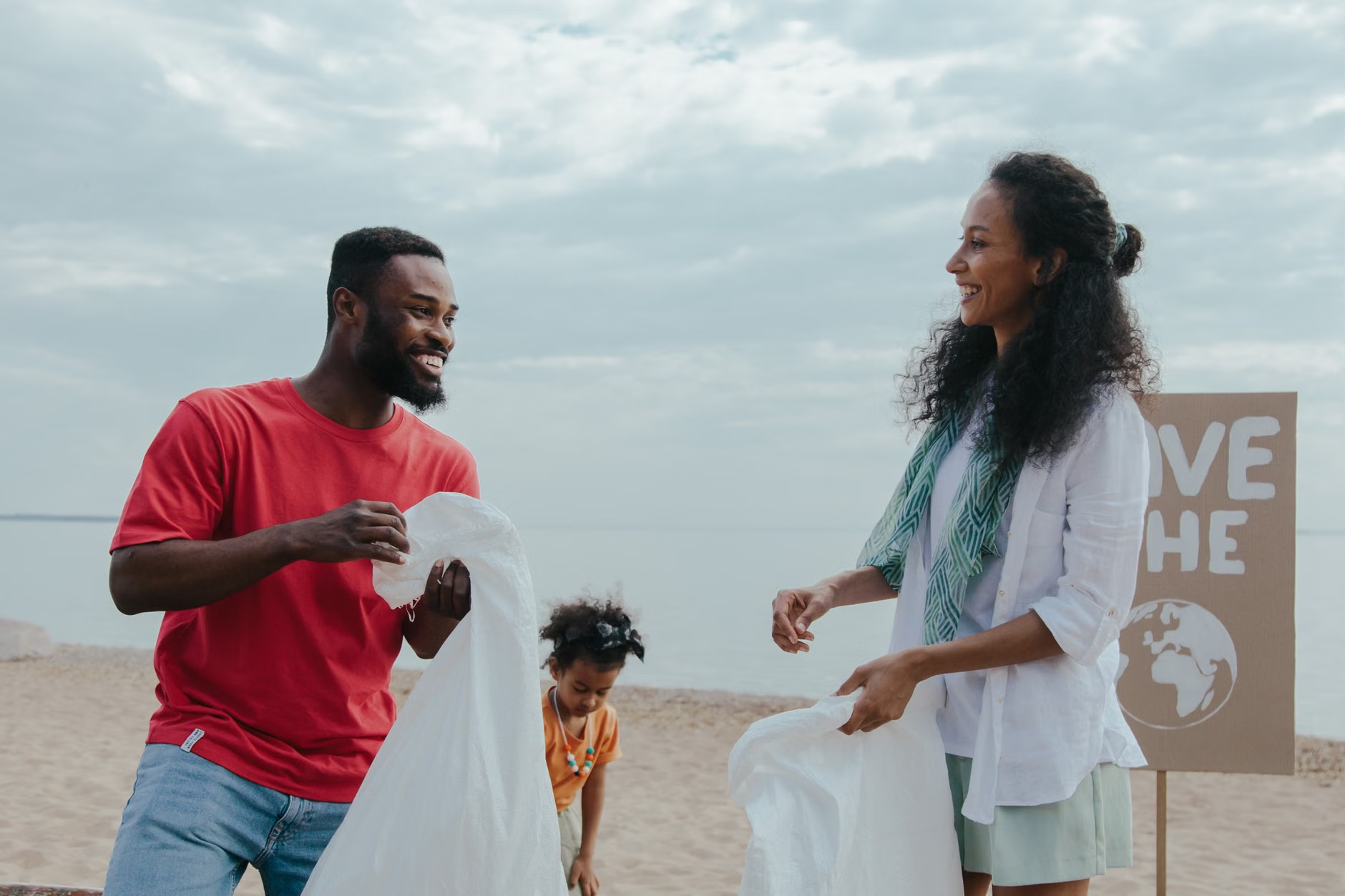
There are several common mistakes that even the best-intentioned families make. Avoiding these will immediately put you ahead of 90% of other travelers.
- The “Orphanage” Trap: Never, under any circumstances, participate in “volunteering” at an orphanage. Research by groups like Better Care Network has shown that orphanage tourism fuels the separation of children from their families. It is a predatory industry, not a charitable one.
- The “Wildlife Interaction” Trap: Avoid any project that allows you to touch, hold, or take selfies with wild animals. If you are “volunteering” at a sanctuary that lets tourists bottle-feed tigers or walk with lions, you are supporting an entertainment business, not a conservation effort. Ethical sanctuaries are “hands-off.”
- The “Savior” Language: Check your language. When you talk to your kids about the trip, avoid saying “we are going to save the forest” or “we are going to help the poor people.” Instead, say “we are going to learn how they protect the forest” or “we are going to support the work they are already doing.”
The shift in language is small, but it changes the entire power dynamic. It moves you from a position of superiority to a position of humility. As parents, we want to teach our children that the world is not a playground for us to fix, but a complex, beautiful place that we are privileged to visit.
The Role of Financial Transparency
If you have the budget, the most effective way to help is often not through your labor, but through your resources. Many people feel guilty about this, thinking that if they don’t “work,” they aren’t helping. This is a misunderstanding of how NGOs operate. A $500 donation to a local organization that has the staff and the expertise to execute a project is often infinitely more valuable than a $500 trip where you and your family require food, housing, and supervision.
If you choose to donate, verify the organization’s registration. In the US, this means checking Charity Navigator or GuideStar. Internationally, look for local equivalents. If the organization is legitimate, they will be registered as a non-profit in their home country and should have clear reporting on their activities. If you can’t find a paper trail, don’t send money.
Designing Your Family’s “Impact Itinerary”
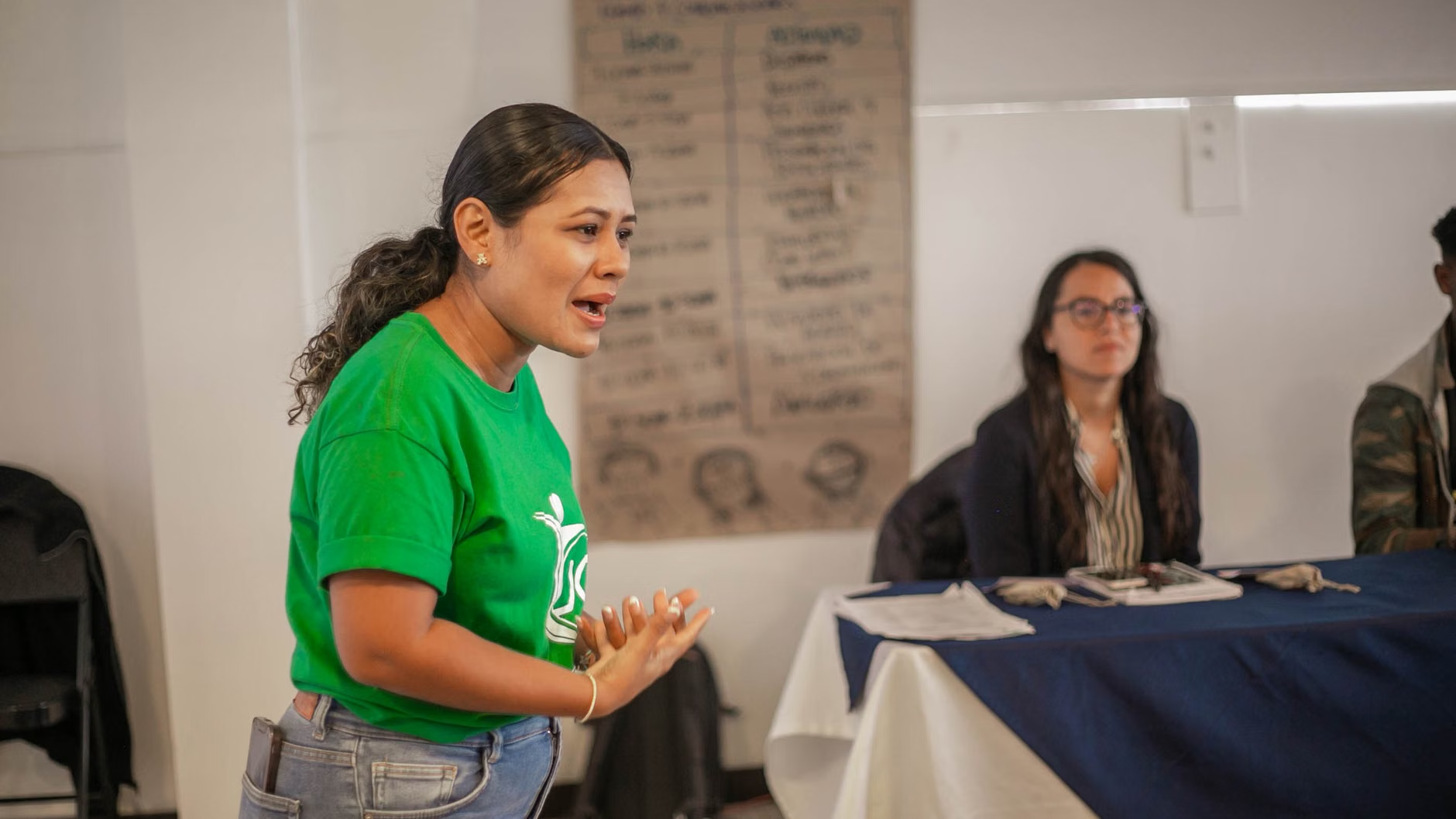
If you are ready to plan, here is a step-by-step approach to building an itinerary that balances family time with genuine engagement.
- Choose a Region with a Known Conservation Need: Focus on areas with high biodiversity or clear environmental challenges—like coastal areas facing plastic pollution or regions with endangered species.
- Contact Local Experts Directly: Before booking a tour, find the website of a local research station or NGO. Reach out to them. Tell them you are a family, you will be in the area, and you want to know if there is a way to support their work through a donation or a guided educational tour.
- Incorporate “Educational Tourism”: Many conservation organizations offer guided tours that fund their research. This is a perfect middle ground. You pay for the tour, you get a world-class education from a scientist, and the money goes directly to the project.
- Allocate “Impact Days”: Don’t make the entire trip about work. Limit your conservation engagement to one or two days. This prevents burnout and keeps the experience special for your children.
- The Post-Trip Follow-up: The most important step is what happens when you get home. Keep in touch with the organization. Subscribe to their newsletter. If you liked the work they do, make a recurring donation. This is how you transition from a “tourist” to a “partner.”
The Long-Term View: What We Actually Teach Our Children
When we take our children on these trips, we are essentially running a masterclass in global citizenship. If we do it right, we aren’t teaching them that they are “better” or “more capable” than the people they visit. We are teaching them that conservation is a collaborative, global effort. We are teaching them that every place has its own challenges and its own local heroes who are already working to solve them.
We are also teaching them to be critical thinkers. When they see a “wildlife sanctuary” that looks more like a zoo, they will learn to ask questions. When they see a project that doesn’t seem to have local support, they will learn to recognize the signs of performative charity. These skills—observation, questioning, and humility—are the most valuable things we can give them.
Ultimately, the goal of Voluntourism 2.0 is to reach a point where the local community doesn’t need your family to visit to survive, but where they value your family’s visit because you are an informed, respectful ally. That is the gold standard of travel.
Frequently Asked Questions
1. Is it ever okay for my kids to participate in manual labor projects?
Only if the project has been vetted to ensure it is not taking work away from local laborers. For example, if a community is building a school and they have requested volunteer help to haul materials because they lack the budget for local transport, that is a specific, defined need. However, if you are painting a wall that a local painter could be hired to do, you are likely causing more harm than good. Always ask the project coordinator: “Is this work that a local person could be hired for?”
2. How do I know if an NGO is legitimate?
Look for three things: 1) A clear, public history of their work. 2) A leadership team that includes local residents in decision-making roles. 3) Financial transparency regarding their income and expenditures. If they hide their finances or if their “about us” page is mostly photos of tourists rather than their conservation projects, be very wary.
3. What if I can’t afford a large donation?
You don’t need to be a major donor to be an ethical traveler. Your value can also come from your expertise. If you are a teacher, a doctor, a writer, or a photographer, offer your professional skills to the organization. Sometimes, a well-written grant proposal or a set of professional photos for their website is worth more to a small NGO than a one-time cash donation. Contact them and ask: “I have these skills; could they be of any use to your team?”
Recommended Resources for Further Research:
- Better Care Network (Information on the dangers of orphanage tourism)
- Charity Navigator (For verifying the financial health of international non-profits)
- International Union for Conservation of Nature (For understanding global conservation priorities)
Travel is a powerful tool for perspective, but it is not a tool for fixing the world. Treat your next family trip as an opportunity to learn, to support, and to listen. The most impactful thing you can do is leave the “savior” mindset at home and show up as a curious, humble guest. That is the future of travel.