Choosing a car-free Alpine resort is the single most effective “parenting hack” for a mountain vacation, as it eliminates the constant safety anxiety of traffic and replaces logistical stress with highly efficient public transport systems.
Key Takeaways:
- Safety & Freedom: Car-free villages allow children to walk, play, and sled on the streets without the danger of through-traffic, significantly lowering parental stress.
- Logistical Ease: Switzerland’s SBB luggage services can transport your bags from your home or airport directly to your hotel, making “train travel with kids” surprisingly manageable.
- Cost Efficiency: While the Swiss Travel Pass seems expensive upfront, it often costs less than car rentals plus parking fees in satellite lots (like Täsch or Lauterbrunnen), especially when kids under 16 travel free.
Have you ever spent a vacation constantly shouting “Watch out for the car!” while your toddler tries to explore a charming European alleyway? We’ve all been there. In the Alps, where streets are often narrow and sidewalks are more of a suggestion than a rule, the presence of cars can turn a relaxing getaway into a high-stakes game of Frogger. This is why the “Alpine-Escape”—specifically targeting car-free villages—has become the gold standard for parents in their 30s and 40s who want the scenery without the safety-induced hypertension.
The concept of a car-free village isn’t just about environmentalism; it’s about a fundamental shift in how you experience a town. Imagine stepping out of your hotel and being able to walk in the middle of the street. Imagine your kids being able to run ahead to the bakery without you needing to grip their hands until your knuckles turn white. It sounds like a fairy tale, but in places like Zermatt, Wengen, and Avoriaz, it’s the daily reality. However, getting there requires a bit of a mental shift regarding logistics, packing, and how you view “convenience.”
The Zermatt Experience: Where Electric Taxis Rule the Road
Zermatt is the poster child for car-free living. You cannot drive to Zermatt. If you arrive by car, you must park it in a massive garage in the valley town of Täsch and take a 12-minute shuttle train into the village. This might seem like a hassle, but it’s actually the moment your vacation truly begins. Once you step off that train at the Zermatt station, the air is noticeably cleaner, and the only sounds are the hum of electric motors and the clip-clop of occasional horse carriages.
What it looks like in real life: In Zermatt, “car-free” doesn’t mean “vehicle-free.” The town uses small, boxy electric taxis and buses. They are quiet, but they are still there. The “decision rule” for parents here is to book accommodation either within a 5-minute walk of the station or ensure your hotel provides its own electric shuttle. Walking across town with two kids and ski gear is still a workout, car or no car.
For parents, the Wolli Park at Sunnegga is the ultimate destination. You take an underground funicular (the Sunnegga Express) which feels like a space-age subway, and in minutes you are at a sunny plateau designed specifically for kids. Because the town below is car-free, the transition from the village to the slopes feels seamless. You aren’t navigating busy parking lots or crossing major roads with skis over your shoulder.
The Logistics of the Täsch-Zermatt Shuttle
If you are driving from elsewhere in Europe, the Matterhorn Terminal Täsch is your final stop. It offers over 2,000 parking spaces. Pro tip: Use the luggage trolleys at the parking garage; they are designed to be rolled directly onto the shuttle train. Don’t try to carry everything. The shuttle runs every 20 minutes, so there is never a need to rush—a small but vital detail for parents dealing with mid-travel meltdowns.
Wengen and Mürren: The Perched Villages of the Jungfrau Region
While Zermatt is at the end of a valley, Wengen and Mürren are perched on high mountain shelves overlooking the Lauterbrunnen Valley. These villages are accessible only by cogwheel train (Wengen) or a combination of cable car and narrow-gauge rail (Mürren). This isolation creates a literal barrier between you and the “real world” of traffic and noise.
Wengen vs. Mürren: Which is better for your family?
| Feature | Wengen | Mürren |
|---|---|---|
| Access | Cogwheel train from Lauterbrunnen. | Cable car + small train. |
| Terrain | Relatively flat and sunny. | Very steep with dramatic cliffs. |
| Vibe | Grand Victorian hotels, family-centric. | Rustic, quiet, adventurous. |
| Best For | Families with strollers or young walkers. | Families with older kids/teens who hike. |
Why it matters: In Wengen, the village center is a natural gathering spot. During winter, there’s a nursery slope right in the middle of town. You can sit at a café with a coffee and literally watch your child’s ski lesson from 50 yards away. In a car-access resort, that nursery slope would likely be tucked away behind a parking structure or require a bus ride to reach.
The hidden cost of these villages is the “mountain tax” on groceries. Because everything must be brought up by train, the local Coop or Volg supermarket will be 10-15% more expensive than those in the valley. What the reader should do: If you are staying in a self-catering apartment for a week, buy your heavy staples (milk, pasta, wine) in Interlaken or Lauterbrunnen before heading up the mountain. Your wallet will thank you.
Saas-Fee: The Glacial Pearl and Its Electric Pulse
Saas-Fee is often overshadowed by Zermatt, but for families, it’s arguably superior. It’s surrounded by thirteen 4,000-meter peaks, giving it a “snow globe” feel. Like Zermatt, you park at the entrance of the village. However, Saas-Fee is more compact. Most things are within a 10-minute walk, making the “car-free” aspect feel even more impactful.
Common Mistake: Thinking car-free means you don’t need to worry about where your hotel is. Saas-Fee is built on a bit of a slope. If you stay at the “top” of the village (near the entrance), you’ll have a long, uphill walk home after a day of skiing at the “bottom” (where the lifts are). The decision rule: Look for “ski-in/ski-out” or “south-end” accommodations to minimize the “uphill trek with tired kids” scenario.
One unique feature of Saas-Fee is the Metro Alpin, the world’s highest underground funicular. It takes you to 3,500 meters. For a parent, this is a godsend because it’s weather-proof. Even on a windy day, you can get the kids up to the glacier safely and comfortably to see the ice pavilion or eat at the revolving restaurant.
Avoriaz: France’s Purpose-Built Car-Free Wonderland
Unlike the Swiss villages which evolved from farming hamlets, Avoriaz in France was designed from the ground up in the 1960s to be car-free. The architecture is “mimetic,” designed to look like the surrounding cliffs. Here, the streets are not paved in the winter; they are groomed snow tracks.
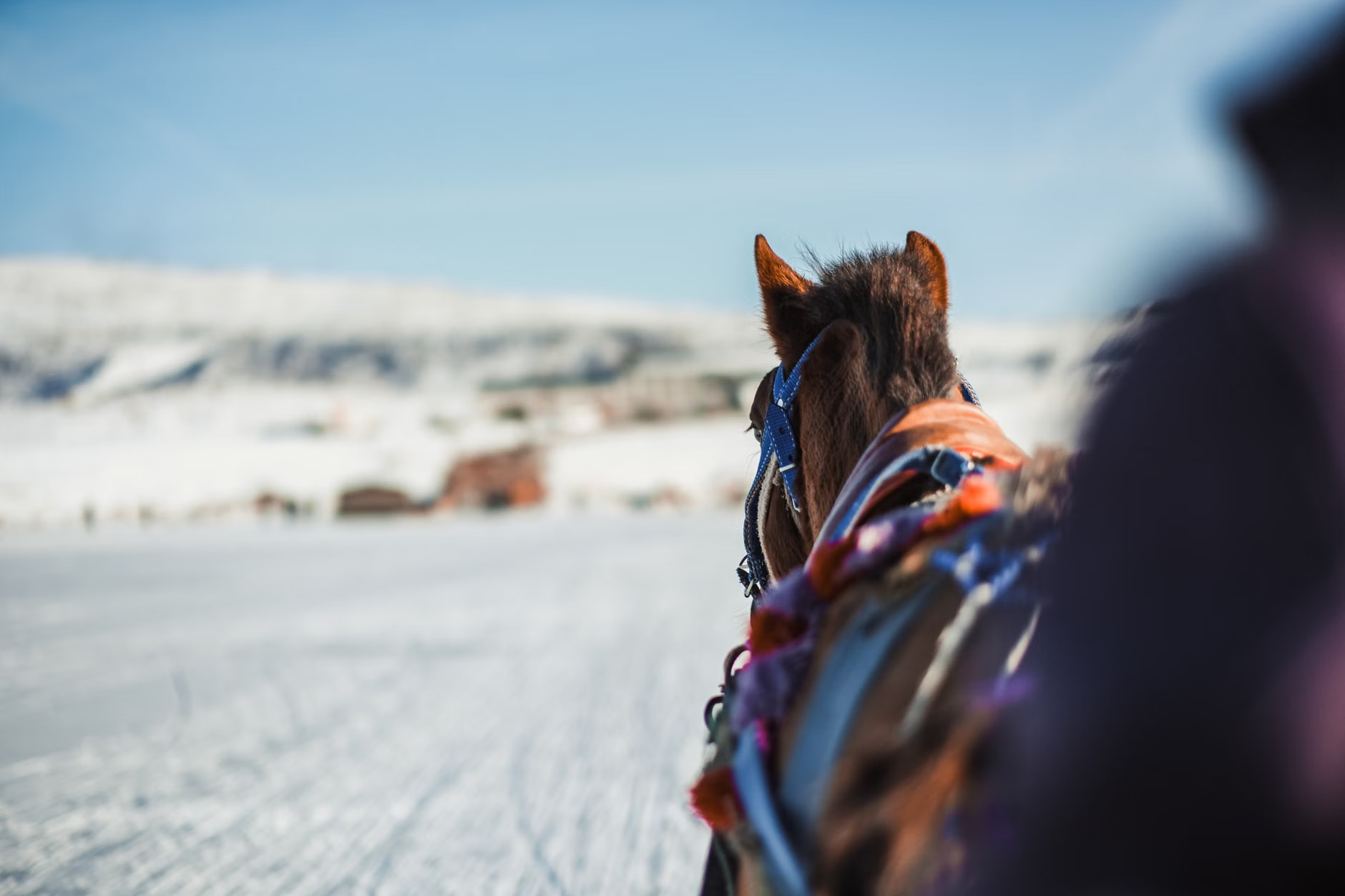
What it looks like in real life: Instead of taxis, you have horse-drawn sleighs. Instead of walking to the lifts, you put on your skis at your apartment door and slide down the street to the cable car. This is the ultimate “low-friction” vacation.
However, there is a trade-off. Avoriaz can feel a bit “artificial” compared to the historic charm of Wengen or Zermatt. It’s a machine for skiing. If your priority is 100% convenience and maximum time on snow with the kids, Avoriaz wins. If you want “Alpine charm” and history, stick to Switzerland.
When you arrive at the “Prodains” cable car or the main car park, you don’t just walk to your hotel. You hire a sleigh (traîneau). It’s a fixed-price service, but it can be chaotic during the Saturday “changeover” day. Practical action: Arrive before 2:00 PM or after 6:00 PM to avoid the massive queues for the sleighs. Carrying three suitcases through knee-deep snow because the sleigh wait was two hours is a mistake you only make once.
The Secret Weapon: Swiss Rail and Luggage Services
The biggest barrier to a car-free vacation is the thought of hauling luggage through train stations. Switzerland has solved this with a level of efficiency that feels like magic. The SBB (Swiss Federal Railways) offers several luggage services that are essential for parents.
- Station-to-Station: You drop your bags at the airport station and pick them up at your destination station two days later.
- Door-to-Door: A courier picks up your bags from your home (in certain countries) or your previous hotel and delivers them directly to your next hotel.
- Flight Luggage: You can check your bags in at a Swiss railway station, and they go all the way to your final destination airport.
Why it matters: Imagine landing at Zurich with two kids. Instead of wrestling with a giant rental SUV and car seats, you hand your suitcases to the SBB desk. You then board a clean, spacious train with a “Family Coach” (Ticki Park) that has a literal playground inside. You enjoy a coffee and the view while your kids play. When you arrive in Zermatt or Wengen, your bags are already waiting at your hotel. This isn’t just travel; it’s a nervous system reset.
The Financial Reality: Is Car-Free More Expensive?
Let’s look at a realistic comparison for a family of four (two adults, two kids aged 8 and 10) for a 7-day trip from Zurich Airport to Zermatt.
Option A: Car Rental
- Large SUV Rental (7 days): ~$800
- Fuel: ~$100
- Parking in Täsch (7 days): ~$120
- Zermatt Shuttle (Round trip): ~$60
- Total: ~$1,080
Option B: Swiss Travel Pass
- Adult Swiss Travel Pass (8 days, 2nd class): ~$450 x 2 = $900
- Swiss Family Card (Kids under 16): FREE
- Luggage Service (4 bags): ~$100
- Total: ~$1,000
The Verdict: For families with children under 16, the train is often cheaper or price-competitive with driving. Plus, the Swiss Travel Pass includes free entry to over 500 museums and free travel on local buses and boats. The “hidden variable” here is the Swiss Family Card. You must request it when buying your pass, but it makes the kids’ travel entirely free. If you drive, you still have to pay for the kids’ mountain railway tickets, which are usually 50% off but not free.
Common Mistakes to Avoid in Car-Free Resorts
- Overpacking: Even with luggage services, you will still need to manage your “day bags.” Car-free villages involve more walking than you think. If you aren’t used to walking 10,000 steps a day, your feet will hurt by day three. Bring high-quality, waterproof walking boots, not just fashion sneakers.
- Ignoring the Last Mile: Many “car-free” hotels are still a 15-minute walk from the station. With a tired 5-year-old, that’s an eternity. Always check if the hotel has a free pickup service. Most 4-star and 5-star hotels in Zermatt and Saas-Fee have their own electric fleets.
- Missing the Last Train: In villages like Wengen or Mürren, if you miss the last train up from the valley (usually around midnight, but earlier on weekdays), you are stuck. There is no “calling an Uber” to get up a mountain shelf. Always photograph the timetable at the station.
- The “I’ll just rent car seats” Fallacy: If you do decide to drive to the parking terminal, remember that European car seats can be different from what you use at home. Bringing your own is a hassle; renting them is expensive. The train requires zero car seats.
The “Alpine-Escape” Decision Matrix
Which village should you choose based on your specific family dynamic?
- If you have a baby/stroller: Choose Wengen. It’s the flattest of the car-free villages and has wide, paved paths that are easy to navigate with a Bugaboo.
- If you want the “Bucket List” view: Choose Zermatt. Nothing beats the Matterhorn. Just be prepared for higher prices and more “tourist buzz.”
- If you are on a budget: Choose Bettmeralp. It’s another car-free Swiss gem in the Aletsch Arena. It’s generally cheaper than Zermatt and incredibly kid-friendly with its own small lake.
- If you want pure “Ski-In/Ski-Out” logic: Choose Avoriaz. The convenience of sliding from your door to the lift is unmatched, especially when managing kids’ equipment.
Practical Next Steps for Your Escape
If you’re ready to pull the trigger on a car-free Alpine vacation, here is your immediate checklist:
- Check the SBB Website: Look at the “Luggage” section and see the lead times. You usually need to book the service at least 2-4 days in advance.
- Download the “SBB Mobile” App: It is the single best travel app in the world. It gives you real-time platform changes, occupancy levels (so you can find a quiet carriage with the kids), and digital ticket storage.
- Verify “Car-Free” Status: Some resorts claim to be car-free but are actually “car-limited” (like Lech in Austria, which is lovely but still has traffic). Stick to the GAST (Gemeinschaft Autofreier Schweizer Tourismusorte) list for guaranteed car-free Swiss villages.
Moving through the mountains without the hum of a combustion engine or the stress of a steering wheel changes the tempo of your holiday. It forces you to slow down, to look up at the peaks, and to actually talk to your children while you walk. It’s not just a “green” choice; it’s a sanity choice. The Alps are majestic, but they are best enjoyed when you aren’t looking for a parking spot.
Official Resources for Planning:
- SBB Swiss Travel Pass Official Site
- Zermatt Official Car-Free Guide
- Avoriaz Official Transport Information
- MySwitzerland Guide to Wengen
Frequently Asked Questions
Q1: How do I get my groceries to my apartment if there are no cars?
Most car-free villages have grocery stores (Coop or Migros) that provide small hand-carts or trolleys you can borrow to wheel your bags back to your accommodation. For larger loads, you can often call a local electric taxi for a small fee (usually 15-20 CHF) to deliver you and your bags to your door.
Q2: What happens in an emergency or if someone is injured?
Car-free villages have full access for emergency vehicles. Ambulances and fire trucks are specially designed (often smaller electric or narrow-track versions) to navigate the streets. In serious cases, helicopter rescue (Rega in Switzerland) is the standard for mountain regions and is incredibly efficient.
Q3: Is the train difficult to navigate with a double stroller?
Swiss trains are generally very stroller-friendly. Look for the “low-floor” icons on the train carriages or the SBB app; these allow you to roll a stroller directly onto the train without lifting. On older cogwheel trains (like the one to Wengen), there is usually a designated luggage/stroller van at the front or back where you can park the stroller unfolded.
Final Takeaway: The initial effort of planning a train-based, car-free trip is rewarded the moment you arrive. The silence, safety, and simplicity of these villages provide a level of relaxation that a car-access resort simply cannot match. Start by booking your Swiss Travel Pass and let the world’s best rail system do the heavy lifting for you.