Key Takeaways:
- Neuroplasticity in Action: Growth-mindset math games rewire how children perceive failure, turning “I can’t” into “I can’t yet.”
- The Process Over Product: Shifting the focus from getting the right answer to understanding the problem-solving journey reduces performance anxiety.
- Integration is Key: Math shouldn’t be an isolated subject; playing games together at home makes numeracy a natural part of everyday life.
The most effective way to help your child excel in mathematics isn’t through repetitive drills or high-pressure tutoring sessions; it is by changing the way they view the struggle of learning itself. If you have ever heard your child say, “I’m just not a math person,” you are witnessing a fixed mindset in action. This belief, often internalized before the age of ten, acts as a self-imposed ceiling on their potential. By integrating growth-mindset math games into your family routine, you aren’t just teaching arithmetic; you are teaching resilience, analytical thinking, and the neurological reality that their brain is a muscle that grows stronger with every challenge.
Understanding the “Fixed” vs. “Growth” Divide
Psychologist Carol Dweck’s research on mindset has become a cornerstone of modern pedagogy for a reason: it works. In a fixed mindset, a child believes their intelligence is static. If they struggle with a math problem, they conclude they lack the innate “math gene.” This leads to avoidance, anxiety, and a quick surrender when the work gets tough. Conversely, a growth mindset frames struggle as the necessary friction required for neural growth. When a child views math as a skill to be developed rather than a talent they either have or don’t, they are far more likely to persist through complex problems.
Why does this matter in the context of math specifically? Math is often treated as a subject of “right or wrong” absolutes. This binary nature makes it the perfect breeding ground for anxiety. If you get the answer right, you are smart; if you get it wrong, you are not. Growth-mindset math games disrupt this narrative by focusing on the strategy used to reach a solution, rather than the speed or accuracy of the result. When we play games that reward multiple approaches, we validate the process of thinking, which is far more valuable than memorizing a formula.
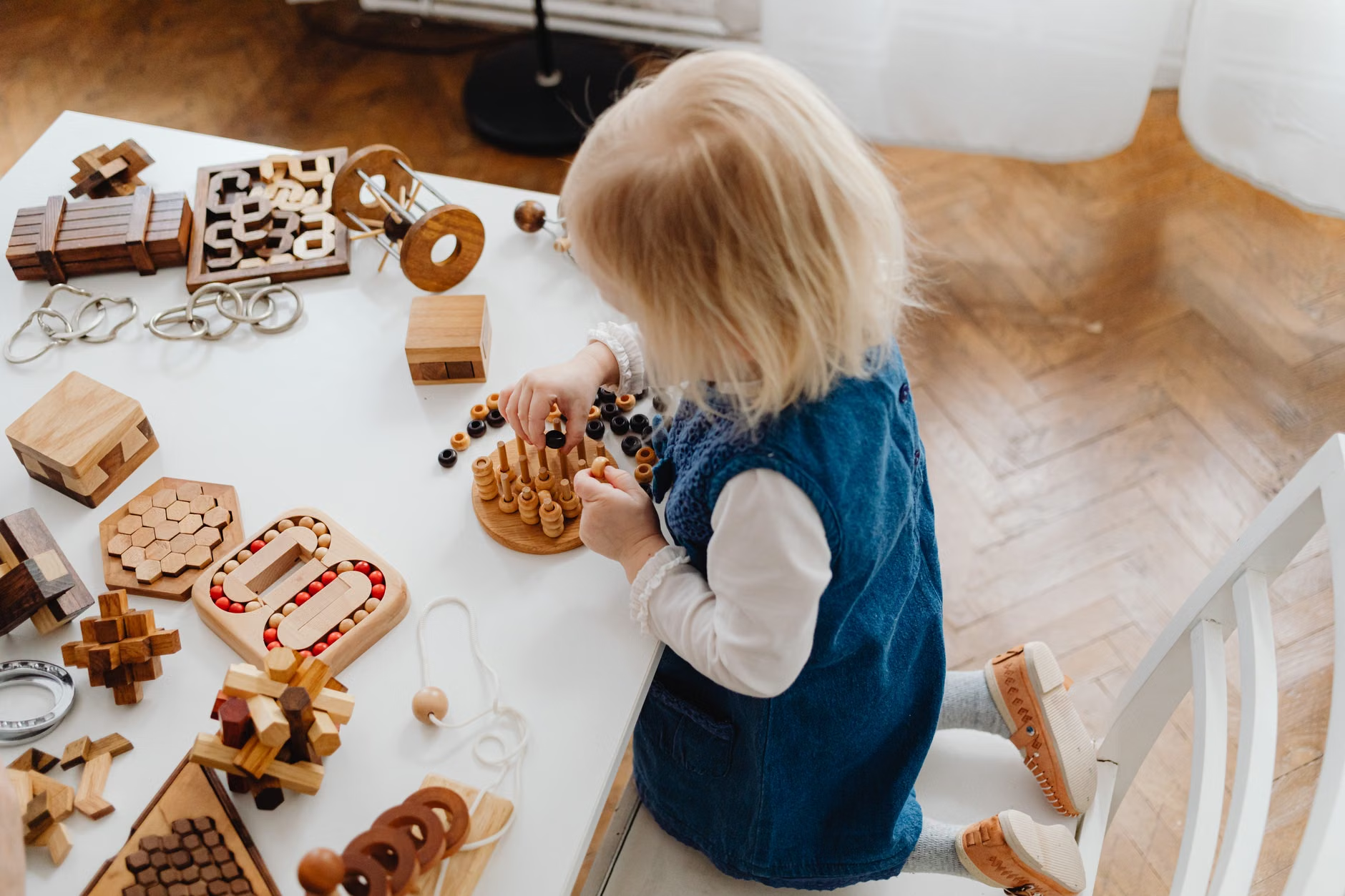
The Neuroscience of “Not Yet”
When a child encounters a difficult math problem and feels the urge to quit, their brain is actually at a critical juncture. Neuroscientific studies show that when we struggle with a challenging task, the brain’s synapses fire more intensely. This is the moment of learning. If a child stops, they miss the opportunity for their brain to forge new connections. Using the phrase “not yet” is a simple but powerful tool to bridge this gap. It acknowledges the current difficulty while maintaining the expectation of future success.
Math games facilitate this by lowering the stakes. In a classroom, a wrong answer on a test can feel like a public failure. In a board game or a logic puzzle, a wrong answer is simply a piece of information—it tells the player that they need to try a different strategy. This shift in perspective is crucial for children in their early formative years. It changes the internal monologue from “I am failing” to “This strategy didn’t work, so let’s try a different one.” This is the essence of mathematical inquiry: the ability to hypothesize, test, and adapt.
Selecting the Right Games for Your Home
Not all games are created equal. When selecting games to foster a growth mindset, look for those that offer low floors and high ceilings. A “low floor” means the game is easy to start—anyone can jump in without feeling overwhelmed. A “high ceiling” means there is significant room for complexity and growth as the child masters the basic rules. Avoid games that are purely about speed, like flashcard races, which can trigger anxiety in children who need more time to process information.
| Game Category | Core Skill | Why it Promotes Growth Mindset |
|---|---|---|
| Strategy Board Games | Logic & Planning | Requires adjusting tactics based on opponent moves. |
| Geometric Puzzles | Spatial Reasoning | Focuses on trial-and-error without binary success. |
| Collaborative Math Apps | Pattern Recognition | Encourages shared problem solving rather than solo speed. |
When you sit down to play, be mindful of your own language. If you make a mistake, vocalize your process: “That didn’t work out the way I hoped, I wonder what happens if I move this piece instead?” This models the growth mindset in real-time. Children are incredibly perceptive; if they see you frustrated and quitting, they will mimic that behavior. If they see you curious and persistent, they will learn that math is an adventure, not a chore.

Common Pitfalls: What to Avoid
One of the most common mistakes parents make is “over-helping.” When we see our children struggle, our instinct is to jump in and provide the answer to relieve their frustration. While this might stop the tears in the short term, it robs them of the struggle that builds cognitive resilience. Instead of giving the answer, ask a guiding question: “What have you tried so far?” or “What do you think would happen if we changed this one part of the equation?”
Another pitfall is praising the result rather than the effort. Avoid saying, “You’re so smart at math.” This reinforces the fixed-mindset idea that intelligence is a trait. Instead, say, “I love how you tried three different ways to solve that puzzle before you found the right one.” This reinforces the behavior—the process—that leads to mastery. The goal is to make the child feel proud of their persistence, not just their final score.
Finally, avoid framing math as a “necessary evil.” Comments like “I hated math in school, too” are deeply damaging. They implicitly tell your child that it is normal, or even expected, to be bad at math. Even if you struggled in school, you can frame it as: “I had a hard time with math, but I’ve learned that the more I practice, the more it makes sense.” This keeps the door open for their potential.
Integrating Math into Daily Life
Math isn’t just for the game table; it is everywhere. Growth mindset is about seeing the world through a mathematical lens. When you are cooking, ask your child to help you scale a recipe. When you are shopping, ask them to estimate the total cost or figure out which item is the better value per ounce. These aren’t just chores; they are low-stakes opportunities to practice mathematical reasoning in a real-world context.
For parents in their 30s and 40s, life is busy. You don’t need to dedicate hours to this. Fifteen minutes of playing a logic game or discussing a real-world math problem is far more effective than an hour of forced homework. The key is consistency and the tone you set. Make it a part of your family culture. When math becomes a source of shared curiosity rather than a source of individual performance pressure, the “math anxiety” that plagues so many students begins to evaporate.

The Role of Digital Tools
Technology often gets a bad rap in parenting, but there are excellent digital tools that support growth mindset. Look for apps that emphasize exploration and open-ended play rather than those that just gamify rote memorization. The best apps allow children to manipulate variables and see the immediate consequences, which builds an intuitive understanding of mathematical concepts. However, remember that digital tools should supplement, not replace, physical play. The tactile experience of moving pieces and working with others is essential for developing spatial reasoning and social problem-solving skills.
When selecting apps, check for the ability to turn off timers. Speed-based math apps are the enemy of a growth mindset for many children. They prioritize recall over reasoning. If an app doesn’t allow you to disable the clock, it might be better to skip it. You want your child to feel like they have all the time they need to figure out the logic behind the puzzle.
Building a Culture of Inquiry
A growth mindset thrives in an environment where questions are valued more than answers. Encourage your children to ask “why” and “what if.” If they are stuck on a math problem, ask them to draw it out. Visualizing a problem is a powerful, often underutilized strategy. If they can represent the math in a picture, they are already on the path to understanding it. This is a foundational skill in high-level mathematics, yet it is often abandoned early on in favor of symbolic manipulation.
Consider the “Math Playground” approach. Keep a box of materials—ruler, graph paper, colored pencils, dice, and base-ten blocks—accessible. When they are frustrated with a concept, let them play with the materials. Sometimes simply changing the medium from a pencil and paper to physical objects is enough to unlock the logic. This is not “cheating”; it is using tools to think more effectively, which is exactly what professional mathematicians do.
Long-term Implications: Resilience Beyond Math
The beauty of growth-mindset math games is that the skills learned are transferable. A child who learns to persist through a difficult math puzzle is also learning how to handle a complex science project, a challenging social situation, or a difficult day at work in their future. You are teaching them that their brain is not a static entity. You are teaching them that they have agency over their own intelligence.
When they face a setback later in life, they will have the internal resources to say, “I haven’t figured this out yet.” That is a life skill that transcends school grades. As parents, we cannot protect our children from every challenge they will face, but we can give them the tools to view those challenges as opportunities to grow. By fostering a growth mindset through math, you are building a foundation of confidence and resilience that will serve them long after they have forgotten their multiplication tables.
Summary and Encouragement
The journey toward a growth mindset is not a straight line. There will be days when your child is frustrated, and there will be days when you are tired and tempted to just give them the answer. That is okay. Growth mindset is not about perfection; it is about the ongoing commitment to improvement. Start small. Pick one game, set aside one day a week, and focus on the joy of the struggle. You are doing a great job by being intentional about how you approach their education.
Remember that you are their first and most important teacher. Your attitude toward learning is the most powerful curriculum they will ever encounter. By modeling curiosity, patience, and a willingness to learn from failure, you are giving them the greatest gift of all: the belief that they are capable of learning anything they set their mind to.
For more research on growth mindset and evidence-based learning strategies, you can explore resources from organizations like YouCubed, which provides excellent insights into mathematical mindsets, and the Mindset Works platform, which offers practical applications for Dweck’s research.
Frequently Asked Questions
1. How do I know if my child has a fixed or growth mindset regarding math?
Watch their reaction to difficulty. A child with a fixed mindset will often quit quickly, blame themselves, or express intense frustration when they encounter a problem they can’t solve immediately. A child with a growth mindset, while perhaps frustrated, will continue to experiment with different strategies and express curiosity about how to solve it.
2. Can I use these techniques if I am not good at math myself?
Absolutely. In fact, it might be an advantage. By being honest about your own learning process—acknowledging your past struggles and showing how you approach new problems—you model that intelligence is developed through effort. You don’t need to be a math expert to be a great facilitator of their learning journey.
3. How often should we play these math games to see a difference?
Consistency is more important than duration. Even 15 to 20 minutes, two or three times a week, is enough to build the habit of mathematical thinking. The goal is to make it a low-pressure, enjoyable part of your family routine, not another item on a stressful to-do list.