The most effective way to reclaim your focus isn’t to throw your phone in a lake or move to a cabin in the woods; it is to implement a “Minimalist-Tech” framework that treats your attention as a finite, non-renewable resource that you must guard with the same intensity you guard your family’s safety.
- Attention is the Currency: Recognize that apps are designed to monetize your time; minimalism is a defensive strategy to keep that time for yourself.
- The 80/20 Rule of Apps: You likely use 20% of your installed applications for 80% of your daily tasks; delete the rest to reduce cognitive load.
- Physical Friction is Key: By creating physical barriers between you and your devices, you interrupt the subconscious habit loops that lead to mindless scrolling.
If you are in your 30s or 40s, you are likely living in the “sandwich” of digital fatigue. You have work emails pinging during the school run, group chats blowing up while you are trying to help with homework, and a news feed that seems engineered to make you anxious before you even finish your first coffee. You aren’t just a parent or a professional anymore; you are a data point in a massive attention economy.
But here is the truth: the “digital detox” as it is often sold—a week-long retreat in the mountains without any devices—is rarely sustainable for a parent managing a household. It’s a temporary vacation from reality, not a solution to the problem. Minimalist-Tech is different. It is a systematic, permanent recalibration of how you interact with your digital world, designed to fit into a life that requires connectivity but demands sanity.
Understanding the Architecture of Distraction
To fix the problem, you have to understand why it feels so difficult to put the phone down. Your devices are not neutral tools. They are precision-engineered machines designed to trigger dopamine loops. Every notification sound, every red badge on an app icon, and every infinite scroll mechanism is a calculated attempt to pull your eyes away from the present moment.
When you are tired—perhaps because the baby woke up at 3:00 AM or because you had a grueling day of back-to-back Zoom calls—your willpower is physically depleted. Scientists call this decision fatigue. By the time you sit down on the couch at 8:00 PM, your brain is looking for the path of least resistance. That is when the algorithm wins. It offers you a mindless video, and you take it because your prefrontal cortex, the part of the brain responsible for impulse control, is simply exhausted.
Minimalist-Tech isn’t about being a Luddite. It’s about recognizing that you are currently being “hacked.” Once you accept that the technology is designed to exploit your biology, you can stop feeling guilty about your lack of willpower and start building better structural defenses.
The First Step: Aggressive Digital Sanitization
Start by auditing your digital environment. Most people have dozens of apps on their phone that they haven’t opened in a month. These apps are not just taking up storage; they are taking up “mental real estate.” Even if you don’t click on them, seeing the icon every time you unlock your screen creates a subconscious reminder of an unfulfilled task or an unread update.
Go through your phone and apply the “Delete or Disable” rule. If an app does not provide clear, tangible value to your life—either by making you money, keeping you healthy, or helping you connect with someone you actually care about—it goes. This includes news aggregators that only serve to spike your cortisol, retail apps that tempt you into impulse spending, and social media platforms that leave you feeling drained rather than inspired.
For the apps you choose to keep, turn off all non-human notifications. If it’s not a direct message from a real person, it doesn’t deserve a push notification. Marketing alerts, “likes” on a photo, and game updates are not urgent. By silencing the “machine” notifications, you reclaim your relationship with your device. You start opening apps when you decide, not when they demand your attention.

Creating Physical Friction to Break Habits
Habit formation is largely about friction. If a behavior is easy, you will do it. If it is hard, you will avoid it. Currently, your phone is the easiest thing in the world to access. It’s in your pocket, on the nightstand, or sitting next to your dinner plate. You need to introduce intentional friction.
Start by creating “no-phone zones” in your house. The most important one is the dinner table. If you want to model healthy behavior for your children, you cannot be checking your emails while they are telling you about their day. Another crucial zone is the bedroom. If your phone is your alarm clock, it is also your gateway to late-night scrolling. Buy a cheap, analog alarm clock. It costs less than $15 and will pay for itself in improved sleep quality within a week.
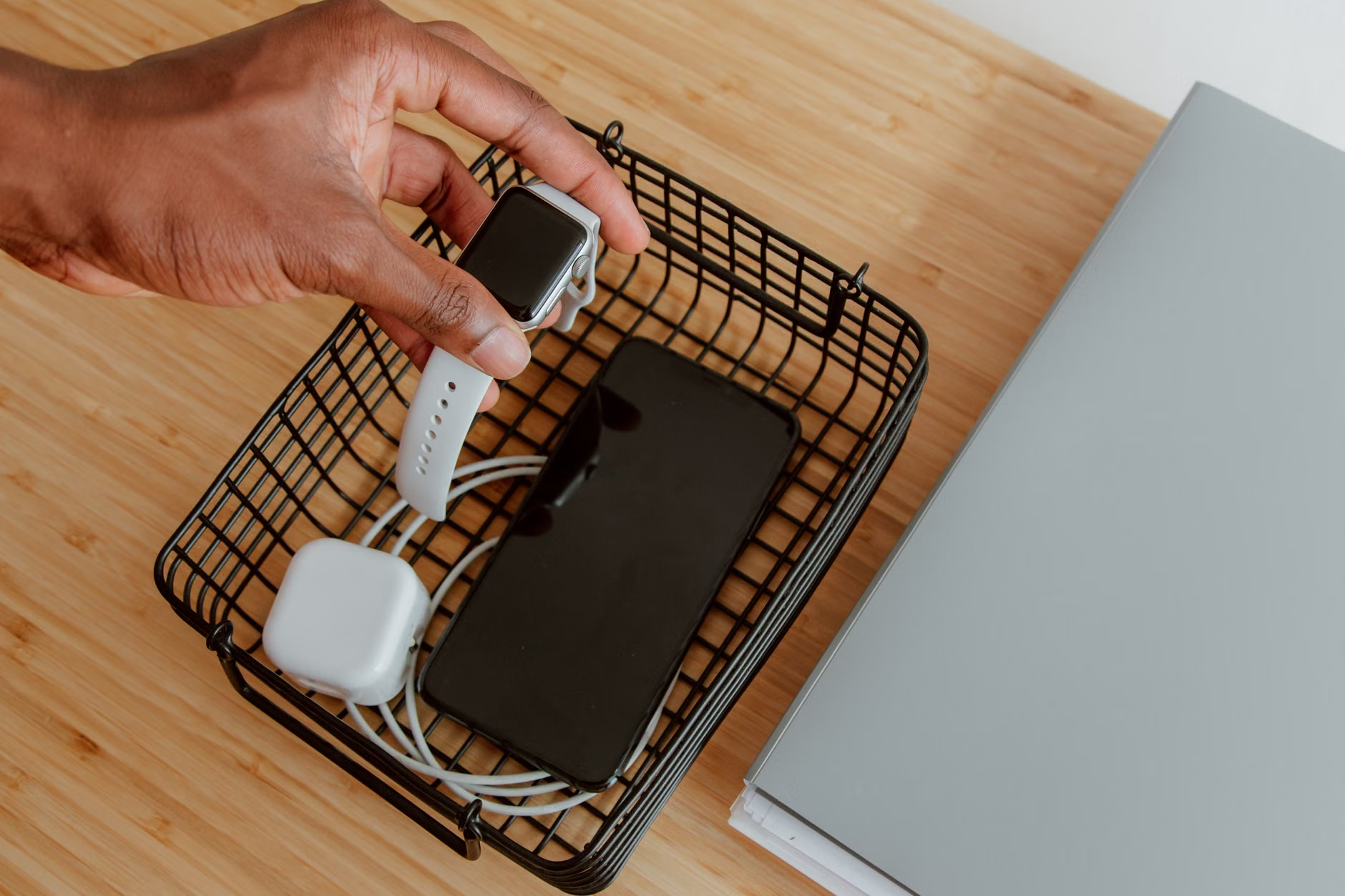
Another technique is the “Charging Station” method. Set up a charging dock in a specific place, like the hallway or a utility room, and make it the only place where your phone is allowed to charge overnight. This forces you to be intentional about when you pick it up in the morning. Instead of reaching for it the moment you open your eyes, you have to physically walk to another room to retrieve it. That 30-second walk is often enough time for your brain to wake up and remember that you have other priorities.
The 80/20 Rule of Digital Productivity
In your 30s and 40s, time is the rarest commodity. You are likely juggling professional responsibilities, household management, and perhaps caring for aging parents or young children. You cannot afford to spend hours managing your digital life.
Apply the 80/20 rule: Identify the 20% of your digital tools that provide 80% of your value. For many, this is email, a calendar, a messaging app for family coordination, and perhaps a music or podcast app. Everything else is secondary. When you focus on these core tools, you stop feeling like you need to be everywhere at once.
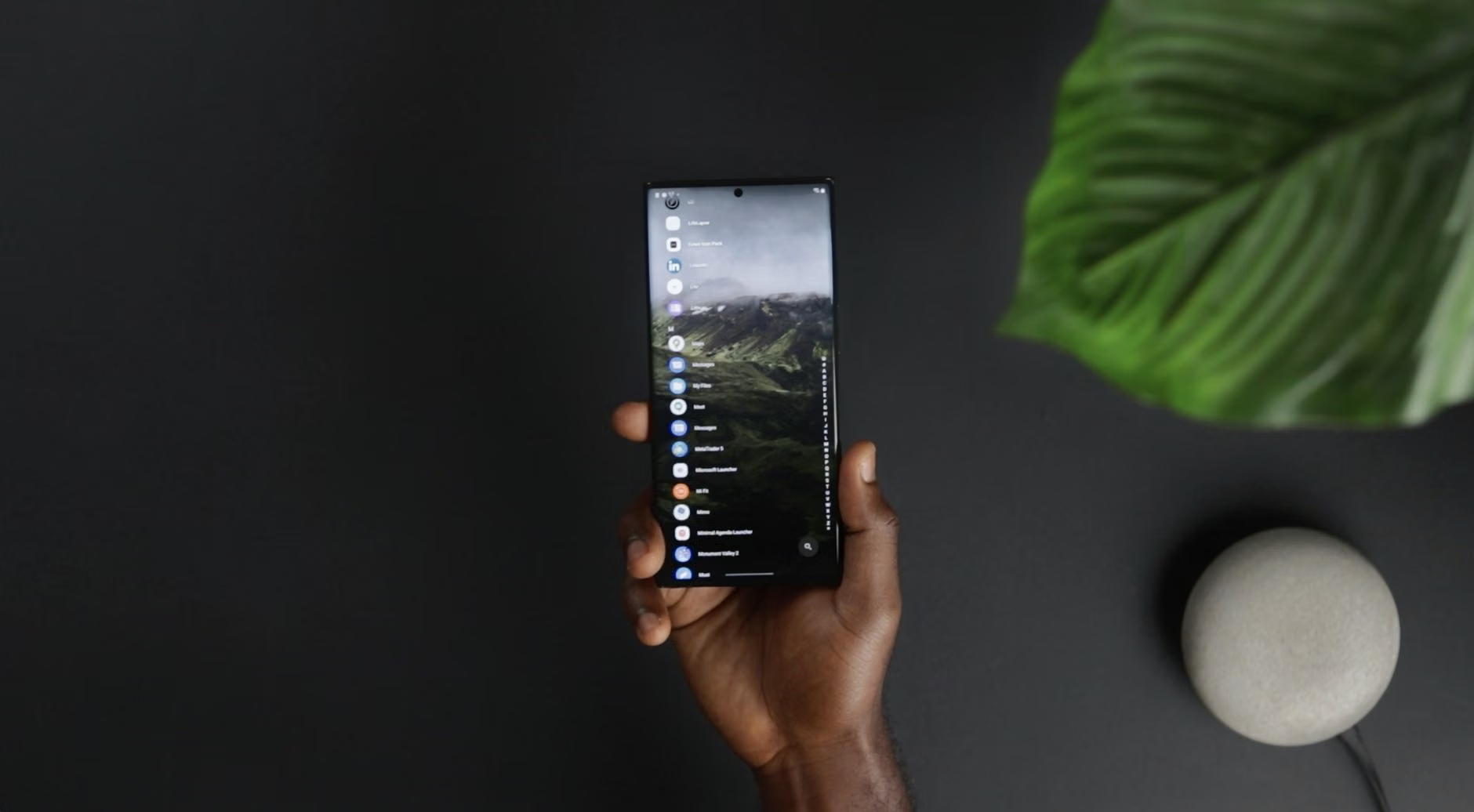
Consider using “launcher” apps or grayscale mode. Grayscale mode is a simple setting in most modern smartphones (found under Accessibility settings) that turns your screen black and white. It sounds minor, but it is incredibly effective. Without the bright red notifications and the vibrant colors of app icons, your phone becomes significantly less stimulating to your brain. It turns the device from a toy into a tool. You will be surprised by how quickly you lose interest in scrolling through a feed when the images look like a newspaper from 1950.
Managing Family Expectations and Communication
One of the biggest anxieties for parents is the fear of being “unreachable.” We convince ourselves that if we aren’t checking our phones every 15 minutes, we might miss an emergency. This is a cognitive bias. True emergencies are rare. Most of what you are checking is noise.
To handle this, create a “communication hierarchy.” Ensure that your spouse, your children’s school, and your closest family members know that if there is a genuine emergency, they should call you. A phone call cuts through the digital noise. By establishing this protocol, you give yourself permission to ignore everything else. If it isn’t an emergency, it can wait until your designated “check-in” window.
Set specific times of the day to process your digital life. Maybe you spend 15 minutes at 10:00 AM and 15 minutes at 4:00 PM clearing emails and messages. Outside of those windows, close the apps. When you are with your family, the phone should be invisible. If the phone is out, it signals to your children that they are competing with the device for your attention. That is a competition they will eventually stop trying to win, and you will lose the chance to be fully present with them.
Common Pitfalls and How to Avoid Them
The most common mistake people make when attempting a digital detox is setting unrealistic goals. Don’t try to go from “addicted” to “monk” in a single day. You will fail, you will feel guilty, and you will go back to your old habits with even more intensity. This is the “rebound effect.”
Instead, look for small, sustainable wins. Start by just disabling notifications for one week. See how it feels. Then, try the “no-phone at the dinner table” rule for a week. If you miss a day, don’t beat yourself up. Just get back to it the next day. This is a lifestyle change, not a temporary diet.
Another pitfall is the “boredom trap.” We use our phones to kill the small moments of boredom—waiting in line at the grocery store, sitting in the car while waiting for school pickup, or standing in the kitchen while the kettle boils. These moments of boredom are actually essential for your creativity and mental clarity. When you are constantly filling them with digital input, you never give your brain a chance to process your day or come up with new ideas. The next time you find yourself waiting for five minutes, try just standing there. Observe the world around you. It will feel uncomfortable at first, but that discomfort is the feeling of your brain resetting.
The Role of Tech in Modern Parenting
Parenting in the digital age requires us to be curators of our children’s digital experience, but we cannot curate what we cannot control ourselves. If you are constantly looking at your screen, your children will mirror that behavior. They don’t listen to what you say; they watch what you do.
When you practice Minimalist-Tech, you are doing more than just saving your own focus. You are teaching your children that technology is a tool to be used with purpose, not a crutch to be leaned on for comfort. This is one of the most important lessons you can pass on to them. They will grow up in a world that is even more saturated with digital distraction than ours. Giving them the framework to manage that distraction is a gift of immense value.
Don’t be afraid to explain what you are doing to your kids. Tell them, “I’m putting my phone away because I want to give you my full attention.” It validates their importance and shows them that you are making an active choice to prioritize them over your device.
Comparison of Traditional vs. Minimalist-Tech Approaches
| Feature | Traditional Digital Habits | Minimalist-Tech Approach |
|---|---|---|
| Notifications | Everything enabled; constant pings. | Only direct human contact allowed. |
| Phone Location | In pocket or hand at all times. | Stored in a designated charging station. |
| Screen Purpose | Default entertainment/distraction. | Intentional, task-based usage. |
| Morning Routine | Immediate check of news/social. | Analog morning, no phone for 1 hour. |
| Reaction to Boredom | Immediate phone usage. | Embracing the pause/mindfulness. |
Moving Toward a Sustainable Future
Minimalist-Tech is not about hating technology. Technology has allowed us to work from anywhere, stay in touch with family across the globe, and learn anything at the click of a button. It is a miracle. But like any powerful tool, it must be used with respect and boundaries.
As you move forward, keep a “Tech Audit” journal. Every month, ask yourself: “Has this app/habit added value to my life this month?” If the answer is no, cut it. Your life is too short to be spent in the digital waiting room of someone else’s algorithm. You have the power to decide how you spend your time. Start by reclaiming the next hour. Put the phone in the other room, pick up a book, talk to your partner, or just look out the window. You’ll find that the world is much more interesting than a 6-inch glass screen.
The goal is to move from being a passive consumer of digital content to an active participant in your own life. It takes effort, and it requires you to be honest about your own habits, but the reward is a sense of agency that is becoming increasingly rare in our connected world. Keep it simple, stay consistent, and remember that you are the master of your tools, not the other way around.
For further reading on the intersection of human psychology and technology, you may find the work of the Center for Humane Technology to be an excellent resource for understanding how these systems are built and how to better protect your attention. Their research provides a deeper dive into the mechanics of the attention economy.
Resources:
- Center for Humane Technology – Insights on how to reclaim your attention from digital systems.
- American Psychological Association – Research on the impact of social media and digital usage on mental health.
Frequently Asked Questions
1. How do I handle work expectations if I stop checking my phone constantly?
Most work-related anxiety stems from the assumption that “immediate response” equals “high performance.” In reality, most high-performers block off time for deep work. Communicate your availability to your team: “I check my messages at 10:00 AM and 4:00 PM; for anything urgent, please call.” Once you set this boundary and show you are still reliable, most colleagues will respect it—or even start doing it themselves.
Not necessarily. If you get value from it, keep it, but change how you use it. Remove the app from your phone and only access it through a desktop browser. This adds a layer of friction that prevents mindless scrolling. If you find yourself checking it out of habit rather than interest, that is a sign it might be time to remove it permanently.
3. What if my children need to reach me during the day?
This is the most common concern for parents. The key is to ensure that your phone is set to allow calls from specific contacts (like your spouse or children’s school) even when it is on “Do Not Disturb” or “Focus” mode. This way, you stay reachable for the people who actually matter, while still blocking out the background noise of apps and emails.