Three Key Takeaways
- The “Third Space” is essential: It is the social environment outside of home (first space) and work (second space) where you can build community without the pressure of spending money.
- Combating Isolation: Modern city planning is shifting away from car-centric designs to prioritize walkability and “third spaces” to improve mental health for parents and professionals.
- Active Participation: You don’t have to wait for city planners; you can foster third spaces by utilizing libraries, community gardens, and local events to strengthen your neighborhood ties.
The secret to surviving the relentless juggle of parenting, professional deadlines, and household management isn’t found in a better calendar app or a more expensive coffee machine—it is found in the “Third Space.” If your life feels like a constant oscillation between the domestic demands of your home and the professional requirements of your workplace, you are experiencing the classic trap of modern living: the loss of the social middle ground. Sociologist Ray Oldenburg coined the term “Third Space” decades ago, but in our current era of digital isolation and hyper-scheduled parenting, the revival of these spaces has become a critical necessity for our collective sanity.
What Exactly Is a Third Space and Why Did We Lose It?
To understand why we feel so perpetually drained, we have to look at how our cities have been redesigned over the last forty years. Traditionally, a Third Space is a social environment that is distinct from the two “usual” environments: the home (the first space) and the workplace (the second space). Think of the classic European village square, the neighborhood pub, the local library, or the barbershop where people gathered not because they were invited to a formal event, but because they knew they would find company there.
These spaces share a few specific characteristics: they are neutral grounds, they are accessible to almost everyone, they encourage conversation as the primary activity, and they are marked by a “home away from home” atmosphere. Crucially, they are places where you are not expected to be productive or performative.
However, as urbanization accelerated, we traded these communal hubs for efficiency. We built sprawling suburbs where the only way to get anywhere is by car, effectively killing the “accidental” social interaction that happens on a sidewalk. We prioritized private backyards over public parks and shifted our social lives into private, gated, or digital spheres. For parents in their 30s and 40s, this has been particularly damaging. We are often left managing our children’s social calendars while our own social lives wither, restricted to occasional, high-effort “planned” outings that require babysitters and reservations.

The Tangible Impact on Parenting and Mental Health
For those of us in the thick of raising children, the absence of a Third Space creates a specific kind of fatigue. We are constantly in “active” mode—managing, guiding, cleaning, or working. The Third Space is supposed to be a place where the pressure to “be” something is removed. When we lack these spaces, we experience what researchers call “social starvation.”
It’s not just about loneliness; it’s about the loss of the “weak tie.” Sociologist Mark Granovetter famously identified the importance of “the strength of weak ties”—the acquaintances we see at the park, the local barista, or the neighbor we wave to. These interactions are the glue that keeps a community functioning. Without them, we feel like islands. When you are a parent, having a place where your child can play safely while you have a low-stakes, 10-minute conversation with another adult is not a luxury; it is a mental health intervention.
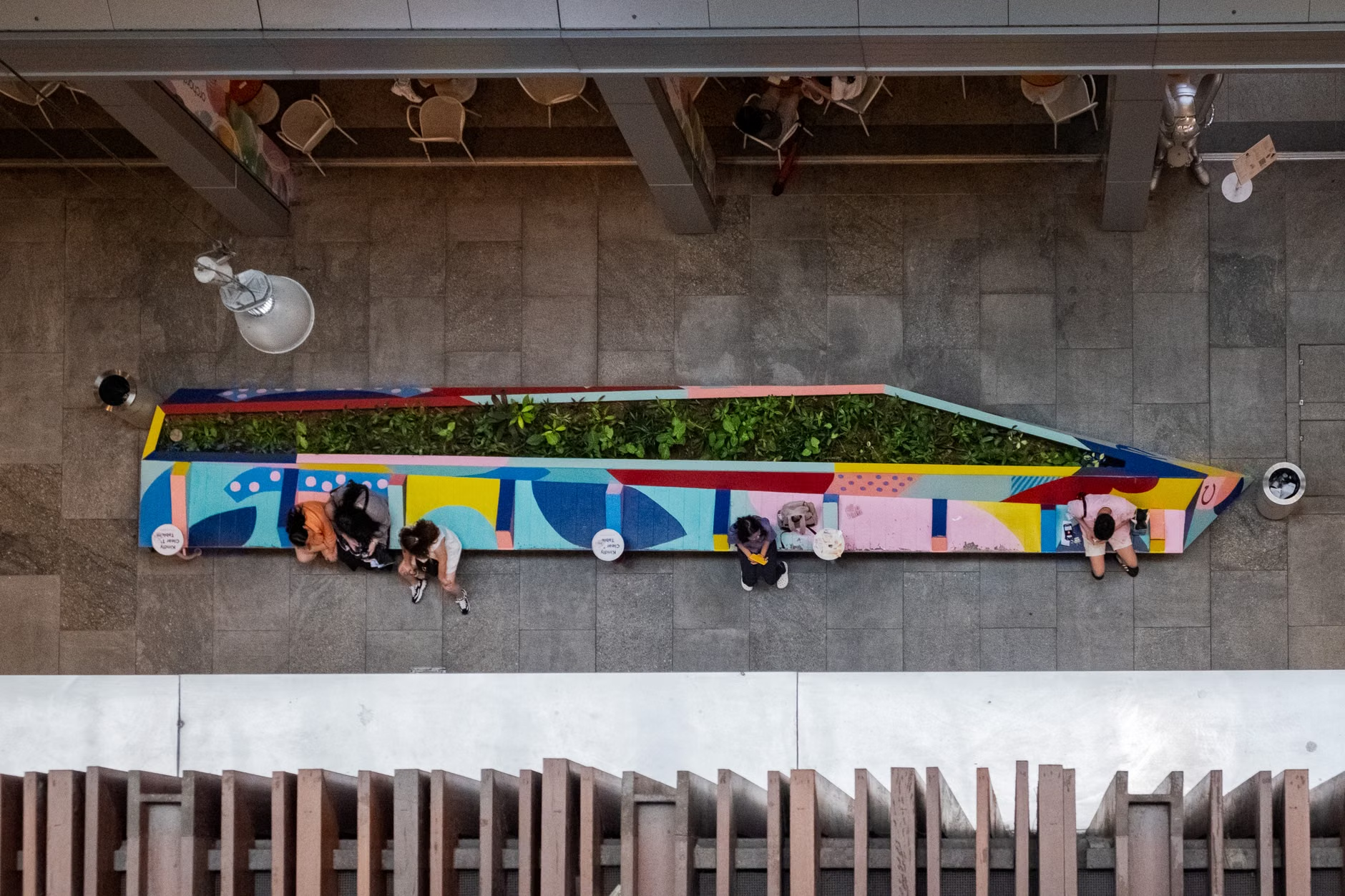
Current urban planning trends are finally starting to pivot. Planners are realizing that “density” isn’t just about packing people into apartments; it’s about creating “third-place density.” This is the intentional design of spaces that allow for lingering. Think of the rise of pedestrian-only zones, the revitalization of public libraries as community hubs rather than just book repositories, and the “parklet” movement—turning parking spots into tiny, green seating areas.
The Economics of the Third Space: Why “Free” Matters
One of the biggest hurdles in the modern Third Space movement is the “commercialization of community.” Many of the places we think of as third spaces—coffee shops, coworking spaces, trendy food halls—require us to spend money to exist there. While there is nothing wrong with supporting a local business, the true Third Space, in its ideal form, is a place where you don’t need a wallet to participate.
This is where the revival movement is getting interesting. Cities are experimenting with “civic infrastructure.” This includes:
- Public Library Upgrades: Modern libraries are becoming community centers, offering everything from tool lending libraries and seed banks to free makerspaces for kids and adults.
- Community Gardens: These are arguably the most effective modern third spaces. They require manual effort, they are inherently intergenerational, and they foster a sense of ownership over public land.
- School-Yard Openings: Some cities are beginning to open school playgrounds to the public during evenings and weekends, recognizing that fencing off these massive, expensive assets is a waste of community potential.
If you are looking to evaluate the “Third Space” potential of your own neighborhood, use this simple checklist:
| Criteria | Why it Matters |
|---|---|
| Low Barrier to Entry | Can you access it without a membership fee or a purchase? |
| Proximity | Is it within a 15-minute walk of your home? |
| Comfort | Does it have seating and shelter from the elements? |
| Inclusivity | Does it feel welcoming to both you and your children? |
Common Mistakes We Make When Seeking Community
A common trap for busy parents is the “over-programming” mistake. We often look for community by signing up for structured classes, organized sports leagues, or parent-teacher committees. While these are excellent for our children, they often add to our own stress levels. The Third Space, by definition, should be the opposite of a structured commitment.
If you find yourself feeling “socially burnt out,” you might be trying to build community through tasks rather than through presence. The goal of a Third Space is to move away from “What do I have to do today?” toward “Where can I go to just be?”
Another mistake is waiting for the city to build it for you. While urban planning is slow, neighborhood culture is fast. If your local park is neglected, even a small group of parents deciding to meet there at the same time every Friday afternoon can effectively “create” a Third Space where none existed before. Consistency is the key to creating a social anchor point.
The Digital Paradox: Using Tech to Find Physical Spaces
It sounds counterintuitive, but technology can actually be a catalyst for finding physical spaces. While we often blame screens for our isolation, platforms like local neighborhood apps, community Facebook groups, or even specialized maps showing “third place” locations can help you identify where the pulse of your neighborhood is beating.
However, the goal of using these tools should always be to get offline. Use the app to find the community garden meeting, then put the phone away once you arrive. The “Third Space” is inherently analog. It requires your physical presence, your attention, and your willingness to tolerate the awkwardness of meeting new people in your neighborhood.
For parents, the struggle is often the “logistics of departure.” Getting out of the house is the hardest part. My advice? Don’t make it an event. Don’t frame it as “we are going out to socialize.” Frame it as “we are going to take the kids to the library to read/play for an hour.” The social benefits will happen as a side effect. By lowering the stakes, you remove the pressure that often prevents us from leaving the house in the first place.

Designing Your Own Micro-Third Space
If your immediate vicinity lacks a public square or a vibrant library, you can start small. The concept of the “front porch” is a historic, micro-version of the Third Space. It is a transition zone between the private home and the public street. Even if you live in an apartment, the “landing” or the building entrance can serve a similar function if you are intentional about it.
Ask yourself: How can I make my home’s perimeter more inviting? Is there a spot to put a bench? Can I leave a “take a book, leave a book” box on my fence? These tiny interventions signal to your neighbors that you are open to interaction. It is the architectural equivalent of a “hello.”
Remember, the revival of the Third Space is not about reclaiming the past; it’s about adapting the concept to the realities of the 21st century. We have different schedules, different family structures, and different needs than our ancestors. But the fundamental human need for connection remains identical. We are wired to be part of a tribe, and in a world that is increasingly atomized, the Third Space is the bridge that gets us there.
Practical Steps to Reclaim Your Social Life
If you are ready to integrate more “Third Space” living into your routine, start with a 30-day experiment. You don’t need to overhaul your life, but you do need to be intentional.
- Map your area: Spend an afternoon walking a 15-minute radius around your home. Ignore the shops you usually visit. Look for benches, parks, libraries, or community centers you’ve never entered.
- Audit your schedule: Find one “dead hour” in your week—perhaps a Saturday morning or a Tuesday evening—and commit to spending that time in a public, non-commercial space.
- Lower the bar: Stop trying to organize “events.” Just show up. If you see someone you recognize, say hello. If you don’t, enjoy the environment. Being a “regular” is the most important step to building community.
- Advocate for small changes: If you see a space that could be a great community spot but is poorly maintained, reach out to your local council or neighborhood association. Often, they are waiting for resident interest before allocating funds to improve a space.
As you begin to spend more time in these spaces, you will likely notice a change in your own perception of your neighborhood. It stops being just a place where you sleep and store your belongings, and it starts becoming a place where you belong. That transition is the first step toward reclaiming your time and your mental health from the grind of modern life.
Final Thoughts on Building a More Connected Future
The “Third Space” is not a destination; it is a practice. It requires us to show up, to be visible, and to be open to the unexpected. In an era where everything is optimized for efficiency, the Third Space is purposefully inefficient. It is slow, it is social, and it is entirely necessary.
For those of us raising children, it’s also a gift we give them. When we model the importance of community and public space, we are teaching our children that the world is more than just their school and their bedroom. We are teaching them that they are part of a larger, vibrant, and accessible world.
Do not be discouraged if it takes time. Communities are built slowly, one conversation and one visit at a time. Start by simply showing up, and let the rest happen naturally. You might be surprised at how quickly the world opens up when you start looking for the spaces in between.
Frequently Asked Questions
1. Why is it called a “Third Space”?
The term was coined by sociologist Ray Oldenburg. “First Space” is your home, “Second Space” is your workplace, and the “Third Space” is the social anchor of community life—a place where you can relax, meet friends, and engage with neighbors outside of those two primary spheres.
2. Can a commercial space like a coffee shop be a true Third Space?
Yes, but with a caveat. Oldenburg argued that a true Third Space should be accessible regardless of your ability to pay. While coffee shops are great social hubs, they can become exclusive if you feel pressured to keep buying drinks to justify your seat. The best Third Spaces are those where you feel welcome even if you aren’t spending money.
3. How can I advocate for better public spaces in my neighborhood?
Start by attending your local neighborhood association or city council meetings. Often, these bodies have “participatory budgeting” or small grants for community projects. Pointing out the lack of accessible seating or the need for a community garden in your area can spark meaningful, long-term change.
For further reading on urban planning and social health, visit the Project for Public Spaces or explore the Urban Institute’s research on community development.