The most effective way to experience a world-class city in 2026 is to abandon the traditional “vacation calendar” entirely and embrace the shoulder-season shift, which offers not just lower prices, but genuine access to local culture that peak-season tourists never see.
- The “Shoulder” Advantage: Visiting cities between late October and early December, or late February to April, can reduce costs by up to 40% while doubling your chances of authentic local interaction.
- Strategic Scheduling: Prioritize cities that are “weather-resilient,” meaning they have robust indoor cultural infrastructure like world-class museums, theaters, and culinary scenes that don’t rely on sunshine.
- The Parenting Edge: Off-peak travel allows for a slower pace, which is essential when managing children, removing the frantic pressure of long queues and overcrowded transit hubs.
Do you ever feel like your family vacations are just a series of standing in lines? You save for months, coordinate work leave, pack the kids into a plane, and arrive at a destination only to find that you’re sharing a sidewalk with 50,000 other people doing the exact same thing. By the time you reach the main attraction, the kids are tired, you’re over budget, and the “magical” experience feels more like a crowded commute.
In 2026, the travel landscape is shifting. With the rise of remote work and a growing focus on “slow travel,” the old rules of peak summer or holiday travel are being challenged. For those of us in our 30s and 40s, balancing the demands of a career and the needs of a growing family, the “off-peak” strategy isn’t just about saving money—it’s about reclaiming the quality of our time.
Why 2026 is the Year to Reclaim the Shoulder Season
The concept of “off-peak” has evolved. It is no longer just about going to a beach when it’s raining. It is about understanding the natural rhythm of a city. Every major cultural hub—from London and Tokyo to Mexico City and Lisbon—has a “breathing” pattern. There are times when the city is gasping for air under the weight of tourism, and times when it is simply living its life.
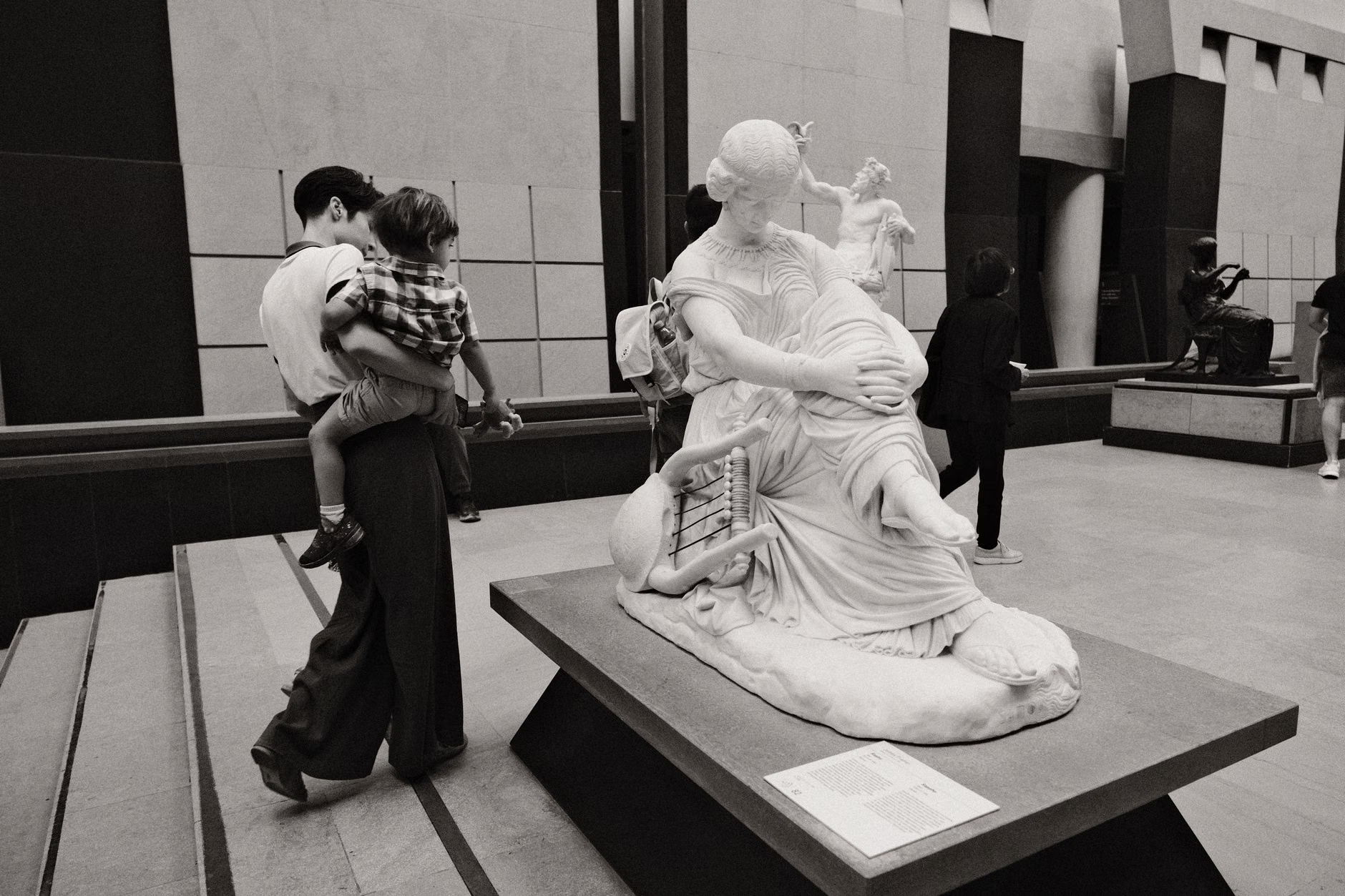
When you visit during the off-peak, you aren’t just a tourist; you become a temporary resident. You get the table at the local bistro that would have been booked solid three months in advance. You get the museum guide’s undivided attention. Most importantly, you remove the “crowd stress” that acts as a multiplier for parenting challenges. A hungry toddler is manageable; a hungry toddler in a three-hour queue for a cathedral is a crisis.
The Math of Off-Peak Travel
Let’s look at the reality of the numbers. According to recent tourism data, travel costs during the shoulder months (the transition periods between high and low season) can be significantly lower than during the peak summer months. We are talking about potential savings of 30% to 40% on flights and accommodation.
But the savings aren’t just monetary. You save time. Think of the “opportunity cost” of waiting in line. If you spend two hours a day in queues for four days, that is eight hours of your life lost. In the off-peak, that time is spent in a café, at a park, or actually seeing the art. That is a massive return on investment for a short, precious family break.
| Factor | Peak Season | Off-Peak Season |
|---|---|---|
| Accommodation Costs | Premium/Maximum | Discounted/Value |
| Crowd Density | High (Stressful) | Low (Relaxed) |
| Local Interaction | Transactional | Conversational |
| Planning Lead Time | Months in advance | Weeks in advance |
Choosing the Right City: The “Weather-Resilient” Framework
Not all cities are created equal when it comes to off-peak travel. The secret is to avoid cities that are strictly “seasonal.” If a city’s primary draw is a beach or an outdoor festival, going off-peak might be a mistake. Instead, look for “cultural anchors.”
A cultural anchor is a city with a dense concentration of indoor activities. Think of cities with incredible transit systems, museums, libraries, theaters, and a deep culinary culture. In 2026, cities like Berlin, Seoul, and Chicago are perfect examples. Even in the dead of winter or the rain of November, they offer a rich, immersive experience that doesn’t rely on the weather.
The “Three-Day Cultural Deep Dive” Strategy
When traveling with children in your 30s and 40s, the “see everything” approach is a recipe for disaster. Instead, try the “three-day deep dive.” Pick one neighborhood, one museum, and one local park. By staying in one area, you minimize transit stress and allow your kids to actually get familiar with their surroundings. Familiarity breeds comfort, and comfort breeds better behavior.
For example, if you are visiting a city like Kyoto or Paris off-peak, don’t try to cross the city twice a day. Spend your morning in a local market, your afternoon in a nearby park, and your evening at a restaurant within walking distance of your accommodation. This is the “15-minute city” concept applied to tourism. It makes the logistics of parenting feel like an extension of your normal life, rather than a frantic departure from it.
Managing the Practical Realities of Off-Peak Travel
Off-peak travel requires a different mindset. You cannot rely on the “tourist infrastructure” that is built for the masses. In July, every shop is open, and every tour is running. In November, some things might be closed for maintenance or shorter hours. This is actually a good thing, but it requires research.
You need to be a bit more “active” in your planning. Use tools like local city council websites or neighborhood blogs rather than generic travel portals. Look for what the locals are doing. If a local museum is closed on Mondays, that is usually a sign that it is a place where actual people go, not just a tourist trap that stays open 24/7 to extract fees.
The “Backup Plan” Mindset
When you are traveling with children, the “off-peak” weather can be a bit unpredictable. If you choose an off-peak month, you must have a “Plan B.” This is where the 30% savings from your flight and hotel should be partially reinvested. Use that extra budget to book a hotel with a pool, or a larger apartment with a kitchen and a living room.
If the weather turns, you don’t want to be trapped in a tiny hotel room. You want a space where the kids can play, where you can cook a simple meal, and where you can all recharge. The “off-peak” luxury is being able to afford a better space for the same price as a cramped, high-season room.
The Psychological Benefits of “Slow Travel”
There is a quiet, profound benefit to traveling when the crowds aren’t there. It changes your perception of time. When you are surrounded by thousands of people, your brain is constantly in “scanning mode”—looking for the exit, looking for the bathroom, looking for the kids. It’s a low-level, constant state of anxiety that we often mistake for “excitement.”
In the off-peak, that noise disappears. You can actually look at a building, or a painting, or your child, without being jostled. You have the space to think. For parents in their 30s and 40s, this is often the only time they get to truly “see” their family. You aren’t managing a logistics operation; you are spending time together.

Common Mistakes to Avoid
The most common mistake people make is trying to force a summer itinerary into a winter or shoulder-season trip. If you go to a northern city in February, don’t pack for a street-food tour. Pack for indoor comforts. Embrace the “hygge” or the “cozy” aspect of the city.
Another mistake is underestimating the length of the day. In many northern latitudes, the sun sets quite early in the off-peak months. This isn’t a problem, but it changes your schedule. Plan your outdoor activities for the middle of the day, and use the late afternoon and evening for indoor cultural experiences—museums, concerts, or long, slow dinners. Do not try to fight the clock; work with it.
Is Off-Peak Right for Your Family?
If you are the type of traveler who needs the “perfect” weather photo for social media, off-peak might be a challenge. But if you are the type of traveler who wants to actually remember the conversation you had with your spouse, or the look on your child’s face when they discover something new, then it is the only way to go.
It requires a bit more effort in the preparation phase. You have to check opening times, you have to pack more layers, and you have to be willing to be flexible. But the trade-off is a trip that feels like it belongs to you, rather than a trip that was manufactured for a brochure.
Think of your next trip not as a “vacation from life,” but as a “continuation of life in a different place.” That shift in perspective is the key to enjoying the world in 2026. You are not trying to conquer a city; you are trying to visit it. There is a world of difference between the two.
Practical Tips for 2026 Travel Planning
When you start researching your 2026 trips, look for the “second city” strategy. If you want to visit a popular country, don’t go to the capital. Go to the second-largest city. It will have all the culture, all the history, and a fraction of the crowds. And if you go in the off-peak, you will practically have the place to yourself.
Always verify your travel dates against local school holidays, even in the “off-peak.” Sometimes, a city is quiet for tourists but busy for locals because of a school break. A quick search for “school holidays in [City Name] 2026” will save you from an unexpected surge in crowds.
Finally, remember that the goal is not perfection. The goal is connection. If a museum is closed, or if it rains, or if you end up spending two hours in a café because the kids are tired—that is not a failed trip. That is a memory. That is the reality of travel. Embrace the imperfections, because that is where the real stories are found.
Encouragement for the Modern Traveler
Traveling with children is never “easy,” but it is always worth it. By choosing to step away from the peak-season herd, you are teaching your children that the world is not just a place to be consumed, but a place to be experienced. You are teaching them that patience, planning, and a bit of curiosity are the most valuable tools in any traveler’s kit.
So, look at your calendar for 2026. Find those quiet, overlooked weeks. Book the trip. And when you arrive, take a deep breath, ignore the map for a moment, and just walk. The city will be waiting for you, and for once, you won’t have to fight to see it.
Frequently Asked Questions
- How do I know if an off-peak city will have enough open attractions?
Check the official tourism board website for the city. Most provide a “seasonal” guide that lists what stays open. Focus on cities with established, year-round cultural institutions like national museums, state-funded theaters, and permanent historical sites, which rarely close regardless of the season. - Is it harder to travel with kids in the off-peak due to shorter daylight hours?
It changes the rhythm, but it doesn’t make it harder. Use the mornings for outdoor exploration and the late afternoons for indoor activities. It actually helps with bedtime routines, as the natural shift toward evening happens earlier, making it easier to settle into a “local” pace. - Should I worry about safety in less crowded, off-peak areas?
Generally, no. In fact, many travelers find cities safer when they are less crowded, as there is less “tourist-focused” petty crime like pickpocketing. Always stick to well-lit areas and use common sense, just as you would at home. Staying in neighborhoods where locals actually live is usually the best way to ensure a safe and authentic experience.
For further research on global travel trends and official city guides, visit the UN World Tourism Organization or your destination’s official city tourism portal.