The “Right-to-Disconnect” is no longer just a trendy buzzword for HR departments; by 2026, it is evolving into a standardized global workplace expectation that empowers you to legally and professionally ignore work communications outside of your designated hours.
- Legality: Governments worldwide are codifying the right to ignore emails and messages after hours to combat the “always-on” culture.
- Boundaries: You are the primary architect of your digital boundaries; clear communication with your team is more effective than waiting for policy alone.
- Sustainability: Protecting your personal time is a long-term career strategy, not a sign of laziness or lack of dedication.
We have all been there. It is 8:30 PM. You are finally sitting on the couch after putting the kids to bed, perhaps with a glass of wine or a cup of tea, when your phone buzzes. It is an email from a colleague in a different time zone, or a Slack message from your manager asking for a “quick” update on a project that is due tomorrow. The Pavlovian response kicks in: you feel that slight spike of cortisol, the urge to check, the pressure to reply so you don’t look “unproductive.”
For those of us in our 30s and 40s, this cycle is the primary driver of modern burnout. We are the “sandwich generation”—juggling high-pressure careers with the increasing demands of raising children or caring for aging parents. The 2026 legislative shifts toward the “Right-to-Disconnect” are a direct response to this exhaustion. But how do you actually implement this in your life without risking your career trajectory?
Understanding the Shift: Why 2026 is a Turning Point
The concept of the Right-to-Disconnect isn’t entirely new, but the momentum behind it is hitting a critical mass. Countries like France, Australia, and parts of Canada have led the charge, and by 2026, we are seeing a global ripple effect where labor laws are catching up to the reality of the smartphone era. The shift is based on a simple, albeit radical, premise: your employer pays for your time during set hours, not for your total availability 24/7.
Think of it like an old-school factory shift. When the whistle blew, the machines stopped, and the workers went home. Digital technology effectively broke that whistle. Now, the “whistle” has to be re-installed digitally. This isn’t about being anti-work; it is about recognizing that rest is a biological requirement for high-level cognitive performance. If you are constantly tethered to your inbox, your brain never enters the “recovery mode” necessary for creativity and long-term problem solving.
Many organizations are now being forced to adopt “Communication Charters.” These are internal documents that explicitly state when it is—and isn’t—appropriate to send non-urgent messages. By 2026, failing to respect these boundaries is increasingly viewed as a management failure rather than an employee’s lack of commitment.

The Anatomy of a Digital Boundary
If you wait for your company to hand you a permission slip to stop working, you might be waiting a long time. The most successful professionals I know—those who actually see their kids’ soccer games and manage to sleep through the night—are the ones who build their own boundaries. It is a process of “social contract renegotiation.”
Start by auditing your current communication habits. Are you the one sending emails at 10 PM, creating a cycle of expectation? If you are a manager, your behavior sets the tone for your entire team. If you are an individual contributor, you need to set expectations early. This isn’t about being difficult; it is about being predictable.
Step-by-Step: Setting Your Off-Duty Status
You don’t need a formal policy to start protecting your time today. Follow this framework to shift the expectations of your colleagues:
| Action | Strategy | Outcome |
|---|---|---|
| The “Delayed Send” Rule | Use the scheduling feature on your email client to send non-urgent messages at 9 AM the next day. | You stop training others to expect late-night replies. |
| Status Transparency | Clearly mark your calendar with “Personal Time” or “Focus Mode” blocks that are visible to your team. | Colleagues see your unavailability before they even decide to message you. |
| The “Emergency” Protocol | Define what constitutes a real emergency that justifies a text or phone call. | Everything else can wait until the morning, reducing anxiety for everyone. |
The goal is to move from “reactive” to “proactive.” When you communicate your boundaries clearly, you aren’t shutting people out; you are teaching them how to work with you effectively. Most people actually appreciate knowing exactly when they can expect a response, as it helps them plan their own workflows.
Managing the Guilt: The Psychology of the “Always-On” Professional
Let’s be honest: the hardest part of disconnecting isn’t the technology—it is the guilt. Many of us in our 30s and 40s have been conditioned to believe that our value is tied to our responsiveness. If we don’t reply in five minutes, we fear we are seen as “disengaged.” This is a cognitive trap.
In reality, the most respected people in an organization are often those who are the most deliberate. They prioritize deep work over constant pings. They don’t jump every time their phone vibrates. They are perceived as having a clear sense of purpose and control over their time. Protecting your time is an act of professional maturity, not a sign of detachment.
If you find yourself feeling anxious when you put your phone away, try “micro-disconnecting.” Start by turning off non-essential notifications for one hour each evening. Then move to two. The goal is to prove to your brain that the world does not, in fact, end if you don’t see an email at 9:15 PM.

The 2026 Landscape: What to Expect from Employers
As we move deeper into 2026, you will likely see a bifurcation in the job market. There will be companies that view the Right-to-Disconnect as a legal burden to be circumvented, and companies that view it as a competitive advantage. The latter will use “Work-Life Integration” as a key hiring pillar to attract top talent.
When you are interviewing or looking for a new role, don’t be afraid to ask about their communication culture. Questions like, “How does the team handle requests that arrive after standard working hours?” or “What is the expectation for weekend availability?” are not only acceptable, they are essential. A company that is defensive about these questions is a company that will likely contribute to your burnout.
Common Mistakes to Avoid
- The “Partial” Disconnect: You turn off notifications but keep the apps open on your computer, meaning you still see the unread badges. This provides the illusion of boundaries without the mental relief.
- Inconsistent Boundaries: Being “off-duty” on Tuesday but responding to emails at midnight on Wednesday sends a confusing message to your team. Consistency is the only way to build a credible boundary.
- Over-Explaining: You don’t need to justify your time off. You don’t need to say, “I’m sorry, I’m at dinner.” Simply saying, “I’ll be offline until tomorrow morning” is sufficient.
Remember that your employer is effectively “renting” your time. They are not buying your soul, your evening, or your weekends. By 2026, this distinction will be legally reinforced in many jurisdictions, but it starts with your own self-respect today.
Technological Tools for Maintaining Control
We are living in an era where the tools meant to make us productive are often the ones making us miserable. However, you can use these same tools to enforce your boundaries. Modern operating systems are now built with “Focus” or “Do Not Disturb” modes that are more granular than ever before.
Configure your phone to automatically switch to a “Personal” profile at 6 PM. During this time, only calls from your inner circle (spouse, children’s school, emergency contacts) should come through. All other apps, including email and Slack, should have their notifications silenced. This isn’t just about blocking noise; it is about creating a psychological space where you are “off the clock.”
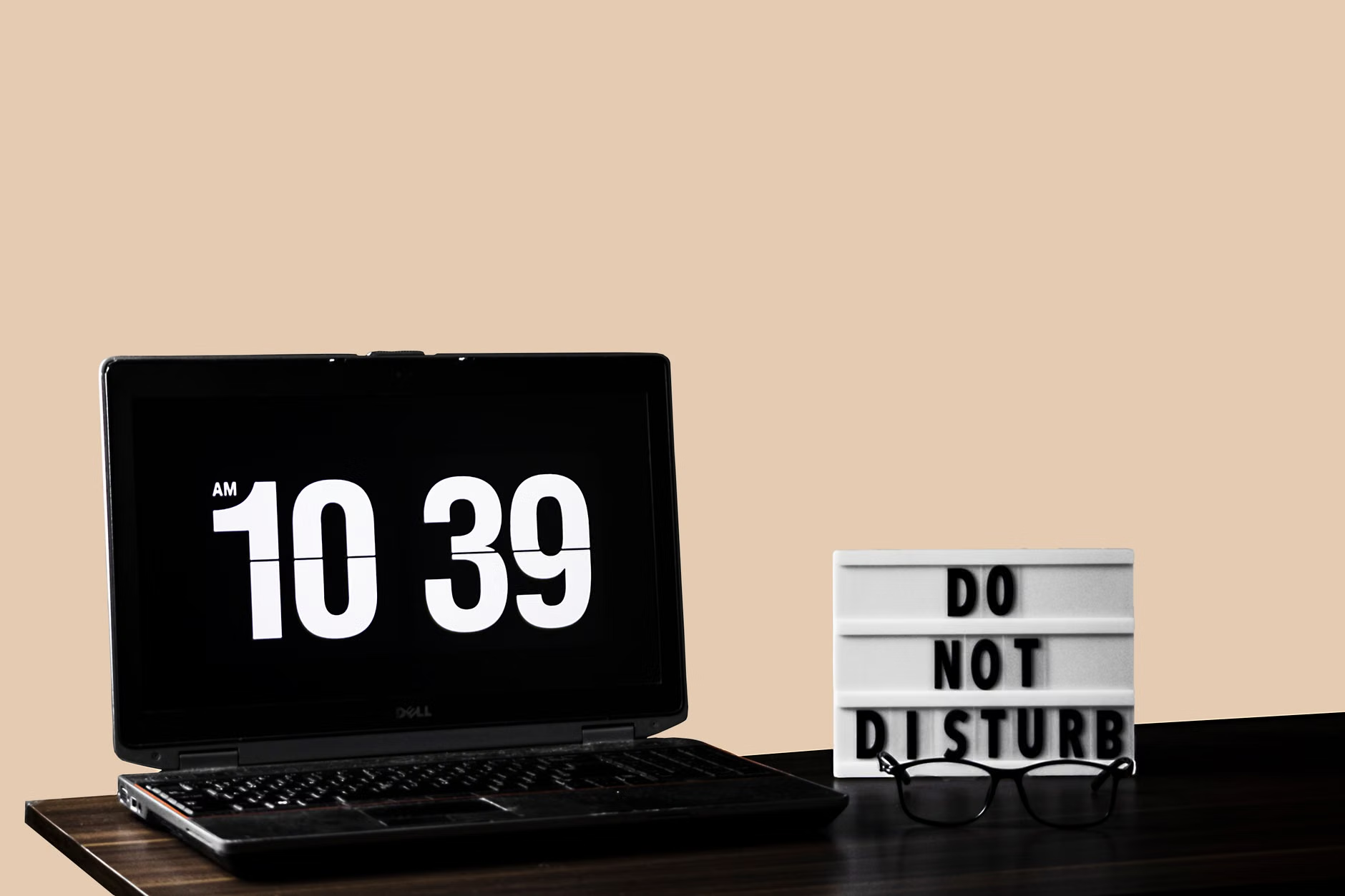
The “Right-to-Disconnect” is ultimately about reclaiming your attention. Every time you check a work email while you are with your children or trying to relax, you are giving your limited, precious attention to someone else’s agenda. By 2026, the people who have mastered the art of “switching off” will be the ones who are the most productive, the most rested, and the most satisfied in their personal lives.
The Long-Term Impact on Your Career
There is a persistent myth that if you aren’t the first to respond, you will be passed over for promotions. While responsiveness is a trait, it is not the *only* trait. In fact, consistently high-quality work, strategic thinking, and the ability to lead a team are far more valuable in the long run. If your career advancement depends entirely on your ability to answer emails at 11 PM, you are likely in a role that is inherently unsustainable.
By treating your off-duty time as non-negotiable, you are signaling that you have high standards for your own work-life balance. This often earns you more respect, not less. It shows that you are a professional who understands the value of time—both yours and your company’s.
As you navigate these changes, keep in mind that this is a transition. It won’t happen overnight, and there will be moments where you feel the pull to return to old habits. That is okay. The goal is to build a lifestyle that allows you to be present for the moments that truly matter, while still being a high-performer when you are on the clock.
Frequently Asked Questions
Does the Right-to-Disconnect mean I can never answer emails after hours?
No. It means you have the right to choose not to. If you are working on a global project with a tight deadline, you may choose to be flexible. The key is that the choice is yours, and it is not an implicit requirement for your job security.
How do I tell my boss I’m not responding after 6 PM without sounding insubordinate?
Frame it as a productivity strategy. Say, “I’ve found that I’m much more effective and focused during the day when I have a complete disconnect in the evenings. I’ll be checking back in at 8:30 AM to hit the ground running.” Most managers respect a clear, professional boundary that is tied to performance.
What if I am in a high-pressure industry like finance or healthcare?
These industries often have different requirements. However, even in high-pressure roles, there is a difference between “on-call” and “always-on.” Ensure your contract clearly defines your on-call status and provides appropriate compensation or time-in-lieu for those periods. If you are constantly on-call, that should be reflected in your compensation package.
In summary, the 2026 shift toward the Right-to-Disconnect is a significant milestone for everyone in their 30s and 40s. It acknowledges that your life outside of the office is just as important as your output inside of it. By setting clear boundaries, using your technology wisely, and communicating your needs with confidence, you can successfully navigate this new era of work-life balance. Protect your peace, stay consistent, and remember that you are more than just your job title.
For more information on the evolving labor laws regarding digital disconnection, you can refer to resources from the International Labour Organization (ILO) or your local government’s labor department websites, which are increasingly providing guidance on “Right-to-Disconnect” policies.