The secret to surviving holiday travel with your family isn’t about sticking to a rigid schedule, but rather adopting an “Adaptive-Routine” that prioritizes core anchors—like meal times and sleep windows—while leaving the rest of the day open for the inevitable chaos of transit.
Key Takeaways
- Anchor points: Keep two non-negotiable daily habits (e.g., bedtime and a morning snack) to provide a sense of security for children while traveling.
- The 70/30 Rule: Plan 70% of your day for necessary travel logistics and 30% for spontaneous downtime or recovery.
- Adaptive Tools: Use digital “buffer zones” and modular packing to reduce decision fatigue when things go off-plan.
If you are in your 30s or 40s, you likely remember a time when travel meant throwing a few clothes into a bag and heading to the airport. Now, travel is a logistical operation involving snack inventories, nap-time calculations, and the constant fear of a mid-flight meltdown. The holiday season adds a layer of pressure: the stakes are higher, the crowds are denser, and the expectations—from family and ourselves—are often unrealistic.
The “Adaptive-Routine” is a framework designed to bridge the gap between the structure kids need to feel safe and the flexibility parents need to keep their sanity. It isn’t a strict itinerary; it is a philosophy of flow.
Understanding the Psychology of Travel Routines
Why do we crave routine? For adults, routine is a comfort mechanism that saves cognitive energy. For children, it is the bedrock of their world. When you travel, you strip away the familiar walls, the specific bed, and the predictable kitchen. This creates “cognitive load”—a fancy term for the mental exhaustion that comes from processing too much new information at once.
When we travel, we often try to replicate our home routine exactly. We try to force a nap at 1:00 PM even if we are standing in a security line. When that fails, we feel like we’ve “ruined” the trip. The Adaptive-Routine acknowledges that you cannot control the environment, but you can control the anchors.
Think of an anchor as a non-negotiable ritual that happens regardless of where you are. If your child’s anchor is reading a specific book before bed, that book travels with you. If your anchor is having a hot coffee before the day starts, that happens even if it’s from a gas station or a airport kiosk. These small, consistent actions signal to your brain—and your children’s brains—that despite the change in scenery, the core of “us” remains the same.

Building Your Adaptive-Routine Framework
How do you build this? Start by categorizing your daily tasks into “Fixed” and “Fluid.” Fixed tasks are those that, if skipped, lead to immediate irritability or physical discomfort. Fluid tasks are those that can be moved, delayed, or abandoned entirely without consequence.
| Category | Examples | Management Strategy |
|---|---|---|
| Fixed | Medication, primary sleep windows, meal intervals | Prioritize these above all else. |
| Fluid | Sightseeing, complex meals, strict activity order | Adjust based on energy levels and transit delays. |
The most common mistake people make is treating fluid tasks as fixed. If you have a reservation for a museum at 2:00 PM, but your flight was delayed and your toddler is currently melting down in the terminal, the museum is no longer a fixed task. It is a source of stress. The Adaptive-Routine demands that you treat the “Fixed” items as the skeleton of your day, and the “Fluid” items as the skin that can stretch, tear, or be replaced as needed.
The 70/30 Rule: Managing Expectations
In project management, there is a concept called “buffer time.” If you think a task will take an hour, you plan for 90 minutes. In family travel, you need to apply this to everything. The 70/30 rule suggests that 70% of your day should be accounted for (travel, eating, sleeping) and 30% should be left entirely open.
That 30% is your “recovery window.” If your flight is on time and everything goes perfectly, that 30% becomes a fun extra—a leisurely lunch, a stroll through a local park, or just an hour of quiet time in the hotel. If things go wrong—which they often do—that 30% becomes your safety net. You don’t have to stress about missing a connection or a dinner reservation because you never scheduled anything into that 30% block to begin with.
This also helps with the “vacation fatigue” that hits around day three. We often try to pack our holidays with activities because we feel like we “should” be doing things. By building in that 30% buffer, you give everyone, including yourself, permission to just exist without an agenda. It is during these unscripted moments that the most memorable family interactions often happen.
Practical Tools for the Adaptive Traveler
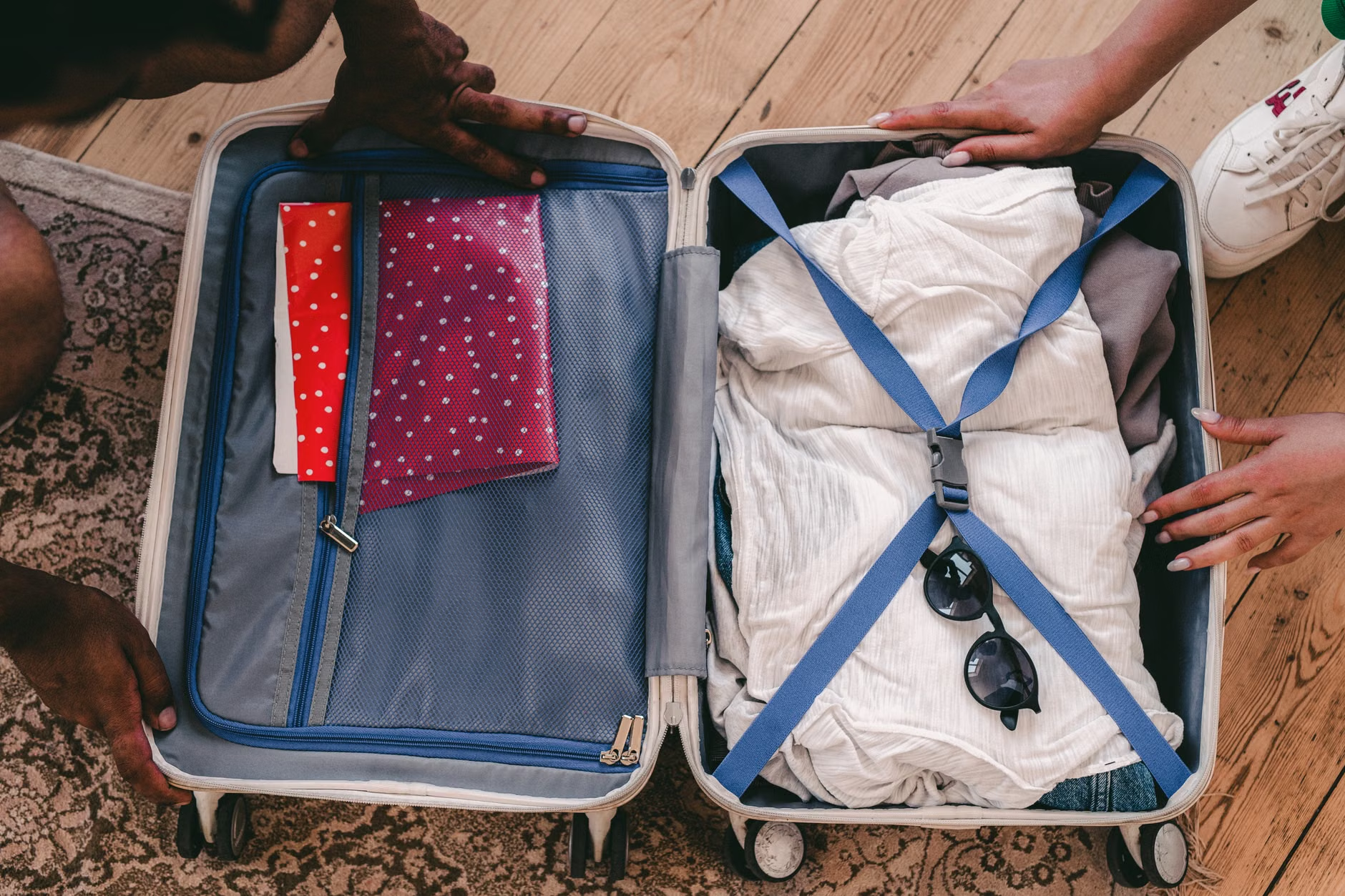
Being adaptive doesn’t mean being unorganized. In fact, it requires more preparation, not less. If you want to be flexible, your gear needs to be modular. If you have to switch trains or grab an Uber in a hurry, you don’t want to be dealing with three different bags and a stroller that is difficult to collapse.
Modular Packing: Use packing cubes. They allow you to pull out exactly what you need for a specific “anchor” (like a change of clothes for a nap) without dumping your entire suitcase onto the floor of an airport lounge. Treat your carry-on as a “survival kit” rather than a place to store extra clothes. Your survival kit should have chargers, non-perishable snacks, a small first-aid kit, and an “emergency” toy or activity that is only brought out during high-stress moments.
Digital Buffer Zones: While we often try to limit screen time at home, traveling is the time to relax those rules. Download offline versions of shows, games, or audiobooks that you know work well. These are your “digital buffer zones.” When you are in a long security line or stuck on the tarmac, these aren’t just entertainment—they are tools to regulate your child’s environment when the physical environment is hostile.
The “One-Bag” Rule for Kids: If your children are old enough, give them a small backpack that is their responsibility. Putting them in charge of their own “entertainment station” gives them a sense of agency, which is often lost during travel. If they feel like they have some control over their environment, they are less likely to resist the moments where they have to follow your lead.
Common Pitfalls and How to Pivot
Even with the best plans, things will go wrong. Your child will get sick, the airline will lose a bag, or the hotel will not be what you expected. The “Adaptive” part of the routine is your ability to pivot without guilt. Guilt is the biggest enemy of a parent on holiday. We feel guilty if we spend the day in the hotel room watching cartoons, or if we buy fast food instead of a healthy meal.
Let go of the “ideal” vacation. The purpose of holiday travel is connection, not optimization. If you spend your time obsessing over the perfect itinerary, you aren’t actually present with your family. If the day goes sideways, acknowledge it, adjust, and move on. You don’t need to “fix” the day; you just need to get through it comfortably.
Another common mistake is trying to over-socialize. During the holidays, there is often pressure to see extended family and friends. While this is a big part of the season, it can be overwhelming for children who are already dealing with the sensory overload of travel. Don’t be afraid to say “no” to an outing if you know your child is at their limit. Protecting your family’s energy is more important than attending every social gathering.
Reframing the Travel Experience
If you are traveling with a partner, the Adaptive-Routine should be a team effort. Discuss your “non-negotiables” before you leave. If you value sleep and your partner values being on time for flights, you need to find a middle ground that respects both. If you are a solo parent, the Adaptive-Routine is even more critical because your bandwidth is limited. Don’t be afraid to outsource or simplify. If that means buying overpriced airport snacks to avoid a grocery store run, consider that an investment in your mental peace.
Remember that children are remarkably resilient, but they mirror our stress. If you are panicked, they will be panicked. If you treat a missed flight as an adventure or an opportunity to get a snack in a new city, they are much more likely to follow your lead. This is the core of the Adaptive-Routine: you are the thermostat, not the thermometer. You set the temperature of the experience.
Final Thoughts on Sustaining Your Routine
As you prepare for your next trip, remember that the goal is not a “perfect” holiday. The goal is to reach your destination with your relationships intact and your stress levels manageable. By focusing on your core anchors, applying the 70/30 rule, and preparing your gear for modularity, you can build a travel experience that feels less like a military operation and more like a shared family journey.
Be gentle with yourself. You are navigating a complex world while trying to keep little ones happy and safe—that is a significant task. If the routine breaks, don’t worry. The Adaptive-Routine is designed to be rebuilt the next morning. Just reset your anchors and start again. That is the beauty of it: it works because it isn’t meant to be unbreakable.
For more official guidance on traveling with children and managing transit expectations, you can visit resources like the TSA’s guide to traveling with children or check the CDC’s advice for family travel health and safety. These sites provide the foundational facts you need to build your own specific plans around.
Frequently Asked Questions
Q: What if my child refuses to stick to the “anchor” schedule?
A: It is important to remember that anchors are for the parents as much as the children. If your child resists, don’t force it. Instead, adapt the timing. If they won’t nap at 1:00 PM, try a “quiet time” where they can look at books or listen to music. The goal is to maintain the *habit* of rest, even if the specific time shifts slightly.
Q: How do I handle the pressure from family members who expect a strict schedule?
A: Set expectations early. Let them know that you have a plan that prioritizes the children’s needs to ensure everyone stays happy and healthy. You don’t need to explain the details, just state your boundaries clearly and kindly. A simple, “We have a bit of a flexible schedule to make sure the kids get enough rest, so we might arrive a little later than expected,” is usually sufficient.
Q: Is it really okay to relax screen-time rules during travel?
A: Absolutely. Traveling is a high-stress environment for children. Think of digital tools as a “safety valve” rather than a reward or a distraction. Using them to help your child regulate their emotions during a long flight or a stressful transit is a responsible use of technology, not a failure of parenting.
Stay grounded, stay prepared, and remember that the best part of the trip is usually the part you didn’t plan for.