- Slow travel by train replaces airport stress with scenic, productive, or restful transit time, which is essential for parents needing a mental reset.
- Central Europe’s interconnected rail network allows for seamless multi-country trips without the need for rental cars or domestic flights.
- Strategic planning—such as booking seat reservations and choosing the right class—turns a commute into the highlight of your trip.
If you have ever spent four hours in an airport security line with a toddler or navigated the logistical nightmare of a rental car return in a foreign city, you know that modern travel often feels less like a vacation and more like a high-stakes endurance test. The solution isn’t necessarily to stop traveling; it is to change how you travel. Slow travel—the practice of prioritizing the journey over the destination—is not just a trend for backpackers. For those of us in our 30s and 40s balancing career demands and family life, it is the most effective way to actually feel rested by the time you reach your hotel.
Central Europe, with its dense rail network and historic city centers, is the world’s premier laboratory for this approach. By choosing the train, you aren’t just getting from Point A to Point B; you are reclaiming your time.
Why the Train Wins for Busy Parents and Professionals
When you are juggling a calendar that is color-coded by school pickups and quarterly reports, the idea of “slowing down” might sound like a luxury you cannot afford. However, slow travel is actually a strategy for efficiency. Think about the “hidden” hours of a flight: the two hours before departure, the transit to and from the airport, and the inevitable delays.
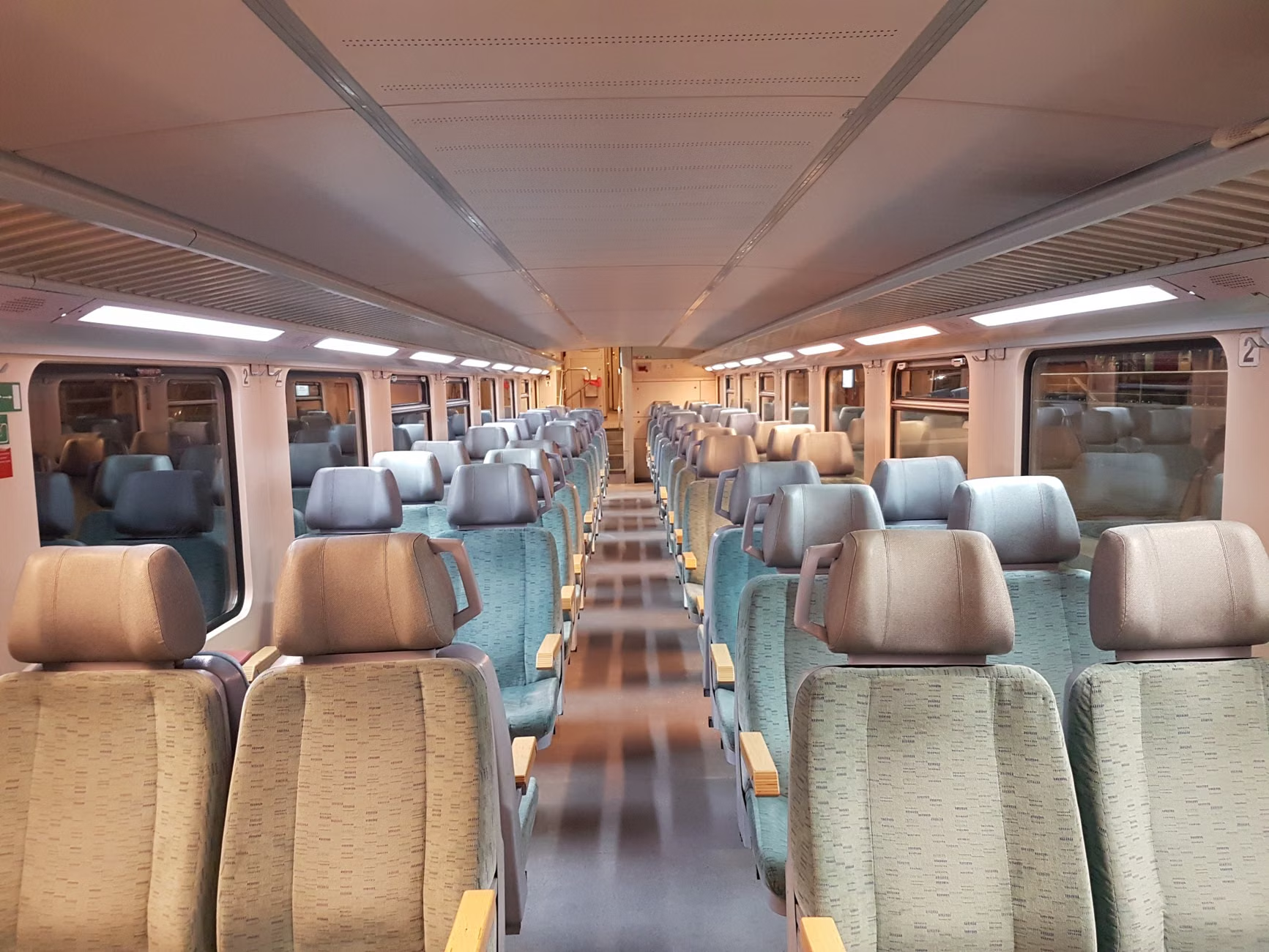
A train journey from Vienna to Budapest or Prague to Berlin is a different beast entirely. You arrive at a city-center station, walk onto the train, and immediately have access to power outlets, Wi-Fi, and—most importantly—space. For a parent, this means the ability to lay out a coloring book or a tablet without being cramped by a seatback in front of you. For a professional, it means a quiet, moving office. You are not “wasting” time in transit; you are using it.
Furthermore, the psychological shift is palpable. There is something inherently grounding about watching the landscape transition from urban architecture to rolling farmland at 150 kilometers per hour. It forces a cognitive “unplugging” that a pressurized cabin at 30,000 feet simply cannot replicate.
Mapping the Central European Rail Corridor
Central Europe is arguably the best region in the world for this kind of travel. The rail infrastructure is a legacy of the Austro-Hungarian Empire, meaning cities were designed to be connected by rail, not separated by highways. You can build a circuit that covers Austria, the Czech Republic, Hungary, and Southern Germany with almost zero friction.
Consider the “Golden Triangle” route: Prague to Vienna, and Vienna to Budapest. These legs are short enough to be manageable (all under 4 hours) but long enough to feel like a proper journey. You can leave your hotel in Prague after a leisurely breakfast and be checking into your hotel in Vienna by lunch. There is no “airport mode” where you have to be at the gate 90 minutes early. You just need to be on the platform.
Recommended Itinerary Structure
| Route Segment | Approx. Duration | Why It Works |
|---|---|---|
| Prague to Vienna | 4 hours | Scenic Moravian countryside views. |
| Vienna to Budapest | 2.5 hours | Quick, efficient, and frequent departures. |
| Munich to Salzburg | 1.5 hours | Perfect for a family day trip. |
The Logistics of “Slow” Planning
If you approach rail travel with the same anxiety you bring to air travel, you will miss the point. The key to slow travel is informed preparation. You don’t need to be a rail expert, but you do need to understand a few basic mechanics.
First, understand the booking window. European train operators, such as ÖBB (Austria), ČD (Czech Republic), and Deutsche Bahn (Germany), usually release tickets 60 to 90 days in advance. Unlike airlines, where prices fluctuate wildly based on search history, train prices are relatively stable, but they do rise as the departure date approaches. If you are traveling as a family of four, booking a “couchette” or a private compartment is a game changer. It gives you a dedicated space where the kids can move around without bothering other passengers.
Second, learn the difference between “Open” and “Reservation-Required” trains. In Central Europe, most regional trains are open, meaning you can jump on any train with a ticket. However, intercity trains (like the Railjet or EuroCity) often benefit from, or require, a seat reservation. Do not skip this step. Paying the extra 3 to 5 Euros for a guaranteed seat is the difference between a relaxing journey and standing in the vestibule with your luggage for three hours.
Common Pitfalls and How to Avoid Them
Even with the best intentions, things can go sideways. The most common mistake is the “tight connection.” If you are traveling with kids or heavy luggage, do not schedule a transfer that requires you to change trains in 10 minutes. Even if the platform is right across the tracks, a minor delay on the first train will cause a cascade of stress. Aim for at least 45 to 60 minutes between connections. Use that extra time to grab a coffee or a local pastry at the station.
Another common issue is luggage management. We all want to pack for every scenario, but train travel requires a different strategy. You have to carry your own bags onto the train and lift them into the overhead rack. If you are traveling as a couple, the “one big suitcase” rule is a trap. It is much easier to manage two medium-sized bags than one massive, heavy trunk. Also, look for “luggage storage” services at major stations if you have an early checkout and a late train. It is a small fee that buys you hours of freedom to explore without your bags.
Technology to Make Your Life Easier
You don’t need a stack of paper tickets anymore, but you do need a reliable digital ecosystem. Download the official app for the primary rail operator in the region where you are starting (e.g., the ÖBB Scotty app is fantastic for all of Central Europe, even for trains outside of Austria). These apps provide real-time platform information, delay alerts, and even carriage maps that show you exactly where your car will stop on the platform.
A portable power bank is a non-negotiable item. While most modern trains have power outlets, they are sometimes finicky or occupied. Having your own backup ensures that you can keep the kids entertained or your navigation apps running without worry. Also, download offline maps of the cities you are visiting. Even if your roaming data is active, station basements or remote valleys can be “dead zones” where you really don’t want to be guessing which way to the hotel.
Embracing the Pace
The beauty of slow travel is that it allows for spontaneity. If you see a beautiful village from the window, you have the option to get off, explore for a few hours, and catch a later train. This is the antithesis of the “flight-to-hotel-to-tour” pipeline. It requires you to be slightly less rigid with your itinerary, which is admittedly hard for those of us who have spent years managing chaotic schedules.
Start small. If you are nervous, try a single, short train leg on your next trip. See how it feels to arrive at a destination without having gone through security, without having to remove your shoes, and without being treated like a piece of cargo. You might find that the journey becomes the part of the trip you actually look back on with the most fondness.
Remember, travel is not a race. You aren’t trying to “complete” Europe. You are trying to experience it. By slowing down, you give yourself the permission to actually observe the world around you, rather than just rushing through it.
Frequently Asked Questions
Is it cheaper to travel by train than by flight in Europe?
It depends. If you book well in advance, train travel is often competitive with budget airlines. When you factor in the cost of airport transfers (taxis or airport express trains) and baggage fees, which are often included in train tickets, the train is frequently the more cost-effective and transparent option.
What should I do if my train is delayed or cancelled?
Central European rail operators have robust passenger rights protocols. If a train is delayed, you can often use your ticket on the next available train without penalty. If a major disruption occurs, speak to the station service desk immediately. They are accustomed to rebooking passengers and can often help you navigate alternative routes that aren’t immediately obvious on your app.
Are trains in Central Europe safe for families?
Extremely. In fact, most trains feature dedicated “family zones” or carriages with more space for strollers and children. The environment is generally much quieter and more relaxed than an airplane cabin. Just be mindful of your belongings when the train stops at stations, as is standard practice in any public space.
For more detailed planning, you can check the official European rail resources such as ÖBB (Austrian Federal Railways) or Deutsche Bahn to compare routes and schedules. Taking the time to look at these platforms before your trip will help you build a realistic and stress-free itinerary that respects your need for both adventure and downtime.