- Cost vs. Value: While train tickets can seem pricier than budget flights, they eliminate hidden costs like airport transfers, baggage fees, and expensive terminal meals.
- The “Door-to-Door” Reality: For trips under 600km, the total travel time for a train is often identical to flying when you factor in security queues and travel to city-center airports.
- Planning for Success: Always book “flex” fares if traveling with children to avoid losing your investment due to last-minute illnesses or schedule changes.
If you are in your 30s or 40s, the “vacation” you once knew—rushing to the airport at 4 AM, stripping off your shoes for security, and praying your toddler doesn’t have a meltdown in a confined metal tube—has likely lost its charm. You aren’t just looking for a destination anymore; you are looking for a way to get there without losing your sanity. This is where the slow-travel movement comes in.
Slow travel isn’t just about being “green” or taking the scenic route; it’s a strategic decision to prioritize the journey as part of the vacation experience. By choosing the train, you reclaim your time. Instead of being strapped into a seat while the world passes by at 30,000 feet, you are moving through the landscape, with room to walk, space to work, and the ability to actually talk to your family.
Why the Train Wins for Parents in Their 30s and 40s
Let’s be honest: the primary hurdle for parents is logistics. When you travel by air, you are at the mercy of strict weight limits, liquid restrictions, and the unpredictable nature of airport security. When you travel by train, the “infrastructure” of your trip changes entirely.
The “Terminal Stress” Factor: Research into travel stress consistently points to the airport environment—noise, crowds, and rigid security checkpoints—as the primary cause of pre-vacation anxiety. On a train, you arrive at the platform 15 minutes before departure. There are no security lines for your shampoo or your toddler’s water bottle. You walk on, stow your bags in the overhead rack, and sit down. The transition from “home mode” to “travel mode” is immediate and significantly calmer.
The Productivity and Connection Trade-off: If you are a remote worker or a freelancer, the train is essentially a mobile office. Most modern rail services offer stable Wi-Fi and, crucially, standard power outlets. Unlike a plane, where you are crammed into a seat that barely accommodates a laptop, train seats typically offer a fold-down table and enough legroom to actually get work done. For families, this means the “travel time” isn’t dead time. It’s time to play cards, read, or simply look out the window—a lost art in the age of constant streaming.

Calculating the Real Cost: Why the Sticker Price is Deceptive
It is common to compare the price of a train ticket to a budget airline ticket and conclude that the train is “too expensive.” However, this is a classic case of comparing apples to oranges. To understand the true cost, you must look at the total door-to-door expense.
Consider this scenario: A family of four flying from a major city center to a destination 500km away. A budget airline might advertise a fare of $80 per person. Total: $320. But add in:
- Airport Transfers: $60 (Uber/Taxi to the airport).
- Baggage Fees: $100 (checked bags are rarely included in budget fares).
- Food at the Airport: $80 (a quick lunch at the terminal).
- Total: $560.
Now, compare that to a train ticket at $130 per person. Total: $520. Even if the train is slightly more expensive on paper, you are arriving in the city center of your destination, saving the cost of an expensive train or taxi from the distant airport. Furthermore, you can bring your own food and drinks on the train without restriction, saving you the “captive market” pricing of airport terminals.
| Factor | Budget Airline | Slow-Travel Train |
|---|---|---|
| Check-in Time | 2-3 hours before | 15-20 minutes before |
| Baggage Policy | Strict weight/size limits | Generous; no liquid limits |
| Space | Cramped; limited movement | Walkable; larger seats |
| Arrival Point | Often outskirts of city | City center |
How to Plan Your Route Without Losing Your Mind
The biggest mistake travelers make when transitioning to train travel is trying to replicate the “point-to-point” efficiency of flying. If you try to force a 12-hour train ride into a schedule that was designed for a 1-hour flight, you will be miserable. The key to successful slow travel is to treat the train ride as a destination in itself.
1. Master the “Mid-Point Stop” Strategy
If your destination is more than 6 hours away, don’t do it in one go. Look for a city halfway along the route. Spend one night there. It turns a grueling day of travel into two easy, manageable legs of the trip. This is particularly helpful if you have children who struggle with being confined for long periods.
2. Choosing the Right Class
In your 30s and 40s, you have the budget to prioritize comfort. Always look for “Premium” or “Business” class on long-haul routes. The cost difference is often minimal compared to the overall trip cost, but the benefits—wider seats, quieter carriages, and included meal service—are massive. When traveling with kids, a “Family Carriage” or an area with a table is worth its weight in gold.
3. Booking Tools and Apps
Don’t rely on generic travel search engines. They often miss regional rail operators. Use dedicated platforms like The Man in Seat 61 for deep-dive advice on specific routes or regional apps like Eurail (for Europe) or Amtrak (for the US). These sites provide the specific knowledge you need to navigate seat reservations and pass requirements.
Common Mistakes That Ruin the Experience
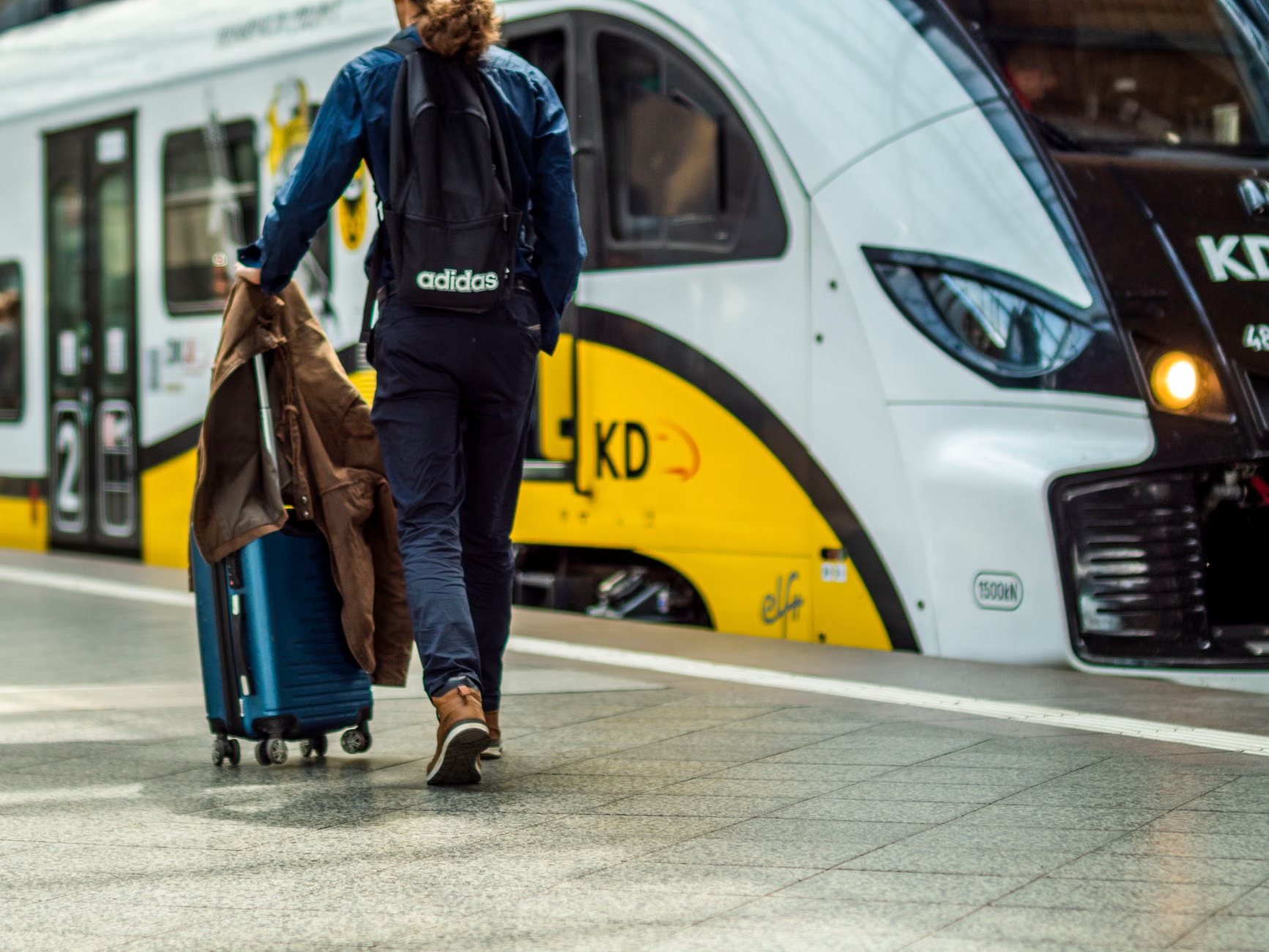
Even with the best intentions, it is easy to fall into traps that make train travel feel like a chore. The most common mistake is over-packing. On a train, you are responsible for your own luggage. You have to lift it onto the train, maneuver it down the aisle, and heave it onto the rack. If you can’t lift your suitcase above your head, you have packed too much. Aim for a “one-bag” philosophy for each family member to keep mobility high.
Another frequent error is ignoring the seat reservation. On many European and Asian high-speed networks, a ticket allows you on the train, but it does not guarantee a seat. In peak season, this can leave you standing in the vestibule for four hours. Always, without exception, pay the small fee for a seat reservation, and prioritize “quiet carriage” or “family carriage” designations based on your needs.
Finally, don’t rely solely on train Wi-Fi. While many modern trains have great connectivity, it often drops in tunnels or remote areas. Download your movies, music, and podcasts before you leave the house. Treat the Wi-Fi as a bonus, not a requirement.
The Hidden Value of the “Slow” Mindset
Why bother with all this? Because the current, frantic pace of life often leaves us feeling like we are just “checking boxes” on our vacations. We arrive at a destination, take the photo, and move on. Slow travel forces a change in perspective. When you take the train, you see the suburbs shift into farmland, the farmland into forests, and the forests into cities. You see the geography of a country in a way that is impossible from the air.
For parents, this is an educational opportunity. Your children get to see the scale of the world. They learn that the world is big, that it takes time to get from one place to another, and that the transition between places can be just as interesting as the destination. It is a lesson in patience that we are all, quite frankly, lacking in our daily lives.

A Practical Checklist for Your First Slow-Travel Trip
If you are ready to book, follow this decision-making framework to ensure your trip is actually enjoyable:
- The 600km Rule: If the destination is under 600km, the train is almost always better than flying when you account for the “door-to-door” time. If it is over 600km, consider a sleeper train.
- Sleeper Trains are Time Machines: A night train is the ultimate “slow travel” hack. You board in one city, sleep in a bed, and wake up in your destination. You save the cost of a hotel night, and you don’t lose a day of your vacation to travel.
- Flexibility is Everything: If you are traveling with kids, always book refundable or “flex” tickets. Life happens. A sick child or a change in plans shouldn’t cost you hundreds of dollars.
- Know the Platform: Download the rail operator’s app. It will give you real-time platform changes, delay notifications, and the ability to order food directly to your seat.
The shift to slow travel isn’t about being a “purist.” It is about making a conscious choice to prioritize your mental health and your family’s comfort. We spend our lives in the fast lane, rushing from one commitment to the next. Your vacation should be the one time you get to step off the treadmill. By choosing the train, you are not just getting to a place; you are giving yourself the gift of a transition, a moment to breathe, and the chance to actually enjoy the scenery of your own life.
Next time you are planning a trip, look at the map. Forget the airport codes for a moment. Look for the rail lines. You might be surprised at how much more enjoyable the trip becomes when you stop trying to beat the clock and start trying to enjoy the ride.
Frequently Asked Questions
Q: Is train travel actually cheaper than flying for a family of four?
A: It depends on the distance and how far in advance you book. For short-to-medium distances, yes, it is often cheaper when you factor in the “hidden” costs of flying like airport transfers, baggage, and terminal food. For very long distances, flying may be cheaper, but the difference is often worth the extra comfort and lower stress levels of the train.
Q: What if I have a lot of luggage?
A: Unlike airlines, most trains do not have strict weight limits, but you are limited by what you can physically carry. If you are traveling with a lot of gear, consider using a luggage forwarding service—many major rail stations in Europe and Asia offer services that will ship your bags to your hotel for a fee, allowing you to travel light on the train.
Q: How do I handle delays or missed connections?
A: Always allow for a “buffer” between connections. If you are switching trains, try to leave at least 45-60 minutes between arrivals and departures. If you are on a single ticket, the rail operator is generally responsible for rebooking you if a delay causes you to miss your connection. If you book separate tickets, you are on your own, so always prioritize booking through-tickets whenever possible.
For further research on specific routes and rail planning, visit The Man in Seat 61 for comprehensive global rail guides.