A “Forest-School” weekend immersion is not just a glorified camping trip; it is a structured, intentional shift away from the digital noise and high-pressure schedules that dominate our lives in our 30s and 40s, offering a proven path to lower cortisol levels for parents and higher cognitive engagement for children.
- The “Green Time” Threshold: Research suggests that even 48 hours of immersion in a forest environment significantly reduces physiological stress markers in adults and improves attention span in children.
- Unstructured Play is Essential: Unlike weekend sports or organized classes, forest-school weekends prioritize child-led exploration, which builds executive function and resilience.
- The Digital Detox Effect: By removing screen-based distractions, parents can move from “monitoring” their children to “collaborating” with them, effectively resetting the family dynamic.
If you feel like your weekends are currently just a frantic extension of your work week—rushing between soccer practice, grocery shopping, and catching up on emails—you aren’t alone. For those of us in our mid-30s and 40s, the “weekend” has become a logistical challenge rather than a time for restoration. We are trying to balance the demands of our careers with the ever-increasing pressure to ensure our children are “optimized” for the future through constant extracurriculars.
But what if the best thing you could do for your child’s development—and your own mental health—is to stop doing? This is the core philosophy of the forest-school movement. It’s an approach to learning and living that takes place entirely outdoors, focusing on risk-taking, curiosity, and the inherent educational value of the natural world.

Why Your Brain Needs a Forest Reset
When we talk about “forest immersion,” we aren’t just talking about a walk in the park. We are talking about deep exposure to natural environments that lack the artificial stimuli—the flashing blue light of screens, the hum of traffic, the constant notifications—that keep our nervous systems in a state of low-level “fight or flight.”
For a parent, this is a physiological necessity. Research from the International Journal of Environmental Research and Public Health consistently shows that spending time in forest environments lowers blood pressure, reduces the production of stress hormones like cortisol, and increases the activity of natural killer (NK) cells, which are crucial for our immune system. When you are in your 30s or 40s, your body is often operating in a state of chronic depletion. A weekend of immersion isn’t a luxury; it’s a biological “reboot.”
For children, the benefit is different. Modern childhood is often characterized by “adult-led” activities. From school to piano lessons to organized sports, children are rarely in charge of their own time. A forest-school weekend flips this script. When a child is left to explore a forest, they are forced to make decisions: Is this branch strong enough to climb? How do I cross this stream without getting wet? What happens if I turn over this rock? This is the crucible of executive function—the ability to plan, focus, and solve complex problems.
What a Forest-School Weekend Actually Looks Like
If you are used to the structure of a hotel stay or a resort, a forest-school immersion will feel different. There is no itinerary, no check-in desk, and no “kids’ club” where you drop your children off so you can go to the spa. The experience is designed to be co-participatory.
In a typical forest-school immersion, the schedule is governed by the environment, not the clock. Here is how a standard Saturday might unfold:
| Timeframe | Activity Focus | Objective |
|---|---|---|
| 08:00 – 09:30 | Slow Breakfast | Transitioning from the “hurry” of the city to the “rhythm” of the woods. |
| 09:30 – 12:30 | Deep Exploration | Child-led navigation, tracking, and sensory observation. |
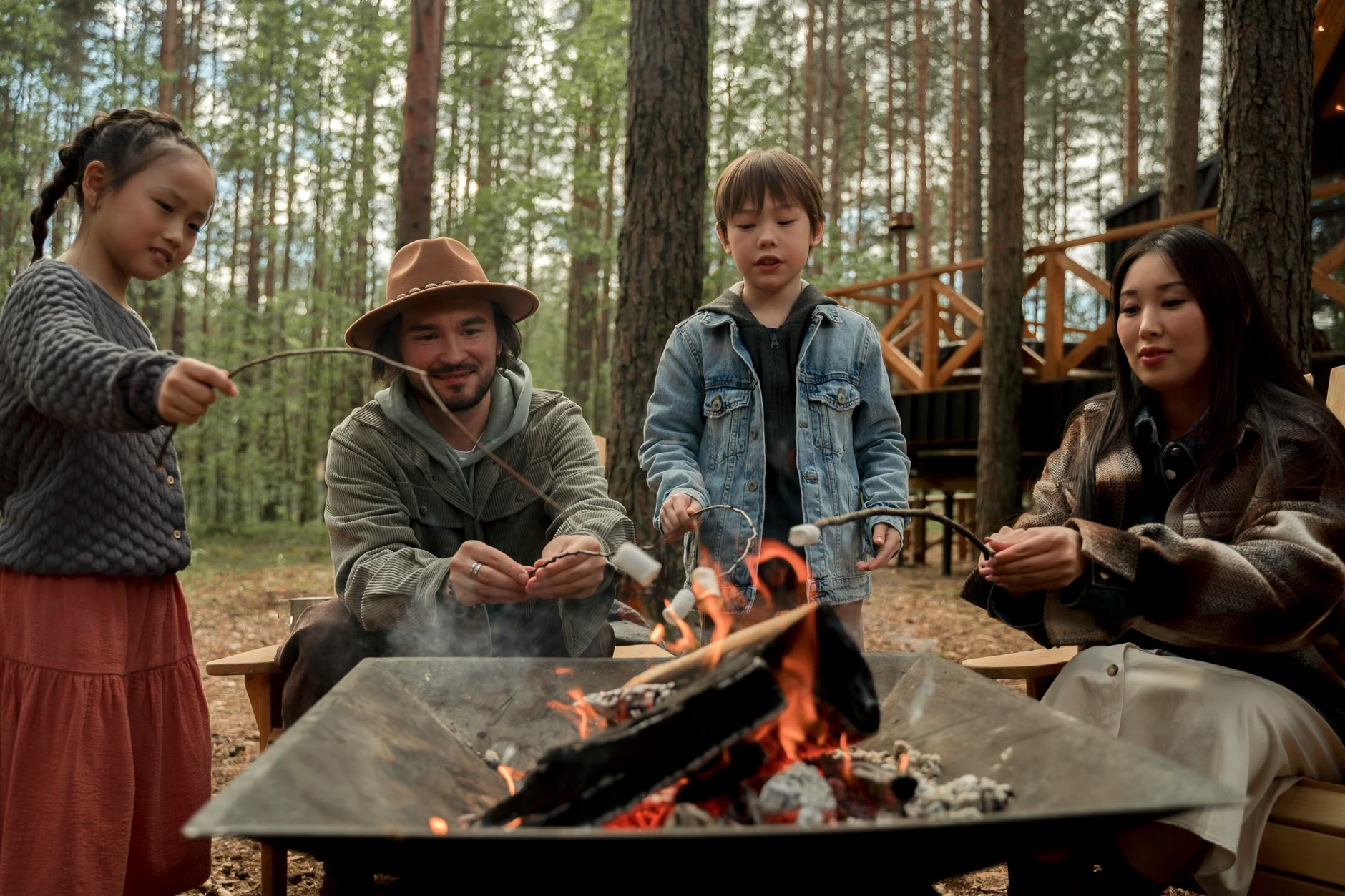
| 12:30 – 14:00 | Foraging & Lunch | Learning about local flora and preparing food over a fire. |
| 14:00 – 17:00 | Project-Based Play | Building shelters, crafting tools, or observing local wildlife. |
The key here is the absence of screens. When you remove the ability to “Google the answer” or “watch a video to pass the time,” you force the brain to engage with the immediate environment. You will find that after the initial withdrawal phase—where your child might complain of being “bored”—they will naturally pivot to creative problem-solving. This “boredom” is actually the gateway to deep, sustained focus.
Common Mistakes and How to Avoid Them
Many parents go into outdoor weekends with the wrong mindset: they treat it like a “task” to be completed. They pack too much gear, plan too many activities, and get frustrated when the weather doesn’t cooperate. If you want this to be a successful immersion, you need to adjust your expectations.
1. Over-packing and Under-preparing
The biggest mistake is bringing “city gear” into the woods. You don’t need a massive tent with five rooms; you need a high-quality, weather-resistant shelter and proper clothing. The rule of thumb for outdoor comfort is: There is no such thing as bad weather, only bad gear. If you and your children are cold or wet, you will not have an immersive experience; you will be miserable. Invest in high-quality wool base layers and waterproof outer shells. You don’t need to spend a fortune, but you do need gear that works.
2. The “Achievement” Trap
Don’t try to “teach” your child the forest. Don’t pull out a field guide and quiz them on leaf shapes. The goal is observation, not acquisition. If your child wants to spend three hours watching ants carry crumbs, let them. If you try to force an educational curriculum onto the weekend, you are just replicating the school environment in a different location. The magic happens when the child directs the learning.
3. Forgetting the “Soft” Transition
You cannot go from a high-stress, high-speed Friday night of work and commute to a deep-forest immersion on Saturday morning without a buffer. Plan for a “deceleration phase.” Arrive at your location on Friday evening, set up your camp, and do nothing but eat dinner and sleep. Give your brain and your children’s brains time to adjust to the change in pace. If you start the weekend at 100 miles per hour, you will spend the entire first day just trying to slow down.
How to Choose the Right Immersion Experience
Not all “forest schools” or “nature retreats” are created equal. Depending on where you live, you might find a spectrum ranging from highly organized, guided weekend workshops to self-guided, wild-camping opportunities. Here is how to evaluate which is right for your family:
- The Guided Workshop (Best for Beginners): If you have never done this before, look for a weekend hosted by a certified forest-school leader. They provide the structure, the safety protocols, and the expert knowledge to help you get comfortable. This is lower risk and higher support.
- The Community Gathering (Best for Socializing): Some forest-school collectives host “camps” where multiple families come together. This is great if your child needs peers to stay engaged, but be aware that it can become a social event rather than a nature immersion.
- The Solo Immersion (Best for Deep Reset): Once you have the skills, the most transformative experience is just your family, alone in the woods. This is where the true, quiet connection happens.
When searching for providers, look for organizations that prioritize Leave No Trace principles. This is not just about environmental ethics; it is about teaching your children that we are guests in nature, not masters of it. This distinction is vital for cultivating empathy and long-term environmental stewardship.
The Hidden Costs and Trade-offs
It is important to be realistic about the trade-offs. A weekend in the woods means you are disconnected from your professional life. If your career requires constant availability, you will need to plan for that. The “hidden cost” of a forest-school weekend is the emotional labor of letting go. You will likely feel a persistent itch to check your phone, to “fix” a situation that doesn’t need fixing, or to keep your child clean and safe at all costs.
Resistance is normal. Your brain is conditioned to seek out the dopamine hit of the digital world. When you take that away, you will feel irritable. Acknowledge this feeling. It is the sign that your brain is recalibrating. If you can push through the first 24 hours, the second day is almost always where the “flow state” begins.
Also, consider the physical reality. It is dirty. It is uncomfortable at times. You might be cold. You might have to deal with bugs. If you go into this expecting a “glamping” experience, you will be disappointed. If you go into this expecting a raw, authentic, and challenging experience, you will be rewarded with a level of family connection that is impossible to replicate in a hotel room.
Step-by-Step Guide to Your First Weekend
If you are ready to take the plunge, don’t overcomplicate it. Follow these steps to ensure your first weekend is a success:
- Choose a location within 2 hours of home. Do not spend your weekend driving. The travel time should be minimal to maximize the time on the ground.
- Prepare your “No-Tech” zone. Decide on a policy for devices. Maybe you keep them in the car, or maybe you use them only for emergency navigation. Whatever you decide, make it clear and stick to it.
- Focus on the “Big Three”: Shelter, warmth, and food. If you have those three covered, everything else is just bonus. Don’t worry about activities. The woods provide the activities.
- Debrief on the way home. On the drive back, ask your children: What was the most surprising thing you found? What was the hardest part? What do you want to do next time? This helps them process the experience and solidify the lessons learned.
Remember that the goal is not to have a “perfect” weekend. The goal is to have a “human” weekend. There will be arguments. There will be moments where you miss your bed. That is all part of the process. The resilience you build together as a family during these moments is exactly the point.
Long-term Impact on Family Dynamics
What happens when you return to the “real world”? Many parents report that the benefits of a forest-school weekend extend far beyond the Monday morning return to work and school. By spending an entire weekend in a collaborative, nature-based environment, you are essentially “re-wiring” the communication channels in your family.
You have moved from a transactional relationship—“Did you do your homework? Did you brush your teeth? Did you finish your chores?”—to a relational one. You have been building a shelter together. You have been watching the same fire. You have been listening to the same wind. These shared experiences create a “memory bank” that you can draw on when the stresses of the week start to mount.
Furthermore, you are teaching your children that they are capable of navigating the world without a screen in their hand. This is a profound gift. In an age where children are increasingly anxious and dependent on digital validation, the ability to find contentment in the silence of the woods is a superpower. It provides them with a “home base” within themselves that they can return to whenever life feels overwhelming.
For parents, the change is equally profound. You realize that you don’t need to be the “manager” of your children’s lives. You can be their partner, their guide, and their companion. This shift in perspective can alleviate much of the guilt that accompanies modern parenting. You stop worrying about whether they are “ahead” or “behind” and start focusing on whether they are engaged, curious, and connected.
Frequently Asked Questions
1. How young is too young for a forest-school weekend?
There is no minimum age, but the approach changes. For toddlers, it is about sensory play—touching textures, smelling the air, and crawling on different surfaces. For school-aged children, it becomes about risk-taking and project-based learning. The key is to adjust your expectations for distance and difficulty based on your child’s age.
2. What should I do if the weather forecast is bad?
Unless it is dangerous (e.g., severe storms or extreme heat), bad weather is actually part of the curriculum. Learning to manage rain or wind is a vital skill. It teaches children that they can be comfortable even in adverse conditions if they are prepared. If you cancel at the first sign of rain, you are missing out on some of the most educational moments of the trip.
3. Do I really need to stay overnight?
While a day trip is better than nothing, the “immersion” effect—where the nervous system truly begins to downshift—usually happens after the first night. The evening and early morning hours in a forest are when the most significant biological and psychological changes occur. If you can, aim for at least one night of camping to get the full benefit.
Final Thoughts: The Priority of Presence
The forest-school weekend isn’t just about spending time outdoors; it’s about reclaiming your capacity for presence. In our 30s and 40s, we are constantly being pulled into the future (planning, worrying) or the past (reflecting, regretting). The forest demands that you be in the present. It demands that you listen to the snap of a twig, the shift of the wind, and the rhythm of your child’s breath.
If you take one thing away from this, let it be this: Your children do not need more organized activities. They do not need more expensive toys. They need you to be present, and they need a space where they can be themselves. The forest is that space. It is waiting for you, and it is the most effective tool you have for resetting your family’s trajectory toward a healthier, more balanced life.
Start small. Plan your first weekend. And when you arrive, leave your phone in the car, take a deep breath, and let the forest do the rest.
For more information on forest-school principles and finding local groups, you can visit the Forest School Association or check your local national park service for designated wilderness camping areas.