The most effective way to reclaim your sanity in a busy urban apartment is to stop fighting the noise and start architecting “Quiet Zones”—dedicated physical buffers that separate high-activity family areas from your personal focus spaces.
- Buffer Architecture: Use “dead spaces” like closets, hallways, or heavy bookshelves as acoustic shields between high-traffic areas and your workspace.
- Acoustic Zoning: You don’t need a renovation to create a quiet zone; soft furnishings, heavy curtains, and floor-to-ceiling rugs can reduce decibel transmission by up to 20-30%.
- The 3-Zone Rule: Organize your floor plan into “Active” (kitchen/play), “Transition” (storage/hallway), and “Quiet” (bedroom/office) to minimize daily friction.
If you live in a typical 80-square-meter apartment, you’ve likely experienced the “sound-bleed” phenomenon. It’s that moment when your child’s cartoon volume or the clatter of dishes in the kitchen makes it impossible to focus on a work call or a moment of meditation. We often blame the thin walls, but the real issue is usually the lack of acoustic zoning.
Urban apartments are designed for efficiency, not necessarily for the multi-faceted lives we lead in our 30s and 40s. When your home is your office, your gym, and your daycare, the lack of physical boundaries leads to mental fatigue. Let’s look at how you can apply professional architectural principles to your current living situation to create a sanctuary of silence.
Understanding the ‘Quiet-Zone’ Architectural Philosophy
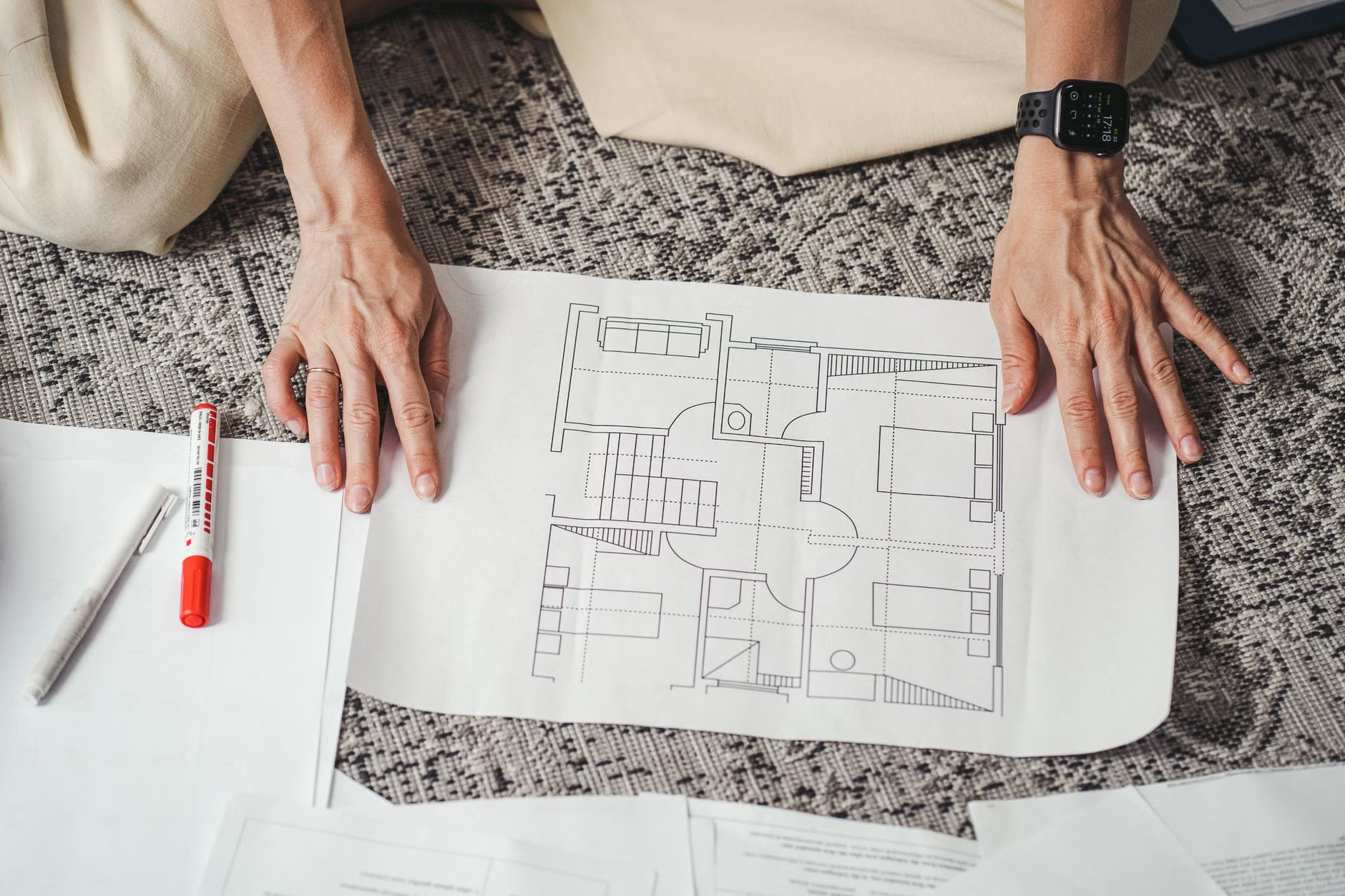
In high-end architectural design, “Quiet-Zone” planning refers to the strategic arrangement of rooms to prevent sound transfer. Architects call this the “buffer technique.” The goal is to ensure that the most active rooms—like the kitchen, living room, and children’s play area—do not share a wall with the most passive rooms—the bedroom or home office.
For those of us living in existing apartments, we cannot move the kitchen plumbing. However, we can use the “buffer principle” to create our own zones. The core of this philosophy is intentional mass. Sound travels through air gaps and vibrates through thin partitions. By placing heavy, dense objects between a noisy room and a quiet room, you interrupt the sound wave’s path.
Think of your apartment not as a collection of rooms, but as a spectrum of activity. On one end, you have the “Loud Zone” (the kitchen and play area). On the other, the “Quiet Zone” (the bedroom or study). In the middle, you need a “Transition Zone.” If your current layout forces these zones to overlap, you are essentially living in a perpetual state of sensory overload.
The Physics of Soundproofing Your Living Space
Before you start moving furniture, you need to understand what actually stops noise. There are two types of sound: airborne (voices, TV) and impact (footsteps, furniture dragging). Airborne sound is blocked by mass; impact sound is blocked by decoupling (separating the vibration source from the structure).
Common Mistake: Many people buy “soundproof foam” panels and stick them on their walls. In a residential apartment, these do very little. They reduce echo within a room, but they do not stop sound from traveling through the wall. If you want to block the sound of a neighbor or a noisy roommate, you need mass, not just surface-level absorption.
Practical Steps to Build Your Buffer
If you are working from a small bedroom, look at the wall shared with the living room. Is it thin drywall? If so, consider these modifications:
- The Bookshelf Wall: A floor-to-ceiling bookshelf filled with books acts as a significant mass barrier. The density of the paper and the solid wood frame will absorb and deflect sound waves before they hit your wall.
- Heavy Textiles: If a bookshelf isn’t an option, heavy, floor-to-ceiling velvet or acoustic-grade curtains covering the wall can significantly dampen sound.
- Decoupling your Desk: If you are working at a desk attached to a vibrating wall, place rubber vibration-dampening pads under your desk legs. This stops the sound of your typing or desk movement from traveling through the floor structure.
The 3-Zone Hierarchy: A Decision Framework
To organize your home, you must categorize your space. Most people try to use every room for everything. This creates “cognitive clutter.” Use the following table to re-assign functions to your apartment’s floor plan based on their acoustic and activity requirements.
| Zone Type | Primary Functions | Acoustic Priority | Strategy |
|---|---|---|---|
| Active Zone | Cooking, Play, TV | Low (Noise generation) | Keep near the front door or away from bedrooms. |
| Transition Zone | Storage, Hallway, Entry | Medium (Buffer) | Use as a “sound-lock” between active and quiet areas. |
| Quiet Zone | Work, Sleep, Reading | High (Focus/Rest) | Furthest point from the main entrance/kitchen. |
If you live in a studio or a small one-bedroom, this hierarchy still applies. Even in a small space, you can create a “micro-buffer.” For example, if your bed is near the kitchen, use a room divider or a rolling storage unit to create a physical distance of even 30-50 centimeters. That gap, combined with a physical barrier, is often enough to break the direct line of sound.
Managing the ‘Invisible’ Costs of Noise
Why does this matter for your health? Research into “environmental stressors” shows that constant, low-level background noise in the home increases cortisol (the stress hormone) levels in both adults and children. For parents, this is a double-edged sword: you are managing your own stress while trying to regulate your child’s emotional responses in a space that doesn’t allow for “quiet recovery.”
When you create a Quiet Zone, you aren’t just making a place to work; you are creating a “reset button.” If you have a dedicated space that is intentionally quiet, you can step into it for five minutes to lower your heart rate. This is essential for maintaining the emotional capacity needed for parenting.
The Overlooked Variable: Lighting and Sensory Regulation
Quiet-Zone architecture isn’t just about sound. It’s about sensory input as a whole. A room that is quiet but visually chaotic (cluttered with laundry, toys, or electronics) will never feel like a true Quiet Zone. To complete the architectural effect, use “visual buffers.”
Use warm, low-color-temperature lighting (under 2700K) in your Quiet Zone. Our brains associate high-intensity blue light (found in most modern LED bulbs) with “alertness” and “activity.” By shifting the lighting, you signal to your nervous system that it is time to transition from “Active” mode to “Rest” or “Focus” mode.
Actionable Implementation: The One-Weekend Transformation
You don’t need a renovation budget to implement these changes. Follow this step-by-step guide to transform your apartment over a single weekend.
- Audit the Sound: Spend one Friday evening sitting in your “Quiet Zone.” Identify exactly where the noise is coming from. Is it the front door? The kitchen? The neighbors above?
- Map the Buffer: Identify the “Transition Zone.” Is there a hallway or a walk-in closet that can be used as a buffer? Move your most active items (like toy bins or exercise gear) into the Active Zone and move your focus items (desk, chair, reading lamp) into the furthest, most protected corner.
- Install Soft Barriers: Purchase high-density acoustic rugs for the floor and heavy curtains for any windows or walls shared with noisy areas. If you are on a budget, even thick blankets hung behind a tapestry can provide a surprising amount of sound dampening.
- Create the ‘Entry Ritual’: A Quiet Zone only works if people respect it. Establish a “door rule.” If the door to the office is closed, it’s a sign that the occupant is in “deep work” mode. This is a crucial boundary for children to learn and for partners to respect.
Common Misconceptions and Troubleshooting
Misconception: “I need expensive soundproofing insulation.”
Reality: Unless you are building a recording studio, you don’t need to rip out your walls. Most noise issues in apartments are due to “flanking paths”—small gaps around doors and window frames. Using simple weather stripping on your office door can reduce noise transmission by 10-15% for less than $20.
Misconception: “My apartment is too small to have zones.”
Reality: The smaller the space, the more important zoning becomes. In a small apartment, you need to be ruthless about “multi-tasking” furniture. A desk that folds into a bookshelf or a bed with under-storage is your best friend. By clearing the floor, you reduce the physical friction of moving between zones.
Common Mistake: Ignoring the ceiling.
Reality: If you live in an apartment, the most common source of noise is the neighbor above. You cannot easily soundproof your ceiling, but you can use “white noise” to mask the sound. A high-quality white noise machine (or a simple air purifier) produces a consistent “floor” of sound that makes sudden noises from above much less jarring.
Why This Matters for Your Long-Term Well-being
Living in an apartment in your 30s and 40s often feels like a balancing act between professional ambition and family life. When your home environment is chaotic, that balance becomes a fight. By applying the “Quiet-Zone” architecture—using buffer zones, controlling sensory input, and establishing clear boundaries—you are doing more than just rearranging furniture. You are creating a sustainable environment where you can actually recharge.
Don’t wait for a larger house to find peace. Work with the walls you have. Start by identifying your most important “Quiet Zone” and protect it with the same intensity you would use to protect your personal time. It is not an indulgence; it is a necessity for mental health in the modern urban environment.
Frequently Asked Questions
1. Can I really soundproof a rented apartment without permanent changes?
Yes. Focus on “soft” solutions: heavy curtains, area rugs with thick under-padding, and furniture placement (like bookshelves against shared walls). Use tension rods for curtains if you aren’t allowed to drill into walls. These are all 100% reversible.
2. How do I enforce a ‘Quiet Zone’ with young children?
Children thrive on visual cues. Use a simple system, like a “stoplight” sign on your office door or a specific lamp that you turn on when you are in a meeting. Explain the “Quiet Zone” as a shared rule—when you are in that space, you are recharging so you can be a more present parent later. It’s about setting boundaries as a form of self-care, not exclusion.
3. What is the most cost-effective way to reduce noise from neighbors?
If the noise is coming through the ceiling, a white noise machine is your best, cheapest tool. If it’s coming through the walls, focus on sealing air gaps around doors and windows with adhesive foam tape. Most noise enters through the tiny cracks around door frames; sealing these is the single most effective “DIY” soundproofing step you can take.
For further reading on urban design and its impact on mental health, you may find the resources provided by the World Health Organization’s guidelines on environmental noise to be an excellent starting point for understanding how noise pollution affects your daily life.