For most homeowners in their 30s and 40s, the decision to install a home battery system is rarely about saving the planet alone; it is a cold, hard calculation of whether the upfront investment will eventually pay for itself through lower utility bills and energy independence.
- The Payback Period: In most regions with standard retail electricity pricing, a home battery system currently takes 10 to 15 years to break even, often exceeding the expected lifespan of the battery itself.
- Utility Rate Structures Matter: Batteries are most economically viable in regions with “Time-of-Use” (TOU) pricing or where solar feed-in tariffs have been drastically reduced.
- The Resilience Factor: If you live in an area prone to frequent grid outages, the “value” of a battery shifts from pure financial ROI to insurance-like peace of mind for your family’s comfort and safety.
You have likely seen the ads: “Say goodbye to utility bills” or “Take control of your energy future.” It sounds great, especially when you are managing a household budget and trying to offset rising energy costs. But when you sit down to crunch the numbers, the math often feels fuzzy. Is it a smart investment, or just an expensive gadget for early adopters?
Let’s strip away the marketing hype and look at the actual economics of home energy storage.
The Core Economics: Why Batteries Are Not Yet a Financial “Home Run”
The primary economic argument for a home battery is arbitrage: charging the battery with cheap solar power during the day and discharging it during the evening when grid electricity is at its most expensive. In theory, this sounds perfect. However, the reality is dictated by the “round-trip efficiency” of the battery and the current cost of grid power.
Most lithium-ion home batteries have a round-trip efficiency of about 90–95%. This means for every 10kWh of solar energy you put into the battery, you only get about 9kWh back out. You lose energy in the conversion process. When you factor in the degradation of the battery over time—most lose a percentage of their capacity every year—the financial margin becomes very thin.
For a typical family, the cost of a battery system, including installation and inverter upgrades, can range from $8,000 to $15,000. If your battery saves you $800 a year on your electricity bill, you are looking at a 15-year payback period. If the battery warranty is only 10 years, you are effectively paying for the privilege of self-consumption rather than making a profit.

When Does a Battery Actually Make Financial Sense?
There are three specific scenarios where the math changes in your favor. If you don’t fit into one of these, you might want to hold off.
1. Extreme Time-of-Use (TOU) Pricing
If your utility company charges significantly more for electricity between 4:00 PM and 9:00 PM, a battery becomes a powerful tool. By shifting your usage to stored solar power during these peak hours, you avoid the highest price tiers. In regions like California or parts of Australia where peak rates can be triple the off-peak rates, the “avoided cost” makes the battery pay for itself much faster.
2. Low or Non-Existent Solar Feed-in Tariffs
Years ago, utilities would pay you a premium for sending your excess solar energy back to the grid. Today, many utilities pay pennies for that power. If you are forced to “give away” your solar power for almost nothing, storing it for your own use becomes the only way to squeeze value out of every watt your panels produce.
3. High Grid Instability
If your neighborhood experiences frequent brownouts or blackouts, the value of a battery isn’t just in the electricity savings—it’s in the avoidance of costs associated with spoiled groceries, missed workdays, or the need for a noisy, gasoline-powered backup generator. In this case, calculate the cost of the battery as an insurance premium, not just an investment.
| Scenario | Financial Viability | Primary Driver |
|---|---|---|
| Flat-rate pricing | Low | None |
| High TOU pricing | High | Arbitrage |
| Low feed-in tariffs | Moderate | Self-consumption |
| Frequent outages | High (Non-monetary) | Resilience |
The “Hidden” Costs You Need to Account For
When you get a quote for a battery, that number on the page is rarely the final cost. As a homeowner, you need to look for the “invisible” expenses that can turn a good deal into a budget-buster.
Inverter Compatibility: Many existing solar systems use older “string” inverters that cannot communicate with a new battery. You may need to replace your entire inverter system, adding $2,000–$3,000 to the project. Always ask your installer if your current setup is “battery-ready.”
Maintenance and Monitoring: While batteries are largely “set and forget,” they do require monitoring. If the software glitches or the firmware isn’t updated, you could be drawing from the grid when you think you are using your battery. Factor in the time you will spend managing the app to ensure it is actually performing as expected.
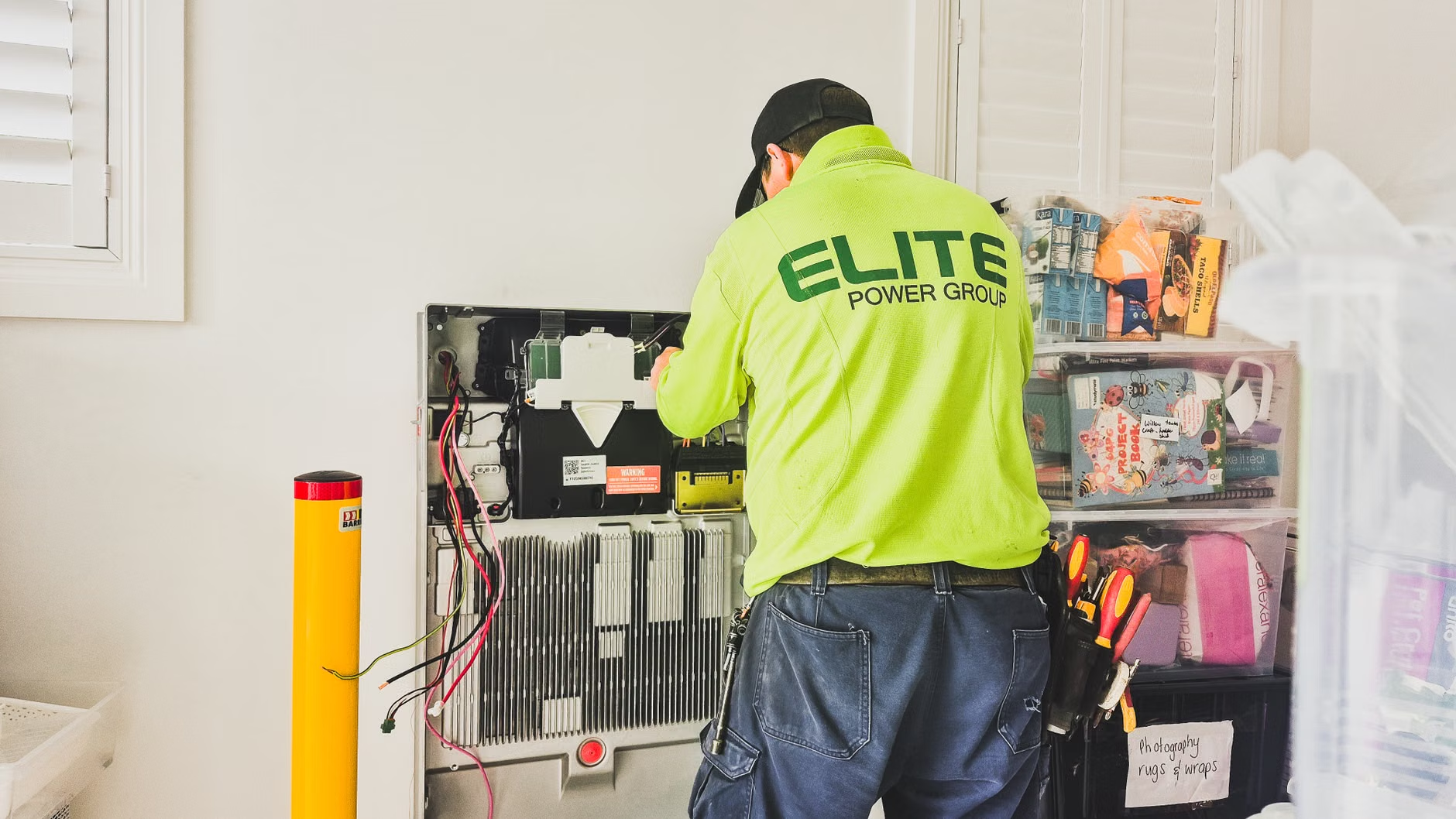
Installation Complexity: Is your garage wall structurally sound? Does your electrical panel have enough “space” (slots) for the new breakers? If your home’s electrical system is outdated, an electrician might require a panel upgrade before the battery can be legally installed. This is a common, and often overlooked, “gotcha” that can add thousands to the bill.
The Decision Framework: A Step-by-Step Guide
Before you sign a contract, use this logical framework to decide if it is right for your family.
- Analyze Your Bill: Look at your last 12 months of electricity bills. Do you have a high “peak” period? If your usage is mostly flat throughout the day, a battery will provide very little benefit.
- Check Your Feed-in Tariff: Contact your utility provider or check your latest statement. If you are being paid a decent rate for your excess solar, keep that revenue stream and skip the battery.
- Assess Your Outage History: Keep a log for three months. If you haven’t lost power, the “resilience” value of a battery is zero. If you lose power once a month, the value is high.
- Request a System Simulation: A reputable installer should be able to run a simulation using your actual usage data to show you the estimated monthly savings. If they can’t provide this, treat it as a red flag.
Common Misconceptions That Cost You Money
One of the biggest mistakes people make is over-sizing their battery. They think, “I want to be completely off-grid.” While romantic, this is incredibly expensive. To be truly off-grid, you need a massive battery array and a solar system large enough to charge it even during cloudy winter days. For 99% of households, a “grid-tied” system—where you use the grid as a backup—is the only way to make the economics work.
Another misconception is that the battery will power your whole house during an outage. In reality, most home batteries are designed to power “critical loads” only—your fridge, a few lights, and the Wi-Fi. If you try to run your central air conditioning or an electric dryer, you will drain the battery in an hour. Be realistic about what you need to keep running.

The Future-Proofing Question
We are currently in the early stages of “Vehicle-to-Home” (V2H) technology. In the near future, your electric vehicle (EV) will essentially act as a giant, high-capacity battery on wheels. If you already own an EV or plan to buy one, it might be more economical to wait for a bidirectional charger that lets you pull power from your car during an outage, rather than buying a separate home battery.
This is a rapidly evolving field. If you don’t have an immediate, pressing need for storage, the best financial move might be to wait 24 months. Prices are trending downward as technology matures and manufacturing scales up.
Final Thoughts: Is It Time to Buy?
If you are looking for a quick financial return, the math for home batteries is currently challenging. It is a long-term play, not a get-rich-quick scheme. However, if you live in a high-cost energy zone, suffer from frequent power grid instability, or want to maximize your self-consumption because your feed-in tariffs are poor, then a battery becomes a strategic household asset.
Do not buy a battery because you feel pressured by a salesperson. Buy it because you have crunched your specific usage data and realized that it provides a tangible, measurable benefit to your family’s lifestyle or your long-term energy security. Take your time, get three quotes, and ensure the hardware is compatible with your existing setup. Your future self—and your bank account—will thank you for the due diligence.
Frequently Asked Questions
Q: Will a home battery work if the grid goes down?
A: Only if your system is configured with a “backup interface” or a “smart transfer switch.” Many basic solar-plus-battery systems are designed to shut down during a grid outage to protect utility workers. Always clarify with your installer that you need “island mode” or “backup capability” specifically.
Q: How long do these batteries actually last?
A: Most manufacturers guarantee their batteries for 10 years or a specific number of “cycles” (charge/discharge events). After this period, the battery will likely still work, but its capacity will be significantly reduced—often to 60–70% of its original state.
Q: Can I add a battery to my solar system later?
A: Yes, this is known as “AC-coupled” storage. It is often easier and more cost-effective to install a battery later rather than trying to force an all-in-one system if your existing solar inverter is still working perfectly. Just ensure your installer evaluates your current electrical panel capacity first.
Official Resources for Further Research:
For those looking to dig deeper into the technical standards and regional regulations, you can check these resources:
National Renewable Energy Laboratory (NREL) – Energy Storage Research
U.S. Department of Energy – Solar Energy Technologies Office