Key Takeaways for Your Neighborhood Network:
- Skill-swapping is a currency: You don’t need money to fix your home; you need to trade your expertise (e.g., electrical work) for someone else’s (e.g., painting or gardening).
- Start small with a ‘Tool Library’: Before jumping into labor, create a shared spreadsheet of household tools to build trust and frequency of interaction.
- Define the ‘Scope of Liability’: Establish a clear rule that participants only tackle non-structural, non-permit-required tasks to avoid insurance and safety complications.
You probably know the feeling: a kitchen faucet starts dripping, a light switch goes dead, or the backyard fence needs a quick patch. You call a professional, and the “minimum service fee” alone is enough to make you reconsider the repair entirely. In your 30s and 40s, when your budget is already stretched thin between childcare, rising utility costs, and mortgage payments, paying $150 just for someone to show up is a bitter pill to swallow.
But here is the reality we often ignore: your neighborhood is likely packed with people who have the exact skills you need, and they are likely just as frustrated as you are by the high cost of maintenance. By building a structured “Parent-Peer Skill-Swapping Network,” you can bypass the service industry for minor household tasks, save thousands of dollars annually, and actually get to know the people living right next door.
Why the ‘Service Economy’ is Failing Your Household Budget
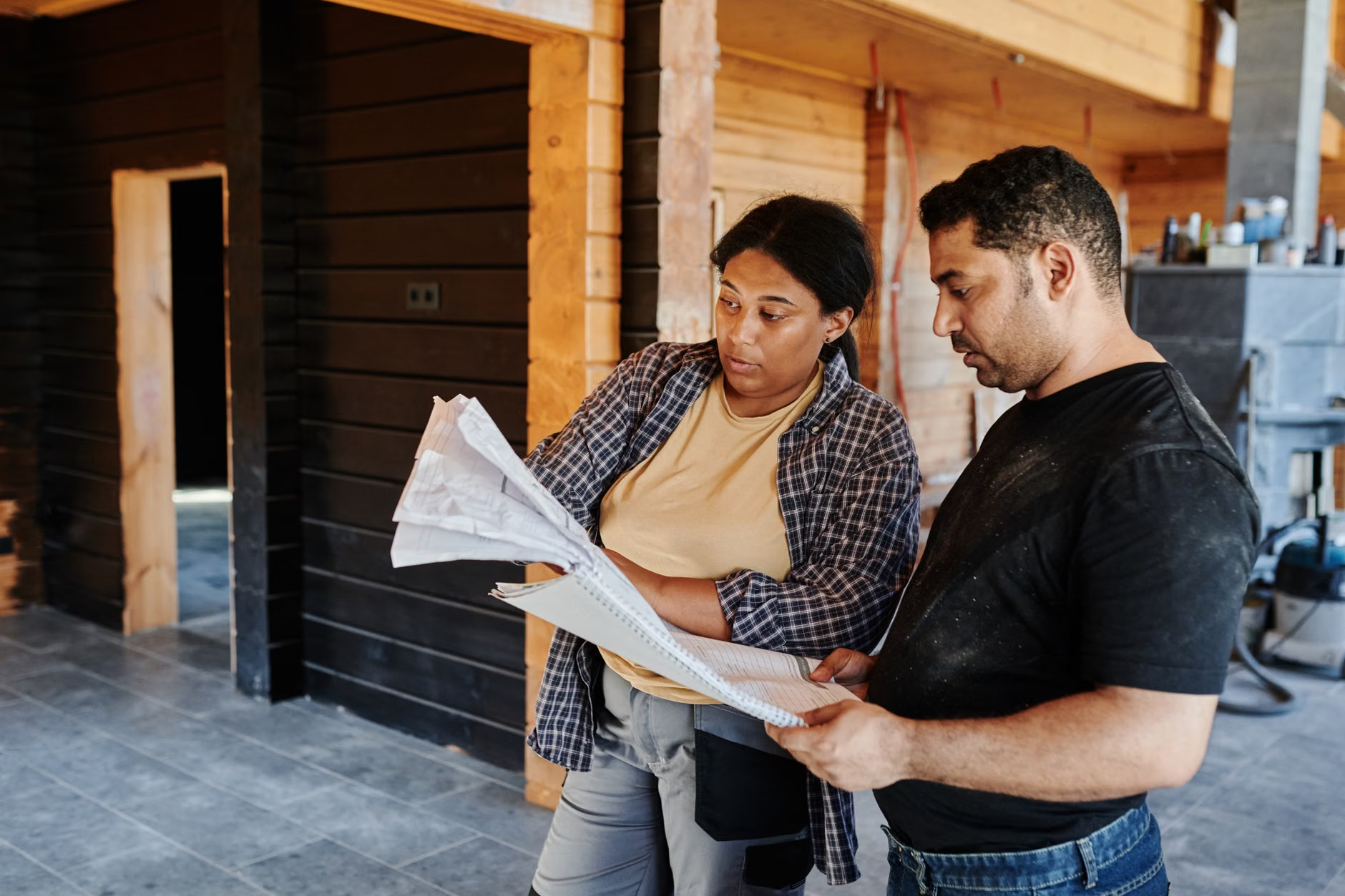
The traditional home maintenance model is designed for high-value projects. When you hire a professional for a major renovation, you are paying for their insurance, their travel time, their administrative overhead, and their profit margin. When you apply that same model to a 15-minute fix—like replacing a GFCI outlet or tightening a cabinet hinge—the cost-to-value ratio is fundamentally broken.
For parents in their 30s and 40s, the issue isn’t just money; it is time and reliability. You want the job done now, not in three weeks when the contractor finally has an opening. A peer network provides a “neighborly” speed that professional services cannot match. However, the biggest barrier to this is the “awkwardness factor”—the fear that asking for help will lead to social debt or subpar work.
To overcome this, you must treat your neighborhood network as a formal system rather than a series of favors. When you transition from “doing a favor” to “exchanging a skill,” you remove the emotional burden of debt. If I fix your sink and you help me paint my nursery, the account is settled. There is no lingering feeling of being a burden, which is the primary reason these relationships fail over time.
Phase 1: Assessing the ‘Skill Inventory’ of Your Neighborhood
Before you start a group chat or a Facebook page, you need to map out what you actually have to offer. Most people mistakenly believe they have “no skills” to trade. If you can assemble IKEA furniture, you have spatial reasoning and tool familiarity. If you can organize a spreadsheet, you can manage the logistics of a neighborhood tool share. If you are good at meal prep, that is a high-value trade for someone who is good at plumbing.
Create a simple, shared Google Sheet or Notion page. Do not use an app that forces you into a proprietary ecosystem; keep it platform-agnostic. The inventory should have three columns: The Skill, The Equipment Owned, and The Availability.
Common skills that are highly tradable in a parenting demographic include:
- Minor Electrical: Changing outlets, installing smart switches, or hanging ceiling fans.
- Assembly & Installation: Mounting TVs, assembling complex play structures, or installing shelving units.
- Basic Plumbing: Replacing P-traps, fixing leaky cartridges, or installing new faucets.
- Landscape Maintenance: Pruning, aerating lawns, or clearing gutters.
The key here is honesty regarding capability. If you are not a licensed electrician, you should only be swapping tasks that are “non-permit required” in your local jurisdiction. In the United States, for example, many municipalities allow homeowners to perform basic maintenance on their own properties, but once you involve structural changes or major electrical panel work, you are legally and insurance-wise in dangerous territory. Never trade a skill that requires a licensed professional to sign off on a permit.

Phase 2: The ‘Tool Library’ as the Foundation of Trust
Skill swapping is high-friction; tool sharing is low-friction. Start here. Most households have a garage full of tools that are used twice a year. A miter saw, a power washer, or a wet-dry vacuum are expensive items that take up significant storage space. By creating a neighborhood tool library, you build the trust necessary to move into actual labor-swapping.
Use a simple “check-out” system. If you want to build a system that lasts, you need to establish a “replacement policy” from day one. If a tool breaks while in your possession, you replace it with an equivalent or better model. This is non-negotiable. If you don’t have this rule, the first time a drill bit snaps or a battery dies, the network will dissolve into resentment.
Decision Rule: If a tool costs more than $200 and is used less than once a month, it should be a candidate for the neighborhood library. If it is a consumable (like sandpaper, drill bits, or paint rollers), the person borrowing the tool should be responsible for providing the consumables for their project.
Phase 3: Managing the ‘Exchange’ to Prevent Burnout
The most common reason these networks fail is that one person becomes the “neighborhood handyman” while everyone else just takes. This creates a power imbalance that kills the community spirit. To prevent this, you must implement a “Credit-Debit” system, even if it feels a bit clinical.
Track exchanges in your shared document. If you spent four hours helping a neighbor install a fence, you have four “credits” to use toward someone else’s time. This turns the network into a collaborative economy rather than a charity. It also protects the experts in your group. If you happen to be an actual carpenter, you shouldn’t be expected to fix everyone’s decks for free. Your time has a higher market value, and the credit system allows you to trade your four hours of professional-level work for perhaps eight or ten hours of general labor (like yard clean-up or painting) from others.
Common Mistake: Failing to account for travel and setup time. If you are helping a neighbor, the “job” isn’t just the repair; it is the commute (if you aren’t adjacent), the setup of tools, and the cleanup. Always factor in an extra 30 minutes of “overhead” for every hour of work.
The Legal and Safety Reality Check
When you are working on your own home, you are responsible for your own safety. When you are working on a neighbor’s home, the liability landscape changes. While most neighborhood networks operate under a “good faith” agreement, you should explicitly discuss the following before picking up a tool:
| Topic | Rule of Thumb |
|---|---|
| Permits | Never touch anything that requires a city permit or inspection. |
| Liability | Sign a simple waiver stating that all participants are volunteers and assume their own risk. |
| Complexity | If a project involves gas lines, high-voltage wiring, or load-bearing walls, call a pro. |
| Damage | If a participant accidentally damages the neighbor’s property, the participant pays for the repair cost only. |
This table is not legal advice, but it represents the “social contract” that keeps neighbors friendly. If you are ever unsure about the safety of a project, the answer is always to hire a professional. Saving $200 on a plumbing repair is not worth the risk of a $20,000 water damage claim or a safety violation that could invalidate your homeowner’s insurance policy.
Building the Culture: Why This Matters for Parents
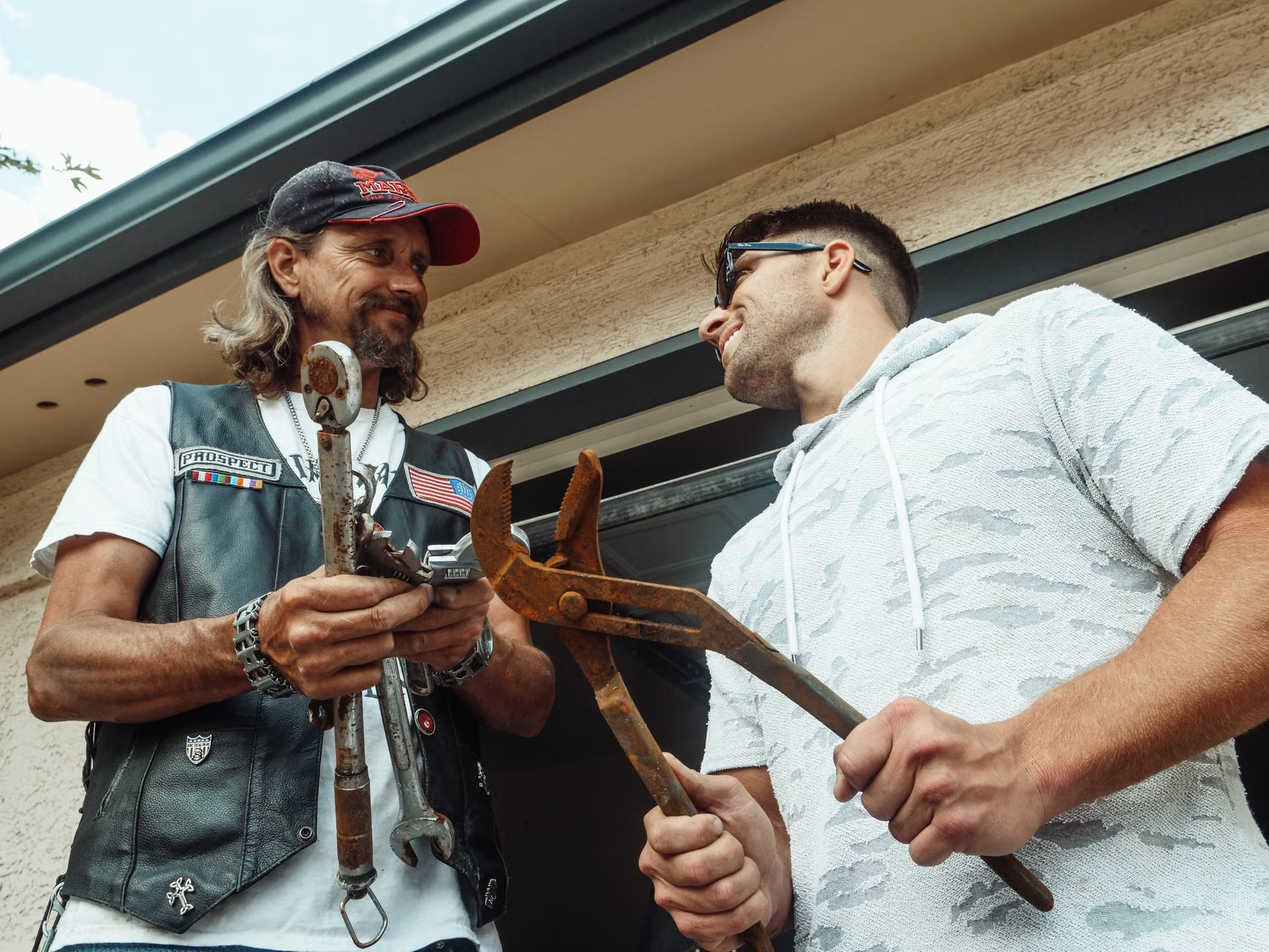
Beyond the money, there is a profound psychological benefit to this network. Our generation is often characterized by “digital loneliness.” We are connected to the world, but we don’t know who lives three doors down. A skill-swapping network forces organic, face-to-face interaction that is centered on a shared goal.
It also sets a powerful example for your children. When your kids see you collaborating, problem-solving, and trusting your neighbors, they learn that community is an active process. They see that “maintenance” isn’t something you just buy from a store; it is a set of skills you acquire and share. This is a subtle but foundational lesson in self-reliance and civic participation.
Start with a small group of three to five families. Any larger, and the logistics become too complex for a casual group. Once the system is running smoothly, you can expand, but the “trust density” of a small group is what will keep the project alive through the inevitable hiccups of broken tools and scheduling conflicts.
Final Next Steps for Your Network
If you are ready to start, do not overthink the setup. Your next step is not to create a website or a complex app. Your next step is to identify two other parents in your immediate vicinity—people you already have a basic rapport with—and invite them over for coffee to discuss the idea. Present the “Tool Library” concept first, as it is the easiest to implement. Once the tools are moving, the skill-swapping will follow naturally.
Remember that this is a marathon, not a sprint. You are building a system that can last for years. Be patient with those who are less experienced, be generous with your own time, and always prioritize the relationship over the repair. A fixed sink is great, but a reliable, supportive neighbor is worth much more in the long run.
Frequently Asked Questions
1. How do I handle a neighbor who constantly asks for help but never offers anything in return?
The credit system is your best defense here. If you have a shared ledger, it becomes visually obvious who is contributing and who is simply consuming. If someone isn’t “earning” credits, politely explain that your current schedule is full and you are prioritizing people who are actively participating in the exchange network. It’s a firm, fair boundary that preserves the group’s health.
2. What if someone breaks a tool they borrowed?
This is why the “replacement policy” must be agreed upon before the first tool is ever lent out. If a tool is broken through normal use (wear and tear), the group should decide if it’s replaced by the group or the individual. If it’s broken through misuse or negligence, the borrower is 100% responsible. Having this written down in your shared document prevents the “he said, she said” arguments that destroy friendships.
3. Should I charge money for these services to keep it professional?
Avoid cash transactions. Once money enters the equation, the relationship shifts from “neighborly help” to “client-contractor.” This opens you up to tax implications, insurance requirements, and a level of expectation regarding quality and timeline that you likely aren’t equipped to handle. Stick to a barter/credit system. If you want to exchange money, you should be operating a formal business, not a neighborhood network.
For further information on home maintenance standards and safety regulations, consult your local municipality’s building department website. You can also find general safety guidelines for DIY projects at the International Association of Certified Home Inspectors (InterNACHI), which provides excellent resources on what homeowners can safely tackle versus what requires a professional.