If your apartment feels perpetually chaotic despite your best cleaning efforts, you are likely suffering from sensory overload caused by your environment, not just a lack of organization. A sensory audit is the most effective way to identify the specific triggers—noise, light, texture, and visual clutter—that are draining your cognitive bandwidth and increasing your daily stress levels.
Three Key Takeaways:
- Sensory Load is Cumulative: Your brain processes background hums, flickering LEDs, and visual clutter simultaneously, leading to “decision fatigue” by the end of the day.
- The 70/30 Rule: Aim for 70% of your home surfaces to be visually “neutral” to act as a background for the 30% of items that provide personality or utility.
- Sound Dampening is Physical: Soft surfaces are the only way to combat apartment echo; hard floors and glass surfaces amplify stress-inducing ambient sounds.
The Science of Why Your Home Makes You Anxious
We often talk about “clutter” as a physical problem—too many toys in the hallway or a mountain of mail on the counter. However, for those of us in our 30s and 40s, juggling professional responsibilities and parenting, the real problem is sensory load. Our brains are not designed to filter out constant, low-level stimuli indefinitely. When you walk into a room, your brain instantly assesses every object, shadow, and sound. If that room is filled with mismatched colors, buzzing appliances, and high-frequency background noise, your brain is working overtime before you even sit down.
This is not just about aesthetics; it is about cognitive load. Research into “Environmental Psychology” suggests that our physical surroundings directly influence our cortisol levels. In an apartment setting, where space is limited and neighbors are close, these stimuli are amplified. You cannot easily move to a different room to escape the light or the sound of the street, making your living space either a recovery zone or a constant source of agitation.
A sensory audit is a systematic approach to identifying these stressors. It involves walking through your home as if you were a stranger, intentionally paying attention to how your body feels in each room. Are your shoulders tight? Is your breathing shallow? Do you find yourself avoiding the living room at night? These are not character flaws; they are biological responses to your environment.
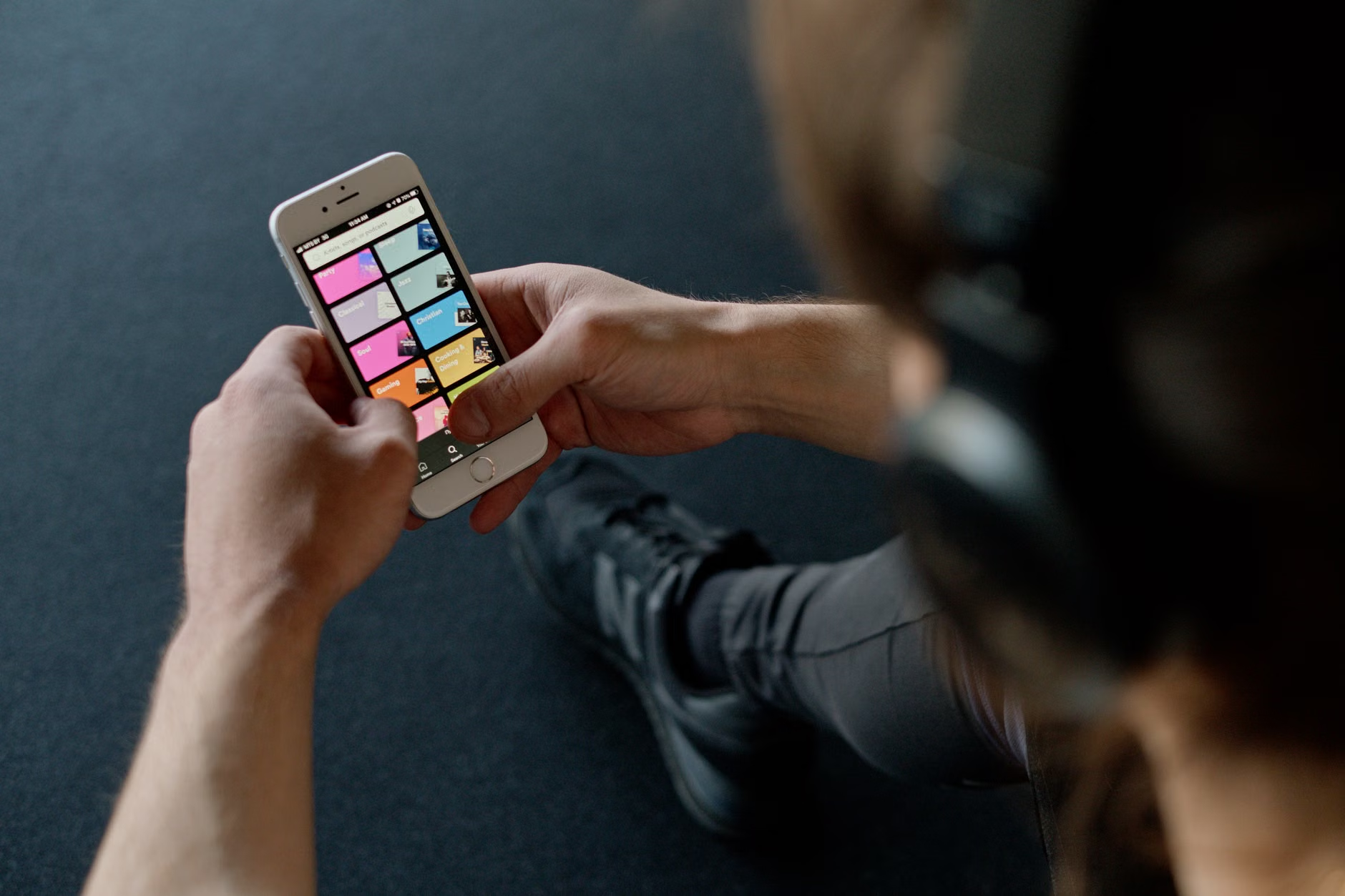
Step 1: The Auditory Audit (Managing Sound Pollution)
Sound is the most overlooked factor in apartment living. Modern construction often relies on hard surfaces—laminate flooring, white-painted drywall, and glass windows—all of which reflect sound waves. This creates a “reverberation effect” where small sounds, like a child’s toy hitting the floor or the hum of a refrigerator, are magnified and sustained longer than they should be.
To perform an auditory audit, you need to identify the “ambient baseline” of your home. Use a basic decibel (dB) meter app on your phone during a typical Tuesday evening. A quiet library is roughly 30-40 dB. If your living room sits consistently above 50 dB due to street noise or appliance hums, your nervous system is in a state of low-level “fight or flight” mode.
The “Soft-Surface” Strategy
If you cannot change the building’s construction, you must change the absorption rate. The rule is simple: if a surface is hard, it bounces sound; if it is soft, it absorbs it. To dampen the noise, look for these three high-impact areas:
- Window Treatments: Thin curtains do nothing for sound. Invest in heavy, thermal, or velvet-lined curtains. They act as a physical barrier against street noise and reduce echo inside the room.
- Floor Coverage: If you have hard floors, rugs are non-negotiable. Place a high-pile rug with a thick felt pad underneath in your main living areas. This can reduce ambient noise reflection by up to 30%.
- The “Appliance Hum” Check: Often, the most irritating sound isn’t the neighbor, but your own home. Check your refrigerator, HVAC unit, or Wi-Fi router. If they are making a high-pitched whine or a constant, rhythmic vibration, they are contributing to your stress. Placing a rubber mat under a vibrating appliance can solve this instantly.
Step 2: The Visual Audit (Reducing Cognitive Clutter)
Visual clutter is the number one culprit for the “I just can’t relax” feeling. In a 30-something household, visual clutter is usually the result of “task-based” living—leaving things out because you intend to use them later. The problem is that every time your eyes rest on an object, your brain briefly processes it. A stack of mail, a charging cable, and a half-finished puzzle are all individual items that your brain is cataloging as “to-do” or “needs attention.”
The 70/30 Rule for Surfaces
To fix this, implement the 70/30 rule. 70% of your visible surfaces should be clear, neutral, and empty. The remaining 30% can hold items you love or need. This provides the brain with a “visual landing strip,” a place to rest your eyes without being stimulated by information.
| Visual Element | High-Stress State | Low-Stress Alternative |
|---|---|---|
| Open Shelving | Overloaded with mismatched items | Uniform baskets or boxes |
| Cables | Tangled/Visible on floors | Cable management sleeves/boxes |
| Countertops | Appliance graveyard | Clear except for daily-use items |
| Wall Decor | Cluttered gallery walls | Single focal point art piece |
If you are struggling with this, perform a “Reset Audit.” Clear every surface in one room completely. Leave them empty for 24 hours. Then, reintroduce items one by one. You will be surprised to find that you only actually need about 20% of what was originally on those surfaces. The rest is just noise.
Step 3: The Lighting Audit (Circadian and Mood Control)
Most apartments come with “builder-grade” lighting: a single, harsh, cool-toned overhead light in the center of the room. This is the worst possible lighting for relaxation. Cool, bright light suppresses melatonin production, which is exactly what you don’t want when trying to wind down with your family in the evening.
A lighting audit involves three specific steps:
- Color Temperature Check: Check your light bulbs. If they are “Daylight” (5000K or above), they are too harsh for living areas. Switch to “Warm White” (2700K to 3000K) for all lamps and floor lights.
- The Layering Principle: Never rely on overhead lighting. Use floor lamps and table lamps placed at “eye level” when you are seated. This creates pools of light, which are naturally more calming than a uniform, bright wash over the entire room.
- The “Flicker” Test: Some cheap LED bulbs flicker at a frequency the eye doesn’t consciously see but the brain registers as stress. If you feel like your eyes are straining, check your bulbs. Replace them with high-quality, flicker-free LEDs.
Step 4: The Tactical “Zoning” of Your Apartment
In smaller apartments, the lack of distinct zones for “work,” “play,” and “rest” creates sensory confusion. When your living room is also your office and your child’s playroom, your brain never gets a signal that it is time to switch modes. You need to create “sensory boundaries.”
Creating Boundaries Without Walls
You don’t need a larger space to create zones; you need visual and auditory markers.
- The “Work-End” Ritual: If you work from home, you must have a way to hide your work equipment. A simple folding screen or even closing a laptop and putting it in a drawer is a sensory signal to your brain that the “work” phase is over.
- The Sound-Boundary: If you have children, use white noise machines in their area to mask their play sounds, and use a separate, higher-quality speaker for your own music or podcasts in the living area. This creates an “acoustic bubble” for both parties.
- Textural Zoning: Use different textures to define zones. A coarse, durable rug in the dining area and a soft, plush rug in the living area helps the brain subconsciously understand that these spaces have different purposes.

Common Mistakes and Hidden Costs
The most common mistake people make during a sensory audit is trying to do everything at once. This leads to “renovation fatigue,” where you end up buying expensive organizational tools that don’t actually solve the underlying problem. Focus on the cheapest, highest-impact changes first: lighting and sound.
Another overlooked variable is the “scent” aspect of your home. While not strictly a visual or auditory sense, smell is the most direct pathway to the brain’s emotional center. If your home has a stale odor or an overpowering artificial scent from plug-in diffusers, it can trigger anxiety. Opt for natural ventilation or subtle, essential oil-based scents. Avoid synthetic fragrances, as they are often a hidden sensory irritant for many people.
Finally, be wary of the “minimalist trap.” A home that is too sparse can feel sterile and cold, which is equally stressful. The goal is “curated comfort,” not an empty white box. Keep items that bring you joy or serve a clear purpose, but be ruthless about removing items that only serve to clutter your visual field.
Taking Action: Your One-Week Plan
Don’t try to fix your whole apartment in a day. Use this one-week plan to audit your space with intention.
| Day | Task | Goal |
|---|---|---|
| Day 1 | Sound Audit | Identify the top 3 sources of noise/echo. |
| Day 2 | Lighting Audit | Replace harsh bulbs with warm ones. |
| Day 3 | Surface Audit | Clear one main surface (table/counter). |
| Day 4 | Cable Audit | Hide or bundle loose wires. |
| Day 5 | Zone Audit | Create a “work-closed” ritual. |
| Day 6 | Review | Re-assess the “feel” of the room. |
| Day 7 | Final Adjustment | Add one soft element (rug/curtain). |
By the end of the week, you will likely notice that your home feels “quieter,” even if you haven’t moved a single piece of furniture. That is the result of reducing your sensory load. Your brain, no longer forced to process unnecessary information, can finally focus on what matters: resting and spending time with your family.
If you find that even after these changes, you still feel overwhelmed, consider the “Externalization Strategy.” Sometimes, the problem is not the home, but the sheer volume of “stuff” we keep. If you cannot store it out of sight, you likely have too much of it. In apartment living, space is the ultimate luxury, and the best way to gain space is to curate your possessions with a brutal, honest eye.
Remember that your home is a tool for your life, not a project that needs to be perfect. The sensory audit is not about creating an Instagram-ready space; it is about creating a space where your nervous system can finally settle down. Start small, track your progress, and pay attention to how your body reacts to the changes. You will find that the most impactful shifts are often the ones that cost the least.
Frequently Asked Questions
1. Does a sensory audit require buying expensive furniture or home decor?
Absolutely not. In fact, the most effective sensory audits often involve removing items rather than adding them. The most impactful changes—like changing light bulbs to a warmer temperature, clearing off surfaces, or bundling cables—are extremely low-cost. If you do need to add items, prioritize functional ones like rugs or curtains, which can be sourced affordably second-hand.
2. How do I balance sensory needs with children who naturally create clutter?
The key is “contained chaos.” Instead of trying to keep the entire apartment perfectly clean, focus on “containment zones.” Use designated bins or baskets for toys in the living area that can be hidden away at the end of the day. This allows your children to play freely while giving you a clear, visual boundary for when the day is “done.”
3. What if I live in a very noisy city and can’t control outside sounds?
If you cannot stop the noise, you must mask it. A high-quality white noise machine or a fan can be incredibly effective at creating a consistent “sound floor” that makes sudden, sharp noises from the street less jarring. Pair this with heavy, sound-dampening curtains, and you will find that the city noise becomes significantly more manageable.
Further Reading and Official Resources:
- American Psychological Association: Environmental Stressors and Mental Health
- Noise Pollution Clearinghouse: Understanding and Mitigating Ambient Noise
Take charge of your environment this weekend. Your home should be the one place that lowers your cortisol levels, not raises them. Start with the lights, clear one surface, and notice the immediate difference in how you breathe when you walk through the door.