You don’t need a flight ticket or a week of annual leave to experience the thrill of travel; the most rewarding adventures are often hiding within a three-mile radius of your own front door.
- The 15-Minute Rule: Hyper-local exploration focuses on the amenities, histories, and secrets accessible within a 15-minute walk or cycle from your home.
- Economic Impact: Shifting your weekend discretionary spending from big-box chains to local, independent businesses has a measurable multiplier effect on your immediate community’s resilience.
- Psychological Reset: “Micro-adventures” provide a necessary cognitive break for busy parents and professionals, reducing the “decision fatigue” associated with complex travel planning.
Why We Are Suddenly Obsessed with Our Own Backyards
If you are in your 30s or 40s, your relationship with “travel” has likely changed. Gone are the days of spontaneous backpacking trips or weekend city breaks that require four hours of airport security and lost luggage. Between managing childcare, professional responsibilities, and the sheer mental load of daily logistics, the idea of a “vacation” often feels like just another item on an exhausting to-do list.
Enter the “hyper-local” movement. It isn’t just about walking to the nearest coffee shop. It is a deliberate shift in perspective that treats your immediate surroundings as an exotic destination. We are seeing a global trend where people are prioritizing depth over distance. This isn’t out of necessity—though economic pressures and environmental awareness play a part—it is out of a desire for connection. In a hyper-connected world, we often know more about global headlines than the history of the building on the corner of our street.
When you commit to hyper-local exploration, you stop being a “resident” and start being an “observer.” This subtle shift has profound impacts. It forces you to slow down, notice the architectural details of your neighborhood, learn the names of the local shopkeepers, and find the “third places”—those social environments separate from the two usual social environments of home and the workplace—that make a city feel like a community.
The Mechanics of Hyper-Local Exploration: A Practical Framework
How do you actually “explore” somewhere you’ve lived for years? The danger of living in one place for a long time is the development of “inattentional blindness.” You drive the same route to the grocery store, you look at the same buildings, and your brain stops processing the visual information because it deems it “known.”
1. The “Tourist in Your Own Town” Audit
Start by treating your neighborhood as if you were a travel blogger writing a guide for a first-time visitor. Most of us have never actually visited the local museum, the historical plaque in the park, or the weird, niche hobby shop two blocks away. Make a list of five places within a 2-mile radius that you have never entered. Your rule: you must visit one every weekend for the next five weeks.
2. The Power of the “Drift”
Adopt the Situationist concept of the “dérive” (or drift). Instead of walking with a destination in mind, set a timer for 45 minutes and walk in a direction you rarely travel. If you usually turn left to go to the train station, turn right. If you usually walk on the main road, take the alleyway. The goal is to break your habitual navigation patterns.
3. Mapping the Micro-Economy
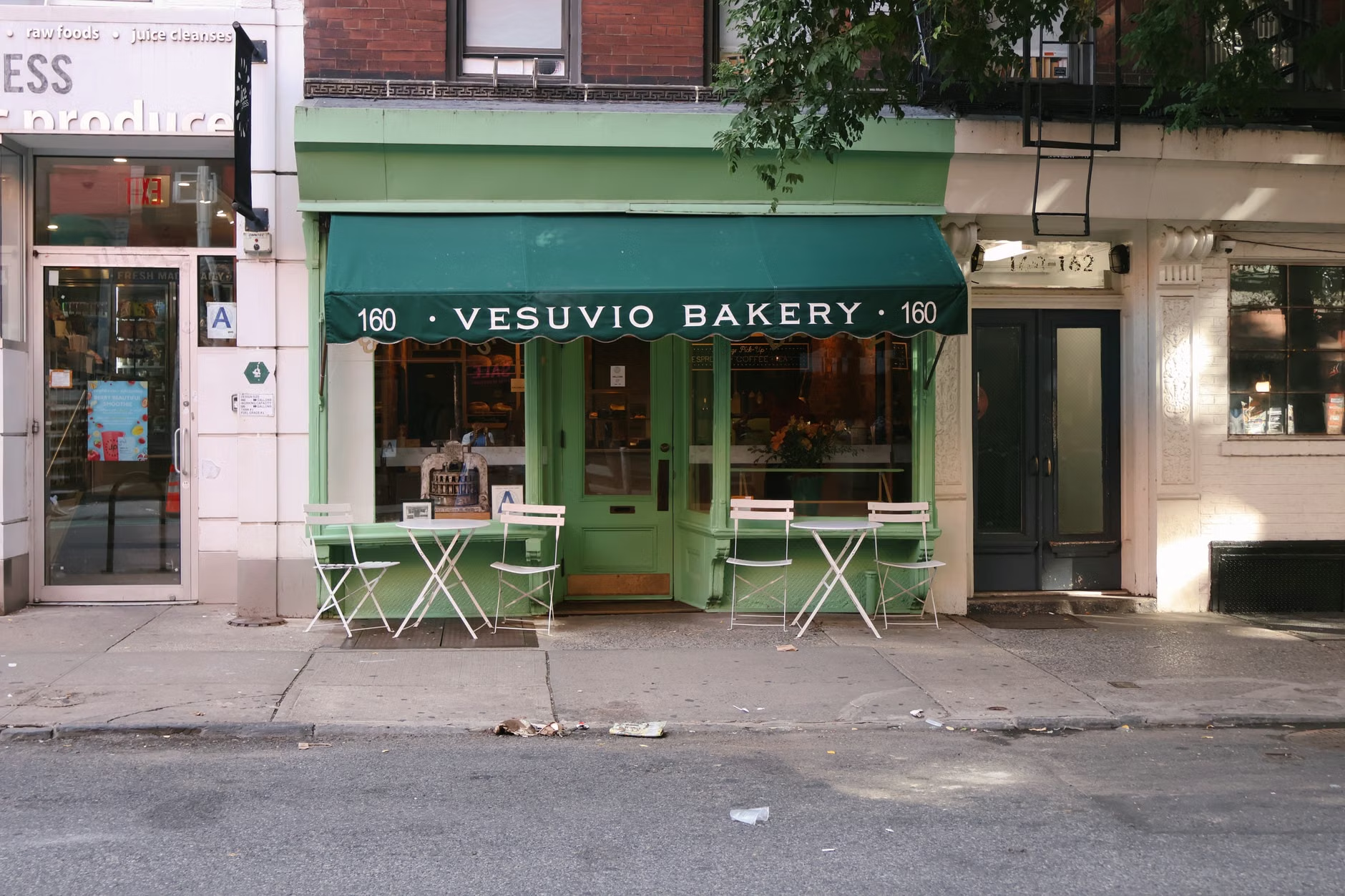
Hyper-localism is also an economic act. Use your weekends to intentionally patronize local businesses rather than national chains. This isn’t just about “supporting local”; it’s about discovery. Local businesses often serve as community hubs. By becoming a regular, you move from being a customer to a neighbor. This is where the true value lies—in the social capital you build.
| Activity Type | Traditional Approach | Hyper-Local Approach |
|---|---|---|
| Weekend Coffee | The nearest global chain drive-thru | A new independent roaster; ask the barista about their beans |
| Exercise | Treadmill at the gym | Urban hiking; mapping every public stairwell or park |
| Entertainment | Streaming services | Community notice boards; local library events |
The Challenges of Balancing Exploration with Parenting
If you are a parent, the “hyper-local” trend is actually your best friend. Traditional travel with children involves high stakes: packing, flights, hotel costs, and the high probability of a tantrum in a place where you don’t know where the nearest pharmacy is. Hyper-local exploration removes the stakes.
If the child gets tired, you are ten minutes from home. If you forget the diaper bag, it’s a minor inconvenience rather than a travel disaster. However, the common mistake parents make is treating these local outings as “errands.” To make this work, you must frame these outings as “adventures” to yourself and your children.
Pro-tip: Create a “Neighborhood Passport.” Print a simple document with check-boxes for different types of local discoveries: “Found a tree I can identify,” “Found a house with a blue door,” “Talked to a neighbor,” “Bought a snack from a local shop.” This gamifies the experience for children and keeps the parents focused on the journey rather than just the destination.

The Hidden Costs and Trade-offs of Slowing Down
It sounds idyllic, but there are trade-offs. The most significant is the “visibility” factor. When you become a known quantity in your neighborhood, you lose a degree of anonymity. If you are the type of person who enjoys the isolation of a big city, being “hyper-local” requires you to engage in social interactions you might otherwise avoid.
Another factor is the pace of life. We are conditioned to measure productivity by how much ground we cover. If you spend your Saturday afternoon sitting in a local park watching the light change or talking to a neighbor, you might feel a lingering sense of “I should be doing something more productive.” This is a cognitive dissonance that takes time to overcome. You must redefine productivity to include “community integration” and “restoration.”
Common Misconceptions
- “My neighborhood is boring.” This is rarely true. It is almost always a failure of observation. If you look at your neighborhood through the lens of history, ecology, or architecture, you will find layers of complexity you previously ignored.
- “I don’t have enough time.” You don’t need a full day. The beauty of hyper-local exploration is that it can be done in 30-minute windows.
- “It’s not ‘real’ travel.” If travel is defined as the act of encountering the unfamiliar and expanding your perspective, then exploring a street you’ve never walked down is just as valid as visiting a tourist trap in a foreign capital.
Integrating Hyper-Localism into Your Daily Life: A Step-by-Step Guide
To successfully integrate this into your life, you need a system. Without a system, the busyness of the week will always win, and you will find yourself back on the couch by Friday night.
Step 1: The Friday Night Briefing. Don’t leave your weekend plans to chance. Spend 10 minutes on Friday evening looking at a digital map of your area. Search for “park,” “historical marker,” or “independent bookstore.” Pick one that you have never visited.
Step 2: The “No-Phone” Rule. When you are out exploring, use your phone only for navigation or photography. Do not check work emails. If you find yourself reaching for your phone to scroll through social media, you have failed the objective of the exercise. The goal is to be present.
Step 3: Journaling the Findings. This sounds academic, but it works. Keep a small notebook or a dedicated folder in your notes app. Write down one thing you learned about your area each weekend. “The old library was built in 1924,” or “The bakery on 5th street makes the best sourdough.” This builds a sense of “place-attachment,” which is scientifically proven to increase happiness and reduce feelings of loneliness.

The Deeper Benefit: Building Community Resilience
Beyond the personal enjoyment, there is a macro benefit to this trend. In an era where we are increasingly isolated, hyper-local exploration is a form of civic engagement. When you know your neighborhood, you care about it. When you care about it, you are more likely to participate in local council meetings, support neighborhood improvement projects, and look out for your elderly neighbors.
This is the “Third Place” theory in action. Sociologist Ray Oldenburg coined this term to describe social surroundings that are not work or home. When these places thrive, society thrives. By being a regular at a local business, you are helping to sustain the fabric of your community. You are not just a consumer; you are a participant in the local economy.
If you are in your 30s or 40s, you are likely at a stage where you are thinking about the long-term environment for your family. Creating a strong, local network of acquaintances and supporting local institutions is one of the most practical things you can do to ensure your own long-term well-being.
Final Thoughts: The Adventure is Already Here
The hyper-local trend isn’t about giving up on international travel or grand adventures. It’s about cultivating the ability to find wonder in the familiar. It is a rebellion against the constant pressure to consume “new” experiences at a distance, and an invitation to invest in the place you actually inhabit.
Start small. This weekend, don’t look for a getaway deal. Look for a street you’ve never walked down, a shop you’ve never entered, or a park you’ve never sat in. The world is much larger than we think, but often, the most interesting parts are just around the corner.
Frequently Asked Questions
Q: How do I deal with the feeling that I’m “wasting” my weekend by staying in my neighborhood?
A: Reframe the experience. If you return to work on Monday feeling more refreshed and connected to your environment than you would have after a stressful trip, you haven’t wasted your time—you’ve optimized it. The “waste” is often the exhaustion of travel, not the time spent at home.
Q: What if my neighborhood is genuinely lacking in “interesting” things?
A: Look harder. Every neighborhood has a history, an ecology, and a social network. If there are no shops, look for natural features—streams, trees, or bird-watching spots. If there is no history, talk to a long-term resident. The “interesting” part of a place is usually a product of your own curiosity, not the inherent quality of the location.
Q: Is this just another way to encourage consumerism?
A: It can be, but it doesn’t have to be. Hyper-localism is about *intentional* engagement. You can explore your neighborhood by visiting a free public library, a park, or a community center just as easily as you can by visiting a cafe. The choice is yours.
Useful Resources for Local Discovery
- Google Maps: Use the ‘Explore’ tab to find highly-rated local spots you might have overlooked.
- Atlas Obscura: A great resource for finding the “hidden” historical or strange sites in your area.
- Meetup.com: Check for local walking groups or community history clubs to meet neighbors with similar interests.