- DNA is only the starting point: Genetic tests provide regions, not records; you must cross-reference them with civil, church, and immigration documents to find specific ancestral locations.
- The “Village Visit” requires local preparation: Do not rely on GPS alone; reach out to local historical societies or parish offices at least three months in advance to ensure records or sites are accessible.
- Manage family expectations: Ancestral travel is often about discovery, not finding a “lost estate.” Focus the trip on the experience of the land rather than the outcome of finding a specific house.
The most effective way to turn a vague desire to “find your roots” into a successful trip is to treat it as a research project first and a vacation second. Many people in their 30s and 40s—juggling careers, school runs, and the general chaos of life—make the mistake of booking flights based solely on a DNA percentage. You arrive in a country, excited to find your great-grandfather’s farm, only to realize that “County Cork” or “Sicily” covers thousands of square miles and your family left no specific address behind.
Moving from Genetic Percentages to Geographic Precision
DNA tests are fantastic marketing tools, but they are notoriously poor at providing the specific “where” you need for a trip. If your test says you are 25% Irish, that is a demographic fact, not a travel itinerary. To plan an ancestral-roots trip, you need to shift from ethnicity to records.
The first step is identifying the “point of departure.” You need the name of the town or parish where your ancestor was born or lived immediately before emigrating. If you don’t have this, you aren’t ready to book a ticket. Spend your time in the digital archives first. Websites like FamilySearch.org (which is free) or Ancestry.com are your primary tools here. Look for naturalization papers, ship manifests, and marriage certificates. These documents almost always list a specific town, not just a country.
Common Mistake: Assuming the surname is enough. In many countries, certain surnames are as common as “Smith.” Without a specific town or parish, you will spend your entire vacation wandering through cemeteries looking for a name that might belong to a completely unrelated family.

The Logistics of Archive Research Abroad
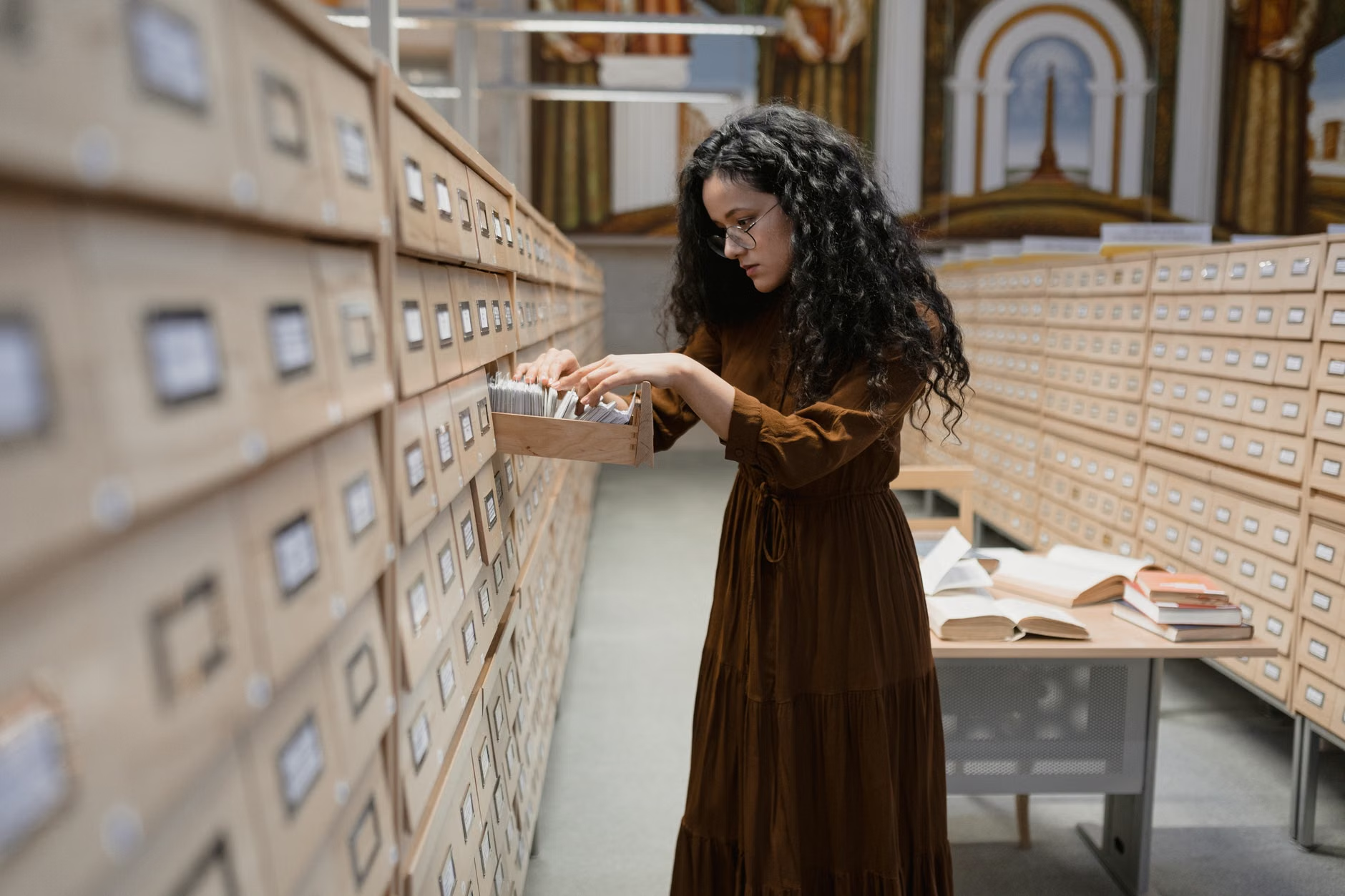
Once you have a town name, the real work begins. You need to verify if that town still holds the records you need. In many parts of Europe, records are kept at the parish level, not the state level. This means the local priest or a local volunteer, not a government official, might be the gatekeeper to your family history.
If you are planning to visit a small village in Italy, Poland, or Germany, do not assume you can just walk into the local church or town hall and ask to see records. Many of these offices have limited hours—sometimes only two mornings a week. If you show up on a Tuesday afternoon, you are out of luck.
Actionable Rule: Send a formal, polite inquiry at least 90 days before your departure. If you do not speak the local language, use a professional translation tool but keep the message simple. State clearly: “I am researching the [Surname] family who lived in [Town] around [Year]. Could you confirm if records from that period are available to view?”
If you are visiting a larger city, look for regional archives (often called Archivio di Stato in Italy or Staatsarchiv in Germany). These institutions often require you to register for a reader’s card before you arrive. Check their websites for “opening hours” and “research policies” well in advance.
Managing the “Ancestral Expectations” Trap
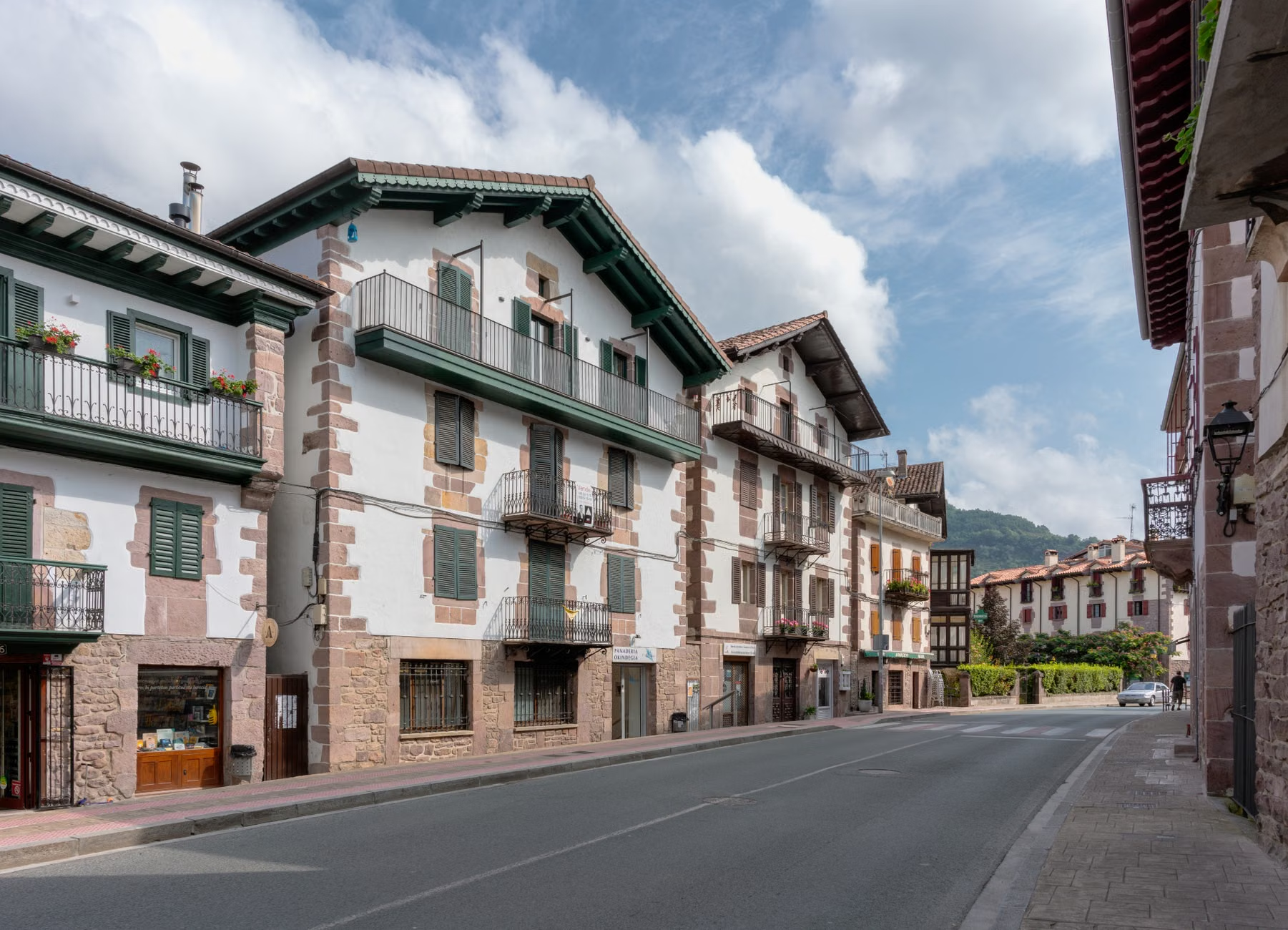
There is a specific kind of disappointment that happens when travelers expect to find a pristine, preserved home that has been passed down through generations. In reality, unless your family was nobility, the “ancestral home” is likely long gone, renovated into something unrecognizable, or replaced by a modern structure.
In your 30s and 40s, you likely have limited vacation time. If you spend three days of a seven-day trip hunting for a house that no longer exists, you will return home feeling like you wasted your time. Instead, frame your trip as a “landscape immersion.”
Decision Criteria: If you find the specific building, treat it as a bonus. If you don’t, focus on the geography. Visit the local market, walk the paths your ancestors walked, and eat the food that was local to that region. Ask yourself: “If I were living here in 1900, what would my daily life have looked like?” This shift in focus guarantees a meaningful experience regardless of whether you find a physical landmark.
Practical Tools for the Field Researcher
You cannot rely on your phone’s data connection in remote, rural areas. When you are standing in a village square in the mountains of Greece or the hills of Ireland, you need offline resources. Download local maps (Google Maps allows you to download areas for offline use) and have your research documents printed or saved in a non-cloud app.
Another overlooked variable is the “family name change.” Many immigrants changed their names at Ellis Island or upon arrival in their new country. If you are searching for “O’Sullivan” and the records show “Sullivan,” or if you are looking for “Schmidt” and the records show “Szymanski,” you will hit a wall. Always search for variations of the name before you leave home.
Step-by-Step Execution Plan
To keep the planning manageable, follow this six-month timeline:
| Timeline | Task | Goal |
|---|---|---|
| 6 Months Out | Document collection | Identify the exact village/parish of origin. |
| 4 Months Out | Local contact | Email local historical societies or parish offices. |
| 3 Months Out | Logistics | Book accommodation near the village, not just the nearest airport. |
| 1 Month Out | Preparation | Download offline maps and print essential records. |
The most important part of this table is the 3-month mark. Staying in a nearby city and “day-tripping” to the village is a common mistake. You will spend more time commuting than researching. Renting a local guesthouse allows you to talk to residents who might have oral histories that aren’t written in any record book.
When Professional Help is Worth the Cost
Sometimes, the language barrier or the complexity of local archives is simply too high. If you find yourself stuck, consider hiring a local professional genealogist for just a few hours. They don’t need to be a fancy agency; often, a local history student or a retired archivist in the region can be hired to do pre-trip research for a fraction of the cost of a full service.
How do you find them? Look for the local historical society’s website or the regional genealogical society. They often have a list of approved or recommended researchers. This is a high-yield investment. If they can confirm that the records you need are held in a specific building, you save yourself days of aimless searching.
The Reality of “Roots Tourism”
Many countries, especially in Europe, are now catering to “roots tourists.” While this has made it easier to find information, it has also led to some “tourist-trap” genealogical services. Be wary of companies that promise to “find your castle” or “trace your lineage to royalty.” These are almost always scams or gross exaggerations.
True genealogy is about the lives of ordinary people. It is about the farmer, the weaver, or the laborer. When you approach your trip with this mindset, you are more likely to find authentic connections to the past. If you find a record of your ancestor paying taxes in 1850, that is a victory. It tells you they were there, they were part of the community, and they existed.
Addressing Common Misconceptions
There is a persistent myth that “everything is online.” While digitization has improved significantly, the vast majority of historical records—particularly church records—are still only available in physical form in the original location. Do not be discouraged if your online search comes up empty. It often just means the records haven’t been scanned yet.
Another misconception is that you need a “guide.” Unless you are going to a region with extreme political instability or dangerous geography, you do not need a tour guide. You need a researcher. A tour guide will show you the sights; a researcher will help you find the records. Know the difference before you spend your money.
Financial Considerations and Hidden Costs
Beyond the cost of travel, budget for “access fees.” Many archives charge a daily rate for researchers. You may also need to pay for copies of documents, which can range from a few cents to significant fees for certified records. Always carry a small amount of local currency; in some small, rural parishes, they may not accept credit cards for archival access.
Also, consider the “gift” factor. If you are visiting a local parish and the priest or administrator spends an hour helping you find your family records, it is customary—and highly recommended—to make a donation to the church or the archive. This isn’t just polite; it ensures that the next researcher who visits has a positive experience.
Integrating the Family
If you are traveling with children, this kind of trip can be boring for them. They likely won’t care about the 1850 census. To make it work, integrate their interests. If you are in a historic region, find the local playgrounds, the best ice cream shops, or the local festivals. If you make the trip about 50% “roots” and 50% “vacation,” you will avoid the resentment that can build when one person is dragging the rest of the family through dusty basements all day.
For your partner, ensure the accommodation is comfortable. If you are spending your days in archives, your partner should have access to local culture, a good cafe, or a scenic walk. A happy partner makes for a longer, more successful research trip.
The Value of Oral History
Never underestimate the power of the local pub or coffee shop. If you are in a small village, people talk. Ask the locals, “Are there any families here still named [Surname]?” You would be surprised how often a casual conversation can lead to a distant cousin or someone who remembers stories about your family. These interactions are the “hidden gems” of ancestral travel that no document can ever provide.
However, be respectful. Don’t go around asking for money or inheritance. Frame your interest as personal curiosity. People are generally very helpful if they sense you are genuinely interested in their town’s history, not just your own gain.
Finalizing Your Research Strategy
Before you board your flight, create a “Research File.” This should be a physical binder or a very well-organized digital folder. It should contain:
- Copies of all your primary documents (birth/death/marriage certificates).
- A list of the specific records you are looking for.
- Contact information for the archives you plan to visit.
- A list of “Plan B” locations if the primary records are unavailable.
Having this ready means you aren’t scrambling for information while you are on the ground. It also shows the people you are asking for help that you are serious and prepared. People are much more likely to help a prepared researcher than someone who shows up with nothing but a vague idea and a smartphone.
Next Steps for the Aspiring Ancestral Traveler
Start your research today. Don’t wait until the month before your trip. The more you know before you leave, the more meaningful your time on the ground will be. If you discover that your ancestors came from a region that is currently undergoing political change or has restricted access, you will have time to adjust your plans.
Remember, the goal is to connect with the past in a way that respects the reality of history. It isn’t always glamorous, and it isn’t always easy, but it is one of the most rewarding ways to travel. By focusing on documentation, local engagement, and realistic expectations, you can turn a simple trip into a lifelong connection to your heritage.
Frequently Asked Questions
1. Do I need to be fluent in the local language to do research?
No, but it is a massive advantage. You don’t need to be fluent, but learning the basic vocabulary for “birth,” “marriage,” “death,” and “church records” in the local language will save you hours of confusion. Most local archivists are used to international visitors and will appreciate any effort you make to communicate in their language.
2. What if my family was part of a displaced population?
If your ancestors were refugees, victims of war, or part of a mass migration, their records might be held in national archives rather than local ones. In these cases, focus on national databases, military records, or records kept by international relief organizations. These types of searches are more complex and often require more patience, but they are not impossible.
3. How much time should I allocate for a “roots” visit?
For each specific town you want to research, allocate at least two full days. This allows for one day of research and one day of “buffer” time in case the archive is closed, you find a new lead, or you need to travel to a nearby town to find more information. Trying to squeeze three towns into three days is a recipe for burnout.
For more information on global genealogy resources, visit the FamilySearch Wiki or the National Archives website for relevant country-specific research guides.