- Equity, not distance: Staycation-equity is defined by the ratio of “effort invested” to “mental restoration achieved,” not by how far you travel.
- The 30-minute rule: For parents with young children, any local activity requiring more than 30 minutes of transit is statistically more likely to result in burnout than relaxation.
- Audit your local blind spots: Most families ignore 80% of local amenities because they view them as “everyday infrastructure” rather than “leisure destinations.”
The most restorative travel experience you will have this year is likely within a 20-kilometer radius of your home, yet you are probably overlooking it. We often mistake “travel” for “distance,” assuming that unless we are boarding a flight or driving three hours, we aren’t truly on a break. This is the “Traveler’s Fallacy”—the belief that the value of an experience is directly proportional to the fuel burned to reach it. For those of us in our 30s and 40s, juggling professional deadlines and the relentless logistics of parenting, this mindset is a trap. It turns our limited free time into a logistical marathon rather than a period of recovery.
Staycation-equity is a framework for re-mapping your local environment. It treats your immediate surroundings not as the place where you “live and work,” but as a portfolio of potential leisure assets. By shifting how you categorize these spaces, you can achieve the psychological benefits of a vacation—novelty, disconnection, and shared experience—without the administrative overhead of long-distance travel.

Defining the Staycation-Equity Ratio
To understand why most local outings feel like “chores” rather than “vacations,” we need to calculate the Staycation-Equity Ratio. This is a simple formula: (Total Restoration Value) / (Total Logistics Burden) = Equity.
The “Logistics Burden” includes packing, car seat installation, snack preparation, route planning, and the inevitable “are we there yet” friction. If you drive two hours to a crowded park, the denominator is high. If the park is crowded, the numerator (restoration value) drops. When the denominator exceeds the numerator, you aren’t on a staycation; you are just performing parenting in a different zip code.
High-equity staycations prioritize low-friction entry. This means choosing locations where the commute is less than 30 minutes, or where the transit itself (like a train ride) is part of the entertainment. By optimizing for low-friction, you preserve the mental bandwidth required to actually enjoy the time with your family, rather than spending the entire day managing the logistics of the excursion.
Auditing Your Local “Blind Spots”
We are all prone to “infrastructure blindness.” We see the neighborhood library, the local museum, or the nearby nature reserve every day, so our brains relegate them to the category of “utility.” We assume they aren’t “special” enough for a weekend outing. This is a cognitive bias that limits our ability to find joy in our own backyard.
To break this, I suggest conducting a “Tourist Audit.” Spend 15 minutes this weekend looking at your city through the lens of a visitor. Use platforms like Google Maps or TripAdvisor as if you were a tourist visiting your city for the first time. You will likely be surprised to see that your local museum, which you haven’t visited in five years, is ranked in the top 10 things to do in your region. The goal isn’t to find something “new,” but to re-contextualize the “familiar.”
The Four Categories of Local Assets
When mapping your area, categorize locations into these four quadrants to ensure you have a balanced “travel” portfolio:
| Category | Example | Equity Benefit |
|---|---|---|
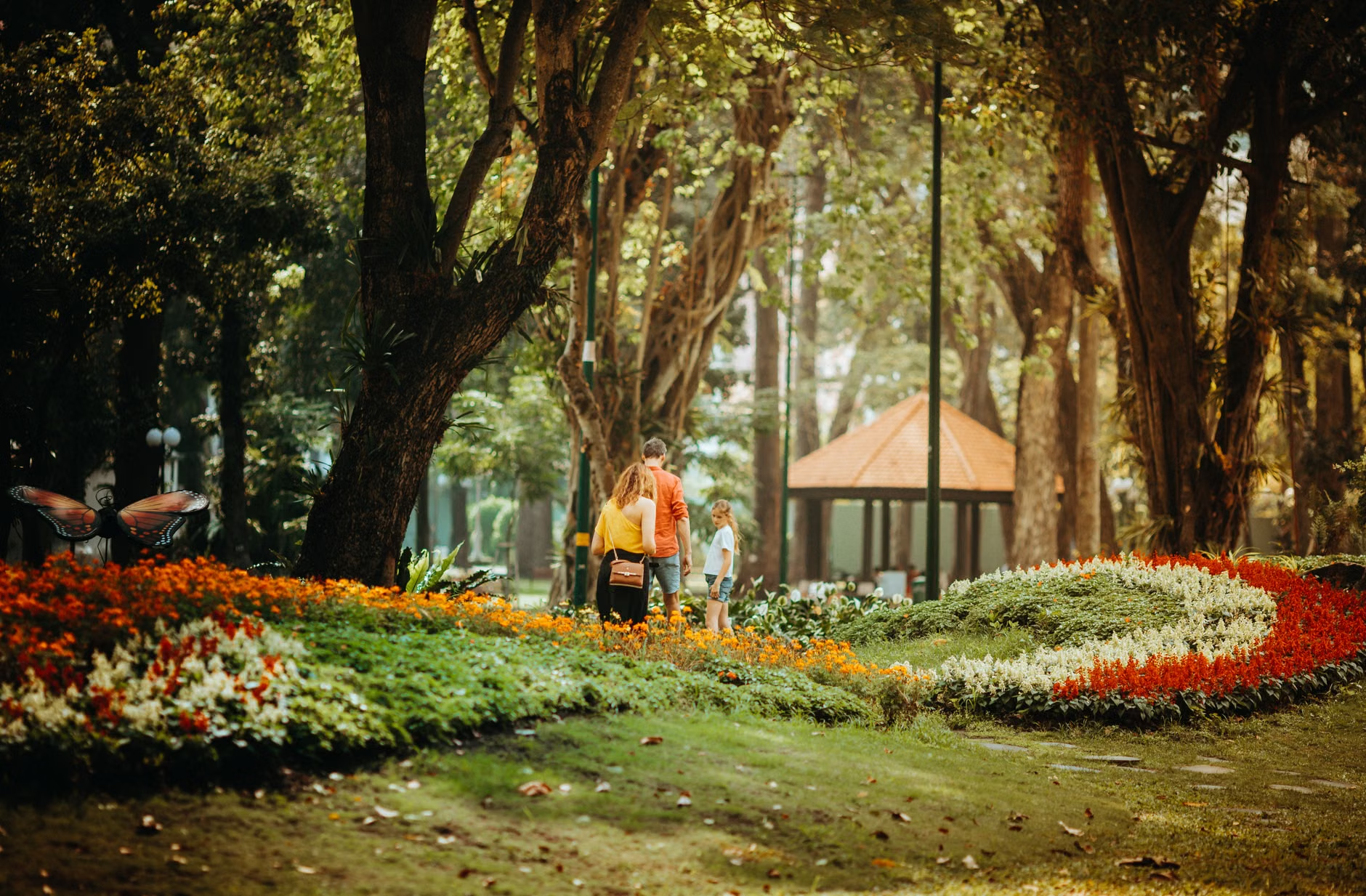
| Low-Traffic Nature | Local arboretums, small town forests | High sensory restoration, low crowd stress. |
| Cultural Infrastructure | Small galleries, public libraries | Controlled environment, quiet, climate-controlled. |
| Niche History | Local landmarks, historical markers | Educational, sparks conversation, low cost. |
| Active/Kinetic | Public pools, climbing centers | Burns off excess energy, ensures better sleep for kids. |
The key here is to avoid the “Default Destination.” If your family always goes to the same big park, that’s not an adventure; it’s a routine. A true staycation requires a deviation from the pattern. Even if the destination is only three miles away, if it’s a place you’ve never entered, it functions as a novel environment for your brain.
Why the 30-Minute Threshold Matters
In our 30s and 40s, we are often operating on a “sleep debt” or “decision fatigue” deficit. Research into urban mobility and family stress suggests that once a transit segment exceeds 30 minutes for young children, the likelihood of a “meltdown event” increases exponentially. This isn’t just about the kids; it’s about your own ability to remain patient and present.
When you stay within the 30-minute radius, you keep the “retreat option” open. If the weather turns, or if someone gets hungry, or if the mood shifts, you can be home in less than half an hour. This reduces the psychological pressure to “make the most of the day” because you’ve spent so much time traveling. When you feel less pressure to maximize every minute, you ironically end up having a much more relaxed and enjoyable experience.
The “Tourist-in-Residence” Protocol
To execute a successful staycation-equity map, you need to shift your behavior from “resident” to “visitor.” This means changing the rules of the day. If you are a resident, you are worried about the laundry, the grocery shopping, and the emails waiting on your phone. If you are a visitor, those things don’t exist.
Step-by-Step Execution
- The “No-Home” Rule: From the moment you leave your front door until you return, you are not allowed to handle home-related tasks. No stopping for “just one quick errand” at the pharmacy.
- Budgeting for “Novelty”: Allocate the money you would have spent on gas or flights for a long-distance trip toward a “local splurge.” Maybe it’s a lunch at a place you usually skip, or an entry fee to an attraction you thought was too expensive.
- Document the Day: Take photos as if you were showing them to someone from another country. This small psychological shift forces your brain to look for the beauty and interest in the mundane.
- The “Souvenir” Strategy: Buy something small and local. A local bakery item, a postcard, or a small trinket from a museum shop. It creates a physical anchor for the memory of the day.
Many parents make the mistake of trying to do “too much” on a staycation. They treat it like a mission to check off five local spots. Instead, treat it like a slow-travel experience. Pick one “anchor” location and spend three hours there, rather than racing across the city to hit three different spots. The goal is to reach a state of flow, not a state of exhaustion.
Common Misconceptions and Hidden Costs
One of the biggest misconceptions is that “free” local activities are better. While they are often great, they can also be the most crowded and stressful. A free park on a Saturday afternoon can be a chaotic environment that leaves you feeling more drained than when you started. Sometimes, paying a nominal entry fee for a less-crowded botanical garden or a private nature trail is a better investment of your “equity” because it guarantees a quieter, more restorative atmosphere.
Another common mistake is failing to account for “transition time.” Even if the destination is close, the time it takes to get everyone out the door is significant. If your partner or children are not on board with the “staycation” mindset, the day will fail. It is crucial to frame this as an adventure, not as “we have to go out because we can’t afford a real vacation.” Frame it as: “We are exploring our city like tourists this weekend.”
Finally, watch out for the “Screen Trap.” It is tempting to bring tablets or phones to keep kids occupied during the commute. While this might make the travel easier, it defeats the purpose of the staycation. The goal is to reconnect with your environment and each other. Use the commute—even if it’s just a 15-minute drive—to talk, play simple games like “I Spy,” or listen to an audiobook together. The transition is part of the experience.
Decision Criteria: Is This a High-Equity Activity?
Before you commit to a local outing, run it through this quick decision filter. If it fails more than two of these, reconsider your plan:
- Is the environment controlled? (e.g., Is there shade, seating, and access to water/restrooms?)
- Is the transit time under 30 minutes? (If not, is the transit itself fun, like a ferry or a train?)
- Does it break the “Routine Loop”? (Is it a place you have never visited, or a place you visit differently than usual?)
- Is the cost-to-restoration ratio favorable? (Does the price of the activity justify the stress of the prep work?)
If you find yourself choosing an activity that is high-stress and low-reward, you are effectively paying to be stressed. The most high-equity activities are those where the environment does the heavy lifting for you. A library with a children’s section, for instance, provides the space, the activities, and the climate control. You just have to show up.
Final Thoughts on Local Exploration
The Staycation-Equity map isn’t about finding the most exciting thing in the world; it’s about finding the most sustainable way to disconnect from your daily grind. By treating your local area with the same curiosity and intentionality as you would a foreign city, you unlock a hidden reservoir of leisure time that you already possess. You don’t need a passport to find novelty. You just need to change your perspective, lower your transit threshold, and stop viewing your local environment as a series of chores to be completed.
Start small. This weekend, pick one “blind spot” on your map—a place you’ve lived near for years but never entered. Treat it as your primary destination. Bring a notebook, bring your family, and leave the “resident” mindset at home. You will be surprised at how much distance you can cover without actually traveling very far at all.
Frequently Asked Questions
Q: What if my local area really doesn’t have many “tourist” attractions?
A: You are likely looking for “attractions” (like big monuments) rather than “experiences.” Re-frame your search to include small nature trails, community gardens, local craft shops, or even neighborhoods with unique architecture. Every area has a history or a micro-culture that is worth exploring if you look closely enough.
Q: How do I get my partner/children to buy into the “staycation” idea?
A: The best way is to gamify it. Create a “Local Passport” in a notebook. Every time you visit a new place, add a date, a photo, and a quick rating. Making it a project makes it feel like an intentional adventure rather than a “cheap” alternative to a real vacation.
Q: Is it okay to do a staycation at home?
A: A staycation at home is a valid form of rest, but it is not the same as local exploration. If you are staying home, you must treat it like a hotel stay. That means no cleaning, no laundry, and no “taking care of the house.” If you can’t psychologically disengage from the chores, get out of the house. The physical act of leaving is often the best trigger for a mental shift.
For more ideas on local exploration and urban planning, you can consult resources like the Project for Public Spaces, which provides excellent insights into why certain local environments are more restorative than others.