Starting in 2026, the European Union’s Carbon Border Adjustment Mechanism (CBAM) will fully transition from its reporting phase into an active taxation system, a shift that is set to ripple through global supply chains and eventually change the price tags on the gadgets you buy for your home.
- Price Hikes: Electronics manufacturers will likely pass the cost of carbon certificates onto consumers to offset the tax on energy-intensive components like semiconductors and aluminum casings.
- Supply Chain Realignment: Companies are aggressively shifting manufacturing to regions with lower carbon intensity or cleaner energy grids to avoid the “carbon penalty,” which may temporarily disrupt product availability.
- The “Green Premium”: Expect a clearer divide in the market between budget electronics that rely on high-carbon production and premium devices that prioritize carbon-neutral supply chains.
If you are in your 30s or 40s, you have likely noticed that the price of home technology doesn’t just fluctuate based on features anymore. We track chip shortages, shipping delays, and now, we have to consider the regulatory environment of the countries where our devices are built. The “Carbon Border Tax” isn’t just a piece of dry environmental policy; it is a fundamental restructuring of how global trade accounts for the climate impact of manufacturing.
For the average family, this means the era of “cheap, disposable electronics” is facing a significant economic headwind. When we buy a new laptop for work or a tablet for the kids, we are rarely thinking about the energy used to smelt the aluminum in the chassis or the carbon footprint of the silicon wafers inside. By 2026, those hidden costs will be brought to the forefront.
What Exactly is the Carbon Border Adjustment Mechanism (CBAM)?
Think of CBAM as an “equalizer” for carbon emissions. Currently, if a company produces electronics in a country with strict environmental regulations, they pay a high price for their emissions. If they produce them in a country with lax regulations, they pay almost nothing. This creates a competitive disadvantage for the “cleaner” manufacturer.
The European Union is implementing CBAM to ensure that goods imported into the EU face a carbon price equivalent to what they would have paid if they were produced under EU emission standards. While the initial phase focuses heavily on raw materials—like iron, steel, aluminum, and fertilizers—the scope is widely expected to expand to include complex manufactured goods, such as household electronics and automotive components, as the regulation matures.
Why does this matter to you? Because the global supply chain is deeply interconnected. Even if you live outside the EU, the global nature of electronic manufacturing means that a tax levied by one of the world’s largest consumer markets forces manufacturers to adjust their entire global production strategy to stay competitive. If a factory in Southeast Asia has to pay a carbon tax to export to Germany, they will likely raise prices for their exports to the United States, Canada, and the rest of the world to cover the overall increase in their operational overhead.

How the “Carbon Tax” Will Show Up in Your Household Budget
Most of us don’t see “carbon tax” on our receipts. Instead, we see “price adjustments” or “inflationary pressure.” Understanding how these costs translate to the consumer requires looking at the bill of materials (BOM) for common household electronics.
Take a standard mid-range laptop. It contains aluminum (used for the casing), steel (used for internal brackets), and complex semiconductors. Under the CBAM framework, the embedded carbon of these materials is calculated. If the manufacturer sources these materials from a grid heavily reliant on coal, the “carbon debt” is high.
| Component Category | Carbon Intensity | Likely Price Impact |
|---|---|---|
| Aluminum Chassis | High | Moderate increase |
| Steel Components | Moderate | Minor increase |
| Semiconductors | Very High | Significant increase |
The table above illustrates a critical reality: the more energy-intensive a component is to produce, the more it will be impacted by carbon pricing. Semiconductors are the heart of every modern device, and their production requires immense amounts of electricity and ultra-pure water. As energy markets transition to renewables, the “carbon cost” of electricity will fluctuate, and manufacturers will pass these costs to the consumer.
The Shift Toward “Green” Electronics
You might be wondering: if costs are going up, is there a way to avoid it? The short answer is that the market is already beginning to pivot. Companies are investing in “Green Aluminum” and renewable-powered semiconductor foundries. While this is great for the planet, it is not necessarily cheaper for the consumer in the short term.
We are entering a phase where the “Green Premium” will become a standard part of our shopping experience. A device marketed as “carbon-neutral” might carry a higher initial price tag, but it effectively insulates the buyer from the volatility of future carbon taxes. For a family in their 30s or 40s, this means the decision-making process for buying a new appliance or a gaming console is shifting from “What is the cheapest model?” to “What is the most sustainable model that will retain value?”
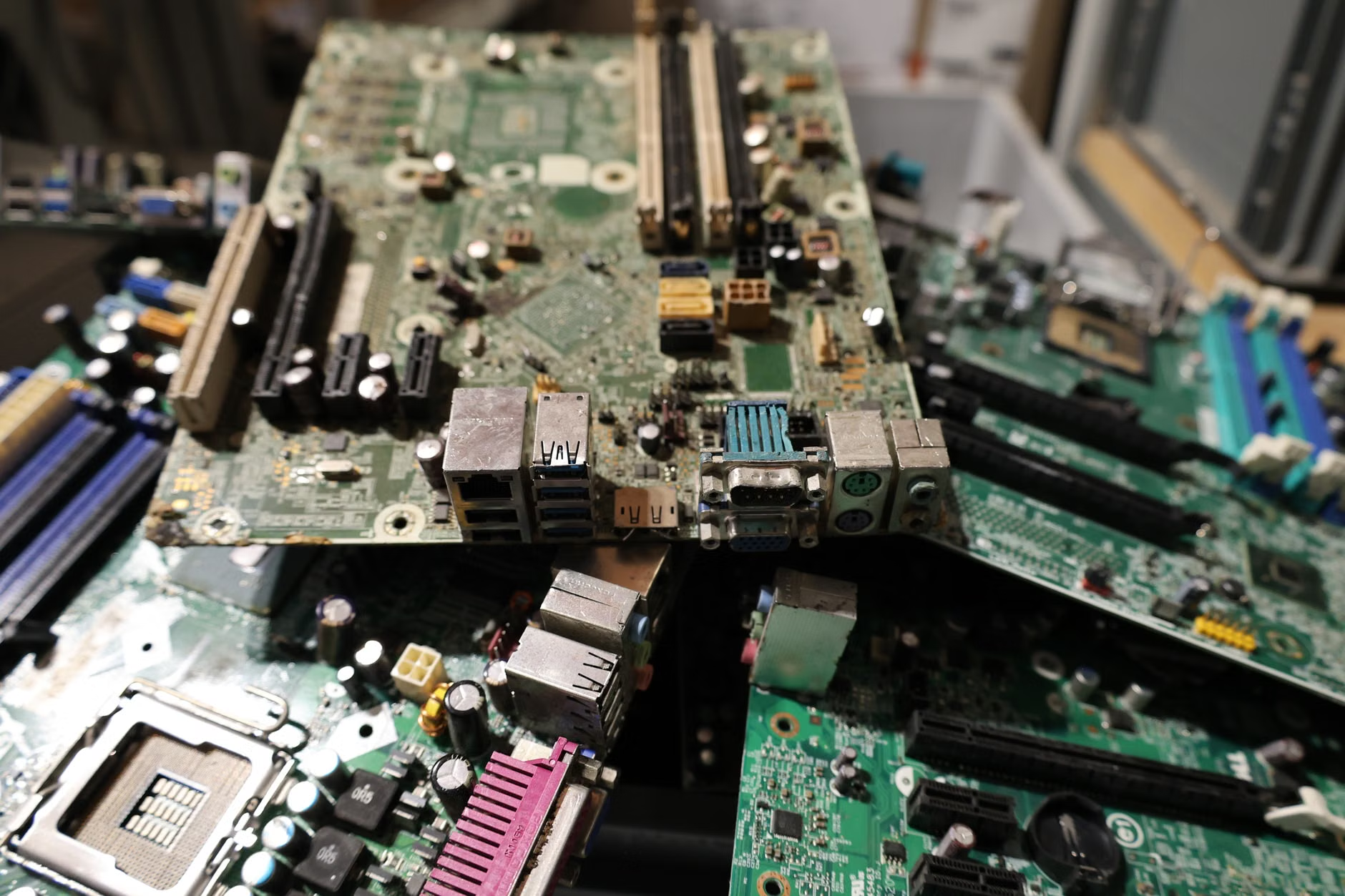
If you are planning your family’s technology upgrades for the next few years, you don’t need to panic, but you do need to be strategic. Here is how you can prepare for the changing economic landscape of consumer electronics.
1. Prioritize Longevity Over Frequency
The most effective way to mitigate the rising costs of electronics is to extend the lifecycle of the devices you already own. If you are currently replacing your family’s tablets or laptops every 24 months, consider shifting to a 36- or 48-month cycle. By choosing devices with better build quality and longer software support, you insulate your household budget from the cumulative effect of carbon-tax-driven price hikes.
2. Look for “Circular” Brands
More companies are adopting “circular economy” models—where they offer official refurbishment programs, trade-in credits, and modular designs that are easier to repair. These brands are less reliant on the raw material supply chain that is most heavily taxed under CBAM. When shopping, prioritize brands that explicitly state their commitment to using recycled materials and renewable energy in their manufacturing processes.
3. Understand the “Repairability” Index
Several countries and regions are introducing “repairability scores” for electronics. A device with a higher score is generally easier to fix, meaning you won’t have to buy a new one when a battery dies or a screen cracks. In a world where new devices are becoming more expensive due to carbon levies, the ability to repair is a major financial advantage.

Common Misconceptions About Carbon Taxes
There is a lot of noise surrounding climate policy, and it is easy to get caught up in misconceptions. Let’s clear up a few points to help you make better decisions.
Myth 1: The tax only applies to the manufacturer. While the tax is levied at the border, the cost is almost always passed down the supply chain. If a factory in China pays a tax to export to Europe, they have to recover that cost by increasing their wholesale prices. This impacts the global retail price, not just the price in the EU.
Myth 2: All electronics will double in price. This is highly unlikely. The carbon tax is a percentage of the carbon intensity of the product, not a flat tax on the retail value. While it will certainly add a premium, it is not going to make a $500 laptop cost $1,000 overnight. Expect price increases in the range of 3% to 7% for high-intensity items, depending on the energy mix of the production site.
Myth 3: You can avoid it by buying local. While buying locally produced goods is often better for the environment, the raw materials—like steel and aluminum—are global commodities. Even if a product is assembled in your home country, the components inside are likely sourced from global markets that are subject to these same carbon price pressures.
The Future of Home Tech: A More Intentional Approach
As we head toward 2026, the “Carbon Border” will change the way we view our devices. We are moving away from the era of hyper-cheap, throwaway gadgets and into a period where the true cost of production—including its environmental impact—is reflected in the price. For a family balancing a budget, this is not just about paying more; it is about getting more value out of what you buy.
The most successful consumers in the coming years will be those who view their technology as an investment rather than a disposable commodity. By researching the environmental commitments of the brands you trust and focusing on repairability and longevity, you can navigate these changes without breaking your household budget.
Ultimately, the goal of these regulations is to drive the industry toward cleaner production. While the transition may be bumpy and result in higher price tags in the short term, it is a necessary shift to ensure that our future technology is built on a foundation that doesn’t cost the earth.
Next Steps for Your Household:
- ✔ Audit your current tech: Identify which devices are nearing the end of their life and plan for a replacement before major market shifts occur.
- ✔ Check manufacturer sustainability reports: Look for companies that are already investing in low-carbon manufacturing; these will be the most stable players in the coming years.
- ✔ Prioritize repair: Before buying a new device, check if the manufacturer offers spare parts or official repair services to keep your current tech running longer.
For more detailed information on the progress of the Carbon Border Adjustment Mechanism, you can visit the official European Commission website on climate action: EU Carbon Border Adjustment Mechanism Overview.
Frequently Asked Questions
Does the carbon tax apply to second-hand or refurbished electronics?
Generally, no. The carbon tax is levied on the importation of new goods. Purchasing refurbished or second-hand electronics is an excellent way to avoid the price volatility associated with new manufacturing, as these devices have already “paid” their carbon cost in their initial lifecycle.
Will this tax affect the price of software or digital services?
No. CBAM is specifically designed for physical goods—raw materials and manufactured products that involve high-energy processes. Digital services, apps, and software licenses are not subject to carbon border taxes, as they do not involve the import of carbon-intensive raw materials.
How can I tell if a product will be hit hard by the 2026 taxes?
Look at the complexity and the materials used. Electronics that rely heavily on aluminum, steel, or complex semiconductor chips—which are manufactured in energy-intensive facilities—are the most likely to see price adjustments. Devices that are lighter, use more recycled plastics, or have simpler internal components may be less affected.
Disclaimer: This article provides information based on current policy trends and economic projections as of 2024. Market conditions can change, and individual purchasing decisions should be based on your own financial situation and research.