The most effective way to improve your family’s sleep isn’t by adding expensive supplements or buying the latest high-tech mattress, but by treating your household’s rest as an engineering problem that requires a systematic audit of your “sleep architecture.”
- Sleep architecture refers to the cyclical pattern of NREM and REM sleep; disruptions to these cycles are usually caused by environmental or behavioral “leaks” rather than biological failure.
- The 90-minute rule: Most sleep cycles last about 90 minutes. Aligning your wake-up times with the end of these cycles is the single most effective way to reduce morning grogginess.
- The Audit Protocol: You must track three variables—light exposure, thermal load, and cognitive wind-down—for seven consecutive days to identify the specific bottleneck in your family’s sleep quality.
If you are in your 30s or 40s, you likely feel like you are perpetually “catching up” on sleep. Between the demands of a career, the logistical maze of parenting, and the inevitable “revenge bedtime procrastination”—that late-night scroll through your phone just to feel like you have a moment to yourself—your sleep architecture has probably collapsed. But it isn’t just about the number of hours you spend in bed; it is about the quality of the cycles you complete.

Understanding Your Sleep Architecture: The Biological Blueprint
Think of your sleep as a construction project. Each night, your brain moves through four to five cycles, each lasting roughly 90 minutes. These cycles are composed of NREM (non-rapid eye movement) sleep—which handles physical restoration—and REM (rapid eye movement) sleep, which handles emotional regulation and cognitive processing. If you wake up in the middle of a cycle, you feel “sleep inertia,” that heavy, fog-like sensation that makes even pouring a cup of coffee feel like a marathon.
For parents, the challenge is that your environment is rarely optimized for these cycles. You are often interrupted or forced to wake up at suboptimal times. To fix this, you don’t need a medical degree; you need an audit. An audit is simply a diagnostic process where you record what is actually happening versus what you think is happening. Most people overestimate how long they sleep and underestimate how many times they “micro-wake” due to environmental triggers like a stray light beam or a fluctuating room temperature.
The goal of this audit is to identify the “environmental noise” that prevents you from transitioning smoothly between these 90-minute cycles. If you can stabilize the transition, you can often feel significantly more rested even if your total sleep duration remains the same.
Step 1: The Seven-Day Data Collection Phase
Before you change a single habit, you must gather baseline data. For seven days, track these three variables. You don’t need expensive wearables; a simple notebook or a note-taking app on your phone will suffice.
- The “Lights-Out” Latency: How long does it actually take you to fall asleep once your head hits the pillow? If it’s over 20 minutes, your cognitive wind-down is failing.
- The Thermal Load: Record the room temperature and how many layers you are wearing. If you wake up feeling hot or cold, your room’s thermal regulation is a primary disruptor.
- The “Tech-Gap”: Record the exact time you put your phone down and the time you actually fall asleep. If there is a gap of more than 30 minutes, you are likely suffering from blue-light-induced melatonin suppression.
Most parents find that their “perceived” sleep is wildly different from their “tracked” sleep. You might think you slept for seven hours, but the audit might reveal you were awake for 45 minutes of that time due to environmental triggers. This data is your roadmap. Without it, you are just throwing solutions at a problem you haven’t defined.
Step 2: Optimizing the Physical Environment (The “Dark and Cool” Rule)
Sleep architecture is highly sensitive to external cues. The most common mistake people make is ignoring the “thermal load” of their bedroom. Your core body temperature needs to drop by about 1 to 2 degrees Celsius to initiate and maintain deep sleep. If your room is too warm, your body stays in a state of hyper-arousal, preventing you from entering the deeper, more restorative stages of NREM sleep.
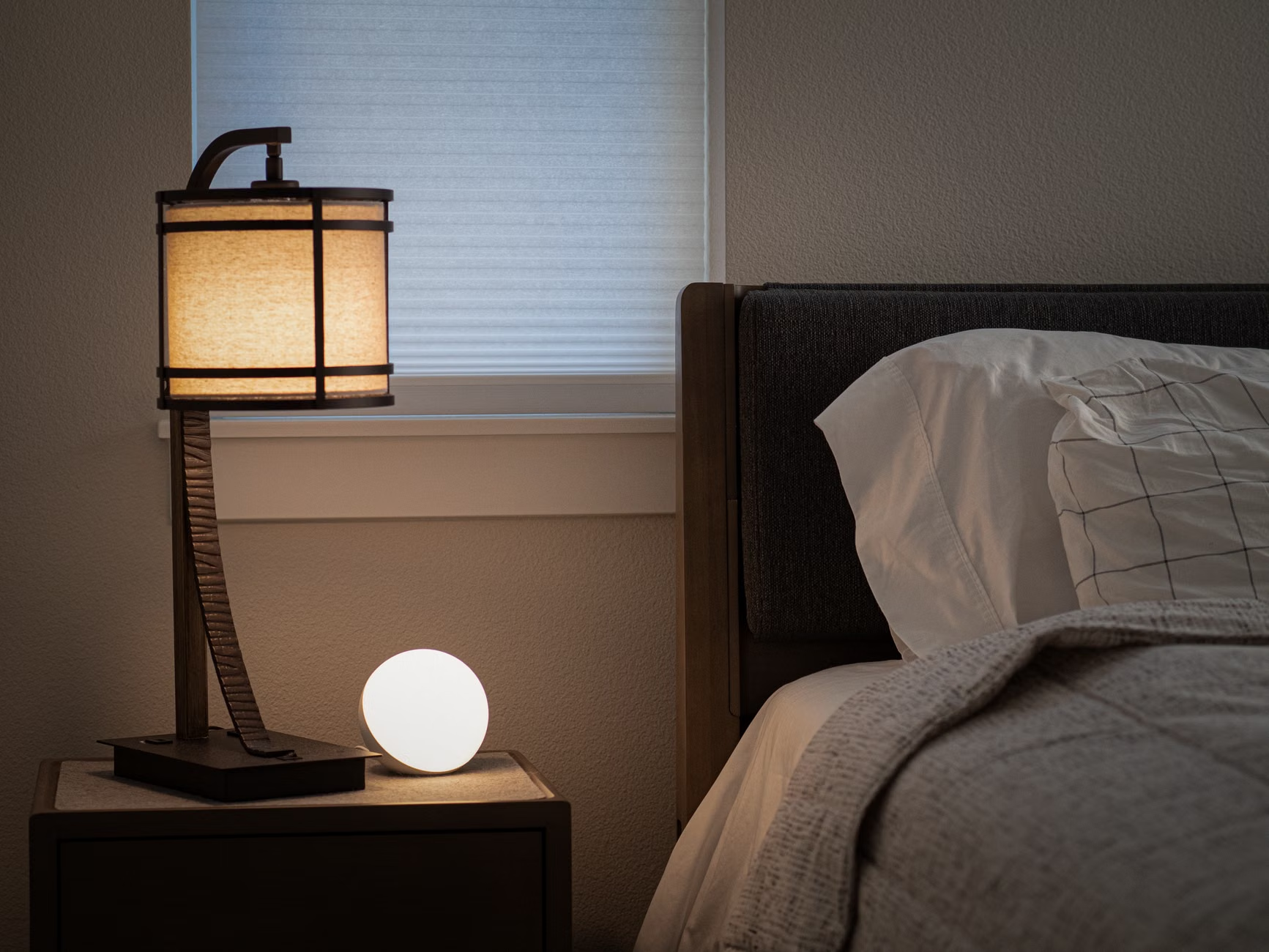
The Audit Fix: Aim for a room temperature between 18°C and 20°C (65°F to 68°F). If you cannot control the central heating, invest in moisture-wicking bedding or a cooling mattress topper. This isn’t just “comfort”; it is a biological requirement for your hypothalamus to signal that it is time to shut down the system.
Furthermore, light is the primary driver of your circadian rhythm. Even the small LED light from a standby television or a charging cable can be enough to disrupt melatonin production. Use blackout curtains or, if that is too expensive or impractical in your rental or home, a high-quality, contoured sleep mask. A mask is a “low-friction” solution that provides an immediate, measurable improvement in sleep latency.
Step 3: Managing the Cognitive Wind-Down
If you are a parent in your 30s or 40s, your brain is likely running a “to-do” list of tomorrow’s logistics while you try to fall asleep. This is cognitive arousal. If your brain is busy solving problems, it cannot enter the first stage of sleep. The most effective way to address this is not “meditation” (which can be difficult to start when you are exhausted), but “brain dumping.”
Keep a notepad by your bed. Before you get into bed, write down every task, worry, or logistical item for the next day. By externalizing the information, you are telling your brain, “It is safe to let go of this; it is recorded.” This simple act reduces the cognitive load that typically keeps you staring at the ceiling.
Also, consider the “tech-gap.” If you are scrolling through social media or checking emails in bed, you are bombarding your brain with cortisol-inducing information. You must establish a “tech-free zone” in the bedroom. If you need your phone for an alarm, keep it across the room. The physical act of having to get out of bed to turn off an alarm is, in itself, a great way to ensure you actually wake up at the end of a sleep cycle.
Step 4: Aligning with the 90-Minute Cycle
Once you have your data, look at your wake-up times. If you are waking up feeling groggy, you are likely interrupting your REM cycle. Since cycles are roughly 90 minutes, you should aim to wake up at a multiple of 90 minutes from your fall-asleep time.
| Sleep Duration | Number of Cycles | Typical Feeling |
|---|---|---|
| 6 hours | 4 cycles | Alert, but potentially short on total rest. |
| 7.5 hours | 5 cycles | Optimal for most adults. |
| 9 hours | 6 cycles | Ideal, though often difficult for parents to achieve. |
If you fall asleep at 11:00 PM, try to set your alarm for 6:30 AM (7.5 hours later) rather than 6:00 AM. That extra 30 minutes of sleep is often less important than the fact that you are waking up at the natural conclusion of a cycle. Experiment with these 90-minute blocks for a few days. You will quickly find which duration leaves you feeling the most “human” in the morning.
Step 5: Addressing the “Parenting Variable”
We need to address the elephant in the room: children. If your sleep is constantly interrupted by a child, you cannot control the start and end of your cycles in the same way. However, you can optimize your “recovery architecture.”

If you are a parent of a young child, your goal is to maximize the efficiency of the sleep you *do* get. This means that when you do have a window of rest, you must ensure that the environment is perfectly primed. Don’t waste your limited downtime on “doom-scrolling” or light housework. Prioritize the “dark and cool” environment mentioned earlier. If you are dealing with frequent wake-ups, consider a “sleep shift” with your partner. One person takes the first half of the night, the other takes the second. This allows at least one person to get a solid 4-hour block of uninterrupted sleep, which is enough to complete two full 90-minute cycles and one partial cycle.
Common Misconceptions and Hidden Costs
One of the most dangerous myths is that you can “train” yourself to need less sleep. Research consistently shows that while you might *feel* less tired, your cognitive performance, reaction times, and emotional regulation decline significantly after just a few days of restricted sleep. Another hidden cost is “alcohol as a sleep aid.” While a glass of wine might help you fall asleep faster (reducing sleep latency), it is a potent disruptor of REM sleep. You might fall asleep, but you won’t get the restorative benefits. If you are having trouble sleeping, alcohol is the first thing to cut from your evening routine.
Also, don’t over-rely on supplements like melatonin. While they can be helpful for jet lag, they are a temporary patch. If your sleep architecture is fundamentally broken due to light exposure or temperature, a supplement won’t fix the underlying cycle disruption. Always prioritize the environment first.
Executing Your Audit: A Practical Checklist
To begin your audit today, follow this checklist. Do not try to do everything at once. Focus on one variable per week.
- Week 1: The Observation Week. Track your sleep latency, temperature, and tech-use. Do not change your habits yet. Just record the data.
- Week 2: The Environmental Fix. Implement the “dark and cool” rule. Use a mask, lower the thermostat, and remove all screens from the bedroom.
- Week 3: The Cognitive Wind-down. Implement the “brain dump” notepad. Clear your head of tomorrow’s logistics before you reach the bed.
- Week 4: The Cycle Alignment. Adjust your wake-up time to align with the 90-minute cycle rule.
If you find that you are still struggling after these four weeks, it may be time to consult a doctor to rule out conditions like sleep apnea, which is more common than many people think, especially in our 30s and 40s. A simple, non-invasive sleep study can provide the clinical data you need to address issues that an at-home audit cannot catch.
Final Thoughts: Rest as a Strategic Asset
Your sleep is not a luxury; it is the foundation upon which your parenting, your career, and your personal happiness are built. By treating it as a system to be audited and optimized, you move from a state of passive exhaustion to active management. You don’t need to be perfect. You need to be consistent. Start with the data, adjust the environment, and respect the cycle. Your mornings—and your family—will thank you.
Recommended Resources for Further Reading:
Frequently Asked Questions
Q: Does “catching up” on sleep over the weekend actually work?
A: Unfortunately, no. You cannot “bank” sleep. While sleeping in on the weekend can help you feel less tired, it often shifts your internal clock (social jetlag), making it even harder to wake up on Monday morning. It is better to have a consistent wake-up time, even on weekends, to stabilize your circadian rhythm.
Q: I have to check my phone for work emergencies at night. What should I do?
A: If you must have your phone, use a “Do Not Disturb” mode that only allows calls from specific, urgent contacts. Set the screen to the warmest possible color temperature (Night Shift or equivalent) and keep the phone at least an arm’s length away from your face to reduce the intensity of the light hitting your eyes.
Q: What if my partner and I have different sleep needs?
A: It is common to have different chronotypes (morning larks vs. night owls). The key is to respect the “dark and cool” environment for both. If your partner needs to stay up later, they should do so in a different room or use a dim reading light that doesn’t disturb your sleep space. Compromise on the environment, but honor your individual biological needs.