By 2026, the global energy grid will face its most significant stress test in decades, driven by a perfect storm of artificial intelligence infrastructure demand, the rapid transition to electric vehicles (EVs), and the increasing frequency of extreme weather events. For those of us juggling careers and parenting, this isn’t just a headline about utility companies; it is a direct signal that our home energy management strategies need a serious upgrade to avoid rising costs and potential service instability.
- The “Load Shift” is Mandatory: Expect time-of-use (TOU) pricing to become the standard; running heavy appliances during peak hours will become significantly more expensive by 2026.
- Infrastructure Bottlenecks: Local grid capacity is failing to keep pace with neighborhood-level demand (EV chargers + heat pumps), meaning localized “brownout warnings” will be more common in suburban areas.
- Smart Home Automation is Your Best Defense: Manual tracking is no longer sufficient; investing in smart home energy management systems (HEMS) is the most effective way to automate savings and protect appliances from grid fluctuations.
The Intersection of AI, EVs, and Your Home Power Bill
If you have noticed your electricity bill creeping up over the last two years, you aren’t imagining it. We are currently living through a fundamental shift in how power is generated and consumed. The primary driver is the massive expansion of hyperscale data centers needed to power global AI ambitions. When you combine this industrial-scale surge with the domestic shift toward electrification—specifically heat pumps and EV charging—the grid is effectively being squeezed from both ends.
For a parent in their 30s or 40s, this means the “set it and forget it” mentality toward home energy is becoming a financial liability. In many regions, utility providers are moving toward “dynamic pricing.” This is a mechanism where the cost of electricity fluctuates based on real-time grid demand. When the grid is stressed—typically between 4:00 PM and 9:00 PM—the price per kilowatt-hour (kWh) can spike to three or four times the off-peak rate.

Think of it like ride-sharing surge pricing, but for your dishwasher and laundry machine. If you are starting a heavy-duty laundry cycle at 6:30 PM while your EV is plugged into a Level 2 charger, you are likely paying premium rates during the most expensive window of the day. By 2026, this won’t just be a suggestion to save money; it will be the primary lever utilities use to prevent grid collapse.
Understanding the 2026 Peak-Load Warning Framework
Why specifically 2026? This year marks a critical juncture where the “legacy grid” (designed for steady, predictable demand) meets the “new grid” (characterized by intermittent renewables and massive, sudden spikes in demand). Utilities are increasingly issuing “Peak-Load Warnings” or “Flex Alerts.” These are not just weather-related warnings; they are grid-health indicators.
When these alerts are active, the grid operator is effectively telling the public that the margin between supply and demand is razor-thin. If too many households run high-wattage appliances simultaneously, the risk of localized grid instability increases. This isn’t necessarily about a total blackout, but rather the increased likelihood of voltage drops that can damage sensitive electronics or cause smart devices to reset.
The Real-Life Impact on Your Appliances
Modern household appliances, including smart refrigerators, induction stoves, and high-efficiency HVAC systems, rely on sensitive power electronics. When the grid voltage fluctuates due to high-load demand, these components take the hit. Many homeowners are unaware that their appliances might be logging “undervoltage” errors, which can void warranties or lead to premature failure.
| Appliance | Peak Load Impact | Mitigation Strategy |
|---|---|---|
| Electric Vehicle Charger | Extremely High | Schedule for 12:00 AM – 5:00 AM |
| Heat Pump / HVAC | High | Pre-cool/heat before peak hours |
| Dishwasher/Dryer | Moderate | Delay start to off-peak |
Actionable Steps: Future-Proofing Your Home Energy Consumption
You do not need to become an electrical engineer to navigate the 2026 landscape, but you do need to adopt a “grid-aware” lifestyle. The goal is to shift your energy-heavy tasks to times when the grid is underutilized. Here is how you can practically manage this without sacrificing your quality of life.
1. Automate Your “Load Shifting”
If your appliances have a “Delay Start” or Wi-Fi connectivity, use it. The most common mistake people make is waiting until after dinner to start the dishwasher. By 2026, many smart home hubs will integrate with local utility “demand response” programs. If you opt into these programs, your smart thermostat or EV charger can automatically throttle back during a peak-load event in exchange for lower monthly rates.
2. The EV Charging Discipline
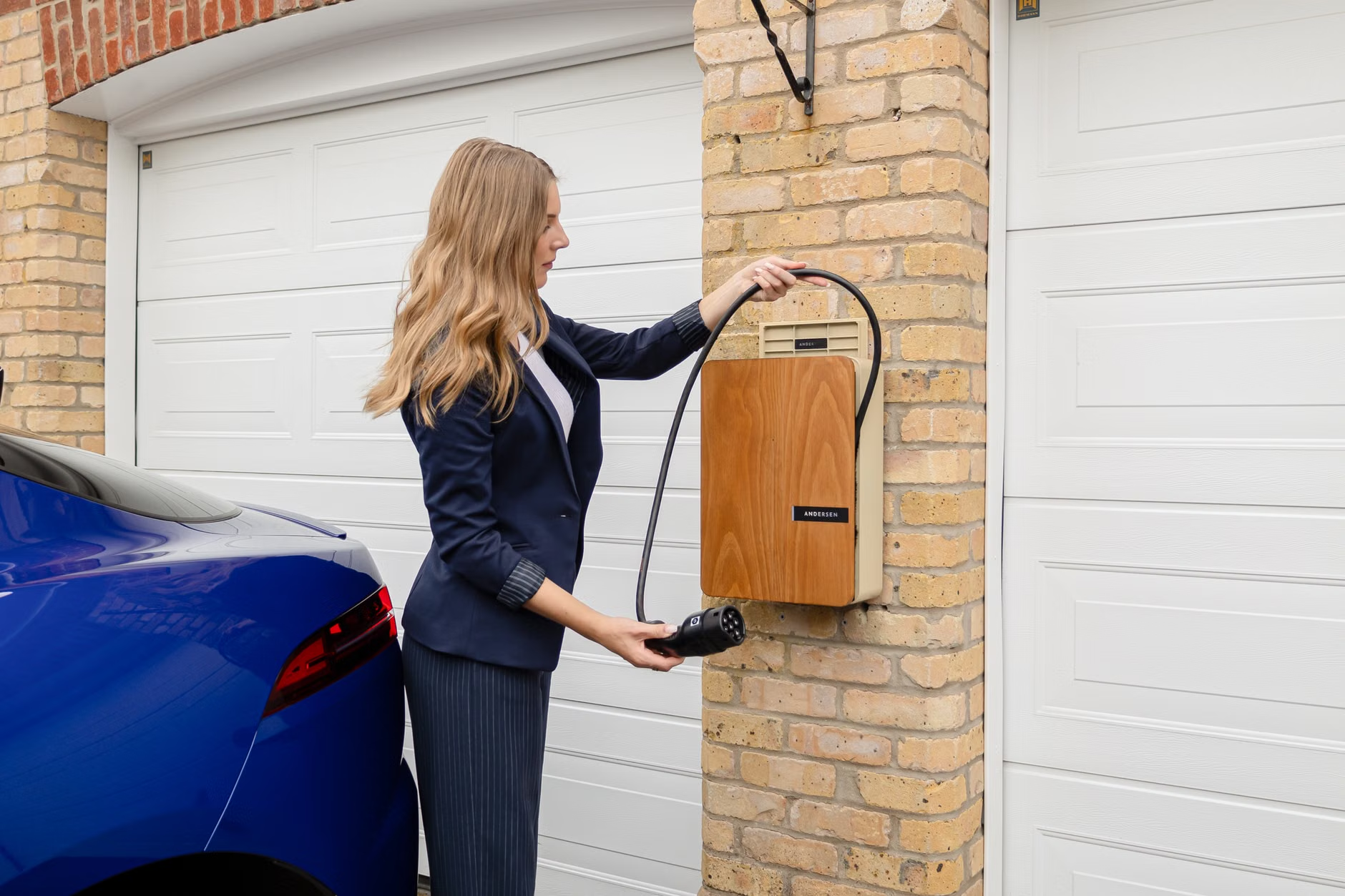
Charging an electric vehicle is the single largest energy spike in a modern home. If you are plugging in at 5:00 PM when you get home from work, you are compounding the grid’s problem. Use your vehicle’s native scheduling feature or your wall-mounted charger’s app to ensure charging starts only after midnight. This is not just a cost-saving measure; it is a contribution to grid stability that prevents the need for rolling outages.
3. Investing in Energy Storage
If you are in a region with high energy costs and frequent grid warnings, home battery systems (like the Tesla Powerwall or similar modular units) are becoming a rational financial decision rather than a luxury. By storing energy during the day (or when rates are low) and discharging it during peak hours, you effectively insulate your household from the volatility of the grid. While the upfront cost is significant, the “arbitrage” value—buying low and using your own energy high—shortens the payback period significantly.
Common Misconceptions About Grid Warnings
There is a lot of noise regarding the state of the grid. It is important to separate fear-mongering from the technical reality. A “Peak-Load Warning” does not mean the entire national grid is failing. It means that the local distribution transformer or the regional substation is approaching its thermal limit. In many cases, these warnings are preventative measures to avoid equipment burnout.
Another common misconception is that “going green” with solar panels automatically solves your grid dependency issues. Unless you have a battery backup system, most grid-tied solar systems automatically shut down during a grid outage for safety reasons (to prevent back-feeding electricity into the lines while workers are repairing them). If your goal is energy independence, solar panels alone are only half the equation; storage is the other, equally important half.
The Hidden Costs of Inaction
The cost of ignoring these trends is twofold: financial and physical. Financially, you will likely see your utility provider shift more costs onto the consumer during peak hours. If you continue to use electricity in the same way you did in 2020, your bill will naturally rise as utilities pass on the costs of grid upgrades and peak-demand management.
Physically, the wear and tear on your home’s electrical system is real. Constantly running high-load devices during peak, high-voltage-fluctuation periods can lead to premature failure of circuit breakers and sensitive smart-home controllers. By shifting your usage, you are essentially “smoothing out” the demand on your home’s internal wiring, which is a sound maintenance practice for any homeowner.
Moving Forward: A Proactive Stance
The 2026 grid landscape is not something to fear, but it is something to plan for. As we balance the demands of our careers and our families, the goal should be to minimize the friction between our lifestyle and the limitations of the infrastructure we rely on. Start by checking your local utility provider’s website for “Time of Use” (TOU) plans. Even if you don’t switch your plan immediately, understanding the “peak” and “off-peak” windows for your specific area is the first step toward regaining control of your energy budget.
If you are currently renovating or looking at purchasing new appliances, prioritize models with “Smart Grid” or “Demand Response” certification. These aren’t just marketing buzzwords; they are features that will allow your appliances to “talk” to the grid and make decisions that save you money automatically. We are moving into an era where our homes are active participants in the energy economy. By staying informed and making small, consistent adjustments, we can ensure that our households remain comfortable, efficient, and resilient, no matter how much the grid is tested.
Frequently Asked Questions
Q: Will my electricity go out if I don’t change my habits during a peak-load warning?
A: Most likely, no. These warnings are generally issued to prevent the grid from reaching a breaking point. However, if enough people ignore the warnings, utilities may be forced to implement “rolling blackouts” to protect the infrastructure. By reducing your usage, you are helping to avoid that scenario entirely.
Q: Is it cheaper to keep my heat pump running at a constant temperature or turn it off during peak hours?
A: For heat pumps, it is almost always more efficient to maintain a steady temperature. However, you can “pre-cool” or “pre-heat” your home by a few degrees just before the peak window begins, then allow the temperature to drift slightly during the peak window. This is known as “thermal storage,” where your home’s insulation acts as the battery.
Q: Are smart home energy management systems worth the investment for an average household?
A: If you own an electric vehicle or have high monthly electricity bills, the ROI on a smart home energy management system (HEMS) is typically very high. These systems can pay for themselves within 2-4 years by automatically optimizing your energy usage, especially if you move to a dynamic pricing utility plan.
For further reading on grid stability and your local utility’s current capacity projects, visit the official website of your regional energy authority or the International Energy Agency (IEA) for global reports on electricity market trends. Always check your specific utility provider’s “Demand Response” page to see if you are eligible for rebates on smart devices.