The “post-growth” parenting trend is not about poverty or deprivation; it is a deliberate decision to prioritize time, connection, and psychological well-being over the relentless cycle of consumption that defines modern urban life.
- Redefining Success: Post-growth parenting shifts the metric of a “good childhood” from the volume of experiences and toys to the quality of presence and emotional regulation.
- The Time-Money Trade-off: By opting out of competitive consumption, families can often reduce their work hours, directly increasing the time available for child-rearing and personal restoration.
- Structural Minimalism: Implementing this trend requires “structural minimalism”—designing your home and schedule to eliminate friction, rather than just decluttering surfaces.
If you are a parent in your 30s or 40s living in a major urban center, you likely know the feeling of the “accumulation trap.” It starts with the nursery gear, moves to the educational toys, and eventually manifests as a calendar packed with expensive extracurriculars designed to “optimize” your child’s future. We are told that more is better—more enrichment, more gear, more social status. But for a growing number of families, this model is hitting a wall of burnout and financial strain.
The post-growth movement, rooted in ecological economics, suggests that infinite growth on a finite planet is impossible. When applied to parenting, it posits that infinite accumulation of “stuff” and “scheduled activities” is equally unsustainable for the human brain and the family unit. Let’s look at how this shift is playing out in living rooms from London to Singapore, and why it might be the most rational choice you make this year.

Moving from Consumption-Based Parenting to Intentional Presence
For decades, the “Good Parent” archetype has been linked to the ability to provide. We equate love with the provision of high-end brands, private lessons, and a home filled with the latest developmental tools. However, current psychological research, such as studies on “the paradox of choice,” suggests that children—much like adults—become overwhelmed by too many options. When a child has fifty toys, they often play with none of them effectively. When a child has five, they learn to animate those objects with their imagination.
The post-growth approach asks a simple, uncomfortable question: Are we buying these things for the child, or are we buying them to alleviate our own parental anxiety about “not doing enough”?
In practice, this looks like “structural minimalism.” This is not just about throwing away old clothes. It is about redesigning the home to facilitate independent play. For example, rather than a toy chest that becomes a dumping ground, post-growth families often use a “rotating library” system. You keep 80% of the toys in storage and rotate them every two weeks. The result is a room that feels fresh without new purchases, and a child who engages more deeply with the objects available.
The Economic Reality of Opting Out
The financial pressure on families in their 30s and 40s is unprecedented. Housing costs in major urban hubs have effectively tethered many of us to high-stress, high-output careers. The post-growth philosophy argues that by lowering your “consumption floor”—the baseline of what you consider necessary to live—you can potentially negotiate a different relationship with your employer.
Consider the “lifestyle creep” that occurs when both parents work full-time to sustain a high-consumption lifestyle. Often, a significant portion of the second income is spent on convenience services: meal kits, after-school care, house cleaning, and expensive weekend activities to “make up” for the lost time. If you strip away the desire for constant upgrades, you might find that the marginal utility of that second, high-stress job is lower than you thought.
Decision Rule: Calculate your “real hourly wage” after taxes, commuting costs, and work-related expenses (including the emotional cost of stress). If you are working to pay for services you could provide yourself if you weren’t working so much, you are caught in a cycle of diminishing returns.

The Practical Framework: How to Implement Post-Growth Parenting
Transitioning to a post-growth mindset isn’t an overnight process. It requires a systematic dismantling of the social pressures that tell us our value is tied to our output. Here is how you can start applying this framework to your daily life.
| Area | Traditional Approach | Post-Growth Approach |
|---|---|---|
| Extracurriculars | Multiple activities per week for “well-roundedness.” | One or two deep-dive interests; focus on unstructured play. |
| Home Environment | High volume of toys/gadgets to prevent boredom. | High-quality, open-ended materials; rotation systems. |
| Social Life | Paid venues (soft play, cinemas, theme parks). | Community-based engagement (parks, libraries, neighborhood walks). |
Reducing the “Enrichment” Burden
One of the biggest sources of modern parenting stress is the “enrichment trap.” We feel that if our children aren’t learning a language, playing a sport, and attending a coding workshop, they are falling behind. This is a myth driven by the competitive nature of urban parenting. Research into child development consistently shows that the most critical “enrichment” for a child under the age of 10 is secure attachment and boredom—yes, boredom.
Boredom is the precursor to creativity. When a child is constantly entertained, they never learn to regulate their own attention or generate their own ideas. By opting out of the “busyness” culture, you are not depriving your child; you are giving them the cognitive space to develop their own internal world.
The Role of Community and Sharing Economies
Post-growth is not about isolation. In fact, it often requires deeper community integration. If you are not buying every piece of equipment, you need a network. This is where the sharing economy comes in. Look for local “toy libraries,” tool-sharing groups, or neighborhood parent swaps. These systems reduce the need for individual ownership and build social capital, which is far more valuable in the long run than a garage full of plastic.
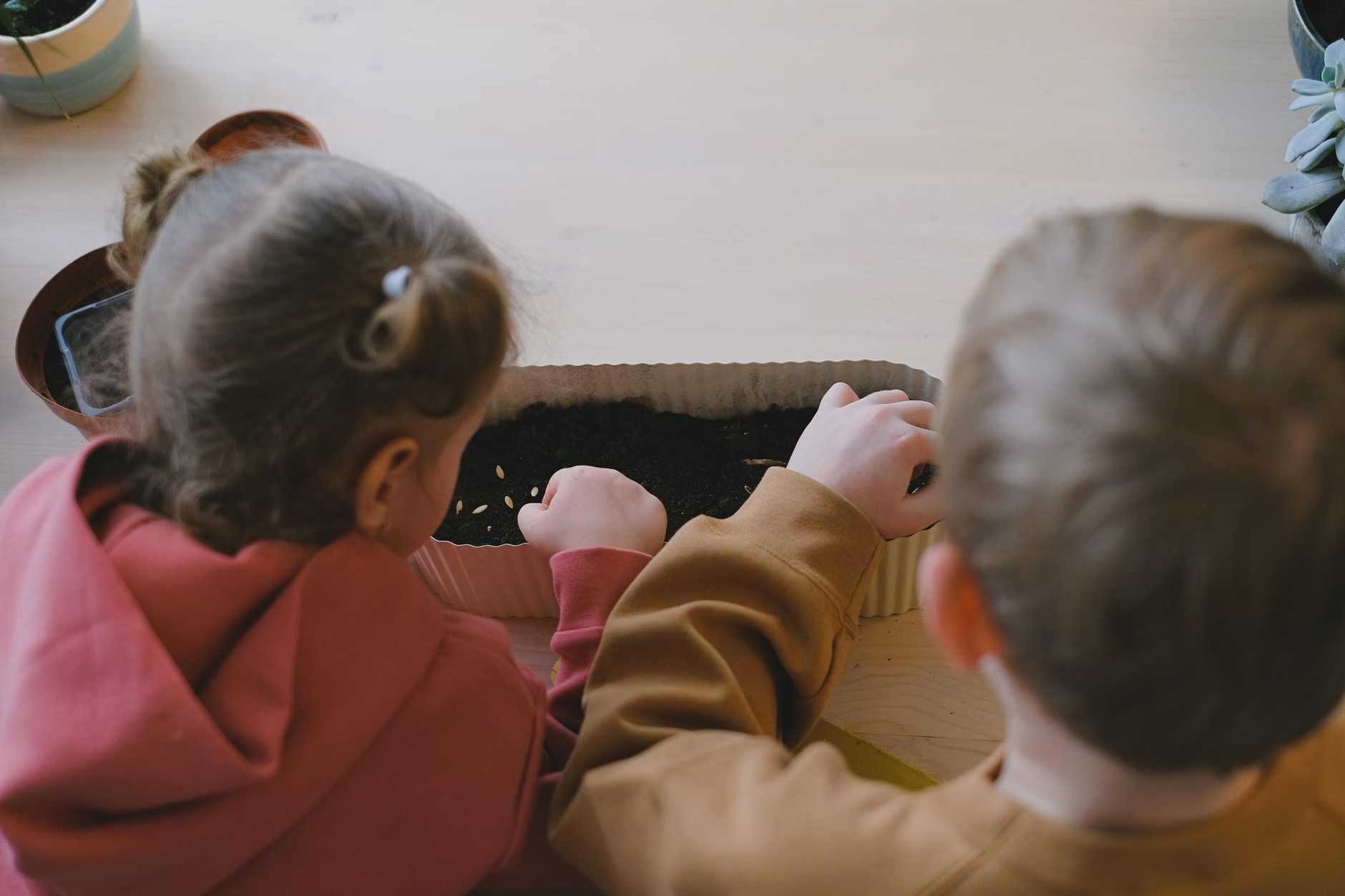
When you start swimming against the current, you will encounter resistance. Here is how to handle the most common issues you will face as a post-growth parent.
1. The “Gift” Problem
Grandparents and relatives often express love through gifts. When you start purging toys, this can create friction. The solution: Be transparent about your values. Instead of asking them to stop giving, ask them to change the *type* of gift. Suggest experiences (a museum pass, a zoo membership, a cooking class) or “consumables” (art supplies, books) that don’t add to the long-term clutter.
2. The “Fear of Missing Out” (FOMO)
You will see other parents posting about their child’s intensive summer camp or expensive new gadgets. You will feel a twinge of guilt. Acknowledge the feeling, then look at your own family’s metrics. Is your child happy? Are you less stressed? Is your bank account more stable? If the answer is yes, you are winning, even if it doesn’t look like “winning” on social media.
3. The “Social Stigma” of Simplicity
In some urban circles, consumption is a status symbol. If you show up to a playdate with homemade snacks and hand-me-down clothes, you might feel judged. Remember that your goal is not to impress other parents; it is to build a life that is sustainable for your family. The people who matter will respect your autonomy, and the ones who don’t are not your target audience.
Deepening the Philosophy: Beyond the Surface
To truly embrace post-growth parenting, you must look at the structural dependencies in your life. This involves auditing your “time-sinks.” Many of us are caught in a cycle of working to pay for convenience, which then leaves us with no time to do the things we are paying for. It is a feedback loop of exhaustion.
Start by auditing your weekly expenses. Categorize them into “Life-Sustaining” and “Convenience/Status.” You will likely find that a significant percentage of your budget is going toward things that actually complicate your life rather than simplify it. For instance, do you pay for a premium subscription for a streaming service that keeps your kids zoned out, or could you spend that time walking in a park? The cost is the same (or lower), but the return on investment for family connection is significantly higher.
Furthermore, consider the environmental impact of your parenting choices. The post-growth movement is deeply intertwined with sustainability. By choosing second-hand, buying less, and repairing what you have, you are teaching your children a fundamental lesson about the planet’s limits. This is not a lecture; it is a way of life that they will internalize through observation.
Actionable Steps for the Next 30 Days
If you want to start this transition, do not try to change everything at once. Start with these three steps:
- The 7-Day Audit: Track every dollar spent and every hour worked for one week. Identify the “convenience” costs that don’t add value to your family’s happiness.
- The Toy Purge: Reduce your child’s accessible toys by 50%. Store them away and rotate them monthly. Observe the change in their play patterns—you will likely see an increase in focus and creativity.
- The “No-Spend” Weekend: Commit to one weekend a month where you do not spend money on entertainment or dining out. Use public spaces, hike, or engage in home-based projects. Use this time to observe how your family dynamic changes when the pressure to “consume” is removed.
The post-growth movement is ultimately about reclaiming the agency that modern consumerist culture has stripped from us. By choosing to step off the treadmill, you are not just making a lifestyle choice; you are making a political and personal statement that your time, your family, and your peace of mind are worth more than the status symbols that define the current urban experience.
Frequently Asked Questions
1. Isn’t this just another word for minimalism?
While they share similarities, minimalism is often focused on the aesthetic of the home. Post-growth is a broader socio-economic framework that considers how your family interacts with the wider economy, focusing on labor, time-wealth, and sustainable consumption rather than just decluttering.
2. How do I explain this to my child who wants what their friends have?
Honesty is key. You don’t need to explain macroeconomic theory. Instead, talk about your family’s values. “We choose to spend our money on experiences like our summer trip rather than on new toys, because we value memories over things.” This helps them understand the trade-offs inherent in life.
3. Can post-growth parenting work in a high-cost city?
It is actually more relevant in high-cost cities, where the “cost of living” is often inflated by “cost of status.” By living intentionally, you can often find ways to lower your overhead, allowing for more flexibility in your career even in expensive urban environments.
For further reading on the intersection of parenting, economics, and sustainability, you may find the following resources helpful:
- Research & Degrowth (R&D): An academic collective exploring the theory and practice of degrowth.
- UN Sustainable Development Goals (Goal 12): Official global framework for responsible consumption and production.
Ultimately, the most important thing is to start where you are. You don’t need to be perfect. You just need to be intentional. The goal is not to be a “perfect” post-growth parent, but to be a parent who is present, engaged, and conscious of the choices they make every single day. The freedom you gain from this shift is not just in your schedule; it is in your mind.