The most successful intergenerational heritage trips are not defined by how many landmarks you visit, but by how you manage the gap between your parents’ mobility needs and your children’s attention spans. If you try to replicate a solo backpacking itinerary with three generations in tow, you will likely spend more time managing logistics than actually connecting with your family’s history.
- The 60% Rule: Plan only 60% of your day. The remaining 40% is for the inevitable delays, rest stops, and “discovery moments” that define heritage travel.
- Digital-Physical Hybridization: Use digital tools (like shared Google Maps) for logistics, but keep physical family records (photos, letters) to ground the experience in reality.
- Segmented Mobility: Plan your itinerary based on the slowest member of the group, and build in “splitting” points where the group can divide based on energy levels.
We have all seen the social media posts: a serene, multi-generational family walking through a cobblestone village in Italy, looking perfectly in sync. In reality, the 30-to-40-something parent in that group is likely holding a stroller in one hand, a grandparent’s arm in the other, and a smartphone with a dying battery. Heritage travel—traveling to the places where your ancestors lived or where your family history was shaped—is rewarding, but it is also a logistical high-wire act.
When you are in your 30s or 40s, you are the “sandwich generation” of travel. You are balancing the high-energy needs of your children with the, shall we say, measured pace of your parents. How do you turn a trip to your ancestral homeland from a stressful chore into a meaningful legacy?

The Logistics of Pace: Why Your Itinerary Needs a “Slow” Setting
The biggest mistake in multi-generational trip planning is the “efficiency trap.” You want to see the house where your great-grandmother grew up, the church where they were married, and the local museum—all in one morning. This works when you are traveling alone or with a partner. It fails when you are traveling with a group that spans 60 years in age.
The Reality of Mobility: If your parents are in their 60s or 70s, their walking speed is significantly different from your toddler’s or even your own. If you plan a schedule that requires walking 15,000 steps a day, you aren’t planning a vacation; you are planning a forced march.
The Fix: Adopt the “Hub and Spoke” model. Instead of moving hotels every two days—which is exhausting for both children and seniors—pick one central “hub” (a village or city near your ancestral roots). From there, take “spoke” trips. If the grandparents are tired one day, they can relax at the hub while you take the children on a shorter excursion. This removes the pressure to be a single, monolithic group 24/7.
Bridging the Gap: Digitizing Your Family History Before You Leave
Heritage travel is only “heritage” if you know what you are looking at. Too often, people travel to a town their grandfather was from, walk around for two hours, take a few photos, and leave. They miss the context because they didn’t do the pre-trip homework.
Step-by-Step Preparation:
- The Digital Archive: Before you leave, create a shared cloud folder (Google Drive or iCloud) for the whole family. Upload scans of old letters, maps of the town, and historical photos.
- The “Where Are We?” Map: Use a custom Google Map to pin exact locations. If you have an address of an old house, pin it. If you have a photo of a town square from 1950, pin the location where you think the photographer stood.
- The Oral History Interview: Spend a weekend before the trip recording your parents or grandparents talking about these places. Use a simple voice recorder app. Having their voice in your ear while you stand in that town square changes the experience from “sightseeing” to “memory-making.”
This preparation serves a dual purpose: it builds excitement for the children (who get to see “their” story on a map) and it gives the grandparents a sense of purpose and expertise during the trip.

Managing the “Disappointment Factor” in Heritage Travel
There is a hidden cost to heritage travel that nobody talks about: the reality check. You might have built up a mental image of your ancestral village as a pristine, idyllic place. When you arrive, you might find it has been modernized, commercialized, or simply looks nothing like the stories you were told.
Common Misconception: “Everything will be exactly as it was in the stories.”
The Reality: Buildings are torn down. Streets are renamed. The “small town” might now be a tourist hub. If you don’t manage this expectation, you (and your parents) may feel a sense of profound disappointment. Explain to your children and parents beforehand: “We are going to see where they lived, but it’s going to look different now. That’s part of the history—the world keeps moving.”
Decision Rule: If you are planning a trip specifically to find a “lost” house or a grave, hire a local guide for the first day. Local historians or genealogical researchers often know which archives to check and can navigate the local bureaucracy or language barriers that would take you weeks to decipher.
Comparative Planning: Renting vs. Hotels for Multi-Generational Groups
When you are traveling with five or more people across generations, the choice of accommodation is the single biggest factor in your daily stress levels.
| Feature | Hotel/Resort | Vacation Rental (Villa/Apartment) |
|---|---|---|
| Privacy | High (separate rooms) | Lower (shared common space) |
| Kitchen Access | None/Limited | Full (essential for dietary needs) |
| Socializing | Difficult (lobby/restaurant only) | Easy (living room/patio) |
| Responsibility | Zero (housekeeping provided) | Moderate (cleaning/trash/supplies) |
The Verdict: For heritage trips, vacation rentals are almost always superior. Why? Because heritage travel is about storytelling. You need a living room or a kitchen table where you can spread out old photos, discuss the day’s findings, and let the grandparents tell stories to the kids in a relaxed environment. A hotel room makes this kind of spontaneous family bonding nearly impossible.
Engaging the Children: Making History Feel Relevant
Your 8-year-old probably doesn’t care about the architecture of a 19th-century church. To them, it’s just another “old building.” To make it a heritage trip for them, you need to gamify the history.
Practical Ideas:
- The Scavenger Hunt: Give them a list of things to find: a specific type of tile, a statue mentioned in a family story, or a local treat their grandparent used to eat.
- The “Time Traveler” Journal: Provide a physical notebook. Instead of having them write essays, ask them to draw what they see or collect small, permissible items (like a leaf or a postcard) to paste in.
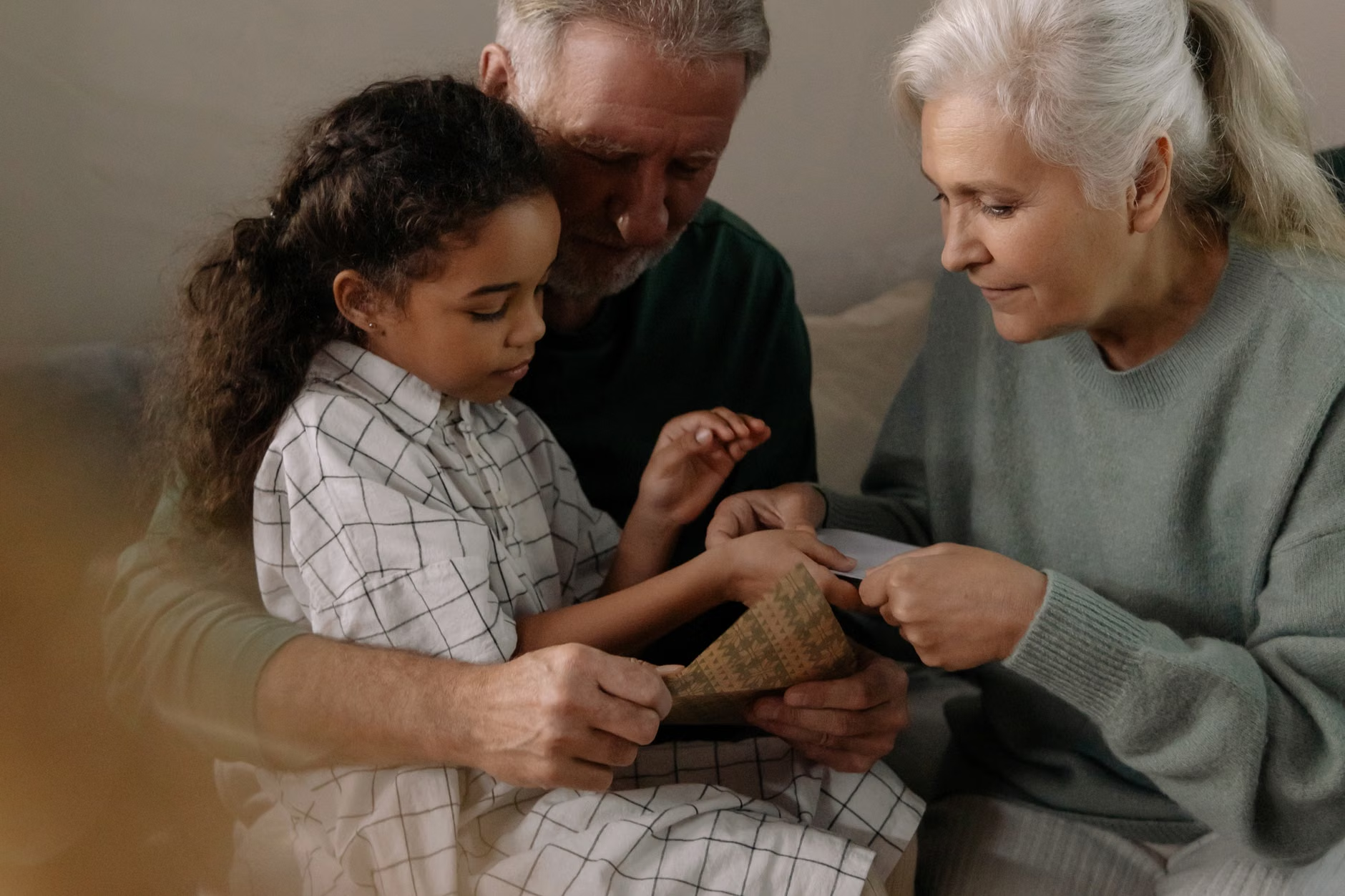
- The Connection Bridge: Explicitly point out the traits they share with their ancestors. “Look at the shape of your nose—you got that from your great-grandfather, whose house we are standing in right now.”
Overlooked Variables: Mobility, Health, and Bureaucracy
When traveling with an older generation, you must account for variables that younger travelers ignore. These are not just “cautions”; they are mandatory planning steps.
1. The “Step Count” Reality: Most European or older Asian cities are not ADA-compliant or stroller-friendly. Cobblestones are brutal for knees and wheels. Action: Check the “accessibility” features of every museum or site. If a site has 200 stairs, the grandparents may need to wait at a nearby café while you and the kids explore. Plan for this by identifying the café before you leave home.
2. Insurance and Medical Records: Ensure everyone has travel insurance that covers pre-existing conditions. More importantly, carry a physical, printed copy of everyone’s medical history and current medications. In an emergency in a foreign country, you do not want to be trying to remember the dosage of your father’s blood pressure medication.
3. The “Splitting the Group” Strategy: This is the most important piece of advice. You must have a “split-off” plan. If the group decides to go to a museum that the children will hate, have a backup plan for one parent to take the kids to a park or playground nearby. Do not force the whole group to do everything together. Forced togetherness is the fastest way to ruin a trip.
What You Should Do Now: A Step-by-Step Action Plan
If you are planning this trip for the coming year, don’t start by booking flights. Start by building the foundation.
Step 1 (Months 6-12 before): Conduct the “Legacy Audit.” Ask your parents what they actually want to see. Do they want to walk the streets of their childhood, or do they just want to eat the food they remember? Sometimes, the “heritage” part of the trip is entirely culinary.
Step 2 (Months 3-6 before): Build the shared document. This is your “Source of Truth.” Put all flight details, accommodation addresses, and, crucially, the “must-see” list here. If it’s not in the document, it doesn’t exist.
Step 3 (Month 1 before): Do a “dry run” of your technology. Make sure everyone has the maps downloaded for offline use. If you are going to a country where you don’t speak the language, make sure you have translation apps (like Google Translate) ready and that your parents know how to use them to find the “home” button.
Step 4 (During the trip): Be the “Chief Logistics Officer.” Your role isn’t to be the most excited traveler; it’s to be the one who ensures that the water bottles are filled, the snacks are in the bag, and the pace is sustainable. If you do your job well, your family won’t even notice the effort you’re putting in.
Heritage travel is a unique opportunity to stitch the generations together. It is rarely perfect, and it is almost always more exhausting than a beach vacation. But when you see your child standing in the same square where their great-grandparent stood, you realize that the effort—the planning, the packing, the navigating—was worth every single minute.
Final Recommendation: Focus on one “anchor” event per day—a lunch at a family-linked restaurant, a visit to a historical site, or a walk through a specific neighborhood. Treat everything else as a bonus. By keeping your “anchor” clear, you ensure that even if the rest of the day goes sideways, the core purpose of your journey is fulfilled.
Frequently Asked Questions
Q: What if my parents are not interested in “visiting the past” as much as I am?
A: Heritage travel should be a dialogue, not a lecture. If they aren’t interested in a specific site, don’t force it. Use the “split-off” strategy. Perhaps they would prefer to spend the afternoon at a local market while you visit the historical site. The goal is to spend time together, not to force them to relive every memory exactly as you imagine it.
Q: Is it better to book a guided tour for heritage trips?
A: A full-time guided tour is often too rigid for a multi-generational group. Instead, book “niche” local guides for specific, high-interest activities. For example, hire a local genealogist or historian for a three-hour walking tour of your family’s ancestral neighborhood. This gives you the expertise you need without forcing you into a 10-hour group itinerary that doesn’t accommodate your kids or parents.
Q: How do I handle the inevitable conflict when everyone is tired?
A: Conflict in multi-generational travel is almost always a symptom of hunger, fatigue, or lack of autonomy. When you feel the tension rising, implement the “Rule of Three”: stop for a 30-minute break, ensure everyone has had water and a snack, and re-evaluate the next two hours. If you are still stressed, cut the next activity. It is better to have one great memory than four miserable, rushed ones.
For further research on planning family history trips, you can consult resources like the FamilySearch guide to heritage travel, which provides excellent tips on identifying ancestral locations. Always cross-reference local travel advisories via your country’s official government travel portal before finalizing bookings.