- Prioritize Warmth: Switching to amber-toned (under 2700K) lighting prevents the suppression of melatonin, helping both you and your child fall back asleep faster.
- Automate for Safety: Motion-activated, low-intensity smart lighting eliminates the need for fumbling for switches, reducing the risk of accidents during late-night feeds.
- Energy Efficiency Matters: Low-energy LED smart bulbs consume up to 85% less electricity than traditional incandescents, making them a cost-effective, long-term solution for 24/7 nursery readiness.
If you have ever found yourself stumbling through a pitch-black nursery at 3:00 AM, only to flip on the overhead light and instantly regret it, you are not alone. That sudden, harsh blast of light is the quickest way to signal to your brain—and your baby’s—that the day has begun. The result? You are both wide awake, alert, and staring at the ceiling, wondering why the peaceful night has turned into an unintended early morning.
The solution isn’t just “turning on the light.” It is about managing the quality and intensity of the light. For parents in their 30s and 40s balancing careers, household management, and the demands of raising children, sleep is the most precious commodity. Integrating low-energy, smart lighting is no longer just a “tech-geek” hobby; it is a practical, science-backed strategy to protect your circadian rhythms and ensure that when the baby goes back down, you do too.
Why Blue Light is the Enemy of Your 3:00 AM Routine
To understand why your current lighting setup might be working against you, we need to look at the biology of sleep. Light, particularly light at the blue end of the spectrum, is a potent biological signal. During the day, blue light from the sun keeps us alert and suppresses melatonin, the hormone responsible for sleep. This is exactly what we want at 10:00 AM, but it is the last thing we want at 3:00 AM.
When you flip on a standard LED or CFL overhead light, you are exposing yourself and your child to a high concentration of blue wavelengths. This triggers an immediate chemical response: your brain stops producing melatonin and begins to ramp up cortisol. For an adult, this makes falling back asleep feel like a Herculean task. For a child, it can be the difference between a quick, sleepy feed and an hour of “night-time play” where they are suddenly wide awake and ready to chat.
The Fix: Shift your nursery lighting to the “warm” end of the spectrum. Look for bulbs labeled as “warm white” or “amber,” typically falling in the 1800K to 2700K range. These wavelengths have a significantly lower impact on melatonin suppression, allowing the body to remain in a “sleepy” state even when a light is on.
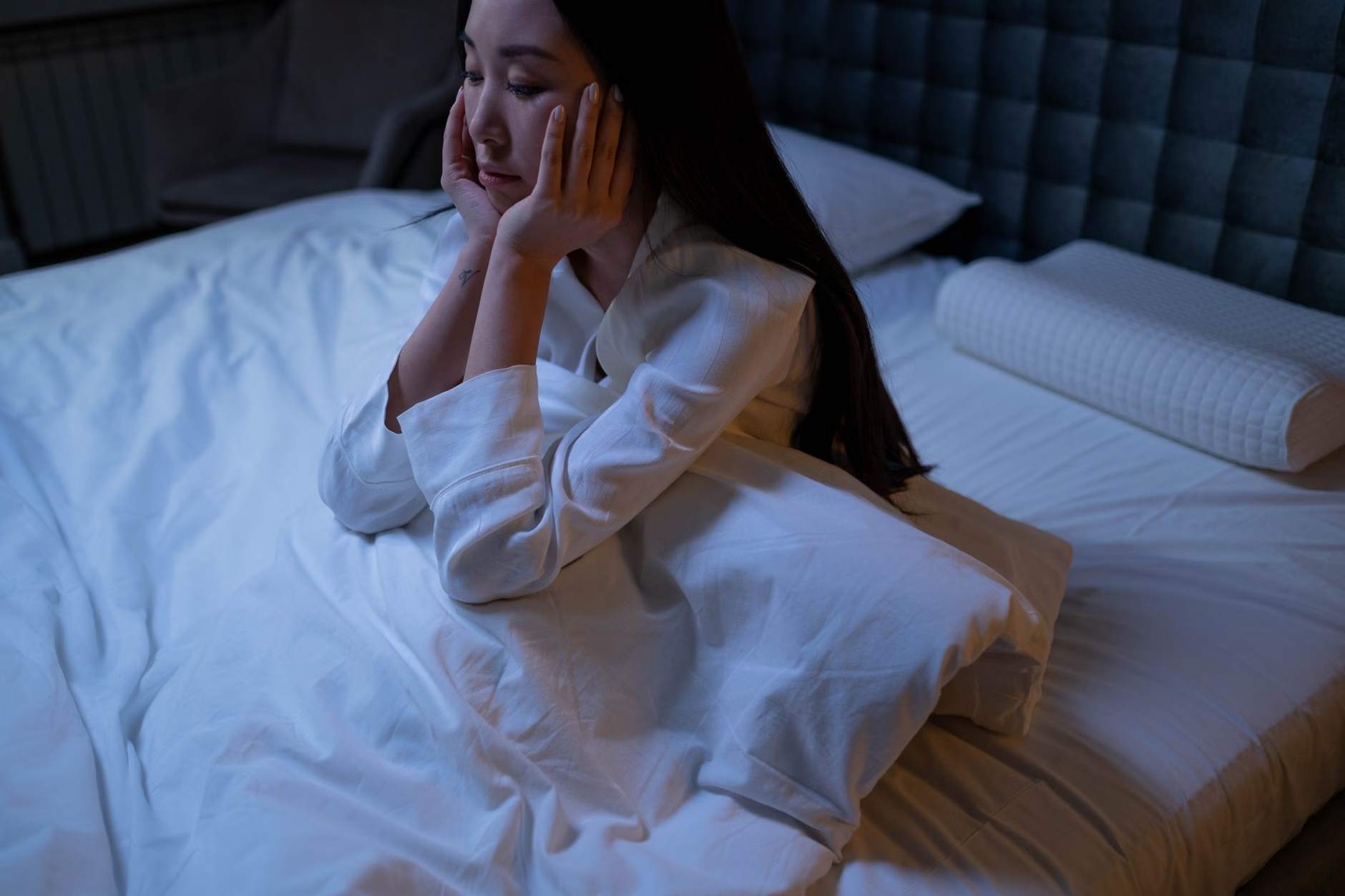
The Practicality of Smart Controls: Why Dimmers are Mandatory
It is not enough to just change the color temperature. Intensity matters just as much. Even a warm-colored bulb can be jarring if it is running at 100% brightness in a dark room. This is where smart lighting truly shines. Unlike a standard wall switch, which is a binary “on/off” device, smart lighting allows you to set “scenes” or “schedules.”
In a real-life scenario, consider the “Night Feed” scene. Through your smart home app (or a voice assistant), you can configure your nursery light to activate at only 5% brightness. This is just enough light to safely navigate the room, change a diaper, or check on a monitor, but it is not enough to fully alert the brain.
Furthermore, the ability to control this via voice or an app means you don’t have to walk across the room to a wall switch. If you are holding a sleeping baby, the last thing you want to do is move around more than necessary. Smart lighting gives you the power to manage your environment from the chair, the doorway, or even from your bed.
Building a “Low-Energy” Ecosystem: Efficiency and Cost
For parents, the “low-energy” aspect of smart lighting is more than just a nod to environmentalism; it is about the practical reality of maintaining a house. We are often running these lights for extended periods or leaving them on as “night lights” for older children. Traditional incandescent bulbs, even at low wattages, can burn through electricity and generate heat, which is a safety concern in a small nursery.
LED-based smart bulbs use a fraction of the power—often 5 to 9 watts—compared to the 60-watt equivalents of the past. Over the course of a year, this adds up. If you have multiple rooms outfitted with smart lighting, you are looking at a noticeable reduction in your monthly energy expenditure. More importantly, these bulbs last significantly longer, meaning you aren’t climbing on a step stool to change a burnt-out bulb in the middle of a sleep-deprived week.
Decision Rule: When shopping for smart bulbs, look for the “Energy Star” certification or check the lumens-to-wattage ratio. A high-quality LED bulb should provide at least 800 lumens for around 9-10 watts. If a bulb claims to be “smart” but requires a massive amount of energy to output decent light, it is likely older, less efficient technology.

Strategic Placement: Where to Put Your Lights
One of the biggest mistakes parents make is relying on a single, high-mounted ceiling light. Even if you dim it, a light source directly above your line of sight is inherently more distracting and stimulating. The goal for night-time parenting is indirect, low-level illumination.
The “Floor-Level” Strategy
Consider installing motion-activated, low-profile LED strips or smart plug-in night lights near the floor. Because light travels upward, placing your light source at baseboard level ensures that the floor is lit enough to prevent you from tripping over a stray toy, while the main sleeping area remains in relative shadow. This is a game-changer for parents who need to move quietly without waking the rest of the house.
The “Table-Lamp” Approach
If you prefer a lamp, ensure it has a shade that directs light downward or away from the baby’s direct line of sight. Using a smart bulb in a bedside lamp allows you to keep the light localized to your immediate area, keeping the “sleep zone” of the crib or bed darker.
| Lighting Type | Best Use Case | Key Advantage |
|---|---|---|
| Motion-Activated Floor Strips | Pathways and Diaper Stations | Hands-free operation; minimal light pollution. |
| Dimmable Smart Table Lamps | Feeding/Reading Chairs | Adjustable intensity; creates a localized “calm” zone. |
| Smart Ceiling Bulbs | General Room Cleanup | Full coverage; useful for daytime play or cleaning. |
As the table above suggests, the “best” light depends on the task. Do not try to solve every problem with one light. A layered lighting approach—using a combination of floor-level sensors and a dimmable lamp—provides the most flexibility.
Common Pitfalls and How to Avoid Them
Even with the best technology, you can still fall into traps. Here are the most common mistakes I see parents make when transitioning to a smart nursery:
- Over-complicating the Automation: Don’t try to sync your lights to complex IFTTT (If This Then That) recipes that involve your email or weather apps. Keep it simple: Trigger, Brightness, Duration. The more complex the system, the more likely it is to fail when you are too tired to troubleshoot.
- Ignoring the “Default State”: Many smart bulbs reset to 100% brightness if there is a power flicker. Ensure you choose a brand that allows you to set a “Power-on Behavior” (often found in the app settings), so if the power cuts out and comes back, the light stays off or returns to a soft, dim setting rather than blinding you at 2:00 AM.
- Neglecting Connectivity: If your smart lights rely entirely on a cloud server, they might stop working when your internet goes down. Look for bulbs that support local control (like those using Zigbee or Thread/Matter protocols) to ensure your lights work even if your Wi-Fi is acting up.
The Psychological Benefit of “Low-Energy” Parenting
There is a subtle, psychological advantage to having a “night mode” for your home. By automating the lighting environment, you remove the need for decision-making during the night. When you are operating on three hours of sleep, every decision—even a simple one like “should I turn this light on?”—is an additional cognitive load.
When the room automatically glows with a soft, amber hue as you walk in, the environment does the work for you. It reinforces the nighttime routine. It signals to your toddler or infant that this is a quiet, calm time. This reduces the friction of the night-time wake-up, making the transition back to sleep smoother for everyone involved.
It is also worth noting that this is not just about the baby. Parents in their 30s and 40s are often already dealing with high levels of stress and “mental clutter.” A chaotic, brightly lit, or poorly lit environment exacerbates that stress. A curated, automated environment is a form of self-care. It is a way to reclaim a sliver of control in a phase of life that is often defined by the lack thereof.
What You Should Do Today
If you are ready to upgrade your night-time setup, follow this step-by-step approach to avoid unnecessary spending and frustration:
- Inventory your current setup: Identify which lights you actually use during the night. You likely only need to replace two bulbs: one for the main lamp and one for a floor-level light.
- Choose your ecosystem: If you already have an Alexa, Google Home, or Apple HomeKit setup, choose bulbs that integrate natively. Don’t add a new hub or app if you don’t have to.
- Test the “Amber” threshold: Buy one bulb first. Set it to 2200K or 2700K and dim it to 10%. If it’s still too bright, look for a “night light” mode in the app, which often allows for even lower intensity than the standard slider.
- Set the “Power-on” behavior: This is the most overlooked step. Go into your app settings immediately after setup and ensure the bulb defaults to “Off” or “Last State” upon power restoration.
Technology should serve you, not complicate your life. By focusing on low-energy, warm-toned, and easily controllable lighting, you are creating a foundation for better sleep for your whole family. It is a small investment, but in the middle of a long night, it will feel like a professional-grade upgrade to your quality of life.
Frequently Asked Questions
1. Does the color temperature really matter, or is intensity more important?
Both matter, but they serve different purposes. Intensity (brightness) affects your immediate alertness and ability to navigate, while color temperature (the “warmth” of the light) directly affects your biological clock. To minimize sleep disruption, you need both: low intensity to keep the brain calm and warm color to prevent melatonin suppression.
2. Can I use these smart lights with a standard dimmer switch?
Generally, no. Most smart bulbs contain their own dimming electronics. Putting a smart bulb on a traditional wall-mounted dimmer switch can cause flickering, buzzing, or even damage to the bulb’s internal components. It is best to use a standard “always-on” wall switch and control the dimming through the app or voice commands.
3. Are there any privacy concerns with using smart lighting in a nursery?
Most major smart lighting brands handle data locally, but it is always a good practice to check the manufacturer’s privacy policy. If you are concerned, look for systems that operate via a local hub (like Philips Hue or Lutron) rather than cloud-only solutions. These systems don’t require an active internet connection to function, which keeps your usage data within your home network.
Useful Resources:
For more on the science of light and circadian rhythms, you can refer to the Sleep Foundation’s guide on light and sleep, which explains the biological impact of light exposure in greater detail. Additionally, the U.S. Department of Energy provides excellent comparative data on the long-term energy savings of LED technology versus traditional lighting.