- Co-regulation is not about fixing the emotion, but about being the calm anchor for your child’s nervous system while they learn to navigate stress during play.
- Play is the primary language of children; by entering their world without an agenda, you provide a safe space for them to process school-day frustrations or social anxieties.
- The “Pause-Reflect-Respond” framework is your most effective tool to shift from reactive parenting to intentional, co-regulating support during daily playtime.
You’ve just gotten home from a long day at the office, the laundry is piling up, and your eight-year-old is suddenly throwing a tantrum because a LEGO tower collapsed. It’s tempting to treat this as a simple behavioral issue to be “fixed” or dismissed. However, what you are witnessing is a nervous system that has reached its limit. This is where co-regulation—the process of using your own calm, regulated state to help your child steady their own—becomes a game-changer.
For parents in their 30s and 40s, life is a constant balancing act. We often view play as a “break” or a “reward” for our children, but for school-aged kids, play is their laboratory for emotional regulation. When you engage in co-regulation during playtime, you aren’t just building blocks; you are building the neural pathways your child needs to manage stress, frustration, and social complexity in the real world.

Why School-Aged Children Still Need Co-Regulation
There is a common misconception that once children hit school age, they should be “independent” in managing their feelings. We expect them to handle the social pressures of the playground, the academic stress of exams, and the complexities of friendships on their own. But the reality is that the prefrontal cortex—the part of the brain responsible for executive function and emotional regulation—is not fully developed until the mid-20s.
When a child spends six hours at school, they are often “masking.” They are holding in their impulses, following strict rules, and navigating social hierarchies. By the time they get home, their “emotional cup” is often overflowing. This is why a minor frustration, like a lost game piece or a dropped toy, triggers an outsized reaction. They aren’t overreacting to the toy; they are reacting to the cumulative stress of their day.
Co-regulation acts as an external nervous system. When you approach your child with a calm voice, steady breathing, and an open posture, your physiology actually influences theirs. This is a biological phenomenon known as limbic resonance. Your presence signals to their amygdala—the brain’s alarm system—that they are safe, which allows them to move out of “fight or flight” mode and back into a state where they can process their emotions.
The Mechanics of Play-Based Co-Regulation
Co-regulation doesn’t require a therapy degree or hours of free time. It requires intentional presence. The goal is to lower the barrier to entry for connection. When you enter your child’s world of play, you are entering their language. If you try to talk through a meltdown while they are building a spaceship, you are likely to be met with resistance. If you join the mission, you gain influence.
Step 1: The “Entry” Phase (Joining, Not Leading)
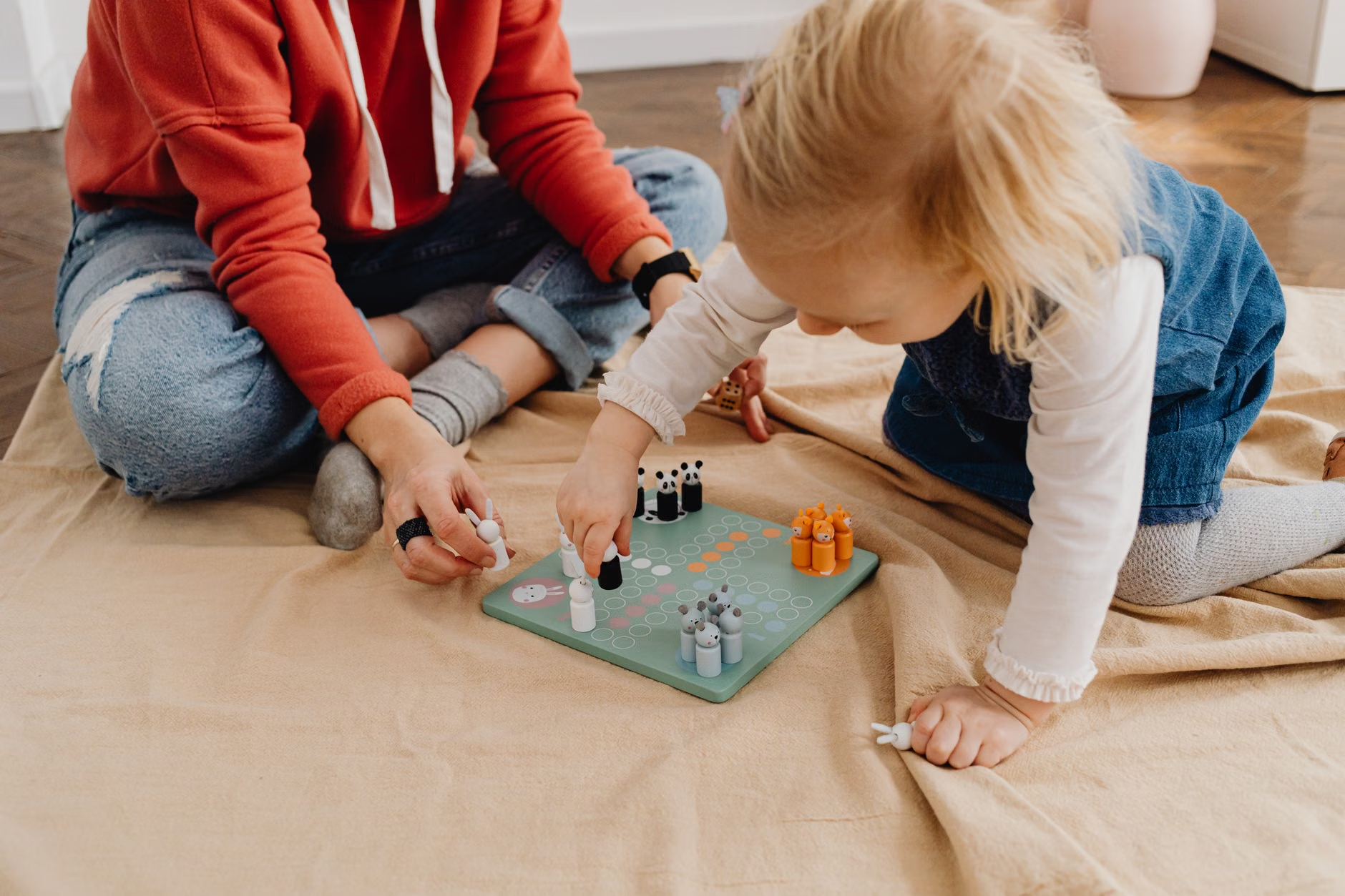
The biggest mistake parents make is trying to “teach” during play. If your child is struggling, the urge to say, “Look, you just need to put the blue piece there,” is strong. But this is an attempt to control the outcome, not support the child. Instead, try “parallel play” or “joining.” Sit nearby, observe what they are doing, and mirror their actions. If they are drawing, draw your own picture. If they are playing with cars, set up your own track. By simply being there, you are creating a “secure base.”
Step 2: The “Attunement” Phase (Reading the Cues)
Attunement is the process of matching your energy to your child’s. If they are hyperactive and loud, you don’t need to be silent and still; you need to be “calmly energetic.” Use your voice to modulate their intensity. If they are spiraling into frustration, lower your voice, slow your movements, and use shorter sentences. You are acting as a thermostat, slowly turning down the heat in the room.
Step 3: The “Expansion” Phase (Building Resilience)
Once you are connected, you can introduce subtle challenges. This is how you build resilience. If you are playing a game, you might model how to lose gracefully. “Oh, I lost that round! I feel a bit frustrated, but I’m going to take a deep breath and try again.” You are narrating the internal process of regulation, which gives them the vocabulary and the strategy to use when you aren’t there.
Common Pitfalls and How to Avoid Them
Even with the best intentions, parents often fall into traps that break the connection. Recognizing these early can save you a lot of headache.
| The Mistake | Why It Fails | The Better Approach |
|---|---|---|
| The “Fix-It” Trap | Focuses on the problem, not the emotion. Increases shame. | Validate the emotion: “I can see you’re really frustrated that this isn’t working.” |
| The “Questioning” Interrogation | “Why are you mad?” puts the child on the defensive. | Observe and reflect: “It seems like you’re having a really tough time with this part.” |
| The “Distraction” Method | Teaches the child to avoid feelings instead of processing them. | Stay with the feeling: Let them sit in the discomfort while you provide safety. |
The “Fix-It” trap is perhaps the most difficult to avoid for parents in their 30s and 40s. We are trained to be problem solvers. In the workplace, we identify a problem, implement a solution, and move on. When we apply this to a child’s emotional state, we often inadvertently tell them that their feelings are a problem to be solved, rather than a natural human experience to be felt and moved through.
Real-Life Scenarios: Putting Theory into Practice
Let’s look at a common scenario: The “Homework Meltdown.” Your child is struggling with a math worksheet. They start erasing the same line over and over until the paper rips. They throw the pencil. Your internal reaction might be, “We don’t throw things,” or “You’re acting like a baby.” Instead, try the co-regulation approach.
First, pause. Take a breath. If you are reactive, you will only add fuel to their fire. Second, validate. “I can see how frustrating this math problem is. It’s really hard.” Third, change the context. Instead of forcing them to keep working, move to the floor. “Let’s take a break. Let’s build a quick tower and then come back to this.” By changing the physical environment and the activity, you help their nervous system reset. They aren’t “avoiding” the work; they are regaining the capacity to do it.
Another scenario: The “Competitive Game.” You are playing a card game, and your child starts cheating or gets angry when they lose. Instead of lecturing them about “playing fair,” use the moment to model regulation. “I see you’re really disappointed that you lost. It’s hard to lose. Let’s play one more round, and I’m going to practice my ‘good loser’ face.” By making it a game about managing the feeling, you remove the pressure of the failure itself.

The Hidden Variable: Your Own Regulation
There is an overlooked variable in all of this: your own capacity. You cannot co-regulate if you are dysregulated. If you are exhausted, stressed, or hungry, your ability to act as an anchor is severely diminished. This is not a failure on your part; it is a biological reality. If you find yourself snapping at your child, it is a sign that you need a reset.
It is perfectly acceptable to say, “I am feeling really frustrated right now, and I need a few minutes to calm down before we continue playing.” This is a powerful lesson in emotional intelligence. You are showing your child that adults have big emotions too, and that we have healthy ways of handling them. That is far more valuable than any “perfect” parenting moment.
Furthermore, consider the “Hidden Cost” of constant stimulation. If your child’s playtime is constantly interrupted by screens, music, or high-energy activities, their nervous system may never have the chance to reach a baseline of calm. Try to incorporate “low-demand” play—activities that are repetitive and soothing, like coloring, building with blocks, or playing with water or playdough. These activities naturally encourage a slower, more regulated state for both of you.
Actionable Steps for Your Routine
You don’t need to change your entire life to start implementing co-regulation. Start small. Here is a simple framework for the next time you have a window of playtime:
- The 5-Minute Check-In: Before you start playing, take 30 seconds to check your own state. Are your shoulders tight? Is your breathing shallow? Drop your shoulders and take three slow, deep breaths.
- Follow, Don’t Lead: Spend the first 5 minutes of play doing exactly what your child is doing, without offering any suggestions or corrections. Just be there.
- Use “Low-Stakes” Failure: During the play, find a way to model a small mistake and show how you handle it. “Oops, that block fell! That’s okay, I’ll just pick it up.”
- End on a Connection Point: Before you stop playing, ensure there is a moment of eye contact or a shared laugh. This “closes the loop” and leaves the nervous system in a state of safety.
Remember that this is a practice, not a performance. There will be days when you are too tired to regulate, and that is okay. The goal is not to be a perfect parent, but to be a consistent one. Your child doesn’t need you to be perfectly calm at all times; they need you to be present enough to notice when they are struggling and to offer your own calm as a bridge back to their own.
For further reading on the science of attachment and regulation, you may find resources from the Center on the Developing Child at Harvard University particularly useful. They provide excellent, research-backed insights into how coregulation functions within the context of early and middle childhood development. You can explore their work at https://developingchild.harvard.edu/.
Frequently Asked Questions
1. Is co-regulation the same as giving in to my child’s demands?
No. Co-regulation is about acknowledging the emotion behind the behavior, not necessarily agreeing with the behavior itself. You can validate your child’s frustration about not getting a treat while still maintaining the boundary that they cannot have it. You are helping them process the feeling, not removing the consequence.
2. Can I co-regulate if my child is in the middle of a full-blown meltdown?
When a child is in a full-blown meltdown, their “thinking brain” is offline. They cannot process logic or reasoning. Your only job in that moment is to be a safe, calm presence. Don’t try to talk them through it. Just stay near them, ensure they are safe, and wait for the intensity to drop. Once they are calm, you can talk about what happened.
3. How long does it take for this to “work”?
Co-regulation is a long-term investment, not a quick fix. You are building neural pathways over months and years, not days. Think of it like physical exercise; you don’t build muscle after one workout. However, you will likely notice that over time, your child recovers more quickly from stressors and begins to use the language and strategies you have modeled for them.
Parenting is a marathon, not a sprint. By focusing on co-regulation during playtime, you are providing your child with the most essential tool they will ever have: the ability to return to calm, no matter how chaotic the world around them becomes. Take a deep breath, find a toy, and start there.