The most effective way to help your child build a strong sense of identity isn’t through expensive extracurriculars or high-tech gadgets, but by systematically documenting and sharing your family’s unique ancestral story.
- Identity Anchoring: Research shows that children who know their family narrative—the “intergenerational self”—show higher resilience and better emotional regulation.
- Start Small: You don’t need a professional genealogy degree; focusing on three generations (grandparents, parents, children) provides the most meaningful impact for a child under 12.
- Prioritize Stories Over Dates: Children connect with anecdotes, recipes, and traditions far more effectively than birth certificates and census data.
If you are in your 30s or 40s, you likely occupy that strange “sandwich” space: you are trying to raise kids who feel connected to their heritage, while simultaneously watching your own parents age and realizing that their stories—the ones you always assumed would “just be there”—are becoming harder to capture. You might have a box of old photos in the attic or a few vague stories about a great-grandfather who moved across the ocean, but organizing these into something your seven-year-old can understand feels like a project that requires a PhD in history and a full-time assistant.
The “Ancestral-Roots” project isn’t about creating a perfect, leather-bound genealogy chart for a museum. It is about creating a living, breathing connection that grounds your child in the reality that they are part of a much larger, ongoing narrative.
Why Family History Is a “Resilience Skill” for Children
Psychologists have long discussed the “Do You Know?” scale, a concept developed by Dr. Marshall Duke and Dr. Robyn Fivush at Emory University. Their research found that children who know more about their family history—the good, the bad, and the mundane—show higher levels of self-confidence and emotional health. This isn’t about teaching them to be proud of a specific lineage; it is about teaching them that they are part of a family that persists through challenges.
When you tell your child a story about how their grandmother saved money to buy her first bicycle, or how their great-uncle navigated a difficult move, you aren’t just sharing a fact. You are providing a mental framework for problem-solving. In their own life, when they face a setback at school or a conflict with a friend, that internal narrative kicks in: “My family members were people who figured things out, and so am I.”
For the modern parent, this is a crucial “soft skill” to nurture. In a world of fleeting social media trends, a deep-rooted sense of “where we come from” acts as an anchor. It doesn’t mean they won’t struggle, but it means they have a compass when they do.
The Three-Generation Rule: Keeping It Manageable
One of the biggest mistakes parents make when starting an ancestral project is trying to go back to the 1700s. Unless your child is a dedicated history buff, the 18th century is an abstract concept that feels disconnected from their daily life. Instead, focus on the “Three-Generation Rule.”
The Focus Zones:
- Generation 1: The child (the hero of their own story).
- Generation 2: You and your partner (the bridge).
- Generation 3: Grandparents (the primary source of stories).
Why stop at grandparents? Because those stories are the most “reachable.” A child can look at a photo of their grandmother and ask questions. They can taste a recipe that their grandfather grew up eating. If you go back further, you are dealing with names and dates, which are useful for your own records but often boring for a child. Keep the “Ancestral-Roots” project focused on the people who have a tangible connection to your child’s life.
Common Mistakes That Kill the Momentum
Many parents treat this like a school assignment, which is the fastest way to make it a chore. Avoid these common traps:
| Mistake | The “Why” it Fails | The Better Approach |
|---|---|---|
| Focusing on dates/maps | Kids don’t relate to 1924; they relate to “the year of the big snow.” | Focus on events, emotions, and funny mishaps. |
| Trying to do it all at once | It feels like a massive chore that gets abandoned. | Make it a “Sunday ritual” of 20 minutes. |
| Filtering out the “bad” parts | Children sense when a story is sanitized and lose interest. | Share age-appropriate struggles (e.g., “Grandpa wasn’t very good at math, so he worked twice as hard”). |
Step-by-Step: Building the Project
You don’t need expensive software. You need a process that turns investigation into play. Here is a practical framework to build your project over the next few months.
Phase 1: The “Interview” Stage
If your child is old enough to hold a microphone or a phone, let them be the “investigator.” Give them a list of three simple questions to ask a grandparent or an older relative. Do not ask for a biography. Ask for specific sensory details:
- “What was your favorite breakfast when you were my age?”
- “What is the funniest thing that ever happened at your school?”
- “What was the first thing you bought with your own money?”
These questions bypass the “I don’t remember” response and get into the vivid, relatable details that children actually care about. If the relatives live far away, use a video call. Record the audio (with permission) because the sound of a grandparent’s voice telling a story is often more valuable than the transcript itself.
Phase 2: The “Artifact” Collection
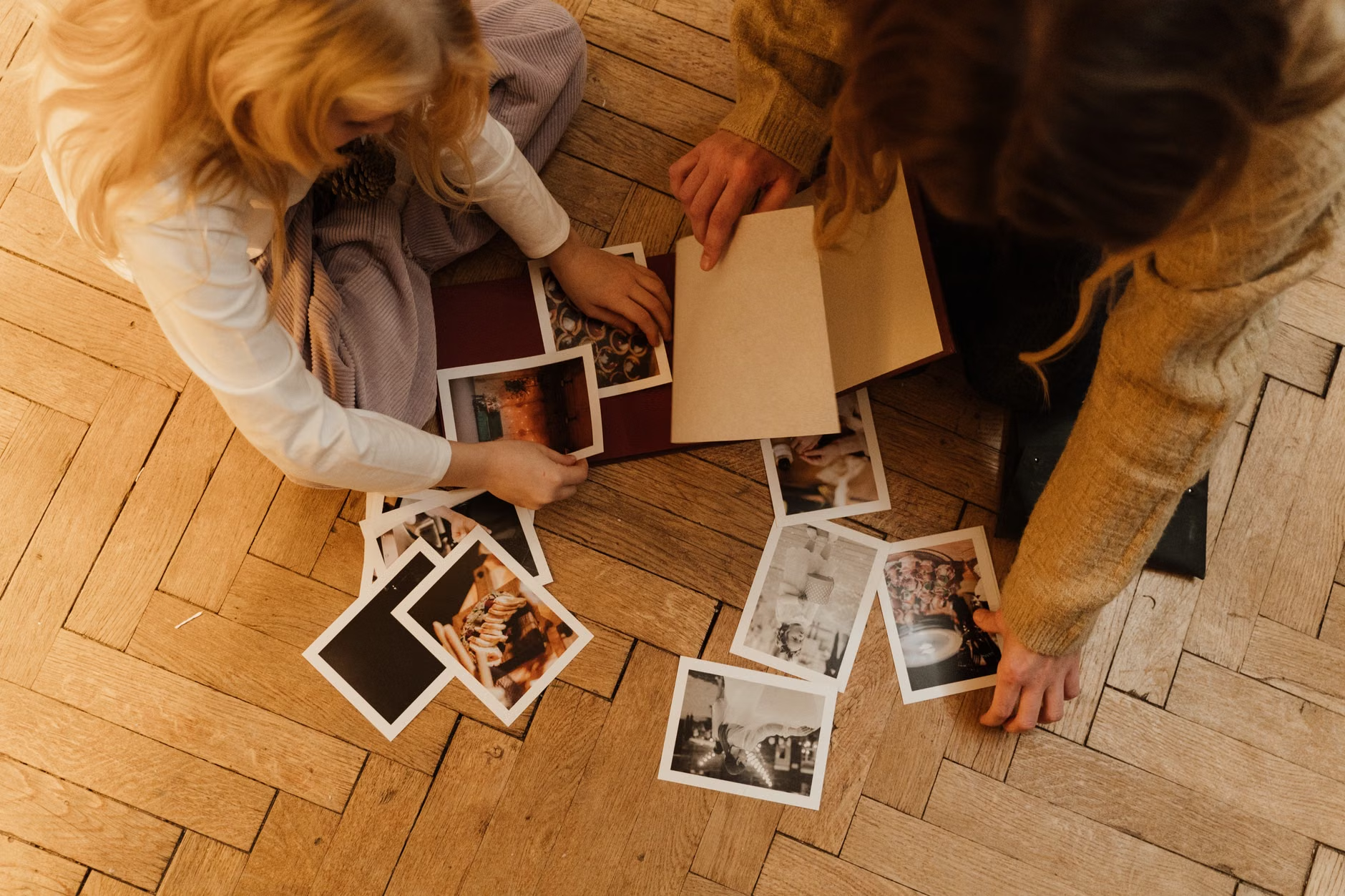
Every family has “artifacts.” It’s not just old documents. It’s the recipe card stained with flour, the old postcard from a trip, the ribbon from a dance, or even a specific song that was played at every family gathering. Ask your child to help you “curate” these items. If you have physical photos, let them help scan them or put them into a physical album. The physical act of handling these items creates a stronger memory than just looking at a digital file on a screen.
Phase 3: The Visual Map
Create a “Roots Map.” Instead of a vertical family tree (which can be confusing), use a physical map of the world. Place pins or stickers on the cities or countries where your ancestors lived. Draw lines connecting these places to where you live now. This helps the child visualize the “journey” of their family. It transforms “I am part of a family” into “I am part of a migration, a story, and a history that covers this globe.”

Digital vs. Physical: Which Path to Choose?
You might be wondering if you should use apps like Ancestry or MyHeritage. These are powerful tools, but they are designed for adults. If you want to use them, do the “heavy lifting” on your own time. Treat the digital database as your “backstage” research area, and the physical, tactile scrapbook as your “frontstage” project for the kids.
The Trade-off:
- Digital Tools: Excellent for storing data, finding distant cousins, and organizing records. However, they lack the “sensory” experience of holding a physical object.
- Physical Scrapbooks/Journals: Excellent for emotional connection, creativity, and tactile memory. However, they are fragile and don’t store “data” efficiently.
The Recommendation: Use a hybrid approach. Use the digital tools to find the facts and verify dates, but print out the photos and stories to put into a physical, handmade book. This gives you the best of both worlds: the accuracy of modern research and the emotional resonance of a tangible family archive.
Unexpected Benefits: What You Might Not See Coming
When you start this project, you will likely discover things about your own family that you didn’t know. Perhaps you find that your great-grandfather was a carpenter, which explains why your child loves building with blocks. Perhaps you find a shared hobby that skipped a generation. These “connective threads” are powerful.
There is also the “hidden cost” of this project: it requires you to confront your own relationship with your family. If your family history involves trauma or difficult dynamics, don’t feel obligated to include everything. The “Ancestral-Roots” project is a curated narrative. You are the storyteller. You decide what is age-appropriate and what provides the most value to your child’s growth. It is perfectly okay to focus on the strengths, the humor, and the resilience, while leaving the more complex or darker histories for when your child is older and better equipped to process them.
Creating the Habit: How to Keep It Going
The biggest hurdle isn’t the research; it’s the consistency. If you make it a grand, one-time project, it will likely fizzle out. Instead, integrate it into your family life. Here are three ways to do it:
- The “Sunday Story” Session: Once a month, have a “family history dinner” where you share one story about an ancestor. Let the kids ask questions.
- The Travel Connection: If you travel, look up if any ancestors lived near that area. Even if it’s just the same country, it makes the geography feel personal.
- The Recipe Exchange: Cooking a meal that a grandparent loved is a powerful, non-verbal way to pass down heritage. Teach your child the story behind the recipe while you cook.
What if your family records were lost, or if you are part of a diaspora where tracing back is impossible? This is a common situation, and it does not make your story any less valid. In fact, the story of *why* the records were lost is part of your family history, too. It is a story of resilience and survival.
If you cannot trace your roots back five generations, focus on the “oral history.” Document what you know. Document the traditions that survived. Document the values that were passed down to you. The project is about the *connection*, not the *documentation*. If you have a missing link, be honest with your child about it. It teaches them that history is not always neat, and that we are responsible for creating our own meaning in the absence of a complete record.
Final Thoughts: You Are the Archivist
You don’t need a museum-grade collection to make this work. You are the archivist of your child’s past. The stories you choose to tell and the artifacts you choose to keep are the ones that will shape their understanding of who they are. Don’t worry about being perfect. Worry about being present.
Start with one photo, one story, and one question. That is all it takes to begin. Your child’s sense of self is a work in progress, and by giving them a map of where they came from, you are giving them the best possible foundation for where they are going.
Frequently Asked Questions
Q: My child is quite young (under 5). Is this too early to start?
A: It is never too early to start sharing simple stories. At this age, focus entirely on the “characters”—the grandparents and great-grandparents. Use photos and simple anecdotes. Don’t worry about timelines; just focus on the people. If they can recognize the faces in the photos and associate them with a happy memory, you have succeeded.
Q: What if my family doesn’t have many old photos or records?
A: Focus on “oral history.” The most important part of family heritage is the stories that are passed down verbally. If you don’t have photos, use your own words to describe the people. You can even have your child draw pictures of what they imagine those ancestors looked like based on your descriptions. This makes the project more creative and personal than just looking at dusty old prints.
Q: How do I handle difficult or tragic family history with my children?
A: The key is “age-appropriate honesty.” You don’t need to share the graphic details of a tragedy, but you can share the *lessons* of it. For example, if an ancestor had to flee their home, you can explain that they were very brave and had to start over, which is why your family is where it is today. Focus on the resilience and the strength that the ancestor showed, rather than the trauma itself. This teaches your child that while life can be hard, their family has the capacity to overcome it.
Useful Resources for Further Research: