If you want to truly disconnect from the daily grind in 2027, the best winter vacation isn’t found at an airport gate—it’s found on a train. Choosing “slow-transit” rail itineraries isn’t just about getting from point A to point B; it’s about reclaiming the travel experience as a part of your vacation, rather than an obstacle to be overcome.
- Prioritize Comfort Over Speed: Modern rail networks in 2027 offer sleeper cabins and dining cars that turn travel time into quality family time, effectively adding an extra day to your holiday.
- The “Multi-Stop” Rule: Use rail passes to break up long journeys into 4-hour segments, which significantly reduces travel fatigue for children and allows for spontaneous local exploration.
- Cost Optimization: Booking 90–120 days in advance is the golden window for premium sleeper routes; waiting until the last month often triples the price due to high demand for winter holiday corridors.
Why the Shift to Slow-Transit Makes Sense in 2027
For those of us in our 30s and 40s, the “vacation” often starts with a high-stress sprint: packing the kids, navigating security lines, and dealing with the inevitable flight delays. By the time you reach your destination, you’re exhausted. Slow-transit rail travel flips this script. It removes the arbitrary “hurry-up-and-wait” culture of air travel and replaces it with a predictable, rhythmic journey.
In 2027, the rail infrastructure across Europe, North America, and East Asia has matured significantly. We aren’t just talking about old-fashioned trains; we are looking at hyper-connected networks where Wi-Fi is standard, seating is ergonomic, and the onboard experience is designed for people who need to balance work, parenting, and rest. When you choose a train, you aren’t just moving bodies; you are moving your entire environment with you.
Consider the trade-offs. A flight from London to the Swiss Alps might take two hours in the air, but when you account for getting to the airport two hours early, the transit time, security, and the commute from the airport to the resort, you’re looking at an 8-hour ordeal. A train journey might take 6 hours, but you can sit, eat, walk around, and even sleep during that time. For parents, this is the difference between a tantrum-filled afternoon and a productive, peaceful travel day.
Planning Your 2027 Winter Itinerary: A Tactical Approach
Planning for a winter trip requires acknowledging the reality of shortened daylight hours and potential weather disruptions. Unlike air travel, where a storm can ground an entire fleet for days, rail networks are generally more resilient. However, they require a different kind of logistical planning.
The 4-Hour Rule for Families
If you have young children, the “4-hour rule” is your best friend. Even if a direct train exists for an 8-hour journey, consider breaking it into two 4-hour segments with an overnight stay in a mid-route city. This turns a grueling day of travel into two manageable segments, allowing you to explore a new city for an evening before continuing your journey the next morning.
Booking Windows and Price Sensitivity
Many travelers make the mistake of assuming rail tickets are always cheaper than flights. In 2027, this is often false for last-minute bookings. Rail companies are increasingly using dynamic pricing models similar to airlines. To secure the best rates, you must monitor the 90-day release window. If you are traveling during the Christmas or Lunar New Year windows, that window effectively moves to 120 days.
| Booking Tier | Strategy | Best For |
|---|---|---|
| Super Early (120+ days) | Group/Family Sleepers | Securing family compartments |
| Standard (60-90 days) | Standard Class | General travel/Flexible dates |
| Late (Under 30 days) | Last-minute availability | Solo travelers or off-peak |
The table above illustrates the hierarchy of booking. Note that “Super Early” is non-negotiable if you need a sleeper cabin. These cabins have limited inventory and are the first to sell out, especially on popular winter routes like the night trains from Paris to Berlin or Tokyo to Sapporo.

Maximizing Onboard Productivity and Relaxation
One of the hidden benefits of rail travel is the “third space.” It isn’t home, and it isn’t the office. It’s a space where you can actually get things done, or conversely, where you can do absolutely nothing without feeling guilty. For parents in their 30s and 40s, this is a rare commodity.
To make the most of this, you need to pack for the train, not just for the destination. This means having a “rail kit.” Your kit should include a multi-port charger (because outlets can be scarce), noise-canceling headphones, and a dedicated bag for snacks. The dining car is an experience, but it isn’t always open or stocked with kid-friendly options. Relying solely on onboard food is a common mistake that can lead to unnecessary expenses and hungry, cranky children.
When you are traveling with a partner, use the train to “tag-team.” One parent can take the kids to the observation car or the bistro while the other uses the time to catch up on emails or simply read a book. This rotation ensures that both parents arrive at the destination feeling like they’ve had a break, rather than feeling like they’ve just managed a domestic migration.
Managing Expectations for Winter Weather
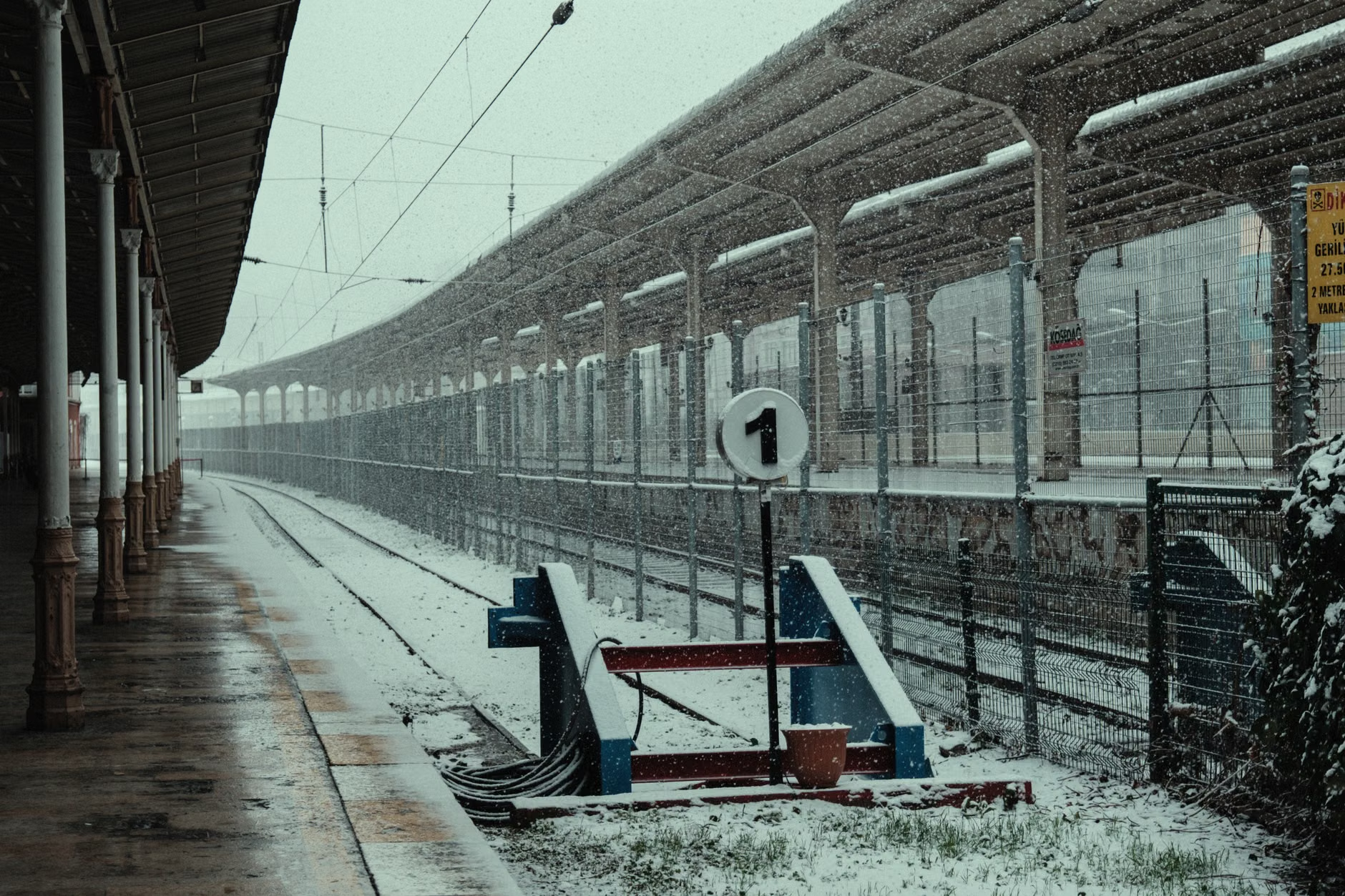
Even in 2027, snow happens. The advantage of the rail system is that it is built to handle it, but you should still have a contingency plan. Winter rail travel often involves longer transit times due to speed restrictions in heavy snow. Always assume that your journey could take 10–15% longer than the schedule suggests.
If you have a connecting train, never book a connection with less than 60 minutes of buffer time. In the summer, 20 minutes might be fine. In the winter, ice on the tracks or a minor engine issue can easily push a train 30 minutes behind schedule. If you miss that connection, you might be stuck in a station that isn’t exactly a tourist hotspot.
The Hidden Costs and Benefits You Should Know
It is easy to look at the ticket price and stop there, but there are hidden variables. For instance, luggage. Unlike airlines, most trains don’t charge by the bag, but they do have space limitations. If you are traveling with ski equipment or large strollers, you need to check the specific train operator’s policy. Some high-speed trains require advanced reservations for oversized luggage, and failing to secure this can result in being denied boarding.
On the benefit side, consider the “city center to city center” advantage. When you arrive by train, you are often in the heart of the city. You don’t need to spend $60–$100 on an airport transfer or a taxi. You can often walk to your hotel or hop on a local tram. When you calculate the total cost of the trip, include these “last mile” expenses. You will often find that the train is significantly cheaper than the “budget” flight once you add up the airport transfers.
Practical Steps for Your 2027 Winter Booking
If you’re ready to book, follow these steps to ensure you don’t run into common pitfalls:
- Check the Operator’s Official Site: Avoid third-party aggregators if possible. While they are convenient, they often charge higher service fees and make changes or cancellations much more difficult.
- Verify Seating Maps: Always look at the carriage layout. If you are traveling with a family, look for “family compartments” or “table seats.” These are often the same price as standard seats but offer vastly more utility.
- Download the App: Every major rail operator in 2027 has a robust app. Download it, save your tickets offline, and enable push notifications for delays. This is your lifeline if things go sideways.
- Pack a Power Bank: Even if your seat has an outlet, they are notoriously unreliable or slow. Bring a high-capacity power bank to ensure your devices stay charged throughout the trip.
Refining the Experience: A Note on Travel Etiquette
Because slow-transit is becoming a trend, trains are getting crowded. Being a good “rail neighbor” is essential for your own sanity. If you have children, try to book seats in a “quiet zone” if you want peace, or a “family carriage” if you want to be able to talk without worrying about disturbing others. Most modern trains clearly mark these zones. Respecting them makes the journey more pleasant for everyone.
Lastly, remember that the goal of slow-transit is to enjoy the journey. If you find yourself constantly checking your watch or getting frustrated by the slow pace, you are missing the point. The point is that you are already on vacation. You are sitting in a comfortable chair, watching the world change outside your window, and you aren’t stuck in a middle seat. That, in itself, is a luxury.
For official schedules and booking, start with the national rail providers in your destination country, such as SNCF Connect (France), Deutsche Bahn (Germany), or JR East (Japan). These sites are the most reliable sources for real-time updates and official pricing.
Frequently Asked Questions
1. Is train travel really cheaper than budget airlines in 2027?
Often, yes, once you account for the “hidden costs.” Budget airlines frequently charge for luggage, seat selection, and airport transfers. When you add these costs to the base fare, the train often becomes the more economical choice, especially for families carrying more than a small backpack.
2. What should I do if my train is delayed and I miss my connection?
If your tickets are booked as a single itinerary, the rail operator is typically responsible for putting you on the next available train at no extra cost. However, if you booked separate tickets (e.g., one ticket for a local train and one for an international high-speed train), you are usually on your own. Always try to book your entire journey under one booking reference if possible.
3. Are sleeper trains worth the extra cost for families?
For journeys longer than 8 hours, absolutely. A sleeper cabin saves you the cost of one night in a hotel and allows you to arrive at your destination refreshed. For shorter trips, however, the cost-to-value ratio is lower, and a standard seat with a good book might be perfectly sufficient.
Ultimately, the move toward slow-transit is about choosing how you spend your time. By choosing the rail over the runway, you’re choosing to arrive at your destination with your sanity intact, your family connected, and a few memories made before you even reach the hotel lobby. Travel well, and take the slow road this winter.