- Demand response programs pay you to slightly adjust your thermostat during peak grid stress, but they require a compatible “smart” device to function automatically.
- The financial incentive is usually small (a credit on your bill or a one-time rebate), meaning the real value lies in long-term grid stability rather than massive monthly savings.
- You retain full control; most programs allow you to override the temperature adjustment at any time if you are feeling uncomfortable or hosting guests.
If you have ever received an email from your utility provider asking if you would like to “opt-in” to a program that manages your smart thermostat during extreme heat waves, you have encountered the world of demand response. It sounds like a win-win: the power grid stays stable, and you get a discount or a rebate for simply letting your home get a degree or two warmer during the hottest part of the day. But for a busy parent in their 30s or 40s, the question isn’t just about the money—it’s about whether your living room will turn into a sauna while the kids are napping.
Let’s look at what demand response actually is, why utility companies are pushing it, and whether the trade-off is worth the effort for your household.
What Exactly is ‘Demand Response’ for Your Home?
At its core, the electrical grid is a delicate balancing act. Power plants must produce exactly the amount of electricity that is being consumed at any given second. When everyone turns on their air conditioning at 5:00 PM on a sweltering July day, the demand spikes. To prevent the grid from failing—or from requiring the activation of expensive, high-pollution “peaker plants”—utility companies need to reduce that demand.
Demand response (DR) is the mechanism by which utility companies incentivize consumers to use less electricity during these peak periods. Instead of building more power plants that sit idle for most of the year, utilities now use software to talk to your connected devices. If you have a smart thermostat (like those from Nest, Ecobee, or Honeywell), you can enroll in a program where the utility is authorized to nudge your temperature setting up by 2 to 4 degrees for a few hours during a “peak event.”
Think of it as a subscription service where you are the supplier. By “renting out” a tiny bit of your comfort for a few hours, you are helping the grid stay balanced. In exchange, you get financial rewards. But the catch is that you need the right infrastructure—specifically, a smart thermostat connected to a reliable Wi-Fi network.
Why Utilities Are Pushing This Now
You might have noticed your utility company becoming more aggressive with these offers. It isn’t just a corporate trend; it is a necessity driven by the transition toward renewable energy. Solar and wind power are fantastic, but they are intermittent. When the sun sets and solar generation drops, but people are still coming home and turning on their appliances, the grid faces a sudden “ramp” in demand that is hard to meet.
For a family, this shift means that the price of electricity is increasingly tied to when you use it, not just how much you use. Many regions are moving toward “Time-of-Use” (TOU) pricing, where electricity costs significantly more during late afternoon and early evening hours. Demand response programs are often the “gateway” to managing these costs.
The Financial Reality: Is the Money Worth the Sweat?
Let’s be honest: you aren’t going to get rich from these programs. Most residential demand response programs offer one of two things: a one-time sign-up rebate (ranging from $50 to $150) or a small annual participation credit ($25 to $50). If you are looking for a way to slash your monthly budget, this is not the silver bullet.
However, the value proposition changes if you combine demand response with a TOU rate plan. By allowing the utility to manage your cooling during the hours when electricity is most expensive, you are essentially letting them do the “energy budgeting” for you. This can save you significantly more than the participation credit alone.
The Practical Side: How to Manage Comfort vs. Savings
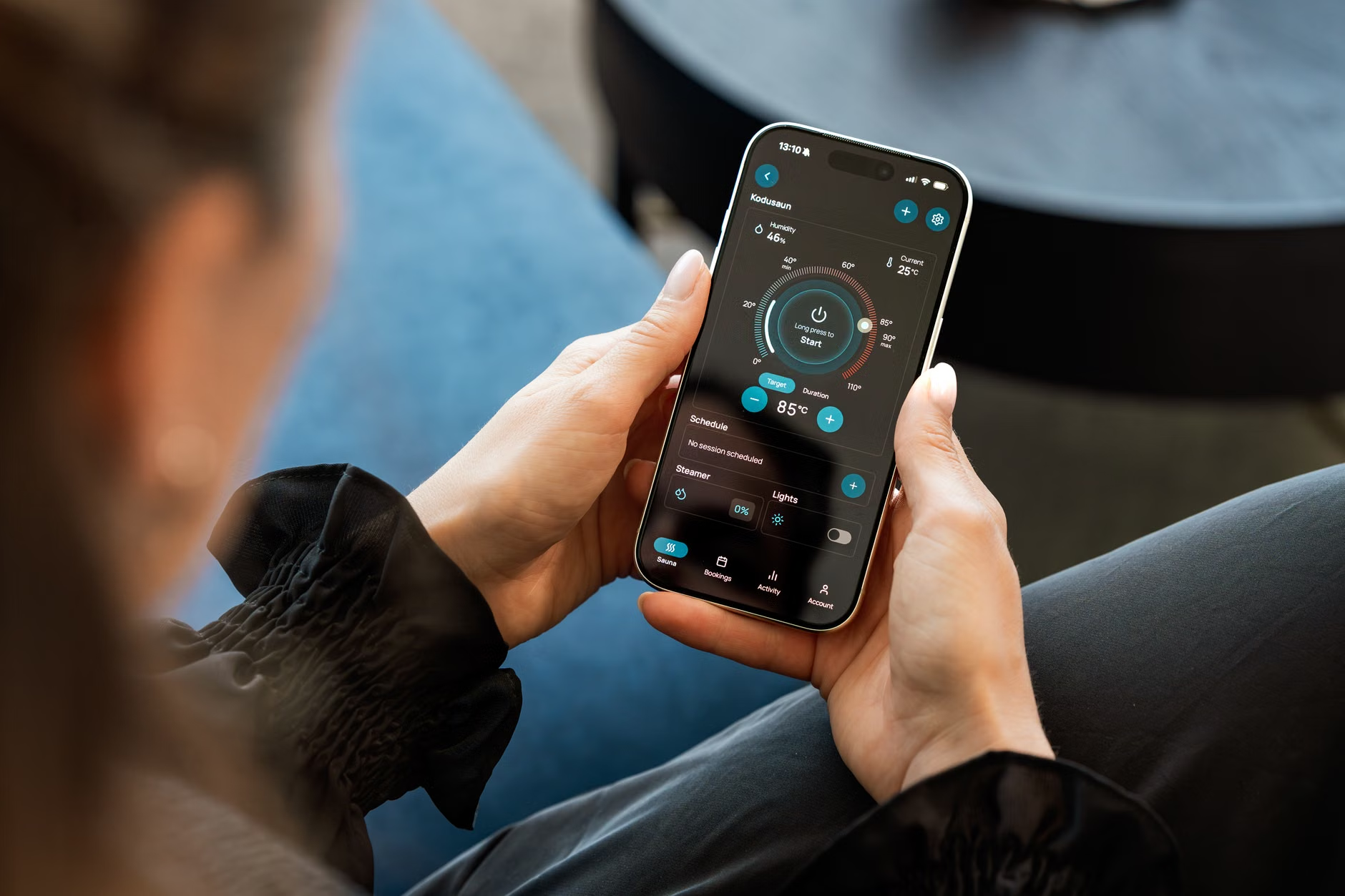
If you decide to enroll, the most common fear is that you will lose control of your home climate. In reality, these systems are designed with a “freedom of choice” clause. You are never locked in. If you are hosting a birthday party or the kids are having a particularly difficult day, you can simply walk over to the thermostat or open your app and override the setting. The utility will simply stop the event for that day.
The “Pre-Cooling” Strategy
One of the most effective ways to make demand response invisible is to use a strategy called “pre-cooling.” Most smart thermostats can be programmed to lower the temperature by a few degrees just before the peak event starts. By the time the utility nudges the temperature up, your home is already cooler than your target temperature, effectively “storing” that cold air in your walls and furniture. By the time the temperature starts to rise, the peak period is often nearly over.
Common Mistakes to Avoid
| Mistake | Why it’s a problem | The Fix |
|---|---|---|
| Ignoring the “Override” feature | Leads to resentment and program cancellation. | Learn how to override in the app before you sign up. |
| Poor Wi-Fi signal at the thermostat | The utility can’t reach your device, leading to connection errors. | Ensure your router reaches the thermostat area. |
| Misunderstanding the “Peak Event” schedule | Expecting savings during off-peak hours. | Check your utility’s specific peak event hours. |
What Should You Look for Before You Sign Up?
Before you jump into a program, you need to evaluate your specific situation. Here are three criteria to help you decide:
- Your Home Insulation: If your home is poorly insulated, a 3-degree shift will feel like a 10-degree shift within minutes. If your home holds temperature well, you might not even notice the change.
- Your Schedule: Are you usually out of the house during the peak 3:00 PM to 7:00 PM window? If so, demand response is essentially free money. If you have toddlers or vulnerable family members at home all day, you need to be more selective about which events you participate in.
- The Program Terms: Look for “opt-out” penalties. Most reputable programs do not penalize you for opting out of an event, but some require a minimum number of successful events to keep your rebate. Read the fine print to ensure you aren’t committing to something that forces you to be uncomfortable.
The Hidden Trade-offs: What Nobody Tells You
While demand response is generally beneficial for the environment and the grid, there is an overlooked variable: equipment wear and tear. Some skeptics argue that aggressive cycling of HVAC systems during extreme heat could potentially shorten the lifespan of your compressor. While modern systems are designed to handle start-stop cycles, if you live in a region with extremely frequent peak events, it is worth monitoring your HVAC maintenance schedule more closely. Keep your air filters clean and ensure your outdoor unit is free of debris to ensure your system works as efficiently as possible during these demanding times.
Furthermore, consider the “Smart” ecosystem lock-in. When you sign up for a utility-managed program, you are often tethering your thermostat to their specific software interface. If you decide to switch utility providers or change your smart home platform, you might have to re-enroll or lose your data history. It is a minor inconvenience, but for those who value total independence from utility oversight, it is a point to consider.
Steps to Getting Started
If you are ready to explore this, follow these steps:
- Check your Utility Website: Search for “demand response” or “smart thermostat rebate” on your local utility’s website.
- Verify Compatibility: Ensure your specific thermostat model is on their approved list. Most major brands are, but older models may lack the connectivity required.
- Set Your Comfort Threshold: Once enrolled, go into your thermostat settings and set a “maximum” temperature that you are personally comfortable with, regardless of the utility’s request.
- Monitor for One Month: Track your bill and your comfort levels. If you find yourself overriding the system more than 50% of the time, the program may not be a good fit for your household’s needs.
Demand response is not about sacrificing your quality of life; it is about smarter energy management. For most families, it is a low-effort way to contribute to a more stable electrical grid while picking up some extra savings. Just remember that you are in the driver’s seat. If the house gets too hot, you have every right to turn the AC back down. The grid will survive, and you will stay comfortable—which, at the end of the day, is the most important thing.
Frequently Asked Questions
1. Will my utility company have total control over my thermostat?
No. You maintain full ownership and control. The utility can only send “requests” to adjust the temperature within parameters you agree to, and you can override these at any time via your thermostat or app.
2. Can I participate if I have an older HVAC system?
Generally, yes, as long as your system is compatible with a smart thermostat. The demand response program works through the thermostat’s ability to communicate with the utility, not directly with the HVAC unit itself.
3. Are there any hidden costs to joining these programs?
Typically, no. The main “cost” is the potential for minor discomfort during peak hours. However, always check your specific program’s terms to ensure there are no “clawback” clauses that require you to return a rebate if you don’t participate in a certain percentage of events.
For further reading on how energy grids are evolving, visit the International Energy Agency’s report on Demand Response. Always check your local utility’s official portal for the most accurate and up-to-date program terms in your specific area.
Deep Dive: The Mechanics of Grid Stability
To truly understand why your utility cares about your thermostat, it helps to visualize the grid as a giant, instantaneous conveyor belt. Every electron you consume must be generated at the exact same moment. When a heatwave hits, the grid operators see a massive surge. If they don’t have enough power plants running to match that surge, they have two choices: buy incredibly expensive electricity from neighboring regions (which drives up your rates) or, in extreme cases, initiate rolling blackouts to prevent a total grid collapse.
By shifting your cooling load by even 2 degrees, you are helping them avoid that “peak” that forces them to fire up the most expensive and least efficient power plants. This is why some programs pay you more during “critical” events than during standard hot days. You are effectively acting as a “virtual power plant.” For a household, this means you are playing a small but meaningful role in the decarbonization of the grid, as the electricity you avoid using is usually the “dirtiest” power produced during peak times.
The Evolution of Smart Home Integration
In the past, demand response was a clunky process involving “load control switches” installed on your AC unit by a technician. It was invasive and often unreliable. Today, the transition to software-based management through smart thermostats has changed the game. Because the system is connected to your home Wi-Fi and the cloud, the utility can send a signal that integrates seamlessly with your existing schedule.
Many smart thermostats now use “learning algorithms” to understand your home’s thermal profile. They know how long it takes to cool down your living room versus your bedrooms. This means they can optimize the demand response event to affect the least-used areas of your house first, or wait until the very last minute to adjust the temperature. For a parent, this means you can set “do not disturb” zones in the nursery or kids’ rooms, ensuring they stay cool while the utility manages the temperature in the living areas.
Addressing Common Misconceptions
One common myth is that demand response is a way for the government to “ration” your electricity. This is a misunderstanding of how the programs function. The utilities are not turning off your power; they are simply adjusting the set-point of your thermostat. You are still receiving the same service, just with a slightly different temperature profile. Another myth is that you must be an “early adopter” or tech-savvy to participate. If you can use a smartphone to order groceries or check the weather, you have all the technical skills required to manage a demand response program.
Strategic Implementation for Busy Households
If you are balancing work, school runs, and household chores, the last thing you need is another complex system to manage. The beauty of these programs is that once they are set up, they are “set and forget.” You can configure your thermostat to automatically opt-in to every event, or you can choose to be notified and manually approve each one. For most busy families, the automated route is best. You will likely find that you won’t even notice the adjustments during the day. If you do, a quick tap on your phone brings the comfort back to your preferred level. It’s a low-friction way to participate in modern infrastructure, and the small annual credit is a nice bonus that can cover a few streaming subscriptions or a family treat at the end of the year.
Ultimately, the decision to participate in a demand response program is a personal one. It balances your budget, your environmental values, and your personal comfort. By understanding the underlying mechanics and the flexibility you retain, you can make an informed decision that works for your family’s unique rhythm. Start small, test the waters, and remember that you always have the final say on the environment inside your home.