Key Takeaways:
- The “Post-Growth” Mindset: It is not about deprivation; it is about decoupling family well-being from constant consumption and finding value in time and shared experiences.
- The “Experience Dividend”: Replacing physical toys with shared activities reduces household clutter and significantly improves long-term parent-child bonding.
- Practical Implementation: Start by auditing your household “hidden costs”—the maintenance, storage, and emotional labor required to manage the things you already own.
You don’t need a bigger house; you need a smaller inventory. If you are in your 30s or 40s, you likely feel the weight of the “growth trap”—the idea that to be a “good” parent, you must constantly provide more: more extracurriculars, more specialized gear, and more digital stimulation. But a growing number of urban families are quietly opting out of this cycle, embracing what economists and sociologists call “post-growth” living. This isn’t about moving to a farm or renouncing technology; it’s about intentionally choosing where to spend your limited energy and resources.
Understanding the Post-Growth Shift in Urban Households
At its core, post-growth is a critique of the assumption that infinite expansion—whether in GDP or household consumption—is necessary for human flourishing. For parents, this translates into a radical question: Does this purchase or activity actually make our family life better, or are we just filling a void created by the pressure to “do it all”?
In high-density urban environments, the cost of “growth” is literal. We pay for square footage to store toys, clothes, and gadgets that are used for a fraction of their lifespan. The post-growth parenting movement argues that by reducing our reliance on mass-market goods, we gain back the one thing we are constantly short on: time.
Why does this matter now? Because we are currently living through a period of “consumption fatigue.” The sheer volume of decision-making—choosing the right car seat, the right educational app, the right extracurricular—is a form of cognitive load that leads to burnout. By shifting focus toward the “post-growth” model, you aren’t just saving money; you are reclaiming your mental bandwidth.
The Real-World Cost of “More”
Consider the “hidden labor” calculation. If you buy a complex, battery-operated toy, you aren’t just paying the $50 retail price. You are paying for:
- Storage: The cost per square foot of the space it occupies in your apartment.
- Maintenance: The time spent finding batteries, cleaning the item, and repairing it.
- Emotional Labor: The stress of managing the clutter it adds to your living space.
- Disposal: The time and effort required to donate or recycle it when it inevitably breaks or is outgrown.
When you look at it this way, that $50 toy might actually “cost” the equivalent of $150 in time and domestic management. A post-growth approach forces you to evaluate items not just by their price tag, but by their “life-cycle impact” on your family’s daily peace.
Auditing Your Family’s Consumption Patterns
The first step toward a post-growth lifestyle is an audit. This isn’t about being perfect; it’s about being deliberate. Most parents in their 30s and 40s are trapped in “convenience loops”—buying things to solve problems caused by having too much stuff in the first place.
Start by identifying the “clutter triggers.” What are the items that constantly end up on the floor, require constant organizing, or frustrate your child? These are the items that are failing your family.
The “Rule of Three” for Household Items
To curb consumption, adopt a strict “Rule of Three” for non-essential items. Before any new purchase, ask:
- Does this serve more than one purpose? (e.g., a sturdy wooden crate that functions as a toy box, a seat, and a building block).
- Is it durable enough to be passed on or reused? If it’s plastic-heavy or fragile, it’s likely a “growth-trap” item.
- Does it replace something we already have? If the answer is no, it’s not an addition; it’s an accumulation.
This isn’t about rigid minimalism. It’s about shifting from a “collector” mindset to a “user” mindset. You want your home to be a place where things are used to death, not a showroom of things that are barely touched.
Building an “Experience Dividend” Culture
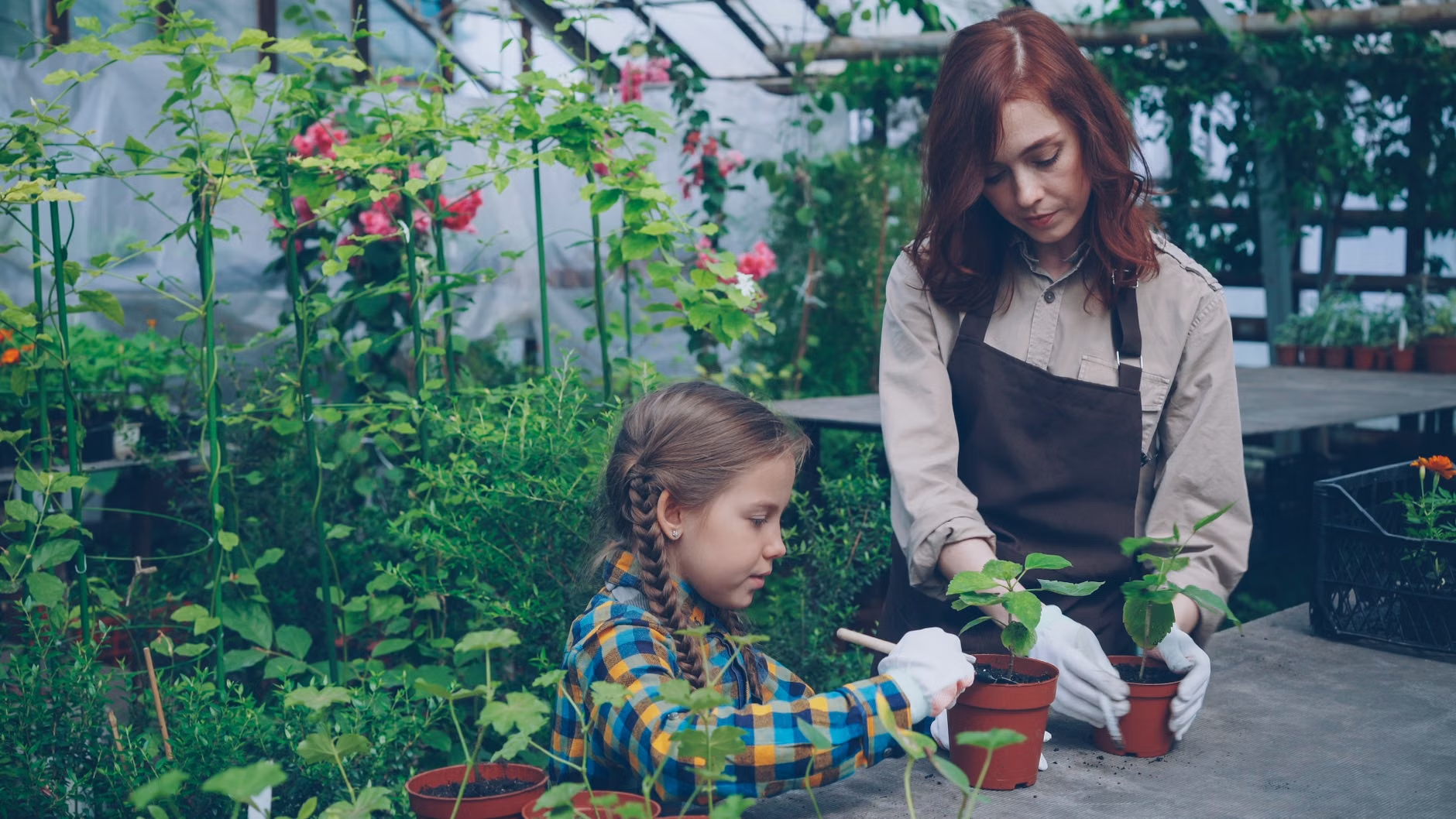
If you aren’t spending your money on physical goods, where does it go? The post-growth movement advocates for the “Experience Dividend”—investing in moments that increase in value over time because they become part of your family’s narrative.
Think of it as a trade-off. Instead of a high-end plastic play structure that occupies 20% of your living room, you invest in a membership to a local botanical garden, a community pool, or a recurring art class. The physical toy provides dopamine for a week; the experience provides memories, skills, and social connection for years.
Comparing Consumption Models
| Feature | Growth-Oriented Parenting | Post-Growth Parenting |
|---|---|---|
| Value Driver | Ownership of new, specialized goods | Access to shared experiences |
| Space Use | Maximizing storage for inventory | Maximizing open space for movement |
| Decision Focus | What to buy next | How to use what we have |
| Long-term Goal | Equipping the child for the future | Building resilience and connection now |
The “Growth-Oriented” model is often pushed by marketing, which tells us that our children’s success is tied to the tools they possess. The “Post-Growth” model suggests that success is tied to the adaptability and social intelligence they develop through real-world interaction.

The Hidden Costs of “Educational” Toys and Tech
One of the most persistent myths in modern parenting is the “educational gadget” trap. We are conditioned to believe that if a toy doesn’t have a screen, an app, or a “STEM-based” label, it isn’t helping our child’s development. This is a multi-billion dollar industry that relies on parental anxiety.
Research into child development consistently shows that the most “educational” toys are often the most open-ended: blocks, fabrics, paper, and art supplies. These items don’t require software updates, they don’t break in ways that require a repair shop, and they don’t become obsolete in six months.
Many urban parents feel that if they don’t provide the latest tech, their child will fall behind. This is a misunderstanding of what “future-ready” means. Future-ready children need to be critical thinkers and creative problem solvers. A child who learns to build a fort out of cardboard boxes and duct tape is learning engineering, physics, and project management—all without a single line of code.
Decision Rule: If a toy or device requires an app to function, it is likely a “growth-trap” item. Ask yourself: “Can my child play with this even if the power goes out or the internet is down?” If the answer is no, it is a liability, not an asset.
Sustainable Urban Living: Practical Steps
Moving toward a post-growth lifestyle in an urban setting requires a shift in how you view your community. You don’t have to own everything. The sharing economy is your best friend.
1. Utilize the Library of Things
Many city libraries now offer a “Library of Things”—not just books, but tools, baking equipment, and even specialized toys. Before you buy, check if you can borrow. This saves money, space, and the environment.
2. The “One-In, One-Out” Protocol
This is the golden rule for urban families. If your child gets a new pair of shoes, the old pair must be donated or passed on. This forces a constant evaluation of what is actually being used. It also teaches your children that space is finite and that they have a responsibility to manage their own belongings.
3. Cultivate Community, Not Just Consumption
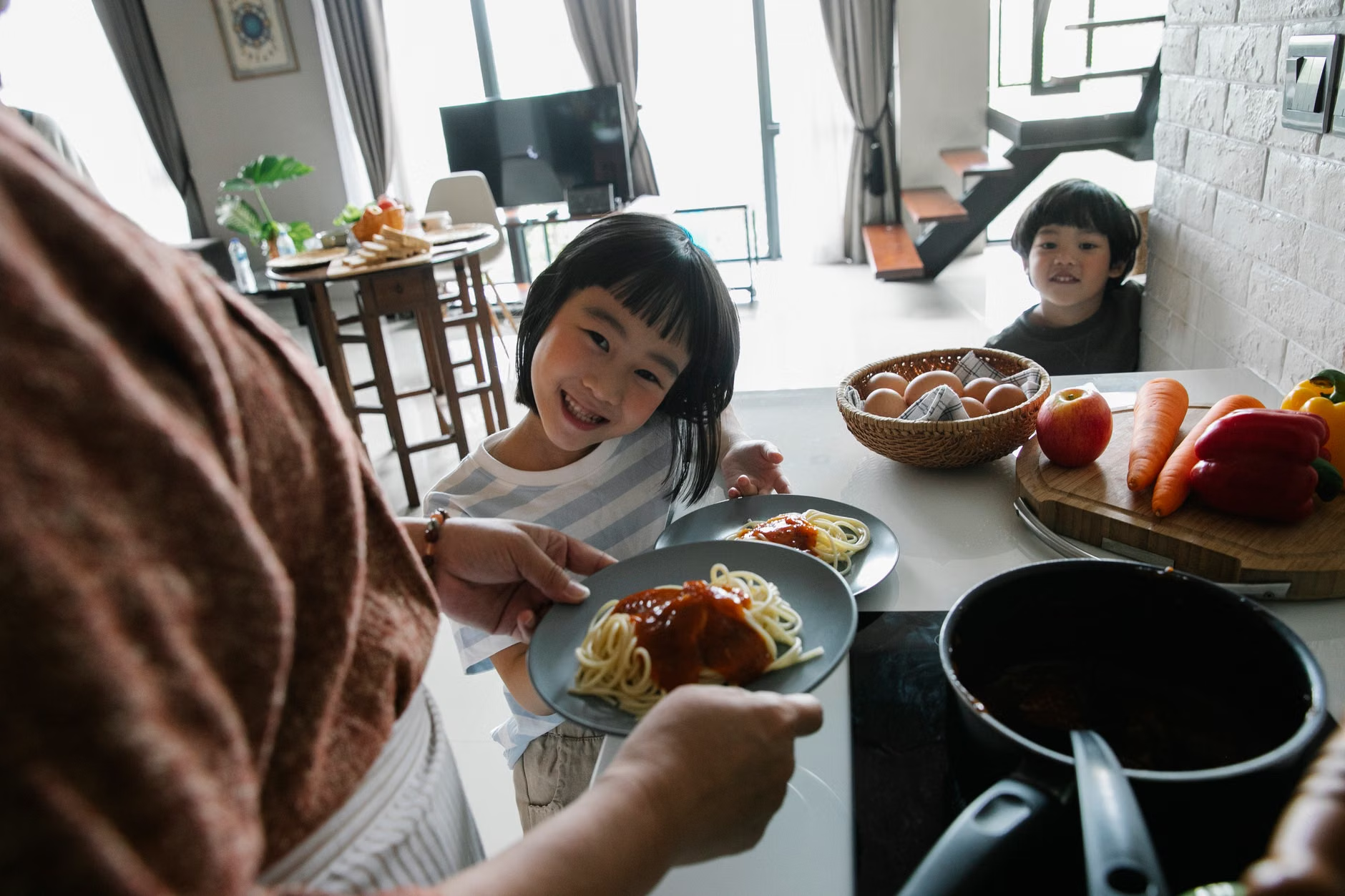
Post-growth isn’t about isolation. It’s about building a “village.” Talk to your neighbors. Can you share large items like strollers, camping gear, or seasonal sports equipment? When families share resources, they build social bonds that are far more valuable than the items themselves.
Overcoming the Social Pressure to “Keep Up”
The hardest part of the post-growth shift is the social aspect. We live in a culture that treats “more” as a proxy for “better.” If you show up to a playdate with a handmade toy or a secondhand item, you might feel the urge to explain yourself. Don’t.
Your choices are about your family’s values, not a critique of others. By modeling this behavior, you actually provide an alternative for other parents who are also feeling the weight of the consumption cycle. You might be surprised to find that when you start talking about the freedom of having less, many of your friends will admit they are feeling the exact same way.
Common Pitfalls to Avoid
- The “Eco-Guilt” Trap: Don’t try to be zero-waste overnight. It’s impossible in an urban environment. Focus on intentionality, not purity.
- The “Cheap vs. Sustainable” Confusion: Sometimes the most sustainable item is the one you already own. Don’t replace your plastic toys with expensive “sustainable” wooden ones just for the aesthetic. Use what you have until it breaks.
- Ignoring the Child’s Perspective: While you are the one managing the household, include your children in the process. Ask them, “Which of these toys do you actually play with?” Let them be part of the decision to let things go. It’s a powerful lesson in agency.
Conclusion: The Freedom of Enough
At the end of the day, the post-growth parenting movement is about reclaiming your role as a parent. You are not a logistics manager for a miniature warehouse. You are a mentor, a guide, and a partner in your child’s growth. By stepping off the treadmill of constant consumption, you create the space for the things that actually matter: spontaneous conversations, shared laughter, and the quiet joy of a home that serves you, rather than the other way around.
Start small. Audit one drawer. Challenge one purchase. Experience the lightness that comes with having enough. It is a radical act of self-care in a world that insists you are never quite “enough” as you are.
Frequently Asked Questions
1. Is post-growth parenting just another word for minimalism?
While they share similarities, post-growth is more focused on the socioeconomic and environmental implications of consumption. It’s a broader philosophy about how we interact with our resources and the wider community, whereas minimalism is often more focused on the aesthetic or personal benefits of clearing clutter.
2. How do I handle gifts from relatives who don’t share this philosophy?
This is a common challenge. The best approach is to be gracious but clear. You can say, “We are really trying to keep our space manageable right now, so if you’d like to get something, we’d love an experience-based gift like a museum pass or a contribution toward a class.” Most family members appreciate having a specific, helpful request.
3. What if I feel like I’m depriving my child by not buying the latest trends?
It is important to distinguish between “deprivation” and “curation.” Children do not need a constant influx of new things to feel loved or stimulated. In fact, children with fewer toys often show greater creativity and longer attention spans. You aren’t depriving them; you are giving them the gift of a less cluttered, more focused environment.
For further reading on sustainable living and the economics of consumption, see the following resources: