The most efficient way to manage your household budget and storage space isn’t by buying better organizers—it’s by stopping the cycle of purchasing expensive, rarely used tools that gather dust 99% of the year.
Key Takeaways
- The 90/10 Rule: Most household tools are used less than 10 hours a year. Renting or borrowing through a micro-community network saves an average of $300–$600 annually in ownership and maintenance costs.
- Liability Mitigation: Using established platforms (like local Tool Libraries) often includes built-in insurance, whereas informal neighbor-to-neighbor sharing requires clear, verbal or written agreements regarding damage.
- Space Reclamation: Transitioning to a shared model can free up to 20% of your garage or utility closet, allowing for actual vehicle parking or family activity space instead of “project graveyard” storage.
If you are in your 30s or 40s, your garage or basement likely looks like a graveyard of “good intentions.” There is the pressure washer you bought for a Saturday project three years ago, the heavy-duty drill set that has seen exactly one shelf installation, and perhaps a specialized tile cutter that is currently serving as a very expensive paperweight. We often buy these items because we value self-sufficiency, but the reality of modern life—juggling work, kids, and limited time—means these tools are mostly just taking up space.
The “Micro-Community” sharing economy is shifting the focus from individual ownership to shared access. It isn’t just about saving money; it’s about reclaiming the square footage in your home and reducing the environmental footprint of your household. Let’s look at how you can actually make this work without turning your home into a chaotic community hub.

Why the “Ownership Trap” is Draining Your Finances
We are conditioned to believe that owning a tool is the only way to be “prepared.” However, for the average suburban household, the math simply doesn’t add up. When you purchase a $200 power tool, you aren’t just paying the sticker price. You are paying for the depreciation, the storage space (which, in many real estate markets, costs hundreds of dollars per square foot), the maintenance (batteries dying, blades dulling), and the mental load of organizing and cleaning it.
Consider the “Cost-per-Use” (CPU) metric. If you buy a $300 pressure washer and use it once a year for five years, your CPU is $60 per use. If you rent that same machine from a neighbor or a local tool library for $20 per day, you’ve saved $40 and, crucially, you don’t have to find a spot for a bulky machine in your garage for the other 364 days of the year.
The Hidden Costs of Ownership
| Cost Category | Ownership Impact | Sharing Economy Impact |
|---|---|---|
| Capital Expenditure | High (Upfront cost) | Low (Rental or membership fee) |
| Storage Space | Permanent loss of sq. footage | Zero footprint |
| Maintenance | Owner’s responsibility | Managed by the library/lender |
| Obsolescence | Owner bears the loss | Access to latest models |
The transition to a shared model requires a mental shift: valuing access over possession. This is particularly relevant for those in their 30s and 40s who are often in a state of high transition—moving homes, renovating, or doing small DIY projects. You don’t need to own the hardware store; you just need to have the right tool for the job when the job arises.
How to Start Your Own Micro-Community Sharing Network
You don’t need a high-tech platform to start. While apps like Fat Llama or NeighborGoods exist, the most effective micro-community networks often start on neighborhood social groups or WhatsApp/Signal threads. The key is establishing a “culture of return” before you ever lend out your first screwdriver.
Step 1: Inventory your “High-Value, Low-Use” items. Sit down and look at your garage. What items do you own that are used less than twice a year? These are your candidates for the sharing pool. Think ladders, carpet cleaners, power washers, specialized garden shears, or even high-end camping gear.
Step 2: Establish the “Rules of Engagement.” This is where most informal sharing fails. You must have clear guidelines. If you lend a tool, does it come back cleaned? Does it come back with a full battery? What happens if it breaks? The best approach is to adopt a “Better Than You Found It” policy. If the user breaks it, they replace it. If they return it dirty, they lose borrowing privileges.
Step 3: Leverage local “Libraries of Things.” Many public libraries and community centers in countries like the US, Canada, UK, and Australia have started “Library of Things” programs. These are public, free, or low-cost alternatives to buying. Before you start a private group, check your local council or municipal website to see if such a facility exists. It is often the most reliable way to access high-quality equipment without the liability of lending to a neighbor.
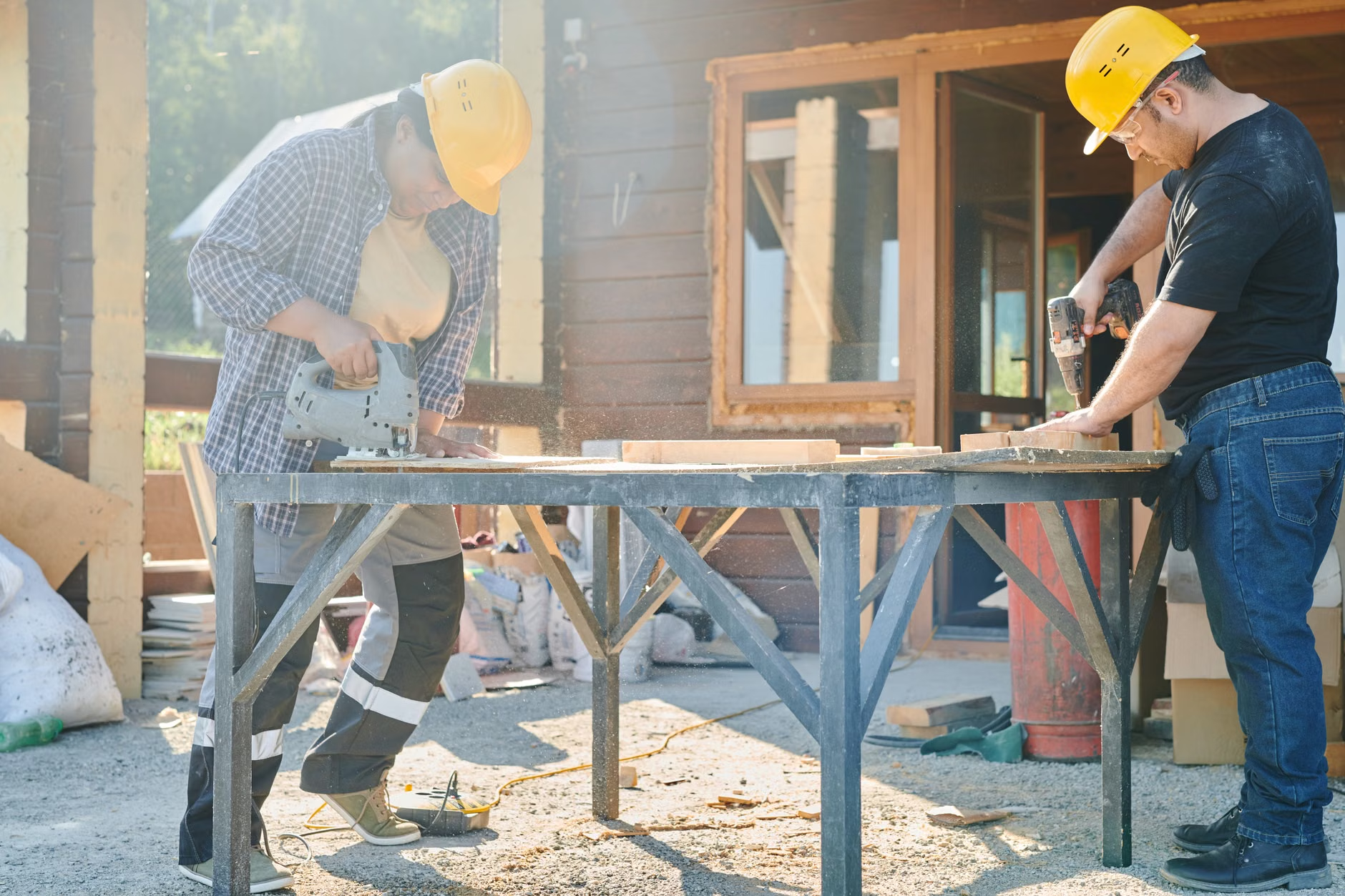
One of the biggest hesitations people have is: “What if my neighbor gets hurt using my saw?” or “What if they ruin my expensive equipment?” These are valid concerns that need to be addressed with a bit of formality, even if you are friends with your neighbors.
When sharing high-risk items (power saws, heavy machinery), it is wise to have a brief, written acknowledgment. This doesn’t need to be a 10-page legal document. A simple text message or email thread can suffice: “Hey, just confirming you’re borrowing the circular saw. You’ve confirmed you know how to operate it safely, and you’ll return it by Sunday in the same condition. If anything breaks, we’ll chat about the replacement cost.”
If you are part of a formal “Tool Library,” they carry commercial liability insurance. This is a massive advantage over peer-to-peer sharing. If you are serious about building a robust micro-community, consider pooling funds to buy a basic insurance policy or simply sticking to low-risk items for informal sharing (e.g., hand tools, lawn chairs, kitchen appliances) and using professional rental services for heavy, dangerous power tools.
Common Mistakes to Avoid
- The “Ghosting” Lender: Never lend an item without getting a firm return date. Vague “bring it back when you’re done” agreements are the fastest way to lose friendships and equipment.
- The “Mystery Damage” Fallacy: Always inspect tools together upon handover. If you don’t check the condition before it leaves your sight, you cannot prove who caused the damage.
- Ignoring Safety Gear: If you lend a tool, provide the necessary safety gear (goggles, gloves, ear protection). If your neighbor doesn’t have them, don’t lend the tool. It’s not worth the liability.
The Psychological Benefit: Building “Weak Ties”
Sociologists often talk about the importance of “weak ties”—the acquaintances in our neighborhood who aren’t our best friends but create a sense of community. The sharing economy is a perfect engine for building these ties. When you borrow a ladder from a neighbor, you have a reason to interact, to say hello, and to build a level of trust that makes a neighborhood safer and more pleasant.
For parents in their 30s and 40s, this is incredibly valuable. You are busy, and you often feel isolated in your own bubble. A tool-sharing network creates a low-stakes, high-utility interaction point. It turns your street from a collection of houses into a functioning, collaborative micro-community.
Furthermore, it teaches your children a valuable lesson about sustainability. Instead of seeing a world where everything is purchased new and thrown away, they see a world where resources are managed, shared, and respected. This is a powerful, tangible way to introduce concepts of circular economy and environmental responsibility without being preachy.

Not everything is suitable for a sharing pool. To maximize the effectiveness of your micro-community, you need to categorize your items based on three criteria: Frequency of Use, Storage Footprint, and Maintenance Requirements.
Items with high storage footprints and low usage frequency are the “Golden Assets” of the sharing economy. A 12-foot ladder is a nightmare to store in a small garage, yet you might only use it for cleaning gutters twice a year. This is the perfect candidate for a shared asset. Conversely, a cordless drill is used frequently and is relatively small; this is an item people generally prefer to own because they don’t want to wait for it to be available.
| Item Type | Decision | Reasoning |
|---|---|---|
| Cordless Drill/Driver | Own | High frequency, small footprint, personal preference for battery charge levels. |
| Pressure Washer | Share | High footprint, infrequent use, high maintenance (winterizing, etc.). |
| Hand Tools (Hammer/Screwdriver) | Own | Low cost, high frequency, minimal storage space. |
| Carpet Cleaner/Steam Mop | Share | Bulky, messy, used once or twice a year. |
| Camping/Outdoor Gear | Share | Very high footprint, high cost, seasonal usage. |
When you start your list, focus on the “Share” category. If you and three neighbors each have a pressure washer, you have three items taking up space and three items that need maintenance. If you sell two and share one, you have freed up space for everyone and have a higher-quality machine that is better maintained because it is used more frequently.
Advanced Implementation: The “Library of Things” Framework
If you want to take this to the next level, you can formalize your micro-community. This works best in apartment complexes, townhome communities, or tight-knit suburban cul-de-sacs. You don’t need a building; you need a process.
1. The Inventory Ledger: Use a simple shared Google Sheet. Include columns for: Item Name, Owner, Current Status (Available/Checked Out), Return Date, and Condition Notes. Anyone in the group can view it. This prevents the “Does anyone have a hedge trimmer?” text chain that happens every weekend.
2. The Maintenance Fund: If you are sharing high-end equipment, consider a small annual fee or a “repair fund.” Everyone chips in $20 a year. If a blade needs sharpening or a belt breaks, you use the fund. This removes the friction of “who pays for the repair” and ensures the tool stays in good working order.
3. The “Library” Day: If your community is large enough, designate a specific time, like Saturday mornings from 9:00 AM to 10:00 AM, for “Tool Pickup and Drop-off.” This centralizes the logistics, so you aren’t interrupted during your dinner or work hours for a borrowed wrench.
Remember, the goal isn’t to create a bureaucracy. It’s to make life easier. If the process becomes more work than just buying the tool, the system will collapse. Keep it lean, keep it friendly, and prioritize trust over strict enforcement.
Addressing the “What If” Scenarios
What if someone moves away? What if someone refuses to return a tool? These are the fears that keep people from starting. The best defense is a strong, transparent community. If your group is small—say, 5 to 10 households—the social pressure to be a good neighbor is usually enough to ensure things are returned. If you are dealing with a larger group, you need a more formal vetting process.
The “Vetting” Rule: Only invite people you know or who have been referred by someone you trust. This is not the time for an open-to-everyone Facebook group. Keep the circle small and manageable. If you are in an apartment complex, the building management might be willing to host a “lending closet” if you provide the inventory. This is often the safest route for urban dwellers.
The “Wear and Tear” Expectation: Be realistic. Tools break. If you lend a tool, accept that it might come back with a scratch or a bit of dust. If you are the type of person who needs your tools to look brand new forever, the sharing economy is not for you. This model is for people who value function and community over pristine aesthetics.
Final Thoughts: Moving Toward a Lighter Lifestyle
The micro-community tool-sharing economy is about more than just hardware. It’s a fundamental shift in how we view our resources and our time. By stepping away from the “buy-it-yourself” mentality, you create space—both physical and mental—for the things that actually matter. You stop being a curator of a personal hardware store and start being a member of a functional, supportive community.
Start small. Don’t try to build a neighborhood library overnight. Offer one of your underutilized tools to a neighbor you trust. See how it goes. The satisfaction of reducing clutter, saving money, and helping a friend is addictive. You might find that the best tool in your garage isn’t the one you bought, but the one you borrowed—and the connection you made in the process.
For those looking to explore this further, check out resources like the Local Tools network, which provides software for managing community tool libraries, or search for your local council’s “Library of Things” initiatives to see what is already available in your area. Your garage space is waiting to be reclaimed.
Frequently Asked Questions
1. How do I handle it if a neighbor returns a tool in poor condition?
The best approach is to address it immediately but politely. Use the “Better Than You Found It” rule as your baseline. Say, “Hey, I noticed the blade is dull/the casing is cracked. It was in great shape when I lent it out. Can we figure out how to get it repaired or replaced?” If they are a good neighbor, they will offer to pay. If they are dismissive, that’s your sign to stop lending to them.
2. Is it worth the effort to set up a system for just a few items?
Absolutely. Even if you only share three or four major items (like a ladder, a pressure washer, and a carpet cleaner), you are saving hundreds of dollars and freeing up significant storage space. The “effort” is a one-time setup of a shared document and a conversation with your neighbors. The payoff is permanent.
3. What if I live in a place where people aren’t very friendly or social?
If your neighborhood isn’t the “community” type, look for existing, professionalized “Library of Things” services. Many public libraries now offer these, and some cities have private tool-rental co-ops. You get the benefits of the sharing economy (access, no storage, lower cost) without needing to rely on personal relationships with neighbors.
Disclaimer: This article provides general information for informational purposes. Always check local laws and insurance policies regarding the lending of equipment in your specific region.