- Process over outcome: Praising effort, strategy, and persistence builds resilience, whereas praising “being smart” or “talented” creates a fragile fear of failure.
- Reframing “I can’t”: Use the “Power of Yet” to bridge the gap between current struggle and future mastery, turning frustration into a developmental milestone.
- Modeling vulnerability: Your children learn resilience by watching you handle your own mistakes with grace and curiosity rather than perfectionism.
The most effective way to build a resilient child isn’t by shielding them from failure, but by changing how they interpret the struggle itself. If you’ve ever watched your three-year-old collapse in tears because their block tower fell over, you know the immediate impulse is to rush in and fix it—or to reassure them that “it’s okay, you’re so smart, you’ll get it next time.” While well-intentioned, this common approach often misses the mark.
Growth mindset, a concept popularized by psychologist Carol Dweck, is essentially the belief that our abilities—intelligence, social skills, physical coordination—are not fixed traits we are born with, but muscles that grow through effort. For parents in their 30s and 40s, balancing the demands of work and home, teaching this mindset is a long-term investment in your child’s future mental health and problem-solving capacity. It’s not about never failing; it’s about learning to love the process of figuring things out.

Why “You’re So Smart” Can Actually Backfire
It sounds counterintuitive. We want to boost our children’s confidence, so we praise their natural intelligence. “You are such a natural artist!” or “You’re so smart at math!” seems like the perfect way to build self-esteem. However, research consistently shows that this type of “person-based” praise can create what psychologists call a “fixed mindset.”
When a child is labeled as “smart,” they begin to associate their identity with success. If they later encounter a task that is genuinely difficult—like learning to tie shoelaces or sharing a toy—they stop seeing it as a challenge to be conquered. Instead, they see it as a threat to their identity. If they struggle, they aren’t just having a hard time; they feel like they are “not smart” anymore. This leads to avoiding challenges, giving up quickly, and a deep-seated fear of making mistakes.
In your daily life, this manifests as a child who refuses to try a new activity unless they are certain they will be good at it immediately. To break this cycle, shift your praise from the outcome or the innate trait to the process. Instead of “You’re so smart,” try, “I saw how hard you focused on matching those colors, and it paid off!” You are rewarding the strategy and the effort, both of which are under the child’s control.
The Power of “Yet” and How to Use It
The “Power of Yet” is perhaps the most practical tool in the growth mindset toolkit. It is incredibly simple but requires rigorous consistency. When a child says, “I can’t do this,” they are expressing a fixed-mindset conclusion. By adding the word “yet,” you redefine the situation from a permanent state of failure to a temporary state of learning.
This isn’t just wordplay. It changes the neurological and emotional response to difficulty. It shifts the brain from a state of “stop” to a state of “continue.” Here is how to implement this in real-world scenarios:
| Child’s Statement | Fixed Mindset Response | Growth Mindset Response (The “Yet” Method) |
|---|---|---|
| “I can’t draw a circle.” | “Yes you can, you’re a great artist!” | “You can’t draw a perfect circle yet. Let’s look at how the lines curve.” |
| “This puzzle is too hard.” | “Don’t worry, you’re smart, you’ll do it.” | “It is hard! What strategy can we try? Maybe rotate the pieces or look for the edges yet?” |
| “I’m bad at cleaning up.” | “No, you’re a good helper.” | “You haven’t mastered the sorting system yet. Let’s try putting the cars in this bin first.” |
The key here is not to force the “yet” upon them, but to use it as a bridge. If your child is in the middle of a major meltdown, they aren’t listening to your pedagogical philosophy. Wait for the storm to pass. Once they are calm, revisit the struggle. Use the “yet” to validate that the difficulty is real, but temporary.
Modeling Resilience: The “Mistake” Audit
Children are master observers. They learn more from how you handle your own failures than from any lecture you give them. If you drop a plate and get visibly frustrated, or if you complain about a work project you couldn’t finish, you are teaching them that mistakes are shameful or catastrophic.
To foster a growth mindset, you must model “productive failure.” This means narrating your own struggles in a way that emphasizes the learning process. When you make a mistake, don’t hide it. Instead, treat it like a scientific experiment.
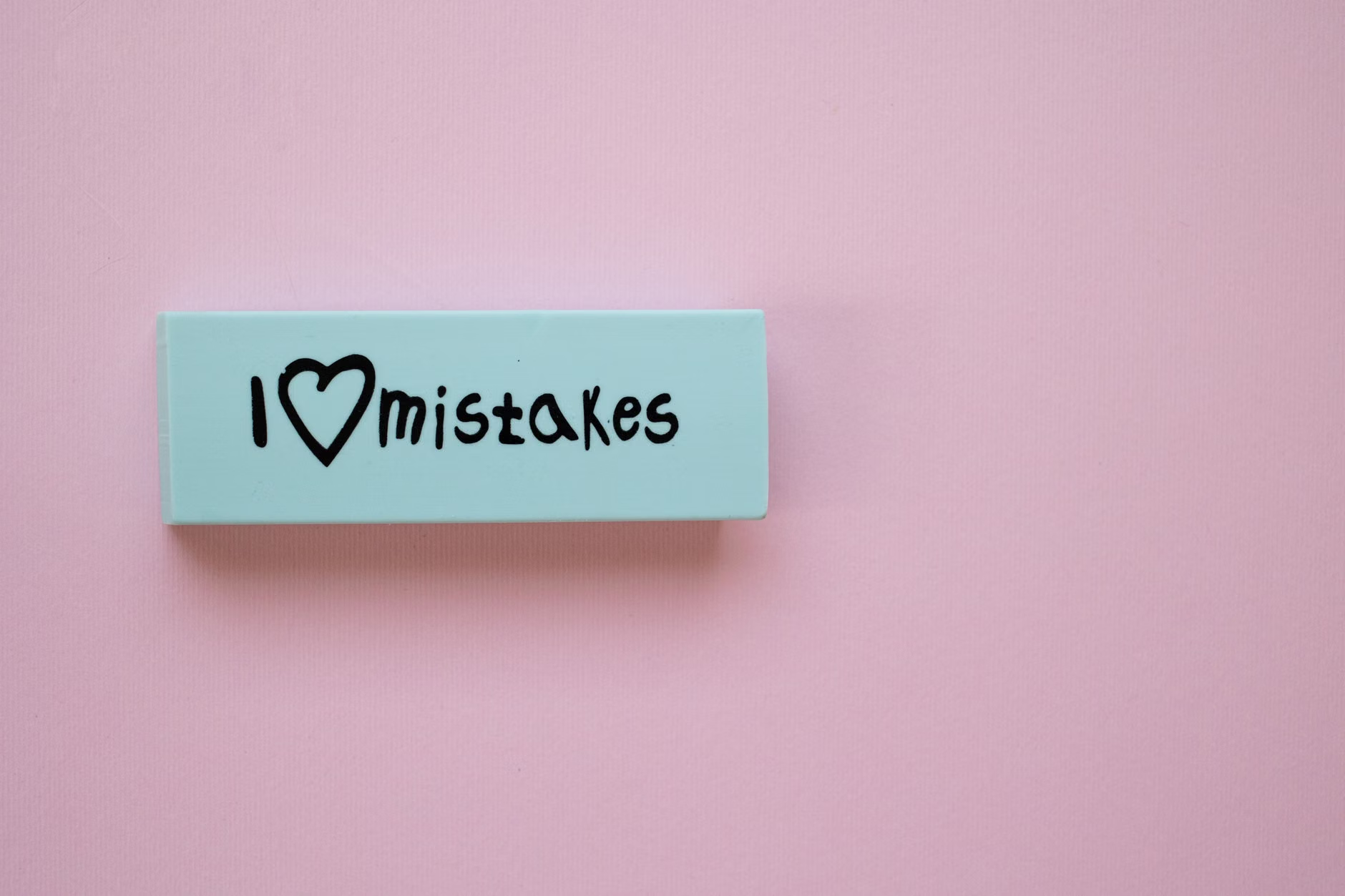
For example, if you burn dinner, instead of saying, “I’m such a bad cook,” try saying, “Hmm, I left the burner on too high and got distracted by the phone. That didn’t work out as planned! Next time, I’ll set a timer so I don’t forget. That’s a good lesson for next time.”
This does two things: it removes the shame from the error, and it provides a concrete plan for improvement. Your child observes that mistakes are not the end of the road, but rather the data needed to get to the next step. This is the foundation of scientific inquiry and emotional resilience.
Structuring Play for Resilience
Modern parenting often leans toward “helicoptering”—removing obstacles before the child even encounters them. While it’s tempting to help your toddler finish the tower so they don’t get upset, you are inadvertently denying them the “frustration threshold” training they need. The frustration threshold is the point where a child feels the urge to quit but chooses to persist instead.
To help them build this, you need to curate their play environment. Choose toys that are slightly above their current skill level—”stretch goals.” If they are building with blocks, provide blocks that are slightly more unstable or require more balance. If they are doing puzzles, pick one that is just a bit more complex than their current ability.
When they struggle, follow the “Support, Don’t Solve” rule:
- Observe: Watch for at least 30 seconds before intervening. Let them sit with the frustration.
- Ask open-ended questions: “What happens if you turn that piece this way?” or “What do you think is making the tower lean?”
- Offer a tool, not the answer: If they can’t reach a block, move a chair near them rather than handing them the block.
This approach transforms you from a “fixer” into a “facilitator.” It builds their internal locus of control—the belief that they have the power to influence their own environment.

The Hidden Costs of Perfectionism
Many parents, especially those of us in our 30s and 40s who grew up in high-achievement environments, struggle with perfectionism ourselves. We want our children to excel, which can lead us to push them toward “safe” successes. We might over-praise their accomplishments in activities they are already good at, while avoiding activities where they might struggle. This is a common trap.
The hidden cost of this is a child who is terrified of the “unknown.” They become adept at performing, but they lose the ability to explore. Over time, this can manifest as anxiety in school, where the pressure to get the “right” answer outweighs the joy of discovery. To combat this, intentionally introduce “low-stakes” activities where the outcome doesn’t matter.
Try art projects where there is no “right” way to do it, or physical activities like obstacle courses where the goal is simply to move their body in different ways. Celebrate the “messy” result just as much as the “neat” one. When they see that you value the experience over the output, they will feel safer taking risks in other areas of their life.
There will be moments when your child genuinely wants to give up. This is normal. The goal of a growth mindset is not to force them to persist until they are miserable, but to teach them how to make an informed decision about their effort. If a child says “I’m done” with a task, don’t just say “No, keep going.”
Instead, ask, “Are you done because you’re tired, or because it’s frustrating?” If they are tired, it’s okay to put the task away. If they are frustrated, encourage them to take a break and come back to it later. This teaches them to listen to their own internal signals. Resilience isn’t just about grinding through; it’s about knowing when to rest, recalibrate, and try again with a different strategy.
Often, the “I’m done” is a signal that they need a new strategy, not a break. You can offer a “reset”: “Let’s take a deep breath, put this away for five minutes, and then try a different way to stack these.” This teaches them that problems can be broken down and approached from different angles, a skill that will serve them well into adulthood.
Setting the Foundation for Long-Term Success
Building a growth mindset is not a sprint; it’s a marathon of subtle daily interactions. It starts with the language you use, the way you model your own mistakes, and the environment you create for play. By shifting the focus from “being good” to “getting better,” you are giving your child the most valuable gift: the confidence that they can handle whatever challenges life throws their way.
As they grow, these lessons will evolve. The toddler struggling with blocks will become the student struggling with algebra, and later, the professional struggling with a complex project. The underlying principle remains the same: effort + strategy + persistence = progress. Keep it simple, stay consistent, and remember that you don’t need to be a perfect parent to raise a resilient child—you just need to be a present one who is willing to learn alongside them.
Frequently Asked Questions
1. Is it ever okay to praise a child for being ‘smart’ or ‘talented’?
It’s best to avoid using these as labels. When you praise, focus on the specific action or strategy that led to the success. Instead of “You’re so smart,” try “I’m impressed by how you figured out that pattern!” This keeps the focus on the child’s agency rather than an inherent, unchangeable trait.
2. My toddler gets extremely upset when they fail. How do I help them without feeding the frustration?
Validate the emotion first. It’s okay to be frustrated. Say, “I see you’re frustrated that it didn’t go the way you wanted. It’s hard when things don’t work the first time.” Once they are calm, help them move to the next step by asking, “What could we try differently next time?” This separates the feeling (frustration) from the goal (solving the problem).
3. How do I maintain a growth mindset when I’m exhausted and just want the task done?
It’s perfectly fine to prioritize efficiency over a “learning moment” when you are tired. You don’t have to turn every single moment into a lesson. When you’re running on empty, it’s okay to just solve the problem for them. The goal is to focus on the growth mindset during the times when you have the energy to facilitate, not to be a perfect teacher 24/7. Consistency over time matters more than being perfect in every interaction.
For more research on the science of mindset and child development, visit the official resources at the Mindset Works Research Hub, which provides evidence-based insights into how these concepts impact learning and brain development.