True resilience in pre-teens isn’t built by telling them they are “smart” or that they “tried hard”; it is built by teaching them how to process the internal discomfort of failure and reframe it as a data-collection exercise.
Key Takeaways
- Growth mindset is not about effort: Praising effort alone can create “fragile achievers” who fear failure; focus instead on the process and the specific strategy used to overcome a hurdle.
- The “Pre-teen Pivot”: Between ages 10 and 13, the brain becomes highly sensitive to social evaluation; resilience training must shift from “I can do it” to “I can learn from what didn’t work.”
- Structural Resilience: You cannot coach a child through a crisis if you don’t model the “post-mortem” analysis of your own daily mistakes.
If you have a child in the 10-to-13 age range, you have likely noticed that the “I’ll just try again” attitude of their younger years has been replaced by a more defensive, perfectionist streak. They aren’t just worried about the math problem; they are worried about what the math problem says about their status among their peers. This is the “Pre-teen Pivot,” where the brain’s social-evaluation centers go into overdrive.
Many parents try to counter this with “Growth Mindset” slogans—posters on the wall, pep talks about how failure is just a stepping stone. But here is the reality: most of these interventions fail because they are too abstract. When a 12-year-old is staring at a failing grade or a failed tryout, “failure is a stepping stone” sounds like condescending corporate speak. To actually build resilience, you need to move from slogans to systems.
Beyond the Slogan: What “Growth Mindset” Actually Means for 11-Year-Olds
Psychologist Carol Dweck’s concept of the growth mindset has been widely misinterpreted in education and parenting circles. It is not a magical switch that makes children love failure. It is, fundamentally, a belief that intellectual and social capabilities are not fixed traits but malleable skills. For a 30-something parent, this sounds logical. For a pre-teen, it is a radical, often terrifying, departure from their reality.
When we talk about resilience training, we aren’t talking about “toughing it out.” We are talking about cognitive reframing. A fixed-mindset pre-teen views a failure as a diagnostic test of their worth (e.g., “I failed the test, therefore I am not good at math, therefore I am not smart”). A growth-mindset pre-teen views a failure as a diagnostic test of their methodology (e.g., “I failed the test, therefore my study method was ineffective, therefore I need to change my strategy”).
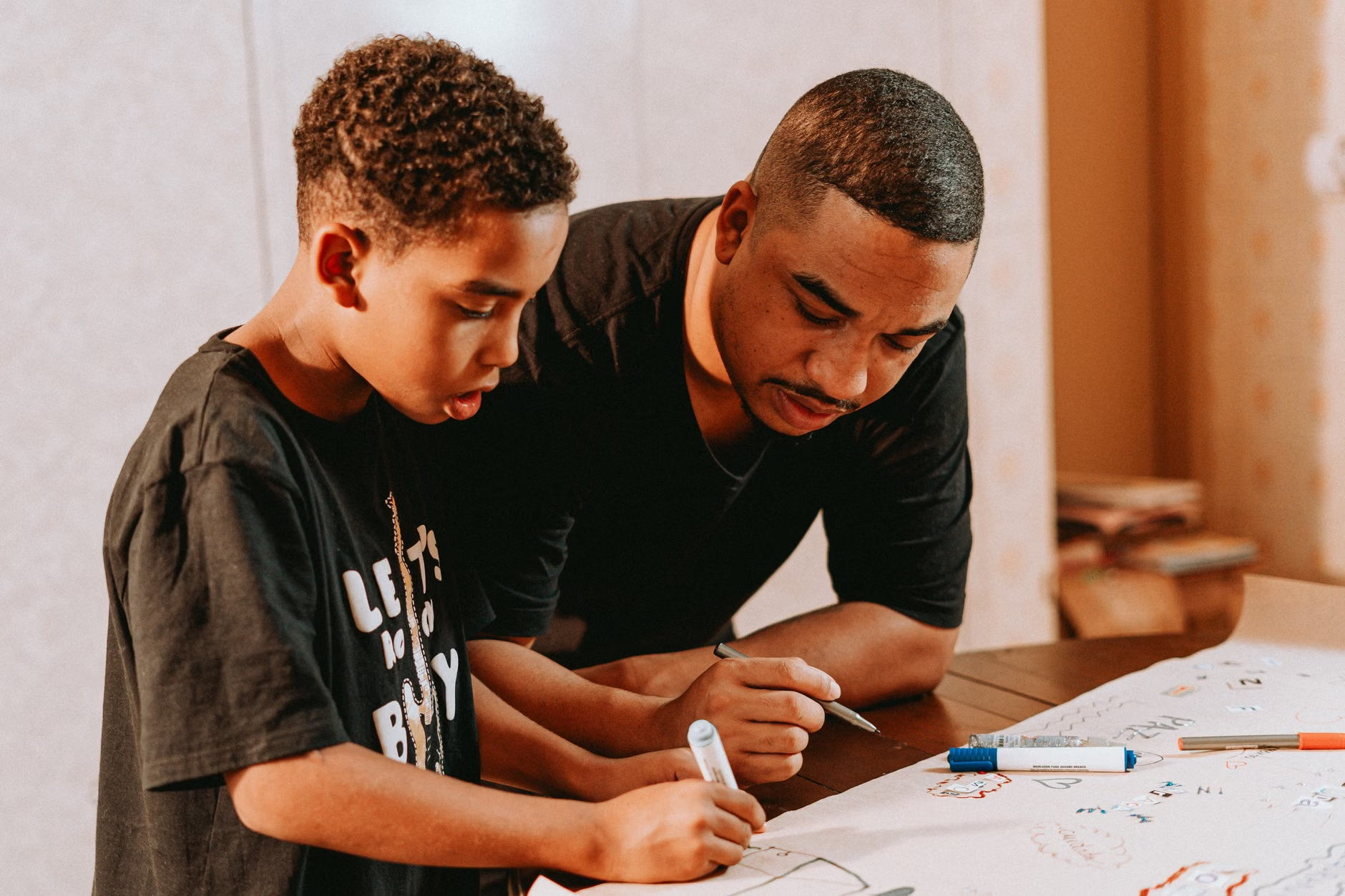
The difference is the locus of control. When the locus is fixed, there is nothing to do. When the locus is the method, there is a clear, actionable path forward. The challenge for parents is that pre-teens are biologically predisposed to seek social validation, which makes them crave “fixed” labels like “the smart kid” or “the athletic one.” Breaking this requires a shift in how you conduct family debriefs.
The “Post-Mortem” Framework: How to Analyze Failure Without Emotion
If you want to build resilience, you must stop treating “oops” moments as emotional events and start treating them as data-collection events. This is what we call the “Post-Mortem” framework. It is borrowed from software engineering, where every bug or system failure is analyzed to prevent recurrence, not to blame the programmer.
When your child comes home with a setback, your instinct is to comfort them. That is fine, but it is not enough. You must transition from comfort to analysis. Use the following table to shift the conversation.
| Common Approach (Emotional) | Resilience-Focused Approach (Systemic) |
|---|---|
| “I’m sorry that happened; you tried your best.” | “What specific part of the process didn’t yield the result you wanted?” |
| “Don’t worry, you’re still smart.” | “What was the variable that caused the error this time?” |
| “Let’s just move on and do something else.” | “What is one thing you will change in your approach next time?” |
This is not about being cold. It is about removing the “self” from the “result.” When the child realizes that their identity is not tied to the output, the fear of failure diminishes. They begin to see that they have agency over their outcomes.
The “Challenge-Skill” Matrix: Finding the Sweet Spot
Resilience is a muscle, and like any muscle, it requires progressive overload. If the challenge is too low, the child gets bored. If the challenge is too high, they experience “learned helplessness,” where they stop trying because they believe the outcome is outside their control.

As a parent, your job is to act as the curator of their “challenge environment.” If your child is struggling with a new hobby—let’s say, learning to code or playing a musical instrument—don’t just tell them to keep trying. Help them evaluate the difficulty-to-skill ratio. If they are consistently failing, the task is likely above their current skill floor. You need to help them break the task down into smaller, manageable units where they can experience “micro-wins.”
Common mistake: Parents often push children to “push through” a task that is genuinely too difficult for their current level of competence. This doesn’t build resilience; it builds burnout. Resilience is not the ability to endure suffering; it is the ability to navigate a challenge effectively. If the challenge is insurmountable, help them modify the parameters. That is not quitting; that is strategic adjustment.
The Hidden Variable: Social Resilience
In the pre-teen years, the most significant source of stress is not academics; it is social dynamics. When a child experiences a social rejection or a conflict with friends, the “growth mindset” advice—”just keep trying”—can be actively harmful. You cannot “try harder” to make someone like you.
This is where we must distinguish between internal resilience (academic/skill-based) and social resilience. For social issues, the goal is not to “succeed” at the relationship but to develop emotional regulation. Teach your child that their reaction to a peer is the only thing they can control. This is a core tenet of Stoic philosophy, which is surprisingly effective for 12-year-olds.
When your pre-teen feels hurt by a friend, ask: “Is your goal to change their mind, or to maintain your own peace of mind?” This shifts the focus from the other person’s behavior to their own internal state. It empowers them to walk away from toxic situations rather than obsessing over why they weren’t “good enough” for a specific friend group.
Practical Steps to Implement Resilience Training This Week
You don’t need a curriculum to start this. You need to change your daily dialogue. Here is a step-by-step guide for the next 7 days:
- Model the “Oops” Analysis: Next time you make a mistake—burning dinner, missing a deadline, getting lost—narrate your process out loud. “I messed up the timing on this. My strategy for checking the clock was poor. Next time, I will set a physical alarm.” This shows them that adults also have systems that fail.
- Audit Your Praise: Stop saying “You’re so smart.” Start saying “I noticed how you used the process of elimination to solve that problem.” Praise the strategy, not the trait.
- The “One-Change” Rule: When they fail at something, forbid them from saying “I’m just bad at this.” Require them to identify one specific change they will make for the next attempt. It doesn’t have to be a big change.
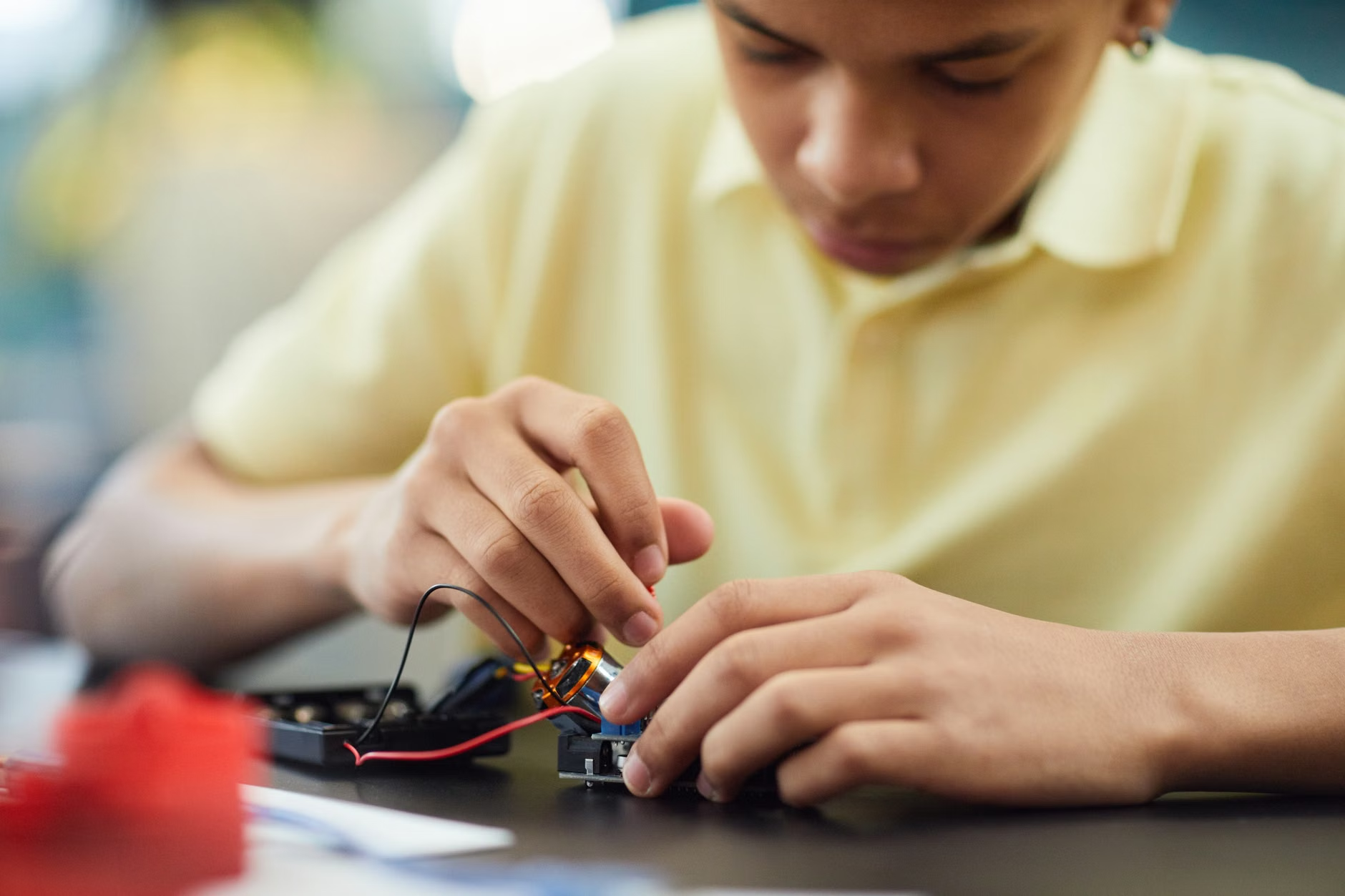
This is about shifting the vocabulary of your household. If “smart” is the goal, failure is a disaster. If “learning” is the goal, failure is just a necessary step in the process. This is the difference between a child who hides their mistakes and a child who brings them to you to analyze.
Why “It Depends” Is Not an Option: Decision Criteria
You might be wondering, “But what if they really are just not good at math?” This is a common trap. The goal of growth-mindset training is not to turn every child into a polymath. The goal is to ensure that they don’t quit before they reach their potential because of a false belief that they lack a “math gene.”
If your child is truly struggling in a subject, your decision criteria should be: Is this a lack of aptitude, or a lack of strategy? If it’s aptitude, they may never be the top of the class, but they can still achieve proficiency through different strategies. If it’s strategy, the growth mindset will eventually close the gap. The only time you should allow them to pivot away from a challenge is when they have exhausted their strategies and are no longer deriving any value from the struggle.
The Long-Term Trade-Off: Resilience vs. Perfectionism
There is a hidden cost to focusing too much on “success.” We live in an era of high-pressure parenting where we want our children to be competitive. However, the most successful people in their 30s and 40s are rarely the ones who were perfect students in their teens. They are the ones who learned how to navigate the “messy middle” of a project—the part where things go wrong, the plan fails, and you have to pivot.
By prioritizing resilience over perfection, you are giving your child a massive long-term advantage. You are teaching them that the world is not a sequence of tests to be passed, but a series of problems to be solved. This mindset is the single greatest predictor of success in the modern workforce, where the ability to learn and adapt is far more valuable than static knowledge.
Remember that this is a slow burn. You won’t see results in a week. You will see results when your child starts coming to you with a problem, not to ask for a solution, but to ask for help brainstorming the next strategy. That is the moment you know your work is paying off.
For further reading on the psychological underpinnings of this approach, you can explore the research on self-efficacy and agency, which provides the evidence base for why these shifts in language matter. Organizations like the Character Lab (https://characterlab.org/) offer excellent, evidence-based resources that break down these concepts into actionable classroom and home-based strategies.
Frequently Asked Questions
1. My child is already discouraged and refuses to try. How do I start?
Start by lowering the barrier to entry significantly. If they are discouraged, they are likely overwhelmed. Find a task that is so small it is almost impossible to fail at, and have them complete it. Then, praise the strategy they used to accomplish that small task. You need to rebuild their “success identity” before you can ask them to tackle bigger challenges again.
2. Is it harmful to praise my child at all?
Not at all. The goal is not to withhold praise, but to change the type of praise. Instead of praising innate traits (“You are so smart,” “You are a natural athlete”), praise the specific, observable actions that led to the success (“I saw how you analyzed the map before we started the hike,” “You focused really hard on your footwork during that drill”). This reinforces that their success is a result of their choices, not their genes.
3. How do I distinguish between a “growth mindset” and just “working them too hard”?
The key is the child’s internal state. If they are stressed, anxious, and losing sleep, they are being worked too hard, regardless of the mindset. If they are engaged, curious, and willing to experiment—even if they are failing—that is a healthy growth-mindset environment. If they are struggling, check the environment, not the child. Often, the issue is not the child’s lack of resilience, but the lack of support or resources provided to them to solve the problem.
Final Thought: Resilience is not something you “teach” by lecturing; it is something you curate by creating an environment where failure is safe, analysis is encouraged, and the focus is always on the next move. Keep your expectations high, but your emotional attachment to their immediate results low. Your child is learning, and that is all that matters.