The most effective way to recover from the exhaustion of modern life is to stop treating your weekend trips as a checklist of sights to see and start treating them as an exercise in intentional stillness. Quiet-Tourism is not just about visiting a rural area; it is a deliberate strategy of removing stimulation to allow your nervous system to reset.
- Prioritize sensory deprivation: Choose locations based on low noise and low visual clutter rather than “must-see” attractions.
- The 24-hour rule: Commit to at least 24 hours of zero scheduled activities to break the cycle of “productivity guilt.”
- Curated minimalism: Pack only what is necessary for comfort; the act of minimizing your physical environment mirrors the need to minimize mental clutter.
If you are in your 30s or 40s, your weekends are likely consumed by a mix of domestic chores, social obligations, and the “Sunday Scaries”—that creeping anxiety about the work week ahead. We often try to solve this by booking a “getaway.” We drive three hours to a new city, pay for a hotel, and then proceed to walk 20,000 steps a day trying to hit all the high-rated museums, cafes, and parks. By Monday morning, we aren’t rested; we are just tired in a different location.
Why Your Current “Break” Is Failing You
The core problem isn’t the lack of leisure time; it is the cognitive load of decision-making. When you are a parent or a mid-career professional, your brain spends the entire week processing inputs: emails, school schedules, grocery lists, and complex logistics. When you go on a traditional vacation, you simply shift that decision-making to a new environment. “Where should we eat?” “What time does the exhibit open?” “Is there enough time to see the cathedral before dinner?”
This is what psychologists call decision fatigue. Even on vacation, you are operating in a state of high executive function. Quiet-Tourism works because it removes the requirement for executive function entirely. It is the practice of “non-doing.” It is not a lack of activity, but a lack of performance. You aren’t there to experience a culture; you are there to experience your own thoughts without the noise of a digital or social calendar.

Defining the Parameters of a Quiet-Tourism Break
To make this work, you need to set boundaries. If you arrive at your destination and immediately pull up Google Maps to find the “top 10 things to do,” you have already failed the Quiet-Tourism criteria. A successful restorative break requires three specific environmental conditions:
| Factor | Standard Vacation | Quiet-Tourism Break |
|---|---|---|
| Primary Goal | Experience/Collection | Restoration/Decompression |
| Planning | Itinerary-heavy | Logistics-only (Food/Shelter) |
| Digital State | Connected (Sharing/Navigating) | Disconnected/Minimal |
| Metric of Success | “Did we see everything?” | “Did I feel my heart rate drop?” |
The table above illustrates the fundamental shift. If your goal is to see a specific landmark, that is perfectly fine, but label it as “sightseeing,” not “restorative travel.” Do not conflate the two. When you are looking for a place to stay, search for terms like “secluded,” “minimalist,” or “no-Wi-Fi,” rather than “central,” “near nightlife,” or “family-friendly entertainment.”
The Psychology of “Non-Doing” for Busy Parents
For parents, the idea of “doing nothing” often triggers immediate guilt. We feel that if we are away from our children, we must be “getting our money’s worth” or “making memories.” This is a significant trap. Quiet-Tourism is actually the best version of parenting self-care because it allows you to return to your family with a regulated nervous system. A parent who has spent 48 hours in quiet contemplation is objectively more patient and present than a parent who spent 48 hours rushing through a crowded theme park.
Consider the “low-stimulation threshold.” Your brain is currently habituated to high levels of stimulation. When you first arrive at a quiet location, you may feel an initial spike of anxiety or boredom. This is normal. It is the withdrawal from the constant dopamine loop of notifications and task-completion. Do not reach for your phone to fill the gap. Instead, sit with the boredom. That initial discomfort is the exact moment the restorative process begins.
How to Plan Your First Quiet-Tourism Weekend
Execution is where most people falter. You don’t need a high-end spa resort to achieve this. In fact, luxury resorts often come with their own social pressures. Look for a simple rental or a low-key guesthouse. Here is your step-by-step framework for a successful weekend:
Step 1: The Logistics Audit
Plan the logistics before you leave. If you are worried about meals, pre-order grocery delivery to the location or prepare simple, non-fussy meals in advance. The goal is to eliminate the “What are we doing for dinner?” conversation. If you are staying at a place that offers breakfast, great. If not, pack simple items that require zero preparation.
Step 2: The Digital Quarantine
This is the most critical step. If you cannot turn your phone off, you must at least turn off all notifications. Better yet, leave the phone in your luggage. If you are worried about being reachable in an emergency, set your phone to “Do Not Disturb” and only allow calls from specific family members. If you check your email, you have broken the seal of the environment.
Step 3: The Environment of Stillness
Choose an environment that forces you to slow down. A cabin in the woods, a quiet beach during the off-season, or even a room in your own home where you have cleared out all the clutter. The environment should support your lack of movement. If the bed is uncomfortable or the lighting is harsh, your body will remain in a state of low-level stress. Prioritize comfort over aesthetics.

Common Mistakes That Ruin the Experience
Even with the best intentions, people often sabotage their own rest. Here are the most common pitfalls to avoid:
- The “Productivity” Trap: You decide to go away to “finally finish that book” or “plan the next year of my career.” This is not rest; this is just working in a different chair. Leave the work behind. If you must bring a book, bring one you have already read or something purely for pleasure.
- The “Optimized” Itinerary: You tell yourself, “I’ll just take one walk to the local village.” This often leads to a cascade of social interactions, shopping, and decision-making. Keep your walking radius small. Stay within walking distance of your accommodation.
- The “Social” Requirement: If you are traveling with a partner, have a “Quiet Agreement” beforehand. Agree that you don’t need to fill the silence with conversation. It is perfectly acceptable to spend four hours in the same room without saying a word.
The Hidden Costs of Always-On Travel
Beyond the obvious fatigue, there is a hidden cost to the way we currently travel: the loss of cognitive recovery. Research in environmental psychology suggests that “soft fascination”—looking at nature or quiet, non-demanding scenes—is essential for recovering from directed attention fatigue. When we travel to busy, high-stimulation environments, we are not allowing our “directed attention” (the part of the brain used for focus and decision-making) to rest. We are simply switching it to a different set of tasks.
This is why you might return from a “fun” trip feeling like you need a vacation from your vacation. You haven’t recovered; you have just exhausted your reserves in a different way. Quiet-Tourism is a long-term investment. By training your brain to tolerate and even seek out silence, you improve your ability to handle high-stress environments during the week. It is a form of cognitive conditioning.
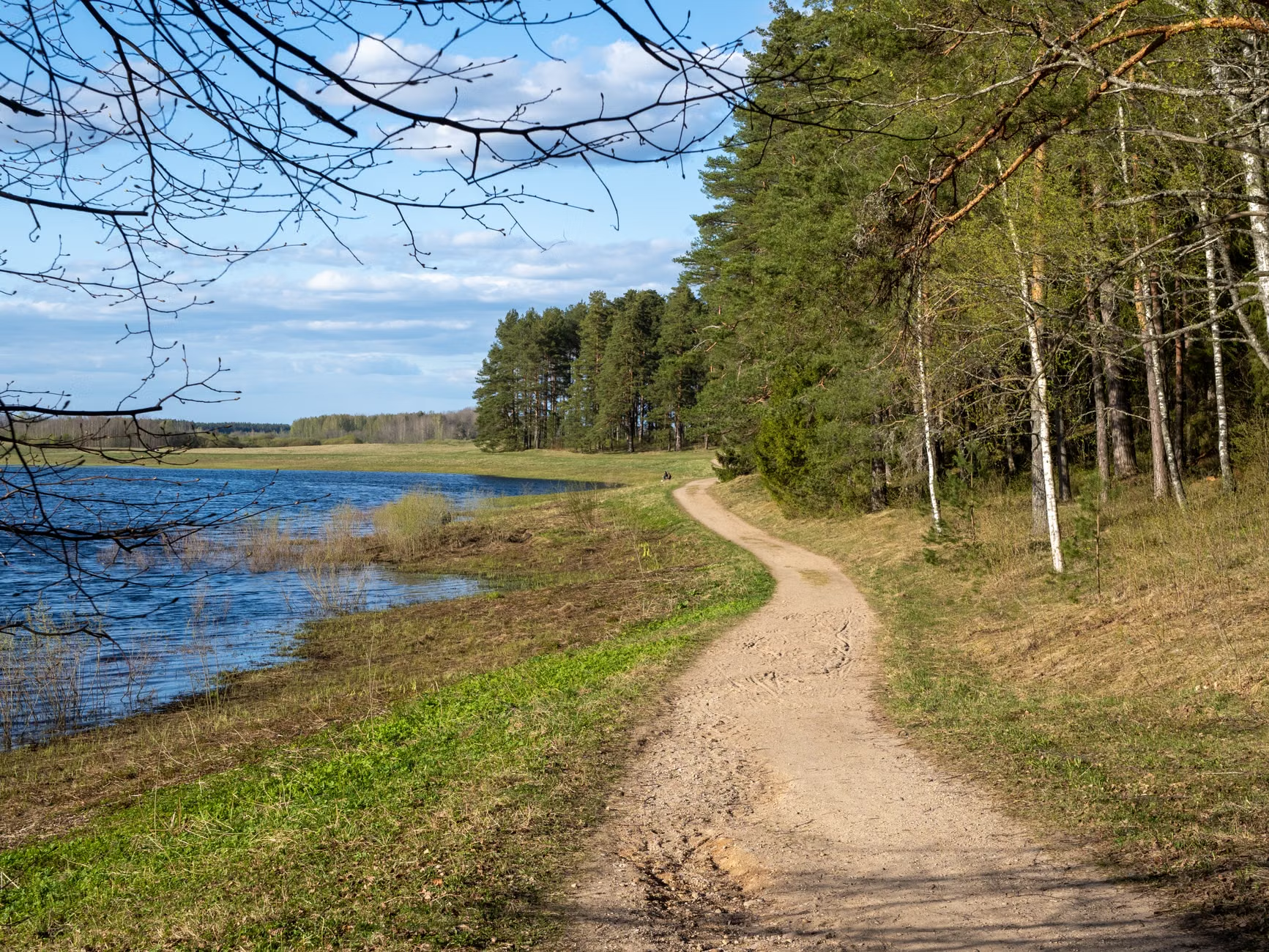
You don’t need to travel far. In fact, long-distance travel adds its own stressors: airports, traffic, and jet lag. The ideal Quiet-Tourism destination is within a two-hour drive of your home. If you spend four hours in a car, you are adding stress to your body. Look for “hidden gems” in your own region. Every area has pockets of silence, whether it’s a state park, a remote coastal town, or a quiet rural village that isn’t on the tourist map.
Use tools like Google Maps’ satellite view to look for dense green areas or quiet residential pockets away from major highways. Don’t look at “Top 10” lists. Look for places that have very few reviews. If a place has 5,000 reviews, it is not a place for Quiet-Tourism. If it has 20 reviews and they mention “peaceful” or “secluded,” that is your target.
Why “Doing Nothing” Is a Radical Act
In a culture that equates busyness with importance, choosing to do nothing is a radical act. You will likely feel a sense of guilt or a nagging feeling that you “should” be doing something. Acknowledge this feeling as a symptom of your current environment, not a truth about your life. The world will not collapse because you spent a Saturday afternoon watching the light move across a wall or listening to the wind in the trees.
This practice is especially vital for those in their 30s and 40s. You are likely at the peak of your responsibility curve. The pressure to optimize every second is intense. Quiet-Tourism is your way of opting out of that optimization. It is a declaration that your internal state is more important than your external output.
Refining Your Approach Over Time
Do not expect to get this perfect on the first try. You will likely find yourself reaching for your phone or trying to plan a “side trip” by Saturday morning. That is okay. Note the impulse and let it pass. If you find yourself needing more structure, try “anchor habits” instead of itineraries. An anchor habit is a single, low-effort activity that grounds your day. Examples include:
- Making a pot of tea at 10:00 AM every day.
- Taking a 20-minute walk at sunset without a destination.
- Reading exactly 10 pages of a book before bed.
These aren’t tasks; they are anchors. They provide just enough structure to keep you grounded without forcing you to engage in high-level decision-making. The goal is to move through the weekend with as little friction as possible.
The Long-Term Impact on Your Life
If you incorporate Quiet-Tourism into your life even once a quarter, you will notice a shift in your baseline stress levels. You will become better at identifying when you are approaching burnout because you have experienced the contrast of true silence. You will start to bring elements of this into your daily life—perhaps by turning off your phone for an hour after work, or by creating a “quiet space” in your home.
This is not about escaping your life; it is about sustaining it. By giving yourself permission to disconnect and be still, you are building the resilience needed to handle the complexities of parenting and a career. You are not running away; you are recharging the battery so you can show up more effectively when you return.
Common Questions About Quiet-Tourism
Is Quiet-Tourism just another name for staying home?
Not necessarily. While you can practice “stay-at-home” quiet, the physical act of leaving your home environment helps to break the psychological associations with your daily chores and responsibilities. Even a change of scenery to a nearby park or a quiet rental changes your brain’s state. The key is that the environment must be different enough to signal “rest” to your brain, but not so different that it requires high-level navigation or adaptation.
What if I get bored?
Boredom is the goal. We have become so afraid of boredom that we immediately fill every gap with a screen. When you feel bored, your brain is actually beginning to decompress and process the backlog of information it has been carrying all week. Instead of fighting it, lean into it. Let the boredom wash over you. It is often in these moments of “boredom” that the most creative thoughts and the deepest sense of peace emerge.
Can I do this with my kids?
Yes, but you must adapt your expectations. You cannot expect a child to engage in “quiet contemplation” for a full weekend. However, you can model the behavior. If you spend time in quiet activities, they will often follow suit. The key is to avoid high-stimulation activities like theme parks or crowded events. Focus on low-key nature activities like walking, beachcombing, or simple crafts. If you have a partner, take turns having “quiet shifts” where one parent is “on” with the kids while the other gets their restorative time.
Ultimately, the success of your restorative break depends on your ability to let go of the need for external validation. You don’t need to post photos, you don’t need to “see” anything, and you don’t need to be “productive.” You only need to exist, quietly, for a little while. Start small, set your boundaries, and see how much lighter you feel when you return to your routine.
For further reading on the importance of rest and its impact on cognitive performance, you may find the following resources useful: