- The ‘Third-Space’ Advantage: Moving work out of the home creates a necessary psychological boundary between “parent mode” and “professional mode,” reducing the risk of burnout.
- Productivity vs. Flexibility: Choosing a hub requires evaluating your specific needs: do you need absolute silence for deep work, or a collaborative environment for networking?
- Hidden Costs and Logistics: Beyond the membership fee, factor in commute time, childcare transition logistics, and the reliability of high-speed internet when selecting a hub.
The most effective way to improve your productivity as a remote-working parent isn’t a new software tool or a better noise-canceling headset; it is physically leaving your house. For those of us in our 30s and 40s, the “home office”—often a kitchen table or a corner of a bedroom—has become a site of constant cognitive switching. We are expected to be focused professionals at 10:00 AM and present, attentive parents by 3:30 PM, all within the same four walls. The psychological friction of this transition is exhausting.
Enter the “Third-Space” community hub. This isn’t just a fancy coworking office; it is a dedicated environment designed to bridge the gap between the isolation of the home and the rigid structure of a corporate headquarters. By establishing a physical boundary, you reclaim your focus and, more importantly, your identity outside of your parenting role.

Why the ‘Third-Space’ is Essential for Modern Parents
The term “third space” refers to a social environment separate from the two primary environments of home (the first space) and the traditional office (the second space). Sociologist Ray Oldenburg originally coined this to describe places like cafes or community centers, but for the modern remote worker, it has evolved into a necessity for mental health.
When you work from home, the “context cues” of professional life are missing. Your brain associates your living room with chores, family tension, and relaxation. When you try to work there, your brain is constantly scanning for distractions: the laundry that needs folding, the toys on the floor, or the proximity of your children. This is known as “cognitive load,” and it drains your mental energy long before you actually start your deep work.
The “Third-Space” solution works because it triggers a Pavlovian response. When you enter a space that is specifically designed for work, your brain enters a “work state.” This transition is a ritual. It might be the 15-minute commute, the act of putting on professional attire, or simply sitting in a chair that isn’t your dining chair. This ritual is a powerful tool to signal to yourself that your professional time has begun.
Evaluating Your Needs: The Hierarchy of Workspace Requirements
Not all third spaces are created equal. Before you commit to a membership, you need to audit your work habits. Are you a “deep-work” specialist who needs total silence, or a project manager who thrives on the background hum of activity? Understanding your personality type will save you from paying for a space that actually hinders your progress.
| Workspace Type | Best For | Primary Trade-off |
|---|---|---|
| Dedicated Private Office | High-level focus, sensitive calls | Highest cost, potential isolation |
| Hot-Desking Hub | Networking, flexible schedules | Noise variability, lack of permanence |
| Quiet Library/Zone | Deep writing, analytical tasks | Limited collaborative potential |
If you are a parent, the most critical factor is often the transition time. If a hub is an hour away, you aren’t just losing time; you are losing the ability to respond to emergencies. Aim for a hub within 20 minutes of your home or your child’s school. This “Goldilocks zone” ensures you are far enough to be productive but close enough to be present when necessary.

Common Pitfalls and How to Avoid Them
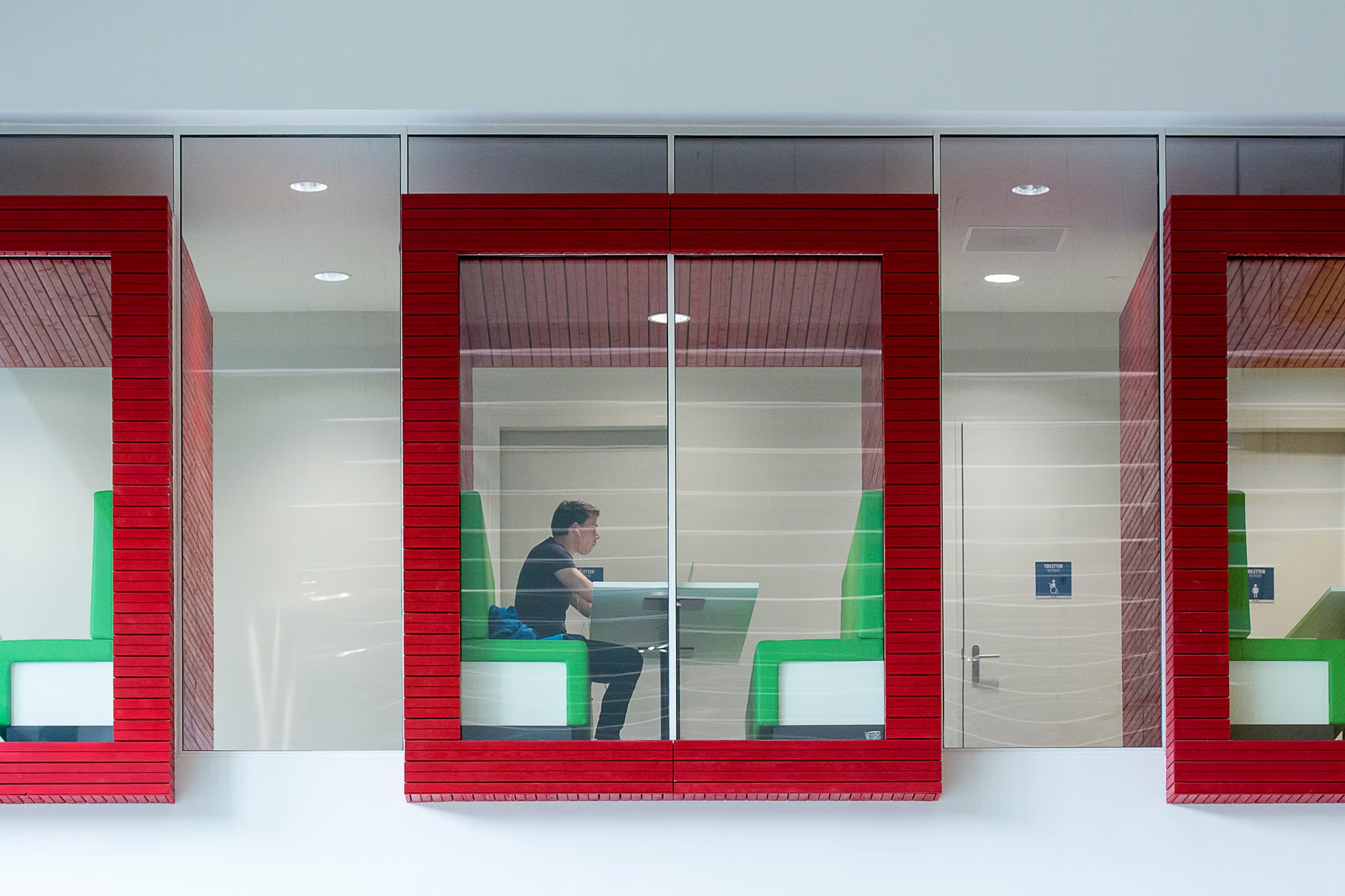
A common mistake is assuming that any coworking space will do. Many parents walk into a “trendy” space filled with loud music and open-plan seating, only to find they cannot focus for more than an hour. If you have video calls, an open-plan space is your worst enemy. Always insist on a trial day. During that trial, test the Wi-Fi speed at peak hours and check the acoustics of the phone booths.
Another overlooked variable is the “community culture.” Some hubs are built for tech-startup founders who work 14-hour days; others are built for freelancers and remote employees who value work-life balance. As a parent, you likely want the latter. Look for spaces that offer amenities like coffee, printing, and most importantly, a culture that respects “deep work” hours.
The “Noise-Canceling” Myth
Many parents believe that a good pair of noise-canceling headphones will solve any environment issue. While they are essential, they cannot filter out the stress of being in a high-pressure environment. If the vibe of the hub is “hustle culture,” you will feel that pressure even with headphones on. Choose a space that matches your professional pace.
Strategic Implementation: How to Make the Transition Work
Once you decide to move to a third space, you need a strategy to make it sustainable. Don’t just show up and hope for the best. Follow this step-by-step approach to integrate the hub into your life:
- Set a “Core Hours” Schedule: Don’t try to work at the hub every day. Start with two or three days a week. Use these days for your most demanding tasks—the ones that require deep focus and zero interruptions.
- The “Transition” Protocol: Use your commute to the hub to shift gears. Listen to a podcast, walk, or simply sit in silence. When you arrive, spend the first 10 minutes planning your day. When you leave, spend 10 minutes reviewing your progress. This “bookending” is vital.
- Communicate with Your Family: Be clear about what your time at the hub means. It isn’t “free time”; it’s “work time.” When you return home, make a conscious effort to “shut off” the professional brain. Put the laptop away entirely.
This structure prevents the “always-on” feeling that plagues many remote workers. By having a clear physical boundary, you are teaching your brain—and your family—that when you are at the hub, you are working, and when you are home, you are present.
The Financial and Practical Reality
Let’s talk about the cost. A membership at a professional community hub can range from $200 to $600 per month depending on your city and the level of service. For many parents, this feels like an unnecessary expense, especially when you have childcare costs. However, consider the productivity-per-dollar ratio.
If working from home means you are 30% less productive, and you are working 30 hours a week, you are losing nearly 10 hours of effective output every week. Over a month, that is 40 hours of lost work. If your hourly rate is $50, you are effectively “losing” $2,000 in potential productivity. When viewed through this lens, a $300 membership is an investment, not a luxury.
Furthermore, many hubs offer networking opportunities that are impossible to replicate at home. Meeting other professionals in your area can lead to new projects, collaborations, or simply a sense of camaraderie that is often missing for remote employees. This “social capital” is a hidden benefit that often pays for the membership fee within the first few months.
Addressing Common Challenges
What happens when your child is sick? What happens when you have a last-minute school meeting? These are the realities of parenting. The beauty of a flexible “third-space” membership is that it is a resource you can use when you need it, and step away from when you don’t. You are not locked into a corporate office culture that demands your physical presence 9-to-5.
Do not feel guilty about taking this space for yourself. By ensuring you have a dedicated environment, you are becoming a more efficient worker, which in turn gives you more mental bandwidth to be a better parent. It is not an “either-or” situation; it is a way to optimize your professional life so that your personal life doesn’t suffer the consequences of burnout.
If you find that your local hub is too expensive, look for “micro-hubs” or community spaces in local libraries or church halls. Many of these have become modern, high-speed internet-equipped spaces specifically for remote workers. You don’t need a high-end, glass-walled office in a skyscraper to gain the benefits of a third space. You just need a place that is not your home.
Final Thoughts: Taking the First Step
If you feel like you are constantly drowning in the “home-work” blur, the most important action you can take is to book a trial day at a local community hub tomorrow. Don’t overthink the location or the amenities. Just get out of the house. Experience the difference between “working” and “being at work.”
Once you experience the shift in focus that comes from a dedicated workspace, you will likely find that your productivity—and your patience at home—increases significantly. Remember, the goal is not to be a perfect worker or a perfect parent. The goal is to create a sustainable rhythm that allows you to succeed in both. Start small, test what works for your specific schedule, and prioritize your mental clarity above all else.
Frequently Asked Questions
1. How do I know if a coworking space is truly “parent-friendly”?
Look for a space that offers flexible, month-to-month contracts rather than long-term leases. A parent-friendly space should be transparent about their noise policy and offer reliable, high-speed internet that can handle video conferencing without lag.
2. What if I can’t afford a membership right now?
Consider alternatives like public libraries with dedicated study zones, or even local cafes that have “quiet hours.” The key is the psychological shift of leaving the house, not the price of the desk. Even a local coffee shop can serve as a third space if you treat it as a workspace rather than a social hangout.
3. How do I handle the guilt of leaving home to work?
Reframing is key. Recognize that you are not “leaving the family”; you are “going to work.” By being more efficient and focused at the hub, you are actually creating more quality, distraction-free time for your family when you return. You are investing in your own mental health, which is the foundation for your family’s stability.
For further reading on the impact of work environments, you can explore the Harvard Business Review’s insights on the future of the office.