For families in their 30s and 40s, the greatest luxury in 2027 isn’t a faster flight or a more efficient connection—it is the deliberate choice to slow down, reclaim your schedule, and trade airport security queues for the rhythmic clatter of a heritage rail line.
- Predictability over Speed: Heritage rail routes offer a controlled, low-stress environment where your kids can move around, unlike the confined space of a commercial airplane seat.
- Cost vs. Experience: While heritage lines often cost more than budget regional trains, they include the “activity” of the trip itself, eliminating the need for separate entertainment or sightseeing costs for that day.
- The “Slow-Transit” Advantage: Booking these routes in 2027 requires planning 6-9 months in advance, as heritage lines are increasingly popular for “digital detox” family vacations.
If you have spent the last three years juggling remote work, school runs, and the sheer mental load of managing a household, the prospect of an “active” vacation—where you have to rush to gates, manage luggage, and keep kids quiet in a pressurized metal tube—might feel less like a holiday and more like a logistical nightmare. This is exactly why the “Slow-Transit” movement is gaining traction among our age demographic.
We are not talking about taking three days to travel 200 miles just for the sake of it. We are talking about integrating the journey into the experience. Heritage rail lines—refurbished steam or vintage diesel routes that operate on historic tracks—provide a unique intersection of history, scenery, and genuine relaxation.
Why Heritage Rail Is the Practical Choice for Modern Parents
When you are in your 30s or 40s, “vacation” is often a misnomer for “relocating your parenting duties to a different zip code.” The beauty of a heritage rail journey lies in its structural simplicity. Unlike a flight, where you are tethered to a seat for hours, or a road trip, where the driver is constantly stressed by traffic and navigation, a train carriage is a mobile living room.
The primary benefit is the spatial freedom. Most heritage lines in the UK, North America, and Europe allow passengers to move between carriages. If your toddler is having a moment, or your primary schooler is bored, you can walk to the observation car, visit the buffet, or simply stand by the vestibule window. This isn’t just a comfort feature; it is a sanity-saving mechanism that prevents the “cabin fever” common in modern transit.
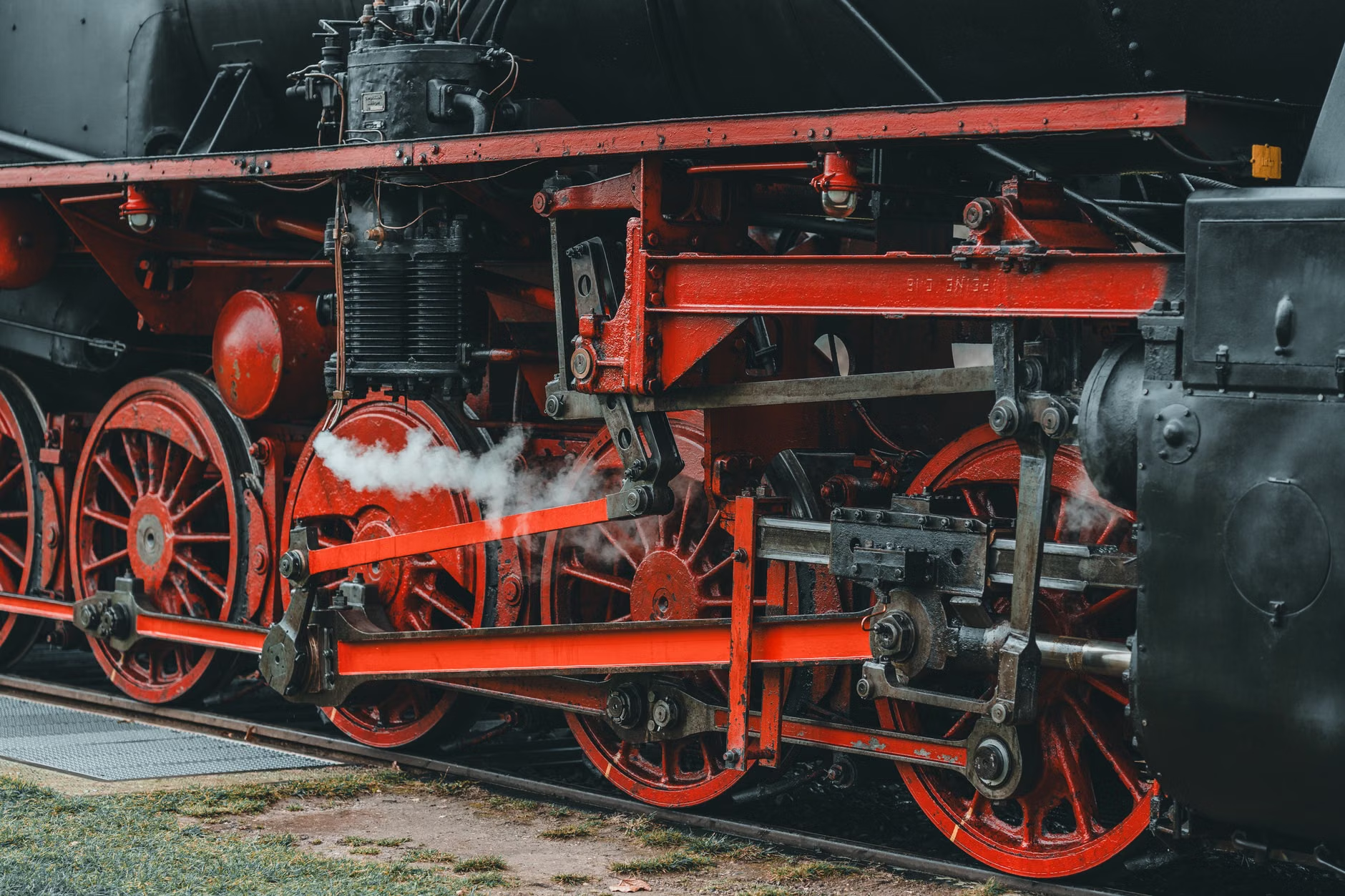
Furthermore, heritage routes often pass through landscapes that are inaccessible by highways. You are seeing the “backside” of the country—the winding rivers, the hidden valleys, and the historic bridges that were the lifeblood of transport a century ago. For children, this is a tactile history lesson. It transforms the “Are we there yet?” question into “Look at that steam coming out of the engine!”
Comparing Transit Modes: Where Heritage Rail Wins
To understand the trade-offs, we need to look at how these modes of travel impact your actual vacation budget and mental energy.
| Feature | Commercial Flight | Rental Car | Heritage Rail |
|---|---|---|---|
| Prep Stress | High (Security, Liquid rules) | Medium (Parking, Gas) | Low (Boarding at leisure) |
| Child Mobility | Very Low | None (Buckled in) | High |
| Experience Value | Zero (Transit only) | Low (Navigation focus) | High (The trip is the tour) |
As the table suggests, heritage rail is not the fastest way to get from Point A to Point B. If your goal is to reach a destination as quickly as possible, this is not for you. However, if your goal is to start your vacation the moment you leave the house, the heritage route is the superior choice. You are paying for the time spent on the train, not just the distance traveled.
The Hidden Costs and Logistics You Need to Manage
While the romanticism of the steam train is undeniable, there are practical hurdles. Heritage railways are often run by charitable trusts or volunteer organizations. This means they do not operate with the same “on-demand” efficiency as a national rail operator. In 2027, many of these lines are seeing record demand, making advance booking a non-negotiable requirement.
The “One-Way” Trap: Many heritage lines are circular or “out-and-back” routes. If you assume you can just hop off at a random station and catch a local bus or taxi back, you might be stranded. Before booking, check the local transit connectivity. In regions like the Scottish Highlands or the American Rockies, a heritage train might be the only way to reach certain remote trailheads, but local transport infrastructure on the other end can be sparse.
The Luggage Constraint: Most heritage trains do not have massive baggage compartments like modern high-speed trains. If you are traveling with a family of four, you need to pack light. Think of it like a weekend camping trip rather than a two-week international vacation. If you are moving between hotels, you may need to arrange for luggage transfer services, which are increasingly available in European hubs but less common in rural North American or Australian heritage routes.

Step-by-Step Guide to Planning Your 2027 Rail Journey
If you are ready to pivot to slow-transit, follow this framework to ensure you don’t end up with a “vintage nightmare.”
- Verify the Rolling Stock: Not all “scenic trains” are heritage steam lines. Some are modern tourist trains that happen to run on historic tracks. If you want the authentic heritage experience, look for lines that explicitly mention “steam locomotive” or “restored 1920s carriage.”
- Check the Accessibility: This is a major point of contention. Many heritage carriages were built before modern accessibility standards. If you are traveling with a stroller or require wheelchair access, check the specific carriage specifications on the railway’s official website. Do not assume “train” means “accessible.”
- Book the “Dining Car” Upgrade: On heritage lines, the food is often prepared in a tiny, historic galley. It is part of the charm. Booking a lunch or tea service in the dining car is often the best way to handle meal times with children, as it provides a structured 60-90 minute window where everyone is seated and fed.
- Check the Weather Policy: Heritage lines often run in open-air carriages during the summer. If you are planning for a 2027 trip, check if your route offers enclosed carriages. A rainy day in an open-air carriage can quickly turn a “quaint” trip into a miserable one.
The Reality of “Slow-Transit” in the Digital Age
There is a misconception that slow-transit is for people who have nothing to do. In reality, it is for people who have too much to do. By choosing a heritage rail route, you are effectively forcing a “forced pause” on your schedule. You cannot check your email with a stable connection in the middle of a remote mountain pass, and you cannot rush the train to go faster.
For parents in their 30s and 40s, this is a psychological reset. The “always-on” culture we live in is exhausting. When you are on a steam train, the primary sounds are the rhythmic chugging of the engine and the whistle. It provides a natural “white noise” that is surprisingly conducive to reading, sketching, or just talking to your partner without the distraction of a glowing screen.
Common Mistakes to Avoid
Over-scheduling: Do not try to combine a heritage rail trip with a high-intensity city tour on the same day. These trains are often slow—averaging 15-25 mph. A 40-mile journey can take two and a half hours. Treat the train ride as the main event for that day.
Ignoring the “Volunteer” Factor: Heritage railways rely on enthusiasts. If you encounter a delay, don’t be the customer who demands a refund or gets aggressive. These lines are preserved by people who love the history. A little patience goes a long way, and often, a friendly conversation with the conductor can lead to a tour of the engine room for the kids—something you will never get on a commercial airline.
Underestimating the Temperature: Vintage carriages often have poor insulation. They are either drafty in the spring or stifling in the summer. Dress in layers. Your “fashionable” travel outfit might not cut it when you are sitting in an unheated 1940s carriage in the mountains.
Choosing the Right Route for Your Family
When selecting your 2027 journey, look for routes that offer “thematic” experiences. Many lines now offer “Family Discovery” days, which include scavenger hunts or storytelling sessions on board. This is a massive help for parents, as it keeps the kids engaged without needing an iPad or a portable gaming console.
If you are in the UK, the Jacobite Steam Train (popularized by its cinematic connections) is a classic, but look at the Bluebell Railway in Sussex for a more family-focused, shorter-duration experience. In North America, the Durango & Silverton Narrow Gauge Railroad is a staple, but consider the Cumbres & Toltec Scenic Railroad for a less crowded, more authentic experience. In Australia, the Puffing Billy Railway in Victoria is essentially designed for families, with open-sided carriages that allow kids to dangle their legs safely over the side—a childhood rite of passage.
Decision Criteria:
- If your children are under 5: Choose a line with a maximum journey time of 2 hours.
- If your children are 6-12: Look for lines that offer “behind the scenes” tours of the engine shed.
- If you are looking for a romantic escape as a couple: Look for “Dining Trains” that run in the evening.
The Long-Term Value of the Slow-Transit Mindset
Why does this matter in 2027? Because the world is getting faster, louder, and more automated. Choosing to spend your vacation on a heritage rail line is an act of defiance against the “optimization” of our leisure time. It teaches our children that the process of getting somewhere is just as important as the destination.
When we look back on our childhoods, we rarely remember the flight duration or the efficiency of the rental car check-in. We remember the sights, the sounds, and the shared experiences. A heritage train journey provides a sensory-rich environment that creates these core memories naturally. The smell of coal smoke, the vibration of the wooden benches, and the sight of a steam engine rounding a bend are things that stick.
As you plan your 2027 calendar, prioritize these experiences. It’s not about being “retro” or “hipster.” It’s about being practical. It’s about recognizing that as parents, we need environments that support us, not just transport us. And if that environment happens to be a 100-year-old steam engine, all the better.
The “Slow-Transit” movement is not going to replace your daily commute or your business travel. It is a tool for your personal life—a way to reclaim the value of time. Start by looking at the heritage lines in your region, check their 2027 schedules, and book a seat. You won’t regret the lack of speed, but you will definitely remember the view.
Frequently Asked Questions
Is heritage rail travel significantly more expensive than standard train travel?
Yes, usually. Heritage lines are not subsidized in the same way as national public transport. You are paying for the maintenance of antique machinery and the labor of specialized staff. However, you should compare the price to a “day out” at an amusement park or a museum. Once you factor in that the rail ticket covers your entertainment for the day, the value proposition often balances out.
Can I bring my own food and drinks on board?
Most heritage lines allow you to bring your own snacks and drinks, but they strongly encourage you to purchase from their onboard buffet or dining car to support the railway’s upkeep. If you have specific dietary requirements (allergies, etc.), it is always safer to bring your own, but check the railway’s policy on alcohol, as some lines have strict rules regarding BYOB.
What happens if the train breaks down?
Heritage locomotives are, by definition, old. Mechanical issues happen. The best way to mitigate this is to ensure you do not have a tight connection on the other end. Do not book a flight or a time-sensitive event for the evening after your train ride. Treat the entire day as “flexible.” If a breakdown occurs, the staff will typically provide alternative transport (like a bus), but the “adventure” of the delay is part of the heritage experience.
For more information on heritage rail standards and global listings, you can explore resources like the Heritage Railway Association or check the specific national rail museum portals for your destination country.