Put every power bank and spare lithium battery in your carry-on, protect its terminals, and check your airline’s own limits before you leave home. That one routine prevents most of the battery-related surprises that turn a family airport morning into an expensive scavenger hunt.
1. Spare lithium batteries and power banks normally belong in cabin baggage, not checked baggage.
2. Capacity matters: up to 100 watt-hours is commonly permitted, while 101–160 Wh generally needs airline approval; airline and national rules may be stricter.
3. Protect terminals, keep devices from accidental activation, and never travel with a swollen, damaged, recalled, or overheating battery.
The awkward part is that a modern family does not travel with “a battery.” It travels with a small electrical ecosystem: phones, tablets, earbuds, watches, cameras, game devices, e-readers, portable fans, trackers and two mysterious black rectangles nobody admits to owning.
Most of those items are easy to carry safely. The difficulty is knowing which battery is installed in a device, which one counts as a spare, what the numbers on the case mean, and whether a regional or airline-specific rule has changed.
This guide turns the official framework used by aviation authorities into a practical packing method. It is written for international family travellers, so it does not assume that one country’s rule applies everywhere. The final authority is always the airline operating each flight and the rules of the departure, transit and arrival countries.
Why airlines care where a small battery sits
Lithium batteries store a surprising amount of energy in a compact package. A manufacturing fault, physical damage, short circuit or uncontrolled internal reaction can produce heat. In rare cases, that heat can spread from cell to cell in an event called thermal runaway.
The cabin is preferred for spare batteries because crew and passengers can notice smoke, heat or unusual odour quickly and respond with trained procedures. A problem hidden in the cargo hold is harder to detect and reach. That is why “carry-on only” is not pointless bureaucracy; it is a visibility rule.
A battery installed in equipment may sometimes be allowed in checked baggage if the device is fully switched off and protected from damage and accidental activation. However, airlines can impose tighter restrictions, and smart luggage creates its own complications. For a family, the simplest default is to keep valuable rechargeable electronics in the cabin whenever size and security rules allow.
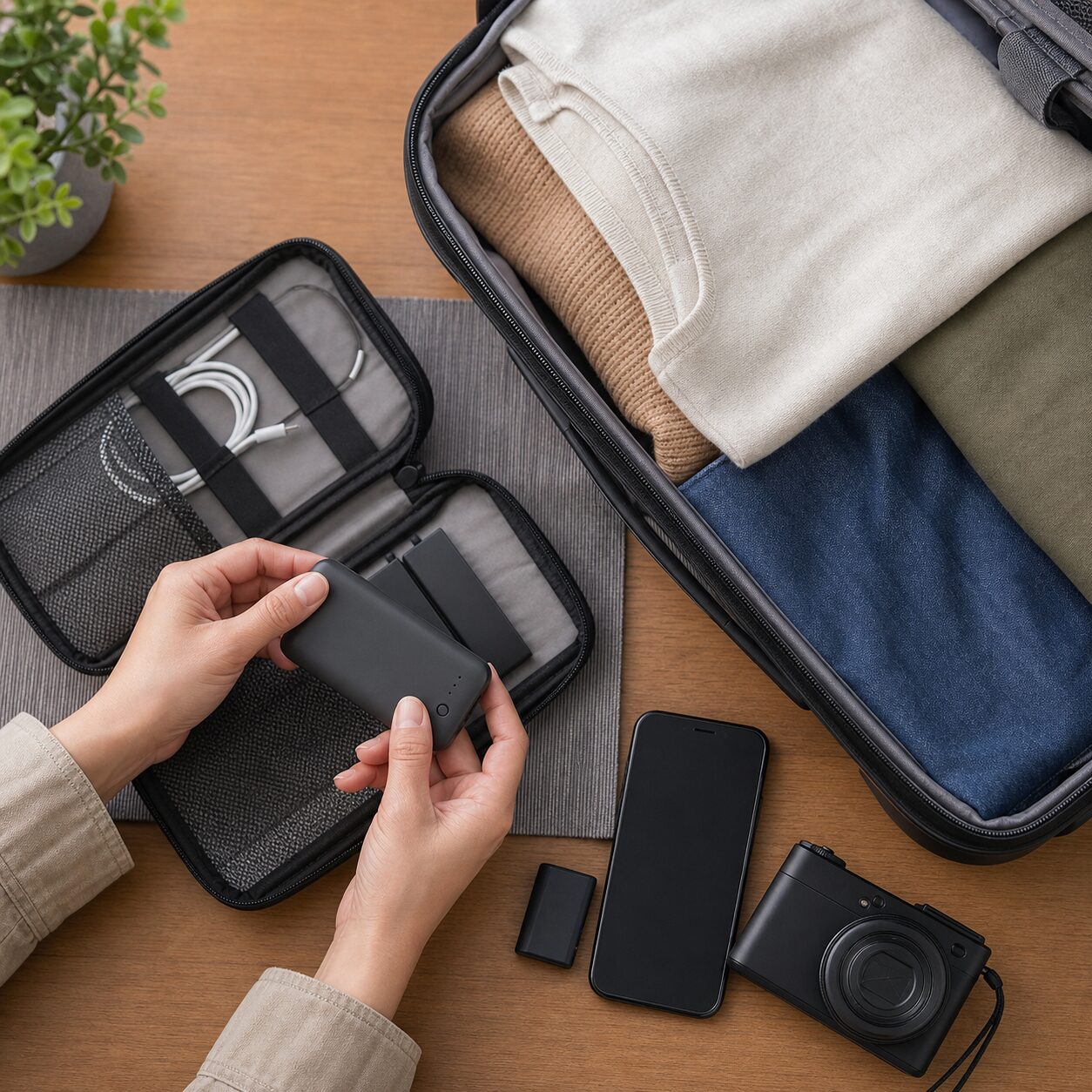
The three categories that make airport rules easier
| Category | Examples | Practical default |
|---|---|---|
| Battery installed in equipment | Phone, tablet, laptop, camera | Carry in cabin when practical; if checked and permitted, switch fully off and protect from damage. |
| Spare battery | Loose camera or drone battery, removable laptop battery | Cabin baggage only; protect each terminal from short circuit. |
| Power bank | Portable phone charger, battery pack | Treat as a spare battery, even though its purpose is charging other devices. |
That last line catches many travellers. A power bank feels like a charger, but aviation rules generally treat it as a battery. The wall plug is the charger; the power bank is stored electrical energy.
Find watt-hours without turning packing night into algebra class
Airline limits are usually expressed in watt-hours, abbreviated Wh. Many power banks are marketed in milliamp-hours, or mAh. Those are not directly interchangeable unless you also know the battery voltage.
The formula is:
Wh = (mAh ÷ 1,000) × voltage
For example, a power bank marked 20,000 mAh and 3.7 V is approximately 74 Wh. A 10,000 mAh unit at 3.7 V is approximately 37 Wh. Do not calculate from the USB output voltage if the product already states Wh; use the manufacturer’s watt-hour marking.
Official passenger-baggage guidance commonly uses three bands. Batteries up to 100 Wh are generally allowed for personal use in the cabin. Batteries above 100 Wh and up to 160 Wh normally require advance airline approval, often with a limit on the number of spares. Batteries above 160 Wh are generally not accepted as ordinary passenger baggage.
| Capacity | Typical passenger treatment | What a family should do |
|---|---|---|
| Up to 100 Wh | Usually permitted in carry-on for personal use | Confirm airline quantity and use restrictions; protect terminals. |
| Over 100 to 160 Wh | Usually requires operator approval | Contact the operating airline before travel and retain written approval. |
| Over 160 Wh | Generally prohibited as passenger baggage | Do not bring it without a specialist dangerous-goods arrangement. |
This table is a framework, not a boarding guarantee. Some airlines or countries limit the number of power banks, require capacity markings to be legible, restrict in-flight charging or storage, or apply special procedures. Connecting flights matter too: the strictest operator on the itinerary may effectively set your packing rule.
What if the label is worn off?
A mystery battery is a poor travel companion. Security staff cannot be expected to accept a capacity you calculated from memory. If the Wh rating and the information needed to verify it are illegible, check the manufacturer’s official documentation and your airline’s policy before travel.
If the case is damaged or the product cannot be confidently identified, replace it through an appropriate recycling route rather than packing it “just in case.” A new, clearly marked modest-capacity power bank is usually cheaper than losing time, missing a flight or surrendering an uncertain one.
The seven-step family battery packing routine
1. Make one household battery inventory
Place every rechargeable travel item on a table. Include the devices children packed themselves. Check coat pockets, camera cases and the bottom of the “cables” pouch. The goal is not to create a spreadsheet worthy of mission control. It is to stop an unnoticed power bank from entering a checked suitcase.
Separate installed batteries from spares and power banks. Note any larger devices such as professional cameras, mobility equipment, medical devices, drones or high-capacity laptop packs because those may need additional checks.
2. Read the capacity and condition
Look for Wh first. If only mAh and voltage appear, calculate Wh and save a photograph of the product label and official specification page. Inspect the case for swelling, cracks, leaks, exposed parts, unusual heat or a chemical smell.
Do not fly with a damaged, defective, recalled or swollen lithium battery. Do not press a swollen device flat, puncture it or place it in household rubbish. Follow local fire-service, municipal or retailer guidance for safe handling and recycling.
3. Check every operating airline, not only the booking website
A ticket sold by one airline may include a flight operated by another. Search each operating carrier’s official dangerous-goods or restricted-baggage page. Check the airport and aviation authority guidance for countries on the itinerary, especially if travelling through regions with recently tightened power-bank rules.
Ask specific questions: How many power banks are allowed? Is airline approval required above 100 Wh? May power banks be used or charged during flight? Must they stay visible rather than in an overhead locker? Are smart bags accepted only when the battery is removable?
4. Protect each spare from short circuit
Loose batteries should not roll around beside keys, coins or metal adapters. Keep each one in its retail packaging, a battery case or a separate protective pouch. Cover exposed terminals with non-conductive tape where appropriate, without hiding essential capacity information.
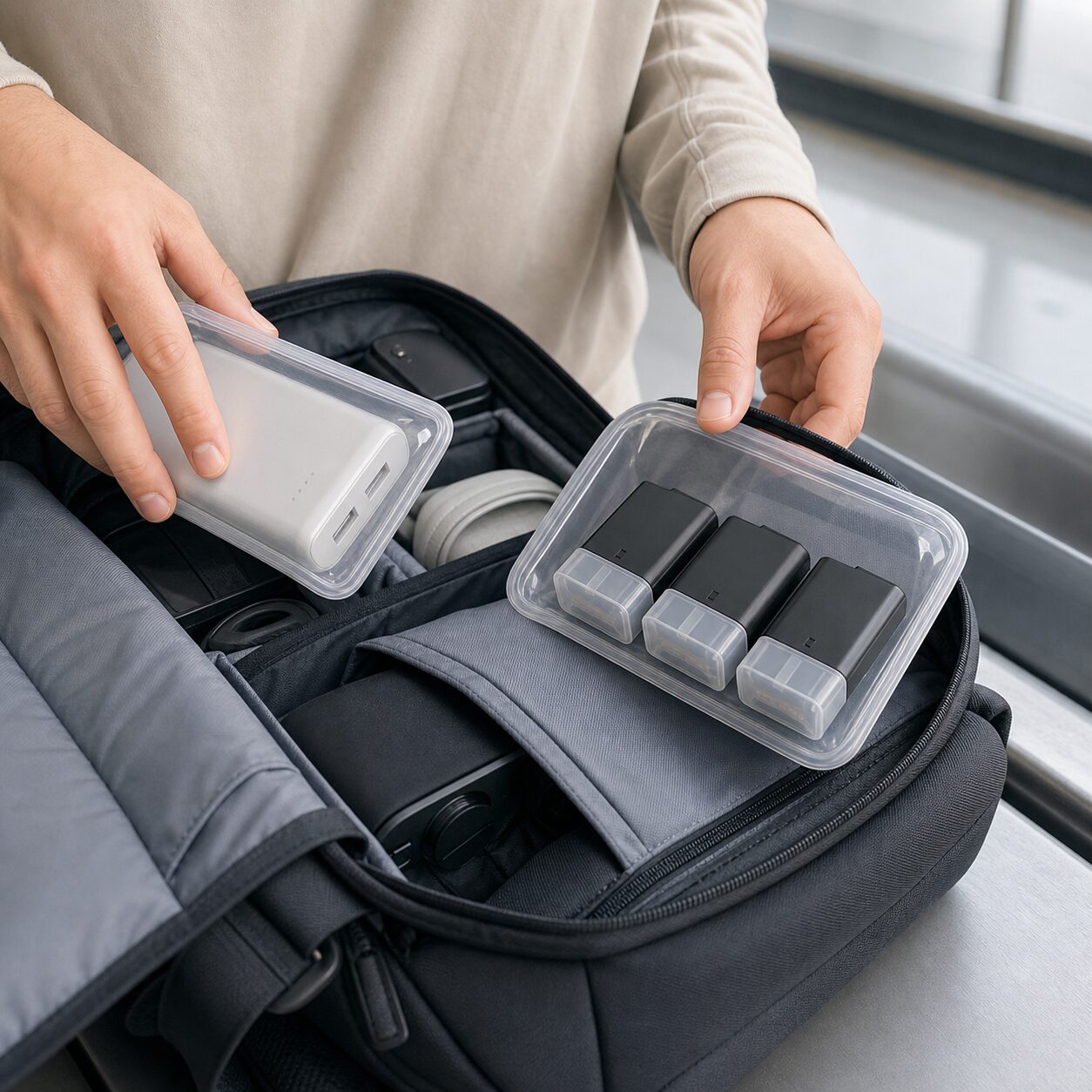
A zip bag can help organise items, but it is not magic armour. The important parts are preventing terminal contact, avoiding crushing and keeping batteries where you can monitor them. Do not cram a power bank into a seat mechanism or let it disappear between cushions.
5. Prepare for the gate-check surprise
On busy flights, cabin bags may be tagged at the gate and moved to the hold. Before joining the queue, place power banks, spare batteries, medication, keys, travel documents and essential electronics in a smaller personal-item bag or removable pouch.
If staff take your cabin suitcase, tell them it contains electronics and remove every spare battery and power bank. This is a useful job for an older child: “battery pouch comes out before the bag goes away.” A simple household rule travels better than a long lecture.
6. Use devices cautiously in the cabin
Follow crew instructions and the airline’s current policy. Do not charge a device that is unusually hot, damaged or trapped under bedding or between seats. Keep ventilation openings clear. Use reliable cables in good condition.
If a phone, tablet or battery becomes hot, swells, smokes, hisses or smells unusual, stop using it and alert cabin crew immediately. Do not hide it, pour random liquids on it or carry it through the cabin looking for help. Crew are trained and have procedures and equipment.
7. Recheck before the return flight
Holiday life rearranges bags. A power bank migrates into a beach tote, a camera battery lands in checked luggage, and somebody buys a rechargeable fan. Repeat the inventory before returning, especially after shopping.
Dispose of damaged batteries only through an appropriate local facility. Do not leave them in a hotel bin, and do not mail lithium batteries casually; postal and courier rules are a separate dangerous-goods system.
Children’s devices need an adult packing rule
Children and teenagers may be perfectly capable of managing a tablet but less interested in battery classifications. Give them a rule they can remember: rechargeable devices and battery packs go in the family electronics pouch, never straight into checked luggage.
Let older children identify the Wh marking and inspect their cable. This turns safety into a practical travel skill. It also reveals whether the enormous battery pack they bought online has a usable label or a trustworthy specification.
For younger children, adults should control charging and packing. Avoid charging devices under blankets, in a stroller pocket exposed to strong heat, or inside a tightly packed bag. A tablet downloaded with entertainment before departure often needs less in-flight charging anyway.
A calm division of labour
| Person | Job |
|---|---|
| Adult booking lead | Check operating-airline and national rules. |
| Adult packing lead | Inspect condition, capacity and terminal protection. |
| Teenager | Bring personal devices to the inventory and report new purchases. |
| Younger child | Hand every rechargeable item to an adult before bags close. |
Smart luggage, trackers and less obvious batteries
Smart suitcases can contain a removable power bank, location module, scale or motor. Airlines may require the battery to be removed before checking the bag. If it cannot be removed, the bag may be refused. Read the bag manufacturer’s instructions and airline policy well before departure.
Small tracking tags generally contain button cells rather than rechargeable power banks, but they are still batteries and must comply with the applicable rules. E-cigarettes and vaping devices use lithium batteries too and are typically restricted to cabin baggage, with use and charging prohibited on board. They also face destination laws unrelated to aviation.
Mobility aids and medical equipment deserve individual planning. Their batteries, design and essential use can trigger different provisions. Contact the airline’s accessibility or special-assistance team early, provide the exact battery chemistry and rating, and keep documentation available. Do not assume a medical purpose erases packing rules.
Why “airplane mode” is not “fully off”
Airplane mode disables certain radio connections; it does not switch off the device. When an airline permits a battery-powered device in checked baggage, guidance generally calls for it to be completely switched off and protected against accidental activation and damage.
A sleeping laptop can wake for updates. A power button can be pressed by packed shoes. If a device must be checked, shut it down fully, use a protective case and pack it against movement. But first confirm that both the device and its battery are permitted in the hold.
What not to do when a battery looks wrong
A swollen phone back, separated laptop case or misshapen power bank is not a minor cosmetic issue. Stop charging and using it. Move away from combustible materials if this can be done safely, avoid pressure or puncture, and seek local professional guidance.
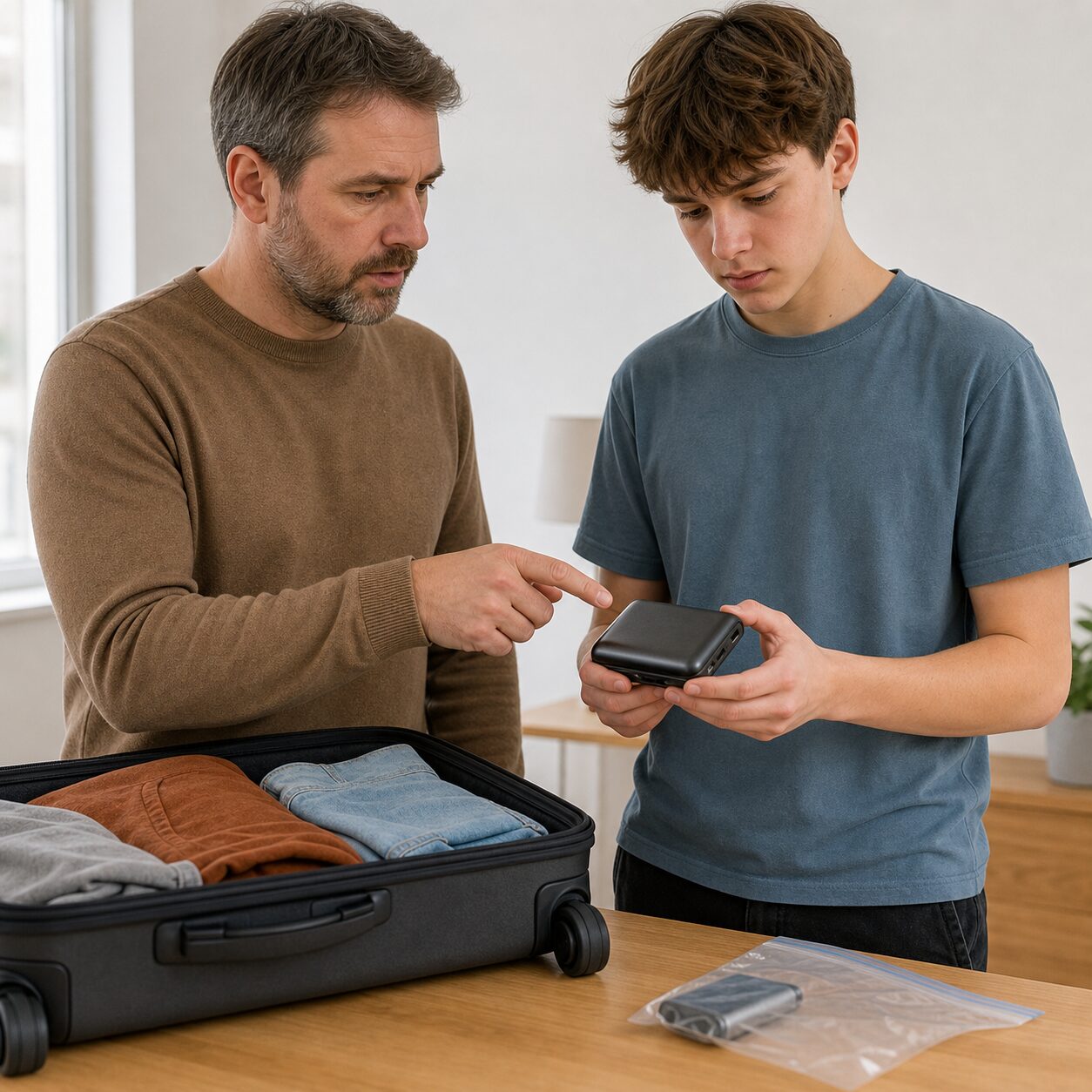
Do not take a questionable battery to the airport hoping security will decide. Airport bins are not battery recycling points, and carrying a known defective battery creates avoidable risk. Check product recalls through the manufacturer and relevant consumer-safety authority.
If an undamaged device becomes hot during flight, unplug it if safe, leave it visible and notify crew. If it smokes or burns, alert crew immediately and follow instructions. The useful instinct is fast communication, not amateur firefighting.
A 10-minute check before leaving for the airport
| Check | Done when… |
|---|---|
| Capacity | Every spare and power bank has a legible Wh rating or verifiable specification. |
| Condition | Nothing is swollen, cracked, recalled, leaking or unusually hot. |
| Location | All spares and power banks are in cabin baggage. |
| Protection | Terminals cannot touch metal and devices cannot switch on accidentally. |
| Airline rules | Each operating carrier’s official page has been checked. |
| Gate check | The battery pouch can be removed from the cabin suitcase in seconds. |
Keep screenshots or saved pages available offline, but note the date you checked them. Policies can change, and an old travel forum answer is not official approval. For batteries over 100 Wh, obtain any required airline approval before arriving at the airport.
How to reduce the number of batteries without losing useful tech
Safe packing becomes easier when the family carries fewer duplicate devices. Start with the jobs you genuinely need: communication, navigation, tickets, photography, translation and entertainment. One reliable phone can cover several of those roles. A shared compact power bank may be more sensible than four unknown ones bought at different times.
Download maps, boarding documents, books and programmes before leaving Wi-Fi. Lower screen brightness, use battery-saver mode and switch off background functions you do not need. Those steps reduce charging demand without creating another rule to research.
Choose power banks from traceable sellers and keep the receipt or product record. Capacity claims that appear physically impossible are a warning sign. A modest, correctly labelled pack from a responsible manufacturer is more useful at security than a giant bargain pack with vague specifications.
Bring one short, undamaged cable for each connector family rather than a knot of ageing cables. Inspect plugs for bent metal, fraying and heat damage. A cable does not store energy, but a damaged one can create poor connections and heat while charging.
At accommodation, charge devices on a hard, open surface rather than under bedding or inside a bag. Use the correct voltage-compatible adapter and avoid overloaded, loose or visibly damaged sockets. Unplug equipment that becomes unusually hot and supervise charging around young children.
Cold and heat also affect battery performance. Do not leave devices in a hot parked car, on a sunny windowsill or beside a heater. If a battery has been exposed to extreme temperature, let it return to a normal indoor temperature and inspect it before charging.
Build a small travel charging kit
A useful kit can be remarkably boring: one clearly marked power bank within the permitted limit, protected spare camera batteries if needed, sound cables, a suitable wall adapter and a small non-metallic pouch. Boring is excellent here. Every item has a known job, and nothing is loose.
Keep the kit accessible during security screening and boarding. Do not attach heavy batteries to a phone with a dangling cable while walking through a terminal. Apart from being awkward, it increases the chance of dropping or bending a connector.
For long journeys, plan charging opportunities rather than assuming every seat has working power. Fully charge essential devices at home, but do not pack a battery that feels hot immediately after charging. Allow it to cool normally and verify that it behaves as expected.
Finally, agree on priorities. A power bank should preserve communication, travel documents and navigation before it fuels several hours of high-brightness video. This is not a moral judgement on cartoons; it is simply useful when a delay turns a two-hour airport visit into six.
Official sources worth checking
The International Air Transport Association passenger-baggage information explains the global industry framework: https://www.iata.org/en/programs/cargo/dgr/dgr-guidance-passengers/
The US Federal Aviation Administration provides detailed PackSafe guidance for portable electronic devices and spare batteries: https://www.faa.gov/hazmat/packsafe/portable-electronic-devices-with-batteries
The European Union Aviation Safety Agency publishes passenger baggage safety information, including lithium batteries: https://www.easa.europa.eu/en/light/topics/dangerous-goods
Use those pages to understand the framework, then check the official website of every operating airline. Airline conditions can be more restrictive and may address quantity, storage and in-flight use in ways a general page cannot.
Three questions travellers ask at the last minute
FAQ 1: Can I put a power bank in checked luggage if it is switched off?
Normally no. Aviation guidance treats a power bank as a spare lithium battery, and spare lithium batteries belong in carry-on baggage. Switching it off does not change its category. Remove it if your cabin bag is checked at the gate.
FAQ 2: Is a 20,000 mAh power bank allowed on a plane?
Often, but mAh alone is not enough. Check the stated Wh rating or calculate it using voltage. A typical 20,000 mAh, 3.7 V pack is about 74 Wh, below the common 100 Wh threshold. The product must be in good condition and clearly identifiable, and the airline may impose quantity or use limits.
FAQ 3: May I charge my phone from a power bank during flight?
It depends on the airline and route. Some operators restrict power-bank use or charging and specify where the battery must be stored. Check the operating airline’s current policy and follow cabin-crew instructions. Never charge a damaged, swollen or unusually hot device.
The packing rule that is actually easy to remember
Family travel already has enough moving parts. Reduce battery safety to a repeatable sentence: known capacity, sound condition, protected terminals, cabin bag, airline checked.
That does not replace official rules, especially for large batteries, smart luggage, mobility aids or medical equipment. It does, however, catch the ordinary mistakes: the loose camera battery beside the keys, the power bank buried in checked luggage and the damaged pack everyone hoped would survive one more trip.
Do the inventory at home, repeat it before the return flight, and give the family battery pouch a permanent place. Ten calm minutes at the table is much nicer than repacking on an airport floor while the boarding clock develops a personality.