The fastest way to recover hundreds of dollars in your annual household budget isn’t by cutting out your morning coffee; it is by systematically dismantling the “subscription creep” that has likely taken root in your bank statements over the last two years.
- The 30-Day Rule: If you haven’t used a service in the last 30 days, it is a candidate for immediate cancellation, regardless of its low monthly cost.
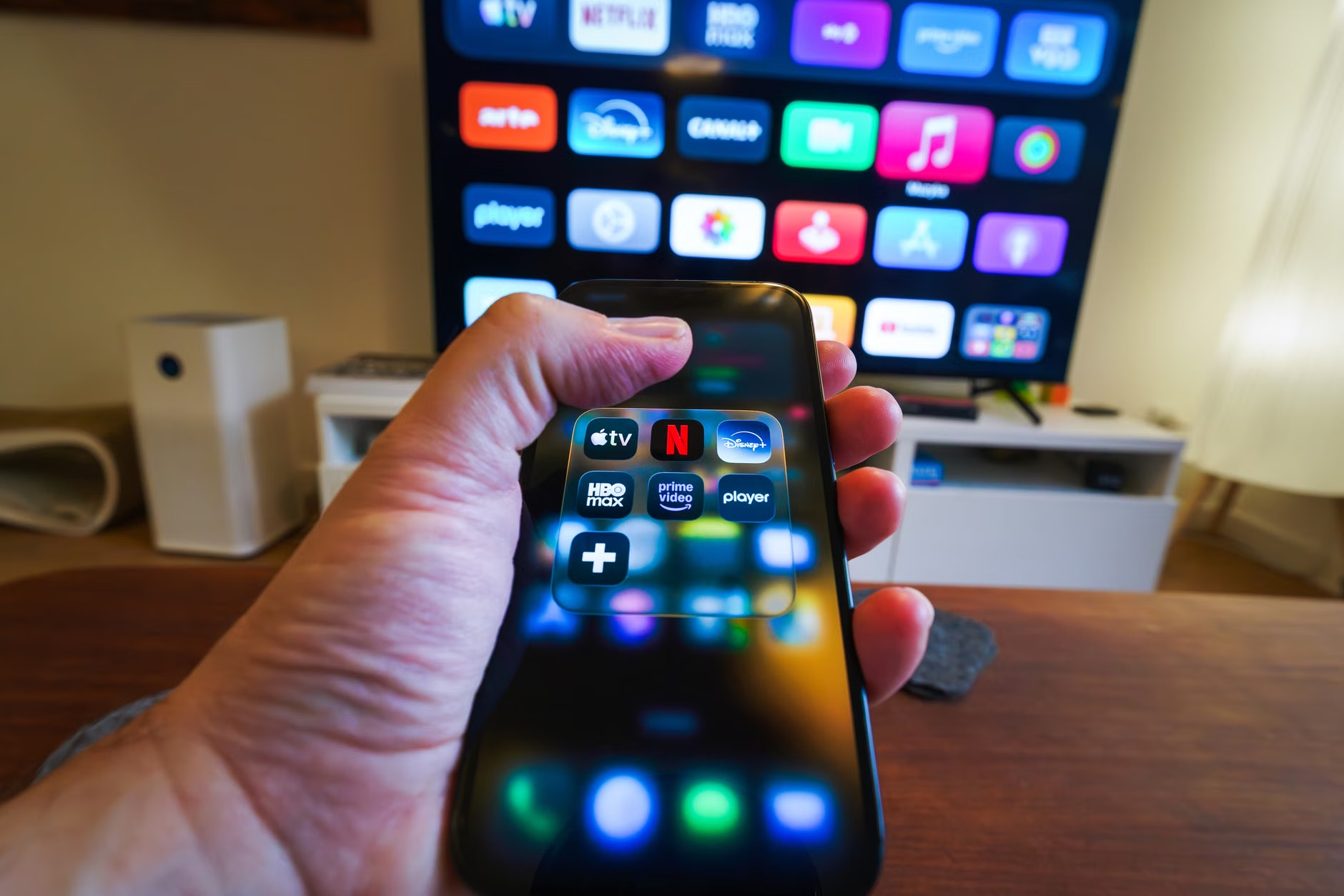
- The “Bundle Trap”: Many households pay for overlapping services (like multiple streaming platforms or cloud storage) that can be consolidated into a single family plan.
- Automated Leakage: Most subscription waste stems from “zombie” accounts—services you signed up for during a free trial or a one-off project that you simply forgot to cancel.
Why Your Monthly Expenses Feel Like “Death by a Thousand Cuts”
If you feel like your bank account is leaking money despite not making any major purchases, you are likely suffering from the subscription economy’s primary design feature: low-friction, automated billing. In our 30s and 40s, we are juggling careers, children, and a never-ending list of household tasks. We sign up for a streaming service to keep the kids entertained during a long weekend, subscribe to a meal-prep kit for a busy month, or start a premium app trial to organize our fitness goals. Then, life happens.
The “set it and forget it” nature of modern billing means that these small charges—$9.99 here, $14.99 there—rarely trigger a red flag in our mental accounting. However, when aggregated, these costs often total over $1,000 per year for the average household. This isn’t just about the money; it’s about the cognitive load. Every active subscription is an implicit commitment, a digital ghost that continues to demand payment even when it has long ceased to provide utility.
Step 1: The Forensic Audit of Your Financial Trail
Before you can cut the bloat, you have to see it. Do not rely on your memory. Your brain is conditioned to ignore recurring charges as “fixed costs.” To perform a true audit, you need to look at the raw data.
The Methodology: Download your last three months of bank and credit card statements as CSV or Excel files. If you use a budgeting app, export your “subscriptions” category. If you don’t use an app, look specifically for recurring merchant names (Netflix, Spotify, Adobe, Apple, Google, Amazon Prime, etc.).
Create a spreadsheet with these four columns:
- Merchant Name: Who are you paying?
- Monthly Cost: Exactly how much is being deducted?
- Utility Rating (1-5): How often do you actually use this? (1 = Never, 5 = Daily).
- Retention Decision: Keep, Cancel, or Downgrade.
Common Mistake: Many people stop at their credit card statements. Remember to check your PayPal, Apple ID/Google Play subscription lists, and even your cellular provider’s add-on section. Many “value-added services” (like extra cloud storage or insurance plans) are bundled into your phone bill and forgotten.
Step 2: The “Keep or Kill” Decision Matrix
Once you have your list, it’s time to be ruthless. Use this decision matrix to determine the fate of each service. Do not let “I might use it later” be an acceptable justification.
| Scenario | Decision | Reasoning |
|---|---|---|
| Used less than once a month | Cancel | The cost-per-use is too high. You can resubscribe if you truly need it later. |
| Duplicate functionality | Consolidate | Pick one cloud service or streaming platform and drop the others. |
| Used weekly, high value | Keep | If it saves you time or provides genuine relaxation, it stays. |
The “Re-subscription” Insight: There is a pervasive fear that canceling a service will be a hassle to set up again. In reality, almost every modern service allows you to restart your subscription in seconds with a single click. Treat your subscriptions as “on-demand” services rather than “always-on” utilities.
Companies know that people are auditing their expenses. When you go to cancel, you will often be hit with a “retention offer”—a discounted rate for three months or a “pause” option. This is a classic behavioral nudge designed to keep you in the ecosystem.
The Decision Rule: If you were planning to cancel because you don’t use the service, do not take the discount. A 50% discount on a service you don’t use is still a 100% loss. If you truly enjoy the service but the price is the only barrier, the discount is a win. If the usage is the barrier, click “Cancel” regardless of what they offer.

The Hidden Costs of “Free” Trials
The most dangerous subscription is the one you signed up for with a credit card to get a “free trial.” These are designed to expire exactly when you are most distracted. To prevent this, use a virtual credit card service if your bank offers one, or set a hard calendar reminder for three days before the trial ends.
If you find yourself frequently signing up for trials, create a dedicated “Subscription Email” address. This keeps your inbox clean and makes it easy to see which services are sending you promotional content. If you aren’t opening their emails, you certainly aren’t using their service.
Consolidating for Maximum Efficiency
One of the biggest leaks in modern households is the “individual plan” trap. Check your family’s accounts. Are you paying for three separate Spotify individual accounts? Are you and your partner both paying for individual cloud storage subscriptions? Moving to a Family or Household plan can often save 30-50% immediately, even if you keep all the services.
Actionable Step: Spend 30 minutes this weekend sitting with your partner or family. List every digital service you pay for. Ask: “Can this be shared?” or “Is this redundant?” You will likely find at least two instances where you can downgrade to a shared tier.
The Psychological Barrier: Why We Hate Canceling
Why do we keep paying for things we don’t use? It’s a mix of the “Sunk Cost Fallacy” and “Status Quo Bias.” We feel that because we paid for it, we should use it, and by canceling, we are admitting we wasted money. This is backward. The money is already gone. Keeping the subscription doesn’t get that money back; it just ensures you lose more money tomorrow.
Reframing the Audit: Stop viewing the audit as a chore. View it as a “found money” exercise. Every subscription you cut is effectively a tax-free raise. If you save $100 a month, that is $1,200 a year that can be redirected toward your family’s actual goals—a vacation fund, an emergency buffer, or a retirement contribution.
Maintaining the “Subscription Hygiene”
Auditing once is great, but the subscriptions will creep back in. To keep your finances clean, implement a quarterly “Subscription Reset.” Every three months, set a calendar event to review your bank statement specifically for recurring charges. This takes less than 15 minutes once you have the process down, and it prevents the long-term accumulation of “zombie” accounts.
Checklist for your Quarterly Reset:
- Review the last 90 days of bank/card statements.
- Check the “Subscriptions” section in your App Store or Play Store account.
- Check your email for any “Your subscription is renewing” notifications.
- Cancel anything that has not been used in the last 30 days.
Final Thoughts on Financial Agency
Managing subscriptions is not just about pinching pennies; it is about reclaiming agency over your financial life. When you allow dozens of small, automated charges to persist, you are essentially delegating a portion of your income to services you don’t value. By taking the time to audit, evaluate, and prune, you are ensuring that your hard-earned money is spent on the things that actually improve your life, your family’s experience, and your future security.
Start your audit today. You don’t need fancy software—just a spreadsheet, your statement, and the willingness to let go of the things that no longer serve you. The results will be visible in your next month’s balance, and the peace of mind that comes from knowing exactly where your money is going is well worth the effort.
Frequently Asked Questions
Q: Should I use third-party “subscription manager” apps to track my spending?
A: These apps can be helpful, but they often require access to your financial data. If you are comfortable with the security, they are excellent for visibility. However, you can achieve the same result with a simple spreadsheet and 30 minutes of effort, which also forces you to actually look at the transactions rather than just seeing a dashboard.
Q: Is it better to pause a subscription or cancel it entirely?
A: Always cancel unless you have a specific date in the very near future when you know you will resume usage. “Pausing” is often a feature companies use to keep you in their database and keep your payment information on file. If you aren’t sure, cancel. It is easier to sign up again than it is to remember to un-pause a service you aren’t using.
Q: Does canceling a subscription affect my credit score?
A: Generally, no. Canceling a subscription service does not impact your credit score because it is a recurring payment, not a line of credit. The only exception would be if you have an outstanding balance that you fail to pay, which could eventually be sent to collections. Always ensure your final payment is processed correctly when you cancel.
Sources and Further Reading:
For more on managing digital finances and consumer rights regarding automated renewals, visit the Federal Trade Commission’s guide on negative option billing, which outlines how companies are required to handle recurring charges and cancellations.