The safest family holiday booking is the one you can independently verify before paying: confirm the property, the seller, the full price, the cancellation terms and the payment route using contact details you found yourself.
- Do not trust a listing simply because it looks polished or appears in a search advert.
- Keep conversation and payment inside a known booking channel, and use a payment method with a dispute process where available.
- Save evidence before paying, then verify again if anyone changes the bank account, price or contact method.
You find a bright apartment, the children approve the pool in six seconds, and a countdown says only one room remains. Then a message offers a small discount if you pay directly. Is that efficient holiday planning, or the moment to close the tab?
Usually, it is the moment to pause. Travel fraud works because genuine bookings already involve urgency, unfamiliar companies, large payments and excited people. None of those details proves fraud. Together, however, they make ordinary families easier to rush.
This guide is a practical pre-payment routine for international travellers. It is not a promise that every loss can be prevented, and consumer rights vary by country, seller and payment method. The aim is simpler: make a scammer pass several independent checks instead of one convincing webpage.
Why a beautiful booking page proves almost nothing
A fake travel page no longer needs to look clumsy. Criminals can copy photographs, descriptions, reviews and branding from a genuine property. They can buy search adverts, imitate an email address or create a social account that looks established. A familiar logo is decoration, not verification.
The US Federal Trade Commission warns about copycat travel sites, unusually cheap premium properties, vague “luxury” offers, surprise fees and sellers demanding wire transfers, gift cards, cryptocurrency or certain payment apps. Those signs matter internationally even though the legal remedies on the FTC page are US-specific.
There are also different kinds of risk. A property may not exist. A real property may be advertised by someone who does not control it. A legitimate intermediary may present optional extras poorly. Or a criminal may compromise a real host’s account and divert payment. That last case explains why a long message history is useful evidence but not absolute proof.
| What you see | What it may mean | Best next check |
|---|---|---|
| Price far below comparable stays | Error, restriction, bait or fake listing | Compare the same dates and total price elsewhere |
| Request to leave the platform | Fee avoidance or attempt to remove protections | Contact the platform through its official app or site |
| New bank details | Administrative change or payment diversion | Verify using an independently sourced number |
| Pressure to pay now | Real scarcity or manufactured urgency | Take a screenshot and pause |
| Only irreversible payment accepted | Major fraud warning | Do not pay; choose another seller |
The nine-check routine before your family pays
1. Start from the real address, not the advert
If you reached a booking page through an advert, message or social post, open a fresh browser tab. Search for the company or platform separately, check the domain carefully, and navigate from a known official page. Sponsored placement means someone paid for visibility; it does not mean a consumer authority approved the seller.
Look for small domain tricks: extra words, swapped letters, unusual subdomains or a country ending that does not fit the business. HTTPS and a padlock only show that the connection is encrypted. A criminal can encrypt a fake site too. Your password manager can help because it generally will not offer saved credentials on a lookalike domain, but that is a clue rather than a guarantee.
For an airline, hotel group or booking platform, use its official app, a bookmark you created earlier, or a link from a trusted tourism or government page. Do not call the number shown in a suspicious message to ask whether the message is suspicious. That is rather like asking the fox to audit the henhouse.
2. Confirm that the property and seller are connected
Search the property name, street address and distinctive phrases from the description. Reverse-image search can reveal that the same photographs belong to a different address or were copied from an estate listing. Repeated images are not automatically fraudulent—legitimate agencies syndicate listings—but mismatched locations deserve an explanation.
Check a map, street view where available, the property’s own website and recent traveller photographs. Does the balcony view match the geography? Does the claimed five-minute walk cross a motorway or a river without a bridge? Small inconsistencies often reveal more than a page of glowing reviews.
Then verify the seller’s authority. For a hotel, call the property on a number found independently and ask whether the booking channel is recognised. For a private rental, use the platform’s identity and property-verification tools where offered, while remembering that badges reduce risk rather than erase it. Some cities publish short-term rental registration databases. Check the relevant local authority, because registration systems and display rules differ widely.

3. Compare the whole price, not the tempting first number
Run the booking through to the final review screen without paying. Record the nightly price, taxes, resort or destination fees, cleaning, service charges, security deposit, card or currency fees, and optional extras such as breakfast, parking and child equipment.
A price difference can be legitimate when one offer is refundable, includes baggage or uses a different room type. Compare like with like. If a seller refuses to provide a written total, walk away. A family budget cannot compare a known total with a mystery.
Rules on fee disclosure are evolving. In the United States, the FTC says short-term lodging sellers must display known mandatory fees upfront under its fees rule. Other jurisdictions use different requirements. Treat transparent pricing as a practical test, but check the consumer authority for the country where the seller operates rather than assuming one country’s rule follows you worldwide.
4. Read cancellation terms as if someone will get ill
The cheerful version of you is booking. The tired version may need to cancel at 2 a.m. Read for that person. Identify the free-cancellation deadline with its time zone, the amount retained after each date, no-show terms, change fees, refund timing and who has authority to approve an exception.
Distinguish a package from separate bookings. In many places, buying transport and accommodation together can trigger different protections from booking each element independently. The European Union amended its Package Travel Directive in 2026, but implementation, scope and timing must be checked on official EU and national pages. A traveller outside the EU should not assume those rights apply merely because the destination is European.
Travel insurance is another separate contract. “Cancel for any reason” is not a universal feature, exclusions matter, and card benefits may require the whole trip to be paid with that card. Read the policy document before relying on a marketing summary.
5. Keep messages inside the recognised channel
A fraudster may say the platform’s messaging is broken, propose a private chat app, or send a payment link by email. A genuine host may also prefer convenient messaging. The difference is that leaving the channel can make verification, customer support and later evidence much harder.
Reply through the official account and contact platform support from the app or a freshly typed official address. Ask whether the request is consistent with the reservation. Never share a one-time security code. A real support agent does not need the code that authorises your login or payment.
If a host’s real account has been compromised, the message may appear in the correct thread. Therefore, treat any new payment destination, urgency or request for sensitive data as a fresh transaction requiring independent confirmation.
6. Choose a payment route with a recovery path
The payment method is not a boring final detail; it is part of the safety design. Credit-card protections and chargeback processes vary, but cards often provide a defined dispute route. Some debit cards and regulated payment services also offer protections. Ask the issuer what applies before making an unusually large booking.
Wire transfers, gift cards and cryptocurrency are especially risky when demanded by an unfamiliar travel seller because reversing them may be difficult or impossible. A request to mislabel a commercial payment as a transfer to “friends and family” is another warning: it may remove purchase protection and breach the service’s terms.
Pay through the checkout you independently verified. Confirm the merchant name, amount and currency. Dynamic currency conversion may show your home currency at the terminal or checkout, but the exchange rate and markup can be worse than your card’s conversion. This is a cost question rather than proof of fraud; review it calmly.
7. Build a small evidence file before pressing pay
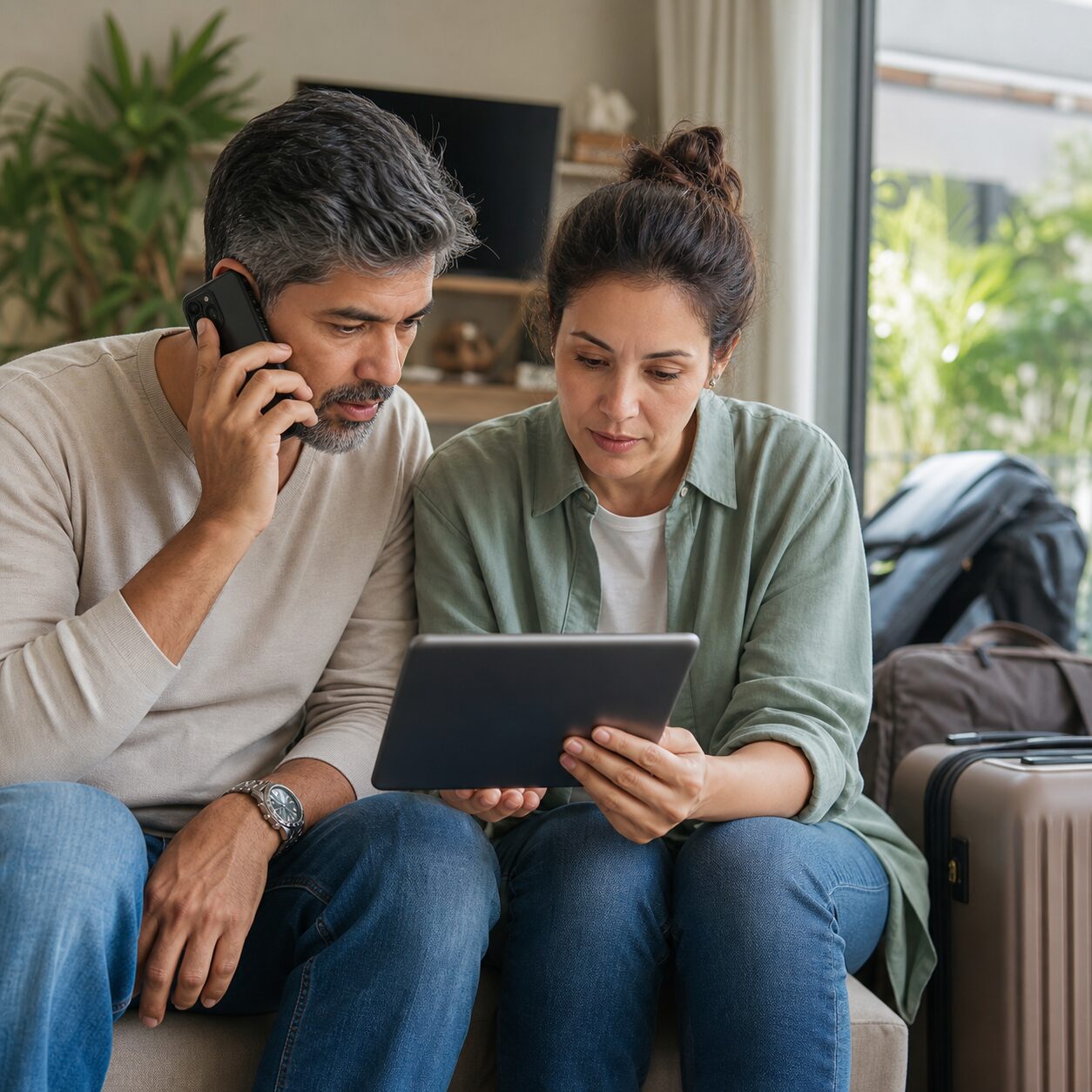
Save the listing, total-price screen, cancellation terms, property address, seller identity, message thread and payment confirmation. Use screenshots or PDFs that include the date. Keep the reservation number and official support contact separately from the booking app.
Do not store complete card details or passport scans in an unprotected family chat. Share only what travellers need. An encrypted password manager, protected cloud folder or device storage with a screen lock is usually a better home for sensitive records. Give another adult access to essentials in case the booking organiser loses a phone.
Evidence helps in three ways. It lets you spot changes before travel. It makes a support conversation faster. And it helps your bank, insurer, platform or consumer authority understand what was promised. Ten orderly screenshots beat two hundred frantic messages.
8. Reconfirm through a second route
For an expensive or important stay, contact the hotel or host after booking using a number or address obtained independently. Confirm the guest name, dates, room or property type, number of travellers, children’s arrangements, included meals, accessibility needs, total paid and balance due.
Reconfirm again shortly before travel. This is particularly useful for a booking made many months ahead, a privately managed rental, late-night arrival or a trip involving several generations. If the property has no record, contact the platform and payment provider immediately rather than waiting to see what happens at the door.
Be cautious if a caller knows your booking details. Data from a compromised email or travel account can make a fraudulent call sound convincing. End the call and ring back through an official number.
9. Give every adult a simple “change means check” rule
Families divide tasks. One person books, another receives airport messages, and someone else pays for an excursion. Scammers exploit the gaps. Agree on one rule: any change to price, bank account, payment link, meeting point or contact channel must be verified independently before anyone acts.
Children and teenagers should know not to forward booking codes, QR codes or one-time passwords. They do not need a lecture on cybercrime during breakfast. A short instruction works: “If a travel message asks for money or a code, show an adult and do nothing else.”
| Family role | Keep available | Never send casually |
|---|---|---|
| Booking organiser | Full terms, receipts, official contacts | Passwords or security codes |
| Second adult | Dates, address, reservation number | Full card image |
| Teen traveller | Meeting point and emergency contact | QR booking pass on social media |
| Trusted contact at home | Itinerary and insurer contact | Unnecessary identity documents |
What to do when the warning arrives after payment
Act quickly, but preserve evidence first. Screenshot the page and conversation, record the URL, save receipts, and note dates and times. Then contact the card issuer, bank or payment provider using the official number on its app, website or your card. Explain that you suspect travel-booking fraud and ask what can be stopped, recalled or disputed.
Contact the genuine booking platform through its official channel. Ask it to secure the account, preserve records and confirm whether the listing or message was legitimate. Change a reused password immediately and enable multifactor authentication. If you entered card details into a fake page, discuss replacement and transaction monitoring with the issuer.
Report the incident to the relevant national fraud or consumer authority and local police when appropriate. In the US, the FTC directs consumers to ReportFraud.ftc.gov. In the UK, travellers can use Report Fraud. EU residents can consult their national consumer authority and the European Consumer Centres Network for qualifying cross-border disputes. Other countries have their own portals.
Do not pay a stranger who promises to recover the money. Recovery scams target people already upset by a loss. A genuine bank, authority or insurer will use its published contact route and will not demand gift cards or cryptocurrency to release funds.
If accommodation may fail while your family is already travelling, prioritise immediate safety. Move to a staffed public place, contact the platform and insurer, and arrange alternative lodging through a channel you can verify. Keep receipts because they may matter to a claim, but do not assume reimbursement until the responsible provider confirms it.

A five-minute booking pause you can actually remember
Long checklists are useful for a once-a-year villa. They are less useful when booking a simple overnight stop on a phone. For everyday use, remember five verbs: open, compare, call, read, save.
Open the official site independently. Compare the address, dates and complete price. Call through a separately sourced contact if anything material changed. Read cancellation and payment terms. Save the promise before paying.
This pause will occasionally cost you a deal. That is acceptable. A genuine seller can explain its identity, terms and payment route. Scarcity may be real, but it does not transform an irreversible transfer into a sensible family decision.
Three realistic booking situations and the safer response
The private villa with a direct-payment discount
Imagine that you find a villa on a well-known platform. The host answers sensible questions, then offers a ten-per-cent discount for a bank transfer outside the platform. The property might be real and the host might simply want to avoid commission. Yet the proposed transaction is now materially different from the one you researched.
The safer response is to keep the reservation and payment in the verified channel. Ask the platform, through its official support route, whether off-platform payment is permitted and what protection would disappear. If you still consider booking directly, treat it as a completely new seller assessment: verify ownership or management authority, obtain a contract, confirm the account holder and understand your payment remedy. A discount is not worth more than the evidence and protection surrendered to obtain it.
The hotel email that changes the card-verification link
Now suppose a message arrives in the same email thread as your hotel confirmation. It says the card failed and the room will be cancelled within two hours unless you “verify” through a link. The names and dates are correct. This can happen after an email account, property system or traveller account is compromised; accurate booking details do not prove that the new link is safe.
Do not use the message link or its telephone number. Open the hotel’s official website independently, call the published number, and ask whether payment failed. Also check the reservation inside the booking platform or hotel app. If you clicked but did not submit anything, close the page and run normal device and browser updates. If you entered credentials or card data, contact the relevant provider promptly and change any reused password.
A cancelled flight creates ideal conditions for impersonation. You post a complaint publicly, and an account with the airline’s colours offers help by direct message. It asks for the booking reference, then a one-time code or a small “rebooking fee.” Genuine companies do offer social support, but criminals watch public complaints because the traveller has already announced urgency.
Move to the airline’s official app, website, airport desk or published telephone line. Never give a login or payment authorisation code to a social account. Keep the public post free of booking references, boarding passes and QR codes. If an agent proposes a new itinerary, confirm it appears in your official reservation before travelling to another airport or paying for transport.
These examples share one pattern: the first booking may be genuine, but the payment or contact route changes. That is why the family rule focuses on change. You do not need to decide whether the person sounds honest. You only need to verify the changed instruction through a route the sender did not provide.
Official sources and where their limits begin
- US Federal Trade Commission, Avoid Scams When You Travel: https://consumer.ftc.gov/articles/avoid-scams-when-you-travel
- US Federal Trade Commission, How to Avoid Travel Website Scams: https://consumer.ftc.gov/consumer-alerts/2025/06/how-avoid-travel-website-scams
- European Commission, Package Travel Directive: https://commission.europa.eu/law/law-topic/consumer-protection-law/travel-and-timeshare-law/package-travel-directive_en
- European Consumer Centres Network: https://www.eccnet.eu/
- UK National Cyber Security Centre, shopping online securely: https://www.ncsc.gov.uk/guidance/shopping-online-securely
These sources support the verification and payment-safety principles in this guide. They do not create identical rights for every reader. Your contract, seller location, residence, payment provider and destination can all affect the remedy.
Three questions families often ask
Is a very cheap holiday automatically a scam?
No. Promotions, new listings, off-season dates and non-refundable rates can be genuinely cheap. Treat an unusually low price as a prompt to compare the exact dates, room, inclusions and cancellation terms. If the seller also creates urgency, hides the address or demands an irreversible transfer, the combined risk is much higher.
Is paying by credit card completely safe?
No payment method makes a booking genuine. A card may offer a clearer dispute process, depending on the issuer and jurisdiction, but claims have deadlines and conditions. Verify the seller first, keep evidence, monitor the transaction and contact the issuer promptly if something is wrong.
Should I book only through large platforms?
Not necessarily. Many hotels, local agencies and independent hosts sell legitimate stays directly. The important questions are whether you can independently establish who controls the property, understand the contract, pay through a traceable route and reach accountable support. A platform can add useful systems, but its logo is not a substitute for your checks.
The calm rule to take on every trip
Travel scams are designed to make sensible people act before they compare. The defence is not suspicion of every host or bargain. It is a repeatable pause that separates the webpage from the real property, the message from the real company, and the payment request from a recoverable payment route.
Verify independently, read the complete terms, save the evidence and make the family rule clear: when payment details change, nobody pays until a second channel confirms it. That modest bit of friction can protect the holiday without draining all the fun from planning it.