- Data Sovereignty is Non-Negotiable: AI toys often collect behavioral, audio, and visual data; always check if the device stores data locally or transmits it to the cloud.
- The “Human-in-the-Loop” Rule: AI should act as a supplement, not a replacement, for human interaction; use these toys as conversation starters, not babysitters.
- Privacy by Default: Treat any toy with a microphone or camera as a connected IoT device; if it’s not in use, turn it off or physically disconnect its power source.
The most important thing to understand about the AI toy explosion is that your child is not just a consumer—they are a data point. When we bring home a “smart” companion that learns your child’s name, remembers their favorite color, or adjusts its difficulty level based on their vocabulary, we aren’t just buying a toy. We are inviting a data-collection node into the most private space in our home: the playroom.
For parents in their 30s and 40s, this represents a unique tension. We grew up with “dumb” toys—Lego bricks that didn’t talk back and dolls that relied entirely on our imagination. Now, we are being sold the promise of “accelerated learning” and “personalized development” through artificial intelligence. But does the convenience of a toy that keeps a child engaged for an extra thirty minutes outweigh the long-term implications of their behavioral data being profiled?
Understanding the Mechanics of AI-Driven Play
To navigate this space, we need to strip away the marketing jargon. Most “AI toys” in the current market fall into three categories: connected companions, adaptive learning platforms, and predictive sensory toys. Understanding which one you have in your house is the first step toward managing the risks.

Connected companions are the most common. These are toys that use natural language processing (NLP) to hold a conversation. They “learn” your child’s speech patterns and preferences. The ethical issue here isn’t just about privacy; it’s about the “uncanny valley” of attachment. When a child begins to treat a machine as a peer, the dynamics of social development shift. If the AI is programmed to steer the conversation toward specific educational content, it is, in effect, a subtle form of behavioral engineering.
Adaptive learning platforms are essentially gamified educational software. They use machine learning to identify where a child is struggling—say, with basic addition or phonics—and adjust the curriculum. The benefit is clear: personalized pacing. However, the trade-off is the loss of “productive struggle.” If the AI always serves up the perfect challenge to keep the child in a flow state, does the child lose the ability to cope with frustration or boredom, which are essential components of cognitive development?
Predictive sensory toys use sensors to detect movement or touch and react accordingly. While these are less likely to pose a privacy risk (as they often don’t store data in the cloud), they can create a “reactive dependency.” If a toy provides constant, high-stimulation feedback to every action a child takes, the real world—which is often quiet and requires patience—can start to feel dull by comparison.
The Privacy Paradox: What Happens to Your Child’s Data?
If you look at the fine print of many “smart” toy privacy policies, you will often find clauses that allow for the “anonymized” sharing of data with third-party partners. But here is the reality: in the world of big data, true anonymization is a myth. Behavioral patterns are often unique enough to re-identify individuals.
When your child interacts with a toy, that data might include:
- Voice recordings: Used to train speech recognition models.
- Play patterns: How long they play, what they ignore, and what frustrates them.
- Location data: Often collected by the companion app on your phone.
- Social metrics: Who else is in the room and what they are saying.
Common Mistake: Many parents assume that because a toy is marketed for children, it must comply with strict privacy standards like COPPA (in the US) or GDPR-K (in the EU) by default. While these laws exist, they are often a floor, not a ceiling. A company can be “compliant” while still hoarding an immense amount of metadata about your child’s developmental milestones.
Actionable Rule: Before connecting any toy to your home Wi-Fi, look for the “Offline Mode.” If a toy requires a constant internet connection to function, it is not a toy; it is a service. If you must use it, ensure it is on a guest network that is isolated from your primary home devices, including your smart home hub or personal computers.
The Impact on Cognitive and Social Development
We often hear that AI toys “prepare children for the future.” But what does that actually mean? Does it mean they learn how to code, or does it mean they learn how to interact with algorithms? Research in child development suggests that the most critical skills for the next generation aren’t technical—they are social and emotional.
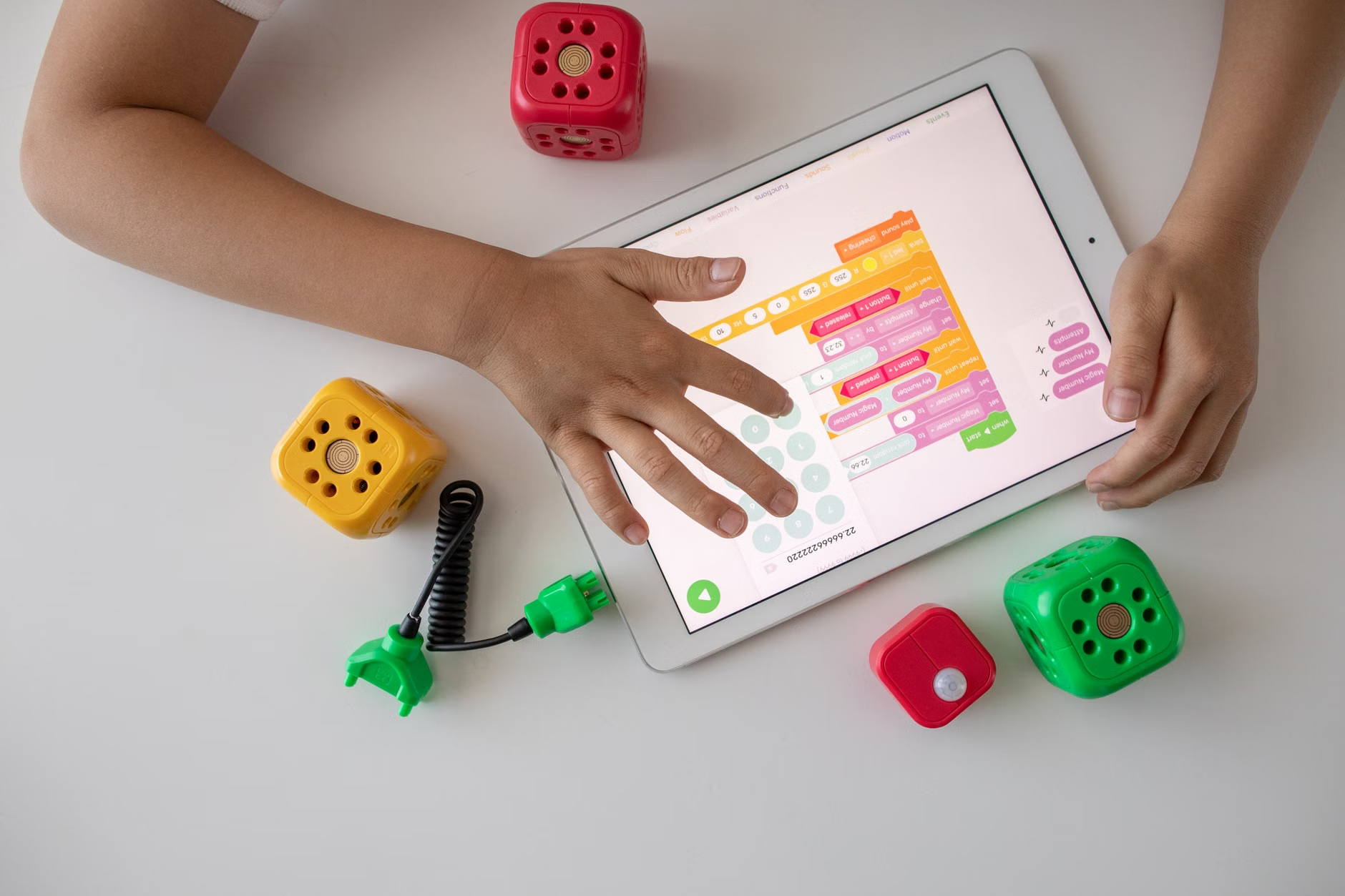
A 2022 study published in the Journal of Children and Media highlighted that when children interact with AI agents, they tend to attribute human-like characteristics to them. This “anthropomorphism” can be helpful in early language learning, but it can also lead to a decrease in the quality of human-to-human play. If the AI is always polite, always patient, and always available, the child may struggle to navigate the messy, unpredictable, and sometimes difficult nature of human relationships.
The “Human-in-the-Loop” Strategy:
- Use the “Rule of Three”: For every hour of AI-driven play, ensure there is at least three hours of “analog” play (books, blocks, outdoor exploration).
- Co-play: Use the AI toy as a bridge, not a destination. If the toy asks a question, pause it and ask your child what they think before letting the toy provide the answer.
- Debriefing: After a session, ask your child, “Why do you think the toy said that?” This helps develop critical thinking skills and helps them understand that the toy is a tool, not a person.
Comparing Traditional vs. AI-Enhanced Learning Tools
It is easy to get caught up in the “tech-first” mindset, but we need to be clear about when AI is actually adding value and when it is simply adding noise. The following table helps break down where the trade-offs lie.
| Category | Traditional Toy | AI-Powered Toy | Verdict |
|---|---|---|---|
| Imagination | High (Open-ended) | Low (Scripted) | Traditional wins for creative growth. |
| Feedback | None (Process-based) | Immediate (Result-based) | AI is better for skill-drilling (e.g., math). |
| Privacy | Total | Variable (Often poor) | Traditional is always safer. |
| Engagement | Requires effort | Passive consumption | Traditional fosters longer attention spans. |
The takeaway here isn’t that you need to throw away all your smart gadgets. It’s that you should choose your “tech battles” wisely. If you want to teach your child to code, use a robot that requires intentional programming. If you want to teach them language, use a book or a conversation. The danger lies in the “passive AI” that does all the heavy lifting for the child.
Practical Steps for Ethical Tech Parenting
You don’t need a degree in computer science to manage these risks. It comes down to basic habits and a bit of skepticism toward marketing claims. Here is a step-by-step framework for evaluating the next “must-have” toy in your house.
1. The Permission Audit
When you download the companion app for a toy, check the permissions. Why does a math-learning toy need access to your contacts, your location, or your camera? If the app requests permissions that aren’t strictly necessary for the toy to function, deny them. If the app refuses to run without those permissions, consider that a red flag and return the product.
2. The “Physical Off” Test
Does the toy have a physical mute switch or a camera cover? If the device is “always listening” to catch a wake word, it is potentially recording ambient noise. If there is no physical way to disconnect the microphone, your best bet is to remove the batteries or unplug the device when it’s not in use. Don’t rely on software-based “privacy modes” that can be toggled back on with a single tap.
3. Data Deletion Cycles
Many companies now allow you to request the deletion of your child’s data. Set a calendar reminder every three months to go into the app settings and clear the history. Treat this like a digital spring cleaning. It prevents the accumulation of a long-term behavioral profile that could follow your child as they grow.
The Hidden Cost of “Free” Educational Features
We often see toys that are relatively inexpensive but come with a “premium” subscription model for advanced learning content. This is where the business model becomes predatory. These companies are not just selling you a toy; they are selling you a lifetime subscription to their ecosystem. The more your child uses the toy, the more “valuable” the data becomes to the company, which they then use to refine their algorithms and sell more products.
Be wary of “gamified progress bars.” If a toy gives your child a “reward” or a “badge” for hitting certain milestones, it is using the same psychological triggers as casinos and social media. This is designed to create a dopamine loop that makes it difficult for the child to put the device down. If you notice your child becoming visibly agitated when it’s time to stop playing with a specific smart toy, that is a clear sign that the device is intentionally designed to be addictive.
Final Thoughts: A Balanced Approach
Technology is not inherently evil, and AI has the potential to be a wonderful tool for curiosity and learning. However, the current landscape of children’s toys is largely unregulated in terms of the long-term psychological impact of algorithmic interaction. The responsibility falls on us, the parents, to act as the gatekeepers.
Don’t be afraid to be the parent who says “no” to the latest trend. Sometimes, the most “educational” toy is a box of cardboard, some markers, and a bit of boredom. Boredom is where the magic of human creativity happens—the kind of creativity that no AI can currently replicate. If you do choose to bring AI into your home, do it with your eyes open, your privacy settings locked down, and your role as a human mentor firmly in place.
Your child’s development is a marathon, not a sprint. Don’t let the promise of a “smarter” toy distract you from the importance of the messy, slow, and human process of growing up.
Frequently Asked Questions
- Q: Should I be worried if my child talks to their AI toy?
A: It is normal for children to engage in imaginative play with inanimate objects. However, if they start preferring the toy to human interaction or seem distressed when the toy is “off,” it’s time to limit usage and re-introduce more social activities. - Q: How do I know if an AI toy is actually teaching my child something?
A: Look for toys that encourage “active” learning—where the child has to solve a problem or create something—rather than “passive” learning, where the child just watches or listens to the toy speak. If the toy is doing all the work, your child isn’t learning; they are just consuming. - Q: Is it safe to use smart toys on my home Wi-Fi network?
A: It is safest to keep smart toys on a separate “Guest” network that is isolated from the devices you use for banking, work, or sensitive personal data. This limits the potential for a compromised toy to access your broader home network.
For further reading on children’s digital rights and privacy, you can consult the resources provided by the Federal Trade Commission on COPPA or the UK Information Commissioner’s Office guide on Age Appropriate Design.