Key Takeaways
- Functionality over abstinence: The zero-proof trend is driven by the desire for better sleep, morning productivity, and health, rather than just complete sobriety.
- Complexity is the new standard: Modern non-alcoholic drinks use botanical distillates and adaptogens to mimic the “ritual” of drinking, moving far beyond sugary juices.
- Social navigation requires strategy: Parents can manage social pressure by choosing high-quality alternatives that offer a distinct taste profile, making them feel like an intentional choice rather than a compromise.
The most effective way to navigate the “zero-proof” trend as a busy parent is to view it not as an act of deprivation, but as a strategic upgrade to your morning recovery. If you are in your 30s or 40s, you have likely noticed that the physiological cost of an evening drink has changed. That singular glass of wine at 9:00 PM no longer feels like a relaxing ritual; it feels like a tax you pay on your 6:00 AM alarm clock. This reality has fueled a massive shift toward sophisticated, non-alcoholic alternatives that provide the ritual of a cocktail without the cognitive and physical fog that follows.
Why the ‘Zero-Proof’ Shift Matters for Modern Parenting
For parents juggling professional responsibilities and the demands of raising children, the “sober curious” movement isn’t necessarily about total abstinence. It is about optimization. When you have a toddler who wakes up at 5:30 AM regardless of your sleep quality, or a high-stakes presentation at 9:00 AM, the trade-off of alcohol becomes mathematically unfavorable. The zero-proof trend has exploded because it offers a “third space” in beverage consumption: you aren’t drinking water or soda, but you aren’t consuming ethanol either.
The core of this trend is the professionalization of non-alcoholic liquids. We have moved past the era of “mocktails” that were essentially cranberry juice with a splash of soda. Today, companies are utilizing complex distillation processes, steam-distilled botanicals, and functional ingredients like adaptogens (herbs believed to help the body manage stress). For a parent, this means you can hold a drink that feels “adult” and complex, allowing you to participate in the social ritual of a glass in hand without the subsequent dip in executive function.
Consider the “Performance Gap.” In your 20s, you could recover from a late night in hours. In your 30s and 40s, the recovery time for a single drink often extends into the next morning, manifesting as a slightly slower reaction time or a lower patience threshold with your kids. By switching to a high-quality zero-proof alternative, you aren’t just “not drinking”; you are actively protecting your bandwidth for the following day. This is the primary reason the market for non-alcoholic spirits has grown exponentially, with global projections suggesting the category will continue to see double-digit growth through 2027.
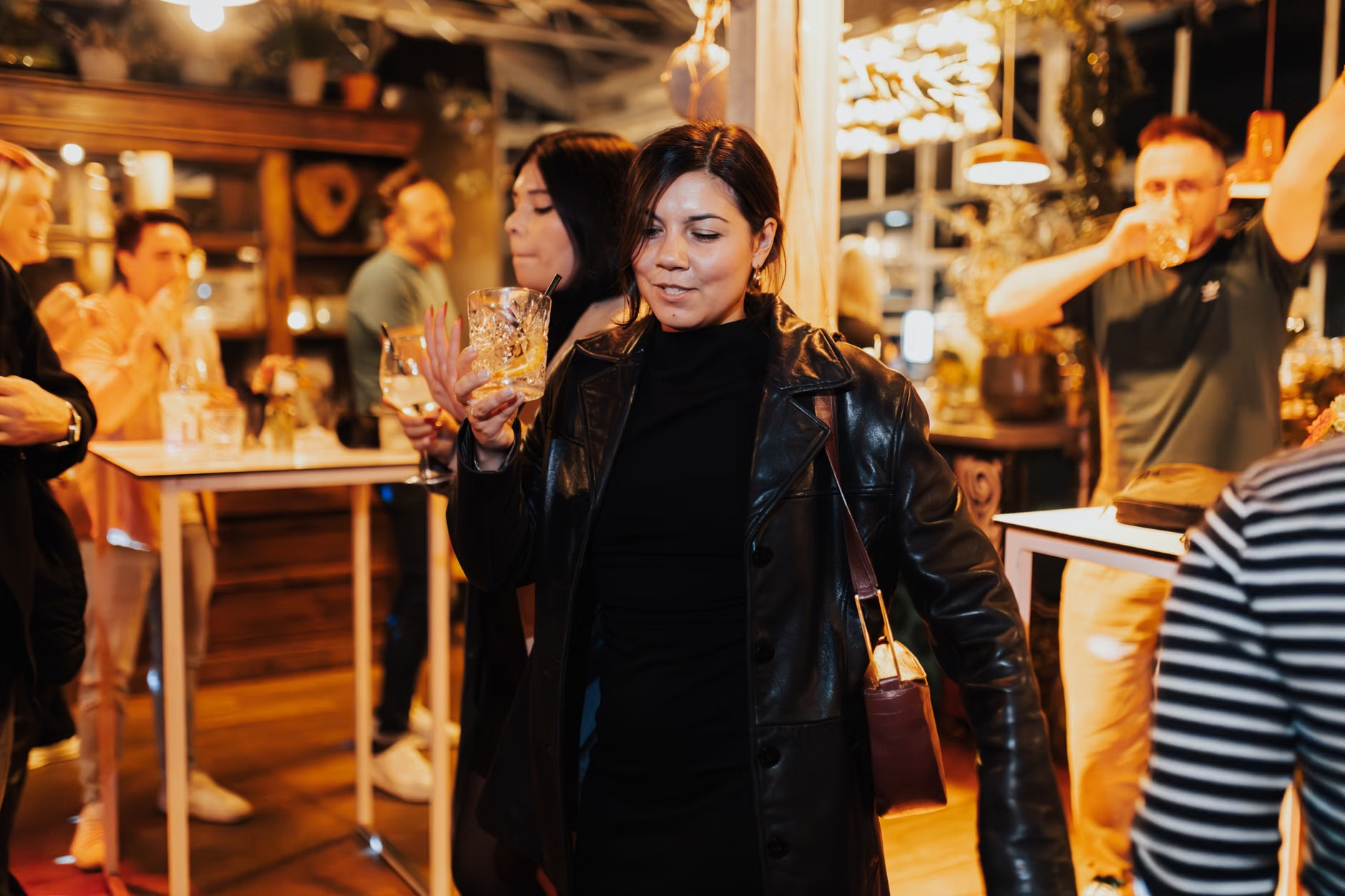
Understanding the Technology Behind the Bottle
If you have walked down the beverage aisle recently, you have likely noticed bottles that look like premium gin or complex bitters but carry a price tag similar to high-end liquor. This is not just branding; it is a result of advanced food science. To understand what you are paying for, you need to look at the three primary categories of zero-proof beverages.
1. Distilled Botanical Alternatives
These are the closest relatives to traditional spirits. Manufacturers use copper stills to extract oils and flavors from botanicals—juniper, coriander, citrus peels, and roots. The alcohol is removed or never created in the first place. These are designed to be mixed with tonic or soda, providing that familiar “bite” or “burn” that many people associate with a cocktail. For a parent who enjoys the specific flavor profile of a gin and tonic, this is the most seamless transition.
2. Fermented and Functional Elixirs
These drinks focus on the experience of the palate and the nervous system. Some contain ingredients like L-theanine or ashwagandha. The goal here is to provide a subtle “shift” in mood—a sense of relaxation—without the intoxication. These are particularly popular for the “wind down” period after the kids are in bed, where you want to signal to your brain that the workday is officially over.
3. Craft Sodas and Shrubs
Shrubs are essentially drinking vinegars. They have been around for centuries, but they are currently experiencing a renaissance. They offer a sharp, acidic profile that mimics the complexity of wine or spirits. They are often less expensive than the distilled alternatives and are highly shelf-stable, making them an excellent “pantry staple” for parents who want a quick, sophisticated drink without needing a complex recipe.
| Category | Best For | Price Point |
|---|---|---|
| Distilled Botanicals | Replicating classic cocktails | High ($30-45/bottle) |
| Functional Elixirs | Stress relief and ritual | Medium-High ($25-40) |
| Shrubs/Craft Soda | Casual daily enjoyment | Low-Medium ($10-20) |
When choosing between these, consider your primary motivation. If you miss the flavor of your favorite cocktail, go for the distilled botanicals. If you are looking for a sensory shift to help you relax after a chaotic day, the functional elixirs might be more effective. If you just want something refreshing that doesn’t feel like a soft drink for a child, go for the shrubs.
One of the most persistent hurdles for parents in their 30s and 40s is the social friction of not drinking. We live in a culture where a drink is the default social lubricant. When you decline, people often ask, “Are you okay?” or “Are you doing a cleanse?” or “Are you pregnant?” It can feel invasive and exhausting to constantly explain your personal health choices.
The “SoCooly” strategy for this is simple: Don’t explain; just hold. When you arrive at a social gathering, grab a glass of sparkling water with a lime wedge or a zero-proof spirit immediately. When your hands are occupied with a glass that looks like a drink, people rarely interrogate you. You have successfully bypassed the “what are you drinking” conversation.
Furthermore, consider the “host trade-off.” If you are hosting, offer a zero-proof option that is just as thoughtful as the wine you are serving. This normalizes the choice for everyone. By placing a high-end non-alcoholic spirit on the bar cart, you invite others to explore it without making it a “thing.” It changes the perception of non-alcoholic drinks from “something for those who can’t drink” to “something for those who choose flavor and clarity.”
Common Mistakes to Avoid
A frequent error is assuming that all zero-proof drinks are low-calorie or “healthy.” Many non-alcoholic alternatives are loaded with sugar to compensate for the lack of body that alcohol provides. If you are drinking three glasses of a sugar-heavy mocktail, you might feel the “sugar crash” just as intensely as you would have felt the alcohol the next morning. Always check the nutrition label for added sugars. Look for options that use natural extracts or lower-glycemic sweeteners.
Another mistake is trying to find a 1:1 taste replacement. If you are looking for a non-alcoholic wine that tastes exactly like a full-bodied Cabernet, you will likely be disappointed. The chemistry of alcohol is difficult to replicate perfectly. Instead of looking for a “replacement,” look for a “new experience.” Treat the drink as a separate entity—a botanical beverage—rather than a “fake” version of something else. This shifts your palate’s expectations and makes the experience much more enjoyable.
The Financial Reality and Value Proposition
You might look at the price of a bottle of non-alcoholic “spirit”—often ranging from $30 to $45—and think it is exorbitant for something without alcohol. From a cost-of-goods perspective, you are correct. However, you need to view this as a lifestyle investment. When you compare it to a high-end bottle of spirits, the price is similar. When you compare it to the “cost” of a ruined Saturday morning with your children, the value proposition changes entirely.
If your budget is a concern, focus on the “mixer” strategy. You don’t need a full bar of expensive non-alcoholic spirits. Buy one high-quality bottle that serves as your “anchor” drink. Use it as a base for different infusions—add fresh mint, cucumber, or a splash of bitters. This allows you to experiment with different flavor profiles without needing to purchase a new bottle for every craving.
Establishing Your Personal ‘Zero-Proof’ Protocol
To make this sustainable, you need a set of rules, or a “protocol,” that works for your life. Without a framework, you might find yourself drifting back into old habits simply because they are the path of least resistance. Here is a recommended approach for implementing the zero-proof trend into a busy household:
- The 7:00 PM Boundary: If you find that your evening drinking is mostly a way to transition from “parent mode” to “me mode,” set a physical boundary. At 7:00 PM, when the kitchen is cleaned up, switch to your zero-proof beverage. The act of pouring it into a specific glass—a nice wine glass or a heavy-bottomed tumbler—is a psychological trigger that signals the end of the workday.
- The “Guest” Rule: When you are out, don’t feel obligated to explain your drink choice. If someone asks, a simple “I’m driving” or “I’m taking a break from alcohol for my training/health” is more than enough. You owe no one a deep dive into your medical or personal history.
- The Pantry Test: Keep at least two distinct types of zero-proof options in your house at all times. If you only have water, you will inevitably reach for the wine when you are tired. If you have a complex, botanical-forward drink ready, you are far more likely to choose that instead.
By implementing these small, structural changes, you turn a vague “I should probably drink less” goal into a concrete, actionable lifestyle modification. It is about removing the friction of making a healthy choice, not about the willpower to resist an unhealthy one.
The Hidden Benefits: Beyond Just Feeling Better
While the obvious benefit of the zero-proof trend is the avoidance of a hangover, there are secondary benefits that are often overlooked. The first is dietary consistency. Alcohol is often accompanied by “impulse eating”—the late-night snack that you would never touch during the day. By removing the alcohol, you effectively remove the primary catalyst for these late-night caloric spikes. Many parents report that their weight stabilizes or drops simply by removing the alcohol-related snacking cycle.
The second is deeper REM sleep. Even a small amount of alcohol significantly disrupts the architecture of your sleep, preventing you from reaching the deep, restorative stages of rest. When you replace your evening drink with a zero-proof alternative, you aren’t just “not drinking”; you are actively improving your recovery. Over the course of a month, the cumulative effect on your energy levels is significant. You aren’t just avoiding the negative; you are gaining a positive, functional advantage in your daily life.
Finally, consider the modeling behavior for your children. If you have children, they are constantly observing how you handle stress. If your primary method of dealing with a difficult day is to reach for a glass of wine, you are subtly teaching them that stress requires external substances to manage. By choosing a sophisticated zero-proof drink, you are demonstrating that you can have a “special” or “ritualistic” moment that is grounded in health and clarity. This is a subtle but powerful lesson in emotional regulation and self-care.
Understanding the Trade-offs
It is important to be realistic about the trade-offs. If you are a connoisseur of fine wines or complex whiskies, you will likely notice that zero-proof alternatives do not always have the same “mouthfeel” or “finish.” Alcohol provides a viscous texture that is very difficult to replicate. Some zero-proof brands use ingredients like glycerin or capsaicin to mimic this, but it will never be an exact replica.
If you find that you are constantly frustrated by the “lack of bite” in your non-alcoholic drink, you might need to adjust your expectations. Don’t look for a 1:1 replacement. Instead, look for a drink that stands on its own merits. Many of the best zero-proof beverages are better understood as “complex botanical sodas” rather than “non-alcoholic spirits.” When you frame them this way, the lack of alcohol becomes a feature, not a bug.
Additionally, be aware of the “social fatigue” factor. There may be times when you simply want to have a drink to fit in. That is okay. The goal here is not to be a purist, but to be intentional. If you decide that you want to have one glass of wine at a wedding or a special event, that is a choice, not a failure. The goal is to avoid the unintentional, habitual drinking that occurs on a Tuesday night in front of the TV.
Final Thoughts and Next Steps
The zero-proof movement is a reflection of a broader cultural shift toward intentionality in our 30s and 40s. We are realizing that we have less time and less physiological margin for error than we did a decade ago. Every choice we make—from what we eat to what we drink—has a direct impact on our ability to show up for our families and our careers. By embracing the zero-proof trend, you are not giving up your social life or your evening relaxation; you are curating them to serve your long-term goals.
Start by identifying which of your “drinking habits” is the most dispensable. Is it the mindless glass while cooking dinner? Or the “nightcap” while watching a show? Start there. Replace that specific habit with a high-quality zero-proof alternative. See how you feel after three days. The difference in your morning clarity, your patience, and your physical energy will likely be the only evidence you need to continue the experiment.
Remember that this is a journey of discovery. The market is evolving rapidly, and new, more sophisticated options are hitting the shelves every month. Don’t be afraid to experiment, try new brands, and find what works for your specific palate. Your goal is to build a toolkit of alternatives that make you feel like you aren’t missing out on anything, but are instead leveling up your daily quality of life.
Frequently Asked Questions
Q: Are non-alcoholic spirits really worth the high price tag compared to juices or sodas?
A: It depends on what you are looking for. If you want a sweet, refreshing drink, juices and sodas are fine. If you are looking for a complex, adult flavor profile that mimics the ritual of a cocktail without the alcohol, the distilled botanical alternatives offer a level of complexity and mouthfeel that simple juices cannot provide. The price reflects the complex distillation and extraction processes required to create those flavors.
Q: Do these drinks contain any hidden alcohol?
A: Most products labeled as “non-alcoholic” or “zero-proof” contain less than 0.5% ABV, which is similar to the trace amounts found in some fruit juices or fermented foods like kombucha. However, if you are strictly abstaining for medical or personal reasons, always check the label carefully, as some brands may vary.
Q: How do I handle social pressure when I’m the only one not drinking?
A: The best strategy is to always have a glass in your hand. When your hands are occupied, people are significantly less likely to comment on your drink choice. If someone does ask, keep your answer short and light—”I’m driving” or “I’m taking a break for my health” is perfectly acceptable. You don’t need to justify your choices to anyone, even friends.
For further reading on mindful drinking and the science of alcohol-free alternatives, you can visit resources like Drinkaware or explore the latest research on alcohol consumption and health via the World Health Organization’s fact sheets on alcohol.